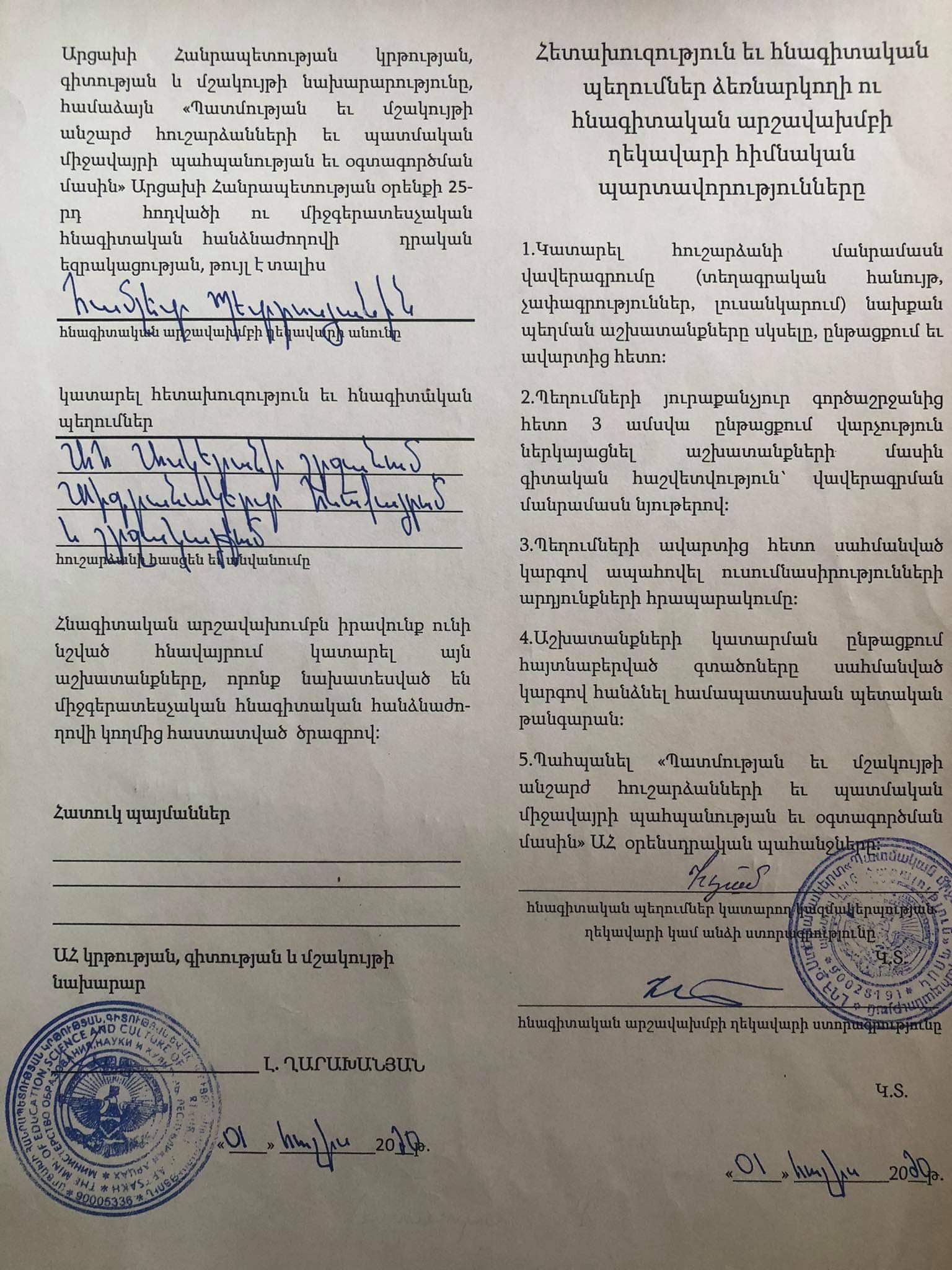
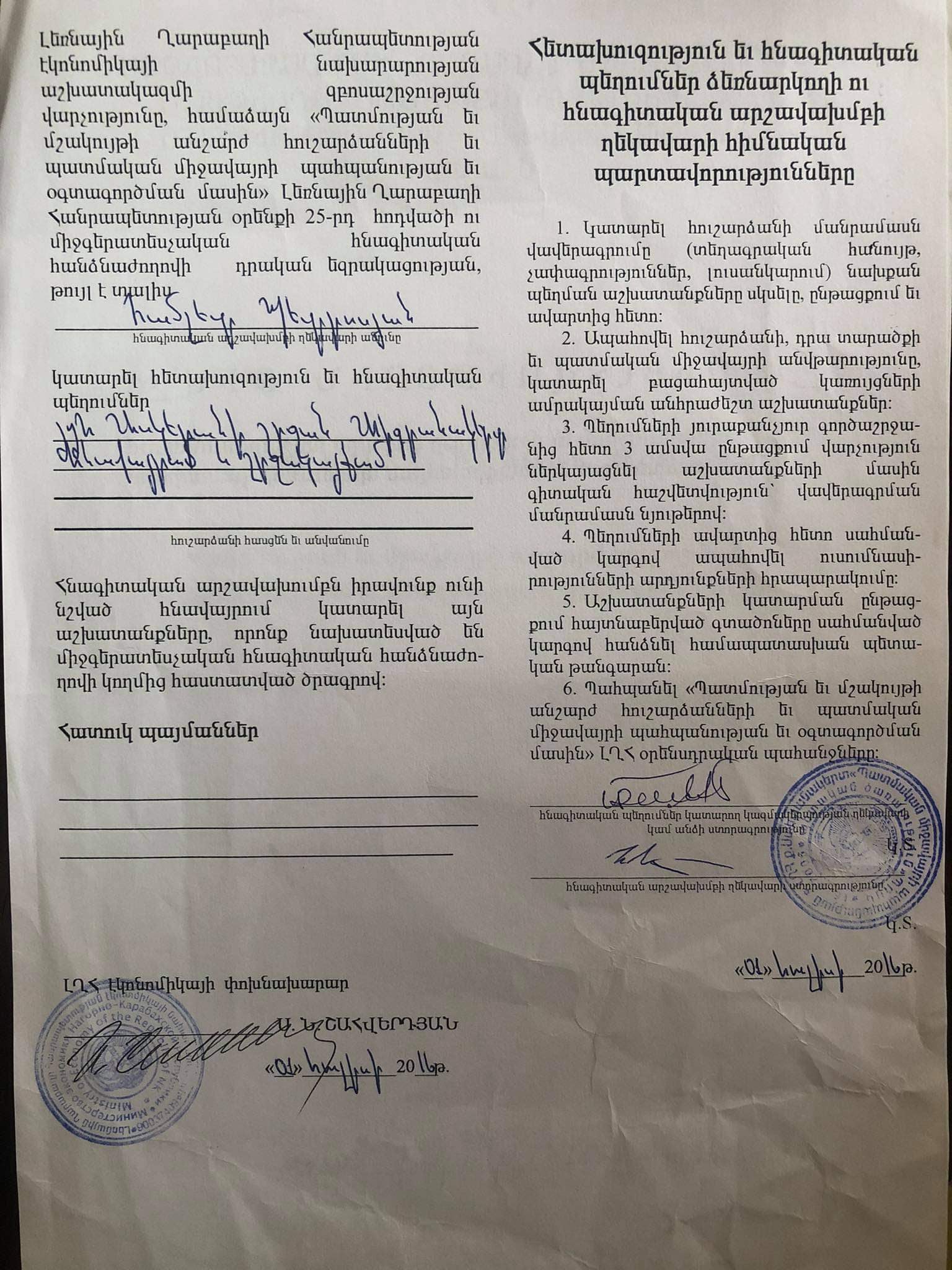
In the Azerbaijani media domain, they post pictures from my Facebook page, which show, among others, the packaging of the materials of the Tigranakert Archaeological Museum. The Azerbaijanis present the materials of the excavations in Tigranakert as “the result of illegal excavations”, describing the evacuation of these items from the war zone as “theft of Azerbaijani cultural heritage”.
I would like to remind the semi-literate propagandists of the aggressive state that the archaeological excavations in Tigranakert were carried out at the official invitation and with the permission of the Artsakh authorities, that every year the archaeological commission within the Artsakh government issued a special permit, so called an open list, to the leader of the expedition (see photos of some of those permits), that the excavations were financed from the Artsakh state budget.
The Tigranakert Archaeological Museum was established, operated by the decision of the legitimate authorities of Artsakh, with funding of the government of Artsakh.
The archaeological research of Tigranakert was carried out on a full legal basis, with high professionalism, the results of the research were regularly presented to the international scientific community. It’s just ridiculous to talk about a secret process.
Let me mention that Azerbaijani archaeologists, who worked in the area in the 60s and 80s of the last century, did not see the archaeological traces of the old city. I urge them not to be so jealous of what they have not been able to find.
During the 44-day war, Tigranakert became an area of enemy shelling, about which we have warned more than once. As a result, the Tigranakert archaeological camp were completely destroyed. The Artsakh authorities and I, our research team, could not allow the Tigranakert Archaeological Museum to suffer such a fate.
The archaeological findings of Tigranakert are the property of the people of Artsakh, the issues of its protection are not within the competence of Baku, but Stepanakert. In case of peace, they will be returned to Stepanakert and will be exhibited in the museum to be created for it.
The fact that Artsakh is not politically recognized does not deprive its indigenous people of their right to culture. Including the right to research and promote cultural heritage.
So, the archaeological research of Tigranakert was carried out on an absolutely legal basis. The Azerbaijani ideology of depriving the people of Artsakh of their cultural heritage is a continuation of the genocide of the Armenian cultural heritage.
Genocide, which we have witnessed for decades, genocide, which culminated in 2005-2006 by destruction of thousands of khachkars in Jugha, the genocide that gained momentum during Azerbaijan’s and Turkey’s recent aggression, continues every day. And it cannot be justified by false political statements and false accusations.
My colleagues and I will continue the research of Artsakh’s cultural heritage, its popularization and the revelations of Azerbaijani vandalism. Aggression, military domination, defamation of international bodies are not competent, cannot deprive the people of Artsakh of the right to preserve their identity with their cultural heritage.
1. What Was Published on September 25 Aram Navasardyan, head of the Armenian branch of…
Why the topic is back in focus Over the past four months, the gas issue…
It's often assumed that the "Albanization" of Armenian heritage — the policy of declaring medieval…
What independent observers are documenting The most systematic data on the fate of Armenian monuments…
On September 12, 2026, a delegation of some 150 diplomats and representatives from 58 countries,…
On September 15, 1918, the oil city of Baku fell to a joint Ottoman-Azerbaijani force,…