A case study in the systematic destruction of Armenian heritage in Turkey and Azerbaijan
The photograph pairs two views of the same volcanic outcrop in west-central Turkey. Above: the towering black basalt fortress-rock that has watched over this settlement for more than three thousand years. Below, at its foot: a row of collapsing stone arches — the skeleton of a building whose roof, dome, and interior have long since vanished, its openings gaping onto weeds, graffiti, and a parked minibus.
This is what remains of an Armenian church in Afyonkarahisar, a city in western Anatolia whose ancient name was Akroinon (also transliterated Akroinos, Ἀκροϊνόν). The ruin is not the product of an earthquake, a fire, or the ordinary decay of centuries. It is the physical endpoint of a documented sequence of events: the demographic destruction of an Armenian community in 1915, the confiscation and militarized use of its churches, and a subsequent, decades-long failure — sometimes active, sometimes by neglect — to preserve what survived. Afyonkarahisar is one case among thousands recorded across Turkey, and its pattern recurs, in a more compressed and openly state-directed form, in Azerbaijan. This article sets out the evidentiary basis for both.
The volcanic rock at the center of the city has been fortified since the Hittite period, when the settlement was known as Hapanuwa, and it played a role in the Bronze Age Arzawa conflicts of the 14th century BC. After the fall of the Hittite state the site passed to the Phrygians, and it is as a Phrygian center that it is best attested archaeologically and toponymically — the fortress rock later bore the Phrygian name Akroinos/Akroinon (“high point”), and only acquired its present Turkish name, Afyonkarahisar (“opium — black fortress”), after 1928, when the Turkish Republic prefixed the word for opium to reflect the region’s main crop.
From Phrygia the site passed through the same sequence of empires as the rest of central Anatolia:
Akroinon’s single most famous moment in written history is the Battle of Akroinon (740 AD), in which Emperor Leo III and his son, the future Constantine V, destroyed a 20,000-strong Umayyad Arab division under Abdallah al-Battal — a battle that, combined with the internal turmoil of the Umayyad Caliphate, halted large-scale Arab incursions into Byzantine Anatolia for a generation (Wikipedia, Battle of Akroinon; historyatlas.com). In commemoration of the victory, the city was formally renamed Nikopolis (“City of Victory”) — a name that, alongside Akroinon, persisted in Byzantine usage into the high medieval period (Virtual Genocide Memorial, Sancak Afyonkarahisar/Nikopolis).
Throughout this entire arc — Hittite, Phrygian, Persian, Hellenistic, Roman, Byzantine — the population of the city and its hinterland was overwhelmingly Christian by the early medieval period, composed primarily of Greeks with a longstanding Armenian minority whose presence in the region is attested at least since the Byzantine period and is documented in Ottoman fiscal registers from as early as the 16th century (Hovannisian & Manuk-Khaloyan, cited in Virtual Genocide Memorial, op. cit.).
Byzantine control of the fortress unraveled after the catastrophic defeat at Manzikert (1071) placed the whole of central Anatolia within the contested frontier zone between Byzantium and the invading Seljuk Turks. Sources place Akroinon still in Byzantine hands as late as 1112, but it had passed to the Sultanate of Rum by the time Manuel I Komnenos won a battle nearby in 1146; firm Turkish control was not established until roughly 1210 (Wikipedia, Akroinon).
It was only at this point — under the Seljuk vizier Sâhib (Sahip) Ata, who repaired the fortress — that the city received its Turkish name, Kara Hisar (“Black Castle”), later Karahisar-ı Sahib. Ottoman rule was established intermittently from 1382 and definitively from 1428–29 (Virtual Genocide Memorial, op. cit.). The Turkish “opium” prefix, afyon, was added only in 1928, under the Turkish Republic.
The conquest triggered a demographic transformation that took centuries to complete but was total in its effect. Where the city had been almost entirely Christian at the start of the 11th century, by 1914 — on the eve of the First World War — the sancak (district) of Afyonkarahisar had a population of roughly 45,000, of whom about 7,000–7,448 were Armenians, concentrated mainly in the district center, alongside smaller Armenian communities in the surrounding kazas of Aziziye and Sandıklı. Muslims by this point made up the overwhelming majority of the district’s population (Kévorkian, The Armenian Genocide: A Complete History, cited in Virtual Genocide Memorial, op. cit.). This inversion — from a near-total Christian population before the Turkic conquest to a small, embattled Armenian minority of roughly 10–15% of the local Christian-descended population by the early 20th century — is the underlying demographic fact against which the destruction of the church must be read: it is the visible remainder of a population that had already been reduced to a fraction of its historic size well before 1915.
Ottoman-era Afyonkarahisar’s Armenian community, though Turkish-speaking (Turkophone) by the modern period, maintained a distinct religious and institutional life. According to the documentation compiled by historians Richard G. Hovannisian and Armen Manuk-Khaloyan in The Armenian Communities of Asia Minor (Mazda Publishers, 2014), the community — composed mainly of Armenian Apostolic Christians, with smaller Evangelical and Catholic congregations — supported:
Local Armenians were known regionally for a distinctive craft: furniture and decorative objects inlaid with silver.
Crucially, the documentary record explicitly states that the Surb Astvatsatsin church was vandalized during the Armenian Genocide, but that part of the structure survived — a detail that matches, in general outline, the arched stone ruin visible in the photograph beneath the Afyonkarahisar rock. The precise identification of a specific standing fragment requires on-site epigraphic or architectural survey, which lies beyond what a photograph alone can establish; what is documented with certainty is that this is the type of structure — a partially surviving, unroofed Armenian Apostolic church at the foot of the fortress rock — that the primary sources describe.
The Armenian community of the Aziziye kaza was deported on 13 August 1915; the Armenians of the Afyonkarahisar district center followed two days later, with only 27 artisan families temporarily exempted on condition of conversion to Islam (Virtual Genocide Memorial, op. cit.). Afyonkarahisar’s position as a railway junction on the Baghdad Railway to Constantinople turned it into a major transit and concentration point for deportees from across the surrounding provinces. A German railway official reporting to the German Embassy in Constantinople in October 1915 described a camp opposite the train station that, according to credible testimony, held approximately 12,000 Armenians at one point and had at times swelled to 50,000–60,000 people living in improvised tents or with no shelter at all.
A genocide survivor from Afyonkarahisar, Sargis Yetarian (b. 1907), later gave a detailed testimony recorded in The Armenian Genocide: Testimonies of the Eyewitness Survivors (ed. Verjiné Svazlian, National Academy of Sciences of Armenia, 2011), describing the deportation of his own family, the murder of relatives, and the suicide of the town’s priest, Father Sahak, who took poison together with his daughters rather than let them be abducted (full testimony reproduced at Virtual Genocide Memorial).
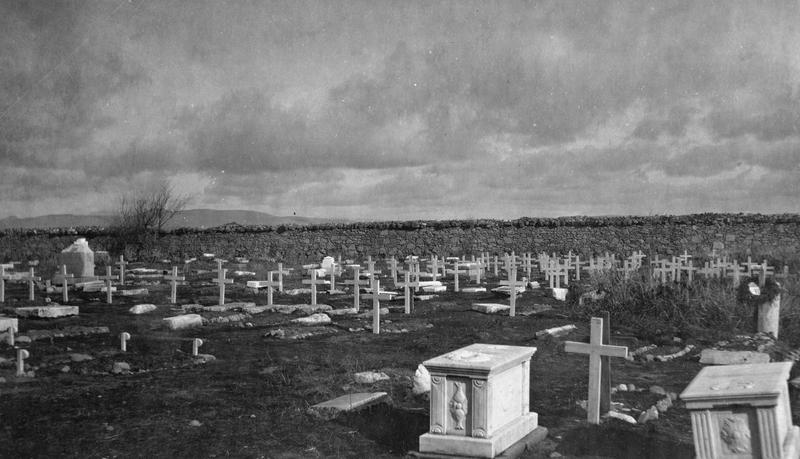
With the Armenian population deported, one of the town’s now-empty Armenian churches acquired an unexpected second life: during the First World War, it was used by the Ottoman authorities to house British prisoners of war captured at Gallipoli — a use recorded independently both by the German-language Virtual Genocide Memorial project and by the English-language Wikipedia article on Akroinon (Wikipedia, Akroinon; Virtual Genocide Memorial, op. cit.). A photograph of the Armenian cemetery at Afyonkarahisar, taken on 7 January 1920 and now held by the Imperial War Museums, London, survives as visual testimony from the same period (IWM photograph Q 37439, reproduced via Virtual Genocide Memorial).
The Ecumenical Genocide Memorial in Berlin maintains a dedicated commemorative plate for Afyonkarahisar/Nikopolis among its regional memorials to the destroyed Ottoman Armenian communities.
What happened to Afyonkarahisar’s churches was not unique — it is one entry in a documented, nationwide pattern.
The Hrant Dink Foundation, based in Istanbul, spent more than two years building an inventory of the pre-genocide Christian heritage of Anatolia. The completed inventory documents roughly 10,000 structures — churches, synagogues, monasteries, schools, hospitals, and cemeteries — of which 4,600 are Armenian, 4,100 Greek, 650 Assyrian, and 300 Jewish. Alongside the structures still standing, the Foundation separately catalogued buildings that have been destroyed, left to ruin, converted into barns or storage depots, or transformed into mosques (Agos, “Cultural inventory of a civilization destroyed revealed”; Armenian Assembly of America summary; interactive map: turkiyekulturvarliklari.hrantdink.org).
Individual, well-documented cases illustrate the mechanism by which “surviving” ruins like Afyonkarahisar’s ultimately vanish or are deliberately razed:
The Armenian National Institute summarizes the broader pattern: church and school buildings that were not burned outright in 1915 were, over the following decades, converted into banks, radio stations, mosques, state schools, tobacco or tea warehouses, private houses, or stables (Armenian National Institute, “The Destruction of Christian Cultural Heritage”).
Read against this documented, nationwide pattern, the Afyonkarahisar ruin is not an anomaly. It is the median case: a church that was not dynamited outright, like Arapgir or Sivas, but was instead abandoned, stripped, and left to the slow erosion of a century — plants growing from its arches, its stones scavenged, its history unmarked at the site itself.
If Turkey’s destruction of Armenian heritage has unfolded gradually — a genocide followed by decades of neglect, occasional demolition, and quiet conversion — Azerbaijan’s counterpart campaign, in the exclave of Nakhichevan, was compressed, systematic, and directly executed by the state.
Nakhichevan was once home to one of the most significant works of medieval Armenian art in existence: the Djulfa (Jugha) cemetery, a necropolis containing at its height an estimated 10,000 khachkars — intricately carved cross-stones, unique to Armenian Christian tradition, some dating to the 6th century, most from the 15th–16th centuries. Researcher Argam Ayvazyan photographed 89 Armenian churches, 5,840 khachkars, and 22,000 tombstones across Nakhichevan between 1964 and 1987 — nearly all of which, the historical record now shows, have since disappeared (Phoenix Tour Armenia, “The Destruction of Djulfa Khachkars”).
The destruction proceeded in documented phases:
The Djulfa case differs from the Turkish pattern in one crucial respect: where the destruction of Armenian churches in Turkey has generally been attributed to a mixture of state policy, local opportunism, and decades of official indifference, the Djulfa destruction was filmed in real time, carried out by uniformed military personnel, on the direct order of the regional government, and subsequently denied by the highest levels of the Azerbaijani state even in the face of independent satellite corroboration. Individual Armenian churches elsewhere in Nakhichevan followed the same trajectory on a smaller scale — for example, the Church of Mijin Ankuzik (Anzur), whose surviving ruins, still standing in the late Soviet period, were confirmed razed to the ground by Caucasus Heritage Watch analysis sometime between 1997 and 2009 (Wikipedia, Church of Mijin Ankuzik (Anzur)).
The two images placed side by side — the ancient fortress rock of Akroinon/Afyonkarahisar above, and the collapsing arches of an Armenian church below — compress three thousand years of continuous, then interrupted, then erased history into a single frame. The rock has outlasted the Hittites, the Phrygians, the Persians, the Macedonians, the Romans, and the Byzantines, all of whom held it in turn. The church beneath it has not been so fortunate: built by a community documented in Ottoman tax registers since at least the 16th century, vandalized in the genocide of 1915, briefly repurposed as a prisoner-of-war barracks, and then left — like thousands of other Armenian churches across Anatolia — to a century of neglect that has finished what the deportations began.
Taken together with the documented record from Arapgir, Sivas, Digor, Izmir, and the hundreds of sites catalogued by the Hrant Dink Foundation in Turkey, and with the state-directed, militarized, and internationally denied destruction of the Djulfa khachkars in Azerbaijan’s Nakhichevan exclave, the Afyonkarahisar ruin belongs to a single continuous story: the physical erasure of a Christian civilization that predates the arrival of Turkic peoples in Anatolia and the Caucasus by well over a thousand years. What survives — a row of stone arches under a Turkish sky — stands as both evidence of what existed and a measure of how much has already been lost.
Image Source:Республика Западная Армения
1. What Was Published on September 25 Aram Navasardyan, head of the Armenian branch of…
Why the topic is back in focus Over the past four months, the gas issue…
It's often assumed that the "Albanization" of Armenian heritage — the policy of declaring medieval…
What independent observers are documenting The most systematic data on the fate of Armenian monuments…
On September 12, 2026, a delegation of some 150 diplomats and representatives from 58 countries,…
On September 15, 1918, the oil city of Baku fell to a joint Ottoman-Azerbaijani force,…