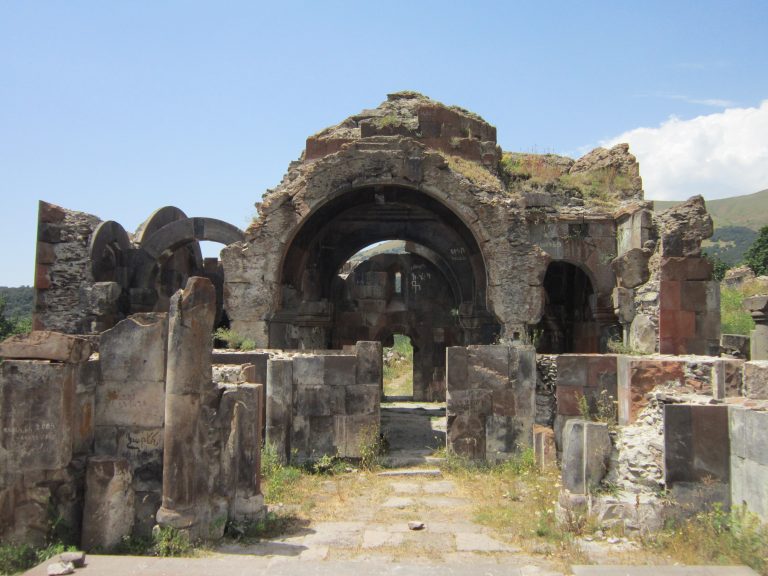
The Teghenyats Monastery is located in a forested fold of the Tsaghkunyats mountain range. It’s set between two streams, with a distant view of Mt. Ararat.
The monument has sheep and horse-shaped tombstones, an impressive half-intact gavit (narthex) next to the ruined sanctuary (12th century) and parts of a monumental dining room (13th c.).
Most sources mentioning Teghenyats Monastery claim the monastery was built in the 11th or 12th century A.D. However, a more recent excavation of the monastery, done during 2001 – 2008 sheds a different light on its history.
During the excavations, ceramic materials were found. The ceramic materials were divided into two groups: habitual & constructional. The habitual pottery consists of non-glazed and glazed potteries related to the 12th–17th centuries.
The ceramic pottery of the Teghenyats monastery follows the examples of large craft centers and cities of Medieval Armenia. The remains that were found at the site of the excavation also prove that ceramic workshops were created at the monastery to satisfy internal needs.
Besides the ceramic materials, there are bibliographic sources and epigraphic
data confirming that the monastery was continuously functional during the 8th–17th centuries.
Sources:
A portrait from the Armenian highlands Two women stand before a painted studio backdrop of…
1. What Was Published on September 25 Aram Navasardyan, head of the Armenian branch of…
Why the topic is back in focus Over the past four months, the gas issue…
It's often assumed that the "Albanization" of Armenian heritage — the policy of declaring medieval…
What independent observers are documenting The most systematic data on the fate of Armenian monuments…
On September 12, 2026, a delegation of some 150 diplomats and representatives from 58 countries,…