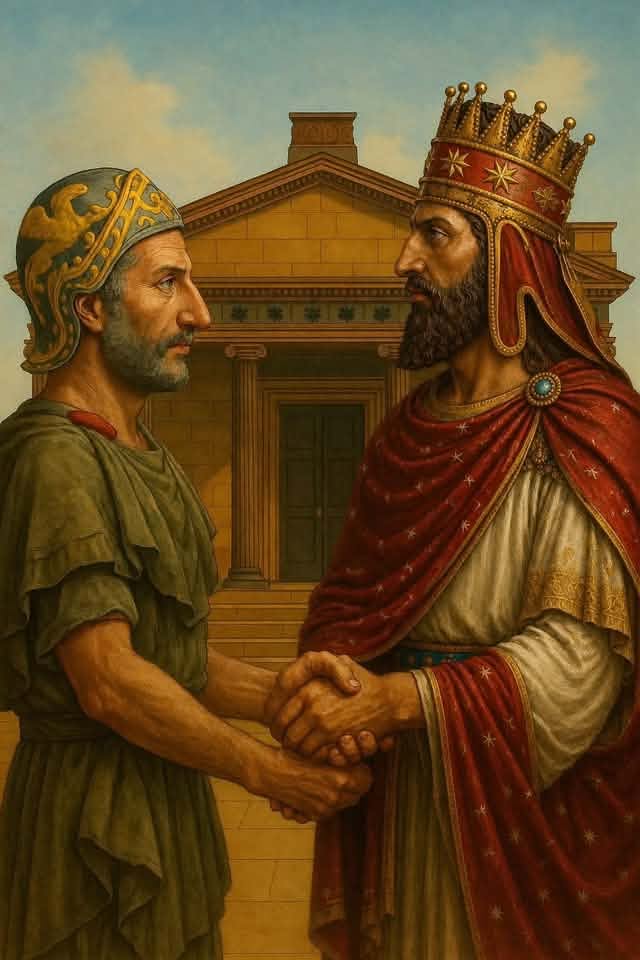
Few episodes in ancient Armenian history capture the imagination quite like the tradition that Hannibal Barca — Rome’s most feared enemy — spent part of his exile at the court of King Artaxias I (Artashes the Great) of Armenia, and lent his military engineering skill to the layout of a new capital city: Artashat, “the Joy of Artashes.” The story survives in the works of two major Greco-Roman authors, Strabo and Plutarch, and it has shaped the way both ancient and modern writers describe the city ever since — as Karthago Armeniaca, the “Armenian Carthage.”
This article lays out what the ancient sources actually say, what is known archaeologically about the city they describe, and what modern historians make of the claim that the great Carthaginian himself walked the hills above the Araxes and Metsamor rivers and helped design a Hellenistic royal capital for an Armenian king.
Artaxias I and the Founding of a New Capital
By the early 2nd century BC, Armenia had emerged from Seleucid overlordship as an independent kingdom under Artaxias I, founder of the Artaxiad dynasty, who had formerly served as a satrap of Antiochus III before the Seleucid defeat at the Battle of Magnesia in 190 BC. According to the 5th-century Armenian historian Movses Khorenatsi, Artaxias personally scouted the site for his new capital:
“Artashes traveled to the location of the confluence of the Yeraskh and Metsamor [rivers], and taking a liking to the position of the hills [adjacent to Mount Ararat], he chose it as the location of his new city, naming it after himself.”
The new capital, founded around 176 BC on a cluster of hills at the meeting point of the Araxes (Yeraskh) and Metsamor rivers near what is now Khor Virap, replaced the older Orontid capital of Yervandashat. Its location gave it control of a major crossroads of regional trade, and within a few generations it had grown into one of the great cities of the Hellenistic East — the seat of the Artaxiad kings for over three centuries, according to the World History Encyclopedia’s entry on Artashat.
The Hannibal Tradition: What Plutarch and Strabo Actually Wrote
The claim that Hannibal was directly involved in choosing and laying out the city comes from two independent Greek authors writing roughly two centuries after the events they describe, drawing on now-lost earlier sources.
Plutarch, in his Life of Lucullus (written around the turn of the 2nd century AD), gives the fullest account. Describing the Roman general Lucullus’s siege of Artaxata during the Third Mithridatic War, Plutarch pauses to explain the city’s origins:
“It is said that Hannibal the Carthaginian, after Antiochus had been conquered by the Romans, left him and went to Artaxias the Armenian, to whom he gave many excellent suggestions and instructions. For instance, observing that a section of the country which had the greatest natural advantages and attractions was lying idle and neglected, he drew up a plan for a city there, and then brought Artaxias to the place and showed him its possibilities, and urged him to undertake the building. The king was delighted, and begged Hannibal to superintend the work himself, whereupon a very great and beautiful city arose there, which was named after the king, and proclaimed the capital of Armenia.”
You can read the full passage in the Loeb-based English translation at Penelope/University of Chicago (Plutarch, Lucullus, 31.3–4), or the same section presented individually at Lexundria. A few chapters later, Plutarch again calls Artaxata simply “a very great and beautiful city,” reinforcing the impression that its size and planning stood out among the fortified capitals of the Hellenistic world.
Strabo, writing his Geography in the same period, is more terse but corroborates the same tradition independently:
“The cities of Armenia are Artaxata, also called Artaxiasata, which was founded by Hannibal for Artaxias the king… being a beautiful settlement and the royal residence of the country. It is situated on a peninsula-like elbow of land and its walls have the river as protection all round them, except at the isthmus, which is enclosed by a trench and a palisade.”
This passage can be read at Perseus Digital Library, Strabo Geography 11.14.6, which also preserves Strabo’s note that the Armenian name of the city, Artaxiasata, reflected the combination of the king’s name with a word for “joy” — matching the Armenian Artashat (“Joy of Artashes”). The Livius.org entry on Artaxata gives a clear side-by-side summary of both citations together with the archaeological picture of the site.
Why Hannibal Was in Armenia at All
The tradition fits neatly into what is independently known of Hannibal’s movements after his defeat at Zama in 202 BC. Facing Roman pressure on Carthage, Hannibal left North Africa around 195 BC and entered the service of Antiochus III of the Seleucid Empire, advising him during his war against Rome. After Antiochus’s defeat at Magnesia in 190 BC and the humiliating Peace of Apamea (188 BC), which required the Seleucids to surrender any Roman enemies sheltering at court, Hannibal fled eastward again — first, according to the sources, toward Crete, and then to the courts of Bithynia and, in this Armenian tradition, to Artaxias.
The chronology lines up: Artaxias founded Artaxata almost exactly in this window, around 176 BC (some scholars place it slightly earlier, closer to 188 BC), precisely when a battle-hardened Carthaginian strategist with firsthand experience of Mediterranean city planning and fortification would have been looking for a new patron. Hannibal’s final years were spent at the court of King Prusias I of Bithynia, where he died around 183–181 BC — meaning any Armenian episode, if historical, would have to fall within this narrow window between his flight from Antiochus and his arrival in Bithynia.
“Armenian Carthage”: The City on the Ground
Whatever the truth of Hannibal’s personal role, the city that rose at the Araxes–Metsamor confluence matched the ambitious description in the sources. Ancient authors describe Artaxata as built across nine (or, by some counts, several) hills, encircled almost entirely by a defensive river bend and protected on its landward side by a ditch and rampart — precisely the “peninsula-like elbow of land” Strabo describes. Archaeological survey work summarized by Livius.org has traced walls roughly three meters thick running for as much as ten kilometers around the site, with the upper city built across steep-sided hills.
Under Artaxias I and his successors, the city grew into a major political, commercial, and cultural center — the Roman historians’ nickname Karthago Armeniaca was not merely decorative but reflected the city’s real strategic importance as a fortified river capital in the mold of Carthage itself. It later served as the flashpoint of repeated wars between Armenia, Parthia, and Rome; Lucullus besieged it in 68 BC (the episode that prompted Plutarch’s digression on its founding), and it was sacked and later rebuilt several times before finally being eclipsed by Vagharshapat and Dvin.
What Modern Historians Say: A Debated Tradition
It is worth being direct about the state of the modern academic debate, since it is often glossed over in popular accounts. While the Hannibal story is repeated by two independent, broadly reliable Greco-Roman authors writing within a few generations of events attested elsewhere, no Armenian source — including Movses Khorenatsi, our most detailed native account of the founding — mentions Hannibal at all. Khorenatsi’s version credits Artaxias alone with choosing and naming the site.
This has led a number of modern historians to treat the Hannibal episode with caution. The Wikipedia article on Artaxata, summarizing the assessment of historian George Bournoutian, describes the Plutarch/Strabo story as “apocryphal,” noting there is “no direct evidence to support this story” beyond the two classical citations themselves. The skeptical reading holds that the tale may reflect a later literary convention — associating a spectacular new Hellenistic city with a legendary foreign genius — rather than a documented historical collaboration.
The more traditional reading, favored by many Armenian historians and reflected in most popular and encyclopedic treatments (including the World History Encyclopedia), takes the convergence of two independent Greek sources seriously as evidence of a real historical memory, especially given how precisely Hannibal’s known itinerary in these years overlaps with Artaxias’s building program. On this reading, the story is not a later invention but a detail that filtered into Greco-Roman historiography through sources — possibly Poseidonius or other Hellenistic writers used by both Strabo and Plutarch — with direct access to Armenian court traditions of the 2nd century BC.
Both positions agree on the essential facts: that Artaxias I founded a spectacular new capital at exactly the point in time when Hannibal is independently known to have been searching for a patron in the region, and that the resulting city was remembered by contemporaries as unusually accomplished in its fortification and layout — accomplished enough to earn a name that put it in the same breath as Carthage itself.
Legacy
Whether or not Hannibal ever personally walked the hills above the Araxes, the story of his role in founding Artashat has become one of the most enduring points of contact between Armenian history and the wider Mediterranean world in antiquity — a reminder that in the turbulent decades after Rome’s rise, exiled generals, displaced kings, and ambitious new states were all navigating the same shifting balance of power, and that Armenia, under Artaxias the Great, was very much a participant in that world rather than a bystander to it.
Sources and Further Reading
- Plutarch, Life of Lucullus, 31.3–4 — Penelope/University of Chicago
- Plutarch, Lucullus 31 — Lexundria (parallel Greek/English)
- Strabo, Geography, 11.14.6 — Perseus Digital Library
- Artaxata — Livius.org
- Artashat — World History Encyclopedia
- Artaxata — Wikipedia (includes modern historiographical caveats)
- Artaxias I — Wikipedia
- Hannibal — Wikipedia