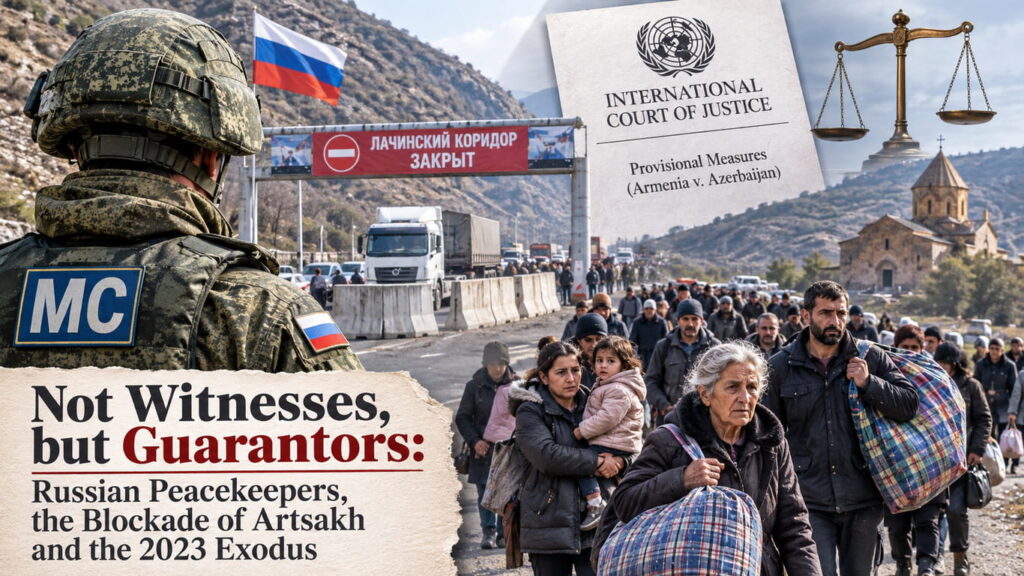
What exactly the Russian contingent undertook to do in the Lachin Corridor, what happened between December 2022 and October 2023, how international institutions, Yerevan and Moscow assess it, and where the line runs between documented fact and interpretation.
The starting thesis
In discussions of the Armenian exodus from Artsakh, one formulation recurs: the Russian peacekeepers were not observers but participants in ethnic cleansing. First, the argument goes, together with Azerbaijan they kept the Armenians under blockade for almost ten months, and then they facilitated the expulsion of more than 100,000 people from their native land within days.
This article tests each link of that thesis against open sources: the texts of the agreements, International Court of Justice decisions, reports by human rights organizations, statements by Russian, Armenian and Azerbaijani officials, and analysis from independent think tanks. A separate section near the end sets out the arguments of opponents and shows what the documents confirm and what remains an assessment.
Key facts in one place
| Parameter | What is established | Source |
|---|---|---|
| Start of the Lachin Corridor blockade | 12 December 2022 | Amnesty International via Emerging Europe |
| Duration | about nine months (until 19 September 2023); Armenian sources more often say “almost ten” | Human Rights Watch, The New Humanitarian |
| Population of Artsakh before the blockade | about 120,000 people | Amnesty via Emerging Europe |
| Start of the Azerbaijani offensive | 19 September 2023 | HRW |
| Start of the mass exodus | 24 September 2023, when the road opened | HRW |
| Number who left Artsakh | more than 100,000 people | HRW, UN mission |
| Those who remained | according to the UN mission, between 50 and 1,000 people | Aravot |
A note on the figures. The blockade lasted a little over nine months (12 December 2022 to 19 September 2023), and “nine months” is the figure used by HRW and most international sources. The exodus ran from about 24 September to the first days of October, that is, from a week to ten days if counted from the start of the offensive on 19 September. For publication it is safer to write “more than nine months” and “within days,” so that the wording withstands fact-checking.
1. What the Russian contingent guaranteed
Russian peacekeepers entered Nagorno-Karabakh under the trilateral statement of 9–10 November 2020, signed by Aliyev, Pashinyan and Putin. The text is published on the Russian Foreign Ministry website, on the Armenian Prime Minister’s website and on the Azerbaijani Foreign Ministry website.
Three provisions matter for our subject:
- Paragraph 3 provided for deploying the Russian contingent along the line of contact and along the Lachin Corridor. The term of deployment was five years, with automatic extension (text on the Armenian Prime Minister’s website).
- Paragraph 6 left the five-kilometer-wide Lachin Corridor under the control of the Russian peacekeepers. At the same time, Azerbaijan undertook to guarantee the safety of the movement of people, vehicles and cargo in both directions (text on armenian-genocide.org).
- Oversight of transport communications was to be carried out with the involvement of the Border Guard Service of Russia’s FSB (Russian Foreign Ministry).
On paper, then, the obligations are divided as follows: Baku must not create obstacles, while Moscow is responsible for keeping the corridor open and under its control. This distinction matters. It explains why the question of Russia’s responsibility cannot be reduced to the question of Azerbaijan’s responsibility, even though the International Court of Justice’s decisions are, legally, addressed to Baku.
2. The blockade: December 2022 to September 2023
From 12 December 2022 the corridor was closed to civilian and commercial traffic. Baku described what was happening as a spontaneous action by “environmental activists” and claimed that transport moved freely, while Yerevan and Stepanakert considered the action organized by the authorities (Al Jazeera, 30 December 2022).
What independent observers recorded:
- Amnesty International stated in February 2023 that humanitarian aid delivered by the ICRC and Russian peacekeepers was insufficient, and that the peacekeeping mission, which is obliged to ensure the safety of the corridor, and Azerbaijan were “manifestly failing to fulfil their obligations.” According to Karabakh authorities, the flow of vehicles fell from 1,200 a day to five or six trucks belonging to the peacekeepers and the ICRC; food rationing was introduced in January (Emerging Europe).
- The International Court of Justice on 22 February 2023, in a case brought by Armenia, ordered Azerbaijan to take all measures at its disposal to ensure unimpeded movement of persons, vehicles and cargo along the corridor in both directions (Interfax, analysis in EVN Report). On 6 July 2023 the Court confirmed that this order applies without limitation, including to the checkpoint Azerbaijan had set up (Armenian Foreign Ministry statement). For a legal analysis of non-compliance, see Opinio Juris.
- The European Parliament in January 2023 condemned the inaction of the Russian peacekeepers and proposed replacing them with an international OSCE contingent (News.am).
- Former ICC Prosecutor Luis Moreno Ocampo concluded on 7 August 2023 that there is a reasonable basis to believe the blockade constitutes genocide under Article II(c) of the Genocide Convention (expert opinion). Azerbaijan commissioned a rebuttal opinion from Rodney Dixon (the hearing materials are listed here).
3. What the peacekeepers did during these months
December 2022 – January 2023: Yerevan’s public complaints
Pashinyan said the contingent was not fulfilling its duty to control the corridor and called this a violation of paragraph 6 of the 2020 statement (Moscow Times, Hetq). The Kremlin replied that the peacekeepers act strictly within the agreements, and the Russian Foreign Ministry called public attacks on the contingent unacceptable (Al Jazeera).
23 April 2023: the Azerbaijani checkpoint at the Hakari bridge
In April Azerbaijan set up a post at the entrance to the corridor. Analysts at Eurasianet noted that Baku had long sought this, and that installing the post would seem to risk a confrontation with Russian forces, yet it went ahead with no apparent confrontation. The Azerbaijani Foreign Ministry, for its part, said the post was being set up in interaction with the Russian peacekeeping contingent (same source). The Russian Defense Ministry, by contrast, said Azerbaijan’s actions were unilateral and uncoordinated and that the contingent’s command was conducting negotiations (Armenpress).
The bridge was within the zone of a Russian peacekeepers’ observation post (op-ed by Tigran Grigoryan, CivilNet). Later the Armenian Foreign Ministry summoned the Russian ambassador and accused the peacekeepers of responsibility for a shootout on the border; in a video, according to the Armenian version, Azerbaijani servicemen were moving under the cover of Russian soldiers (Azatutyun). This is a claim by the Armenian side; the sources reviewed contain no independent confirmation.
August 2023
The contingent declined to provide security to participants in a civic action by Karabakh Armenians who intended to head to the Azerbaijani post. One of the activists said he suspected that, alongside Azerbaijan, the peacekeepers themselves were sustaining the blockade. Karabakh leader Arayik Harutyunyan acknowledged in the same days that Russia had failed to implement the main provision of the agreement on the corridor (Azatutyun).
Moscow’s position
The Russian Foreign Ministry publicly described the humanitarian crisis in Karabakh as a consequence of Armenia’s recognition of Karabakh as part of Azerbaijan, and said that placing blame on the peacekeepers was inappropriate and wrong (Azatutyun, Azatutyun). These arguments are examined in more detail in the section on opponents.
4. 19–20 September 2023: the offensive
On 19 September Azerbaijan began “anti-terrorist measures” and within a day secured the capitulation of the authorities of the unrecognized republic (HRW).
What the peacekeepers did:
- The Russian Defense Ministry reported evacuating about 5,000 civilians from Martakert, Martuni and Askeran to the contingent’s base (Armenpress).
- Russian servicemen were killed. According to Baku, six (Al Arabiya); Aliyev apologized, the Kremlin reported (Moscow Times).
- Andrei Kartapolov, chairman of the State Duma defense committee, said peacekeepers are not entitled to take part in combat as long as the threat does not concern themselves. Zakharova denied Baku’s claim that the contingent had been notified in advance of the operation (CivilNet).
- Pashinyan told Politico that Russia’s peacekeeping mission had “failed,” though he acknowledged he could not say that things would have been better without the peacekeepers (Novaya Gazeta Europe).
5. The exodus: from 24 September
After the road opened on 24 September, people began leaving Artsakh. According to HRW, more than 100,000 people left the region within days. People interviewed by the rights group said they fled in fear and panic (HRW, HRW family story). The organization links this fear to the nine months of blockade, the fighting, and the Azerbaijani authorities’ general human rights record.
The UN mission that visited the region on 1 October confirmed the mass exodus and noted the suddenness with which people had left their homes (The Guardian). Azerbaijan denies ethnic cleansing and calls the departure a personal and voluntary decision by residents (The National).
The European Parliament on 5 October 2023 adopted a resolution (491 in favor, 9 against, 36 abstentions) calling the forced exodus of the Armenian population ethnic cleansing and urging sanctions against responsible Azerbaijani officials (Euronews, text of the resolution, vote result).
In November 2023 the International Court of Justice ordered Azerbaijan to permit the return of refugees (USHMM). For monitoring materials from the Global Centre for the Responsibility to Protect, see here.
6. The denouement: the contingent leaves
In April 2024 Peskov confirmed that the Russian contingent was leaving Karabakh; according to reports, the withdrawal had been agreed by Putin and Aliyev. By 12 June Azerbaijan’s Defense Ministry announced that the withdrawal was complete, although the mandate ran at least until November 2025 (Moscow Times, Aravot). Peskov linked the withdrawal to the Armenian government’s decision to recognize Azerbaijan’s sovereignty over Karabakh (same sources).
The Polish Centre for Eastern Studies (OSW), in an April 2024 analysis, concluded that the swift seizure of Karabakh and its depopulation, which Russian troops passively witnessed, showed that Moscow either lacks the capability or lacks the will to oppose Baku (OSW).
7. The position: “participants,” not “witnesses”
Proponents of this assessment rely on the following.
- Control without performance. By the text of the agreement, the corridor was under the control of Russian forces. They were present on the road every day of the blockade, yet did not restore passage (paragraph 6 of the statement; Amnesty).
- A post beside a Russian position. The Azerbaijani post appeared next to the contingent’s observation post without visible opposition, and Baku publicly described it as installed in interaction with the peacekeepers (Eurasianet).
- Refusal to protect civic protest actions in August (Azatutyun).
- No response to the offensive. The contingent evacuated some people but did not obstruct the offensive; Kartapolov explained this by a lack of authority (CivilNet).
- Moscow’s rhetoric. Russian officials shifted responsibility to the Armenian government and declared complaints against Russia inappropriate (Azatutyun).
- The outcome for the parties. Russia secured the withdrawal of its contingent by agreement with Baku (OSW).
- Assessments by international bodies. The European Parliament calls the exodus ethnic cleansing (resolution), and Ocampo qualifies the blockade as genocide (opinion).
From this point of view, a state that took on the role of guarantor of the corridor and failed to ensure its operation bears responsibility no smaller than that of a witness who could have intervened but chose not to.
8. Counterarguments and the limits of the evidence
This section shows what is proven and what is assessment.
What the Russian side says
- The Russian Foreign Ministry maintains that the crisis resulted from Armenia’s recognition of Karabakh as part of Azerbaijan in Prague in October 2022 and subsequent statements, which “changed the fundamental conditions” of the 2020 agreement (Azatutyun, CivilNet). Armenia replies that nothing new was decided in Prague, and that the Almaty Declaration of 1991, already in force, was merely reaffirmed (Azatutyun).
- Russia notes that its contingent evacuated civilians and took casualties during the offensive (Armenpress, Moscow Times).
- Russia pointed to actions it had taken: organized passage for the ICRC, restoration of gas supplies and communications (statement by Russia’s permanent representative at the OSCE, 17 January 2023).
What Baku and legal experts say
- Azerbaijan denies a blockade and ethnic cleansing and calls the departure voluntary (The National).
- Ocampo’s conclusions were contested by an opinion commissioned by Baku (list of materials).
- The International Court of Justice’s 2023 decisions are provisional measures under the Convention on the Elimination of All Forms of Racial Discrimination, not a judgment on the merits, and are addressed to Azerbaijan (Opinio Juris). Russia is not a party to that case.
- “Ethnic cleansing” is not established in international treaties as a standalone crime (a generally accepted legal caveat), and the European Parliament’s resolution is political rather than judicial in character.
What follows from this
The open sources document: the contingent’s obligations under paragraph 6; the blockade and its humanitarian consequences; Azerbaijan’s non-compliance with the International Court of Justice’s order; the peacekeepers’ passivity when the post was installed and during the offensive; the mass exodus; Moscow’s statements placing blame on Yerevan.
Remaining an assessment or one side’s claim is that the Russian contingent actively assisted the blockade or the exodus in collusion with Baku. The arguments for this rest on the Azerbaijani Foreign Ministry’s statement about “interaction,” on the Armenian interpretation of a video, and on the benefits to Moscow from the later withdrawal. I found no published documents in the sources reviewed showing an agreement between Russia and Azerbaijan on expelling the population.
Two formulations of different strength are therefore sustainable for publication:
- Factual and well supported: the Russian contingent was the guarantor of the Lachin Corridor, failed to keep it operating for nine months, and did not prevent the offensive and the exodus; Moscow bears responsibility for this as well.
- Evaluative, to be presented as a position: the Russian peacekeepers were participants in ethnic cleansing. It is usually grounded in complicity by omission and in political benefit, not in proven collusion.
9. Yerevan’s role: what is confirmed, what is disputed, and what remains an accusation
The question of whether the Armenian government’s policy made it easier for Baku to retake Karabakh, and of whether this amounted to collusion, remains the central subject of dispute within Armenia. This section separates facts from the arguments of the parties.
9.1. Confirmed facts
| Date | What happened | Source |
|---|---|---|
| 6 October 2022 | At a meeting in Prague mediated by Macron and Michel, Pashinyan and Aliyev affirmed their commitment to the UN Charter and the 1991 Almaty Declaration, which fixes mutual recognition of borders along Soviet administrative lines | PanARMENIAN, Eurasianet |
| 14 May 2023 | In Brussels, Michel recorded Armenia’s territory as 29,800 km² and Azerbaijan’s as 86,600 km²; the Armenian opposition immediately interpreted the figure of 86,600 as including Karabakh | Azatutyun |
| 17 May 2023 | Pashinyan publicly repeated these figures at the Council of Europe summit in Reykjavik | Azatutyun, Panorama |
| 22 May 2023 | At a press conference Pashinyan directly confirmed that the 86,600 km² includes Nagorno-Karabakh, adding that the rights and security of Karabakh Armenians should be discussed in a Baku–Stepanakert format | Armenian Weekly, PanARMENIAN, bne IntelliNews |
| 23 May 2023 | The parliamentary opposition condemned this policy as “anti-national” | Panorama |
| 5–6 October 2023 | In Granada Pashinyan signed a declaration that mentions Azerbaijan’s area of 86,600 km²; Aliyev did not come to the meeting | TASS |
| 19–20 September 2023 | Pashinyan said Armenia was not taking part in combat operations and had no army in Karabakh (since August 2021, by his account), and that Yerevan had not taken part in drafting the ceasefire text | Al Arabiya, PanARMENIAN, Armenpress |
No party disputes these facts. What is disputed is their causes and consequences.
9.2. Arguments of those who see assistance to Baku
- Recognition as a legal resource for Baku and Moscow. The opposition argues that the statements in Prague and Brussels opened the way for the offensive (Azatutyun). Moscow’s rhetoric supports this, since it used them to relieve the peacekeepers of blame (see section 8 and CivilNet).
- Refusal to defend Karabakh. Hovannes Khudoyan, a lawyer for an opposition movement, argues that Armenia was obliged to defend Karabakh and its residents in September 2023. Representatives of this movement accuse Pashinyan of complicity in the offensive (Azatutyun).
- The assessment of Karabakh’s leaders. Samvel Shahramanyan, Karabakh’s former leader, said it was because of the actions of the Armenian authorities that the people of Artsakh ended up in their present situation (Azatutyun). As early as May 2023, former Karabakh leaders called Yerevan’s policy unacceptable (Turan, an Azerbaijani source).
- Yerevan’s subsequent line. Critics point to the government’s deliberate failure to react to the trials of former Karabakh leaders in Baku (Azatutyun, Mirror-Spectator), and to Pashinyan’s statement in May 2026 that Karabakh was not Armenian territory and that the Karabakh movement was a fatal mistake (Mirror-Spectator / Euronews).
- The accusation of betrayal. A number of authors note that Pashinyan became the target of accusations of “surrendering” Karabakh (University of Bremen blog). In the 2026 pre-election polemic, part of the opposition claimed outright that he had deliberately paralyzed the defense (Armenian Weekly); this is an assertion, not an established fact.
9.3. The reply of the government and its supporters
- “Nothing new in Prague.” The Armenian Foreign Ministry objects that nothing new was decided in Prague: Armenia, like Azerbaijan, confirmed the already operative Almaty Declaration (Azatutyun). In May 2023 Pashinyan recalled that all Armenian governments had recognized Azerbaijan’s territorial integrity (PanARMENIAN).
- Recognition on conditions. According to the government’s account, the agreement concerned 86,600 km² on condition of guarantees for the security and rights of Karabakh Armenians (Novaya Gazeta Europe).
- Responsibility of predecessors and outside forces. Pashinyan places the blame on previous governments and asserts that certain forces used the Karabakh conflict against Armenia’s independence (Azatutyun, Pan.am). He stresses that the three former presidents did not implement the “brilliant solutions” they now describe (Armenpress).
- The dispute over September 2023. Pashinyan states that part of Karabakh’s former leadership left the region, and blames the “elite,” not the residents (Armenpress). Shahramanyan rejects this (Azatutyun).
- Limited resources. The government points out that there were no Armenian troops in Karabakh and that the Karabakh army was not part of Armenia’s armed forces, although its soldiers held Armenian passports (Media.am).
9.4. Where the line of evidence runs
Documented: the recognition in its various formulations, Yerevan’s position on 19–20 September 2023, and the fact that Moscow and Baku used these statements in their own argumentation.
Remaining an accusation: that Yerevan colluded with Baku or Moscow to surrender Artsakh and expel its population. The sources reviewed contain no documents, testimony, or court or investigative findings that would confirm such an agreement. The arguments of proponents of this version are built on the sequence of decisions and on the government’s later statements, that is, on inferring intent from outcome. Pashinyan rejects the accusation.
Three formulations of differing strength are sustainable for publication:
- Factual: in 2022–2023 the Armenian government publicly confirmed recognition of Azerbaijan’s territorial integrity within 86,600 km², including Karabakh, and took no military or other steps to defend the region in September 2023.
- Evaluative, presented as the parties’ positions: in the opposition’s view, these decisions made the offensive easier; in the government’s view, they merely confirmed existing norms and did not change the balance of forces.
- An accusation, attributed to its authors: collusion to surrender Artsakh. It is advanced by opposition politicians, the government rejects it, and no confirming documents are publicly available.
Sources by group
Texts of the agreements: Russian Foreign Ministry · Government of Armenia · Azerbaijani Foreign Ministry
Human rights organizations: Amnesty (Emerging Europe) · HRW, 5 October 2023 · HRW, 17 October 2023 · USHMM · Global R2P
Courts and institutions: ICJ decision (Interfax) · Opinio Juris · European Parliament resolution · Ocampo opinion
Russia’s position: Al Jazeera · Azatutyun: Zakharova · CivilNet · Russia’s permanent representative at the OSCE
Yerevan’s position and the dispute over it: Azatutyun: Reykjavik · Armenian Weekly: 86,600 km² · TASS: Granada · Al Arabiya: 20 September 2023 · Azatutyun: opposition accusations · Azatutyun: Shahramanyan · Armenpress: Pashinyan’s reply
Chronicle and analysis: Eurasianet · OSW · The Guardian (UN mission) · Moscow Times: withdrawal of the contingent