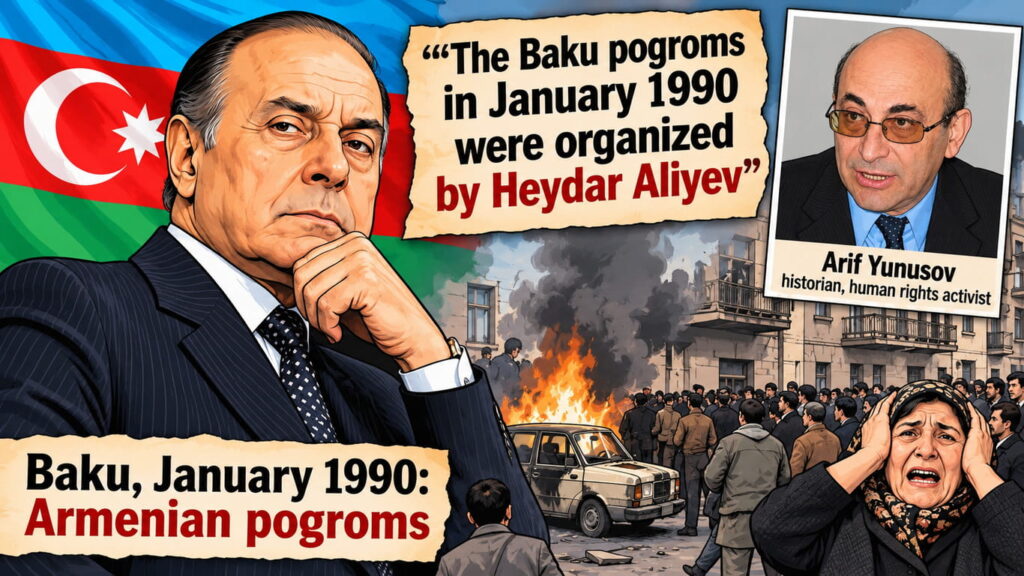
Historian and human rights activist Arif Yunusov lives in exile in the Netherlands. In an interview with the opposition internet channel Obyektiv TV, he stated that the Armenian pogroms in Baku in January 1990 were arranged at Heydar Aliyev’s design. Armenpress reported this. Yunusov repeated the same version in 2021 in a conversation with Lenta.ru.
Yunusov’s version
According to him, the scheme looks like this. In 1988 Abdurakhman Vezirov became first secretary of the Central Committee of the Communist Party of Azerbaijan. By agreement with Gorbachev, he launched an investigation against Aliyev covering the years of his leadership of the republic, 1969 to 1982. By the end of 1989 investigators from Moscow had arrived in Baku, and for mid-January 1990 the USSR Prosecutor General’s Office was preparing a final session. At the end of the month a plenum of the Central Committee was to convene, where Aliyev and his team faced expulsion from the party and removal from politics. Yunusov also spoke about the joint session of the prosecutors’ offices to Lenta.ru.
Aliyev, in Yunusov’s view, knew all this and, through his people in the republic and in the Popular Front, launched a counter-operation. He names Abulfaz Elchibey, Nemat Panakhly, Etibar Mamedov, Fazail Agamaly and Bejan Farzaliyev. Bloodshed, in this version, was supposed to derail the investigation. Yunusov names Panakhly as the organizer of the pogroms, and also attributes to him the breaching of the border in Nakhchivan on 31 December 1989.
The main testimony in his account is a 1992 conversation with Colonel Oleg Aliyev of the Azerbaijani KGB. According to Yunusov, Oleg Aliyev said that Panakhly’s headquarters was at the Schmidt plant and that in the January days belongings from looted Armenian apartments were brought there. Whether Panakhly killed people personally, Yunusov did not claim.
Moscow, in this account, knew about everything and did not interfere, and then used the pogroms as a pretext for sending in troops on 20 January. After that the plenum and the prosecutors’ session did not take place, the investigation was wound down, and Aliyev later came to power.
What other sources confirm
The fact of organized violence is well described. The pogroms began on 12–13 January 1990. According to Human Rights Watch, 48 people died; Thomas de Waal gives about 90; Armenian authors write of a hundred or more (Wikipedia: Baku pogrom). By then some 40,000 Armenians remained in the city (Gazeta.ru).
HRW’s Robert Kushen wrote that the attacks were hardly spontaneous: the attackers had lists of Armenians with addresses. Witnesses told Helsinki Watch and Memorial that the militia did not respond to reports of attacks. The same sources note that the Popular Front’s rhetoric was mostly anti-Armenian, and that on 12 January the Front set up a national defense committee in Baku (Wikipedia: Black January). The full text of the report was published as a book: Conflict in the Soviet Union: Black January in Azerbaidzhan (Helsinki Watch and Memorial, 1991).
The second part of the account, about the role of the center, is also confirmed. According to documents of the military prosecutor’s office in Baku that HRW examined, planning for the operation began even before the pogroms of 13 January, so the explanation “troops were sent in to protect Armenians” looks weak. Troops entered the city on the night of 20 January; according to official figures, 133 people died and 611 were wounded (Current Time).
What open sources lack
Documents. Yunusov says he read part of the materials of the investigation against Aliyev, but does not say where they are kept or how to find them.
A second witness. The conversation with Oleg Aliyev is known only through Yunusov’s own retelling. There is no recording or transcript.
A primary source for Aliyev’s words. In hetq.am’s retelling, Yunusov cites a phrase in which Aliyev supposedly demanded “a lot of blood,” and refers to Panakhly’s interview with the journal Monitor. The text of that interview could not be found.
Confirmation from other authors. Armenian outlets, for example Armenpress, name the Popular Front as the organizer of the pogroms and speak of the connivance of the Azerbaijan SSR authorities. Aliyev’s name is not there. In the retellings of the HRW report that I came across, it is not there either. The link to Aliyev so far rests on the words of one person.
A single version of the interview itself. Armenpress writes that, according to Yunusov, the entry of troops on 20 January also happened on Aliyev’s instruction. In the hetq retelling and in the conversation with Lenta.ru, the point is that Moscow took advantage of the pogroms. Before quoting, it is worth checking this against the Obyektiv TV recording.
The author’s own position must also be taken into account. In 1992–1993 Yunusov headed the information and analytical department of the Azerbaijani president’s staff and investigated the events of 1990, so he is not an outside observer. He is now in exile. That is no reason to reject his words, but it is a reason to look for confirmation independently.
How to read this interview
An accusation of this scale requires documents, and Yunusov names none. That is the main thing to tell the reader plainly: something very serious has been claimed, and the claim cannot be checked.
The account has features that often appear in conspiracy-style constructions:
- Everything comes down to one person and one motive. The Karabakh crisis, the radicalization of the Popular Front and Moscow’s calculations are all explained by Aliyev’s plan.
- Intent is inferred from the outcome: Aliyev later came to power, so that is what he was after.
- The scheme explains any behavior by the participants. Moscow knew and kept silent; Panakhly was an executor but not an agent. Such a construction is hard to refute.
- The supports are inaccessible: the investigation was “read,” a witness is named, but his words are known only through a retelling.
At the same time, the account is not absurd. The organized nature of the pogroms and the passivity of the center are confirmed by independent sources. According to an encyclopedia entry, in 1993 Elchibey himself asked Aliyev to return to Baku (Encyclopedia.com), so there were contacts between them. But that was three years later, and it says nothing about the plans of January 1990.
Who the interview is addressed to. Obyektiv TV positions itself as an opposition channel, and the words are addressed first of all to an Azerbaijani audience: they undermine the heroic image of 20 January and the legitimacy of the Aliyevs’ rule. Armenian outlets take from them yet another confirmation of the organized nature of the pogroms, with the Armenpress headline harsher than other retellings. In the Russian presentation, Moscow’s role comes to the fore.
What could confirm the version:
- published materials of the investigation against Aliyev;
- the archives of the KGB of the Azerbaijan SSR;
- the text of Panakhly’s interview with the journal Monitor;
- testimony from other witnesses, or a statement by Oleg Aliyev himself.
Context: what is known about the Aliyev dynasty
Yunusov’s words do not sound in a vacuum: the Aliyevs’ rule has a reputation, and it is confirmed not only by oral statements. Below is what rests on documents and independent investigations. There is nothing to soften here.
Heydar Aliyev built his career in the state security of the Azerbaijan SSR, headed the republican KGB from 1967, led the republic’s Communist Party from 1969 to 1982, and then joined the Politburo of the CPSU Central Committee (Irish Times). The reasons for his departure in 1987 are interpreted differently. Azerbaijani sources speak of a protest against Gorbachev’s policies (Anadolu), while Wikipedia gives a version of a resignation amid an anti-corruption campaign. In 1993 he became head of parliament, then acting president, and in October was elected president (AzerNews). Some sources describe this as a return at Elchibey’s invitation, others as a military coup that removed Elchibey.
In 2012 the OCCRP named Ilham Aliyev its “Person of the Year” in organized crime and corruption, citing investigations into the family’s hidden stakes in banks, construction and gold mining (OCCRP). According to RFE/RL, the response was a wave of messages about the people’s love for the president that did not address the substance of the accusations. In 2014 criminal cases began against human rights defenders, among them Yunusov himself and his wife Leyla. Human Rights Watch called the charges trumped up, and in 2016 the couple were granted asylum in the Netherlands (Index on Censorship).
Separately, on the fate of Armenian heritage. The Armenian cemetery in Julfa (Nakhchivan), with thousands of khachkars, disappeared between 1998 and 2005: satellite images from 2003 and 2009, analyzed by the American Association for the Advancement of Science, showed that the site had in all likelihood been destroyed and leveled with machinery (AAAS). According to Caucasus Heritage Watch, of 110 Armenian monuments in Nakhchivan identified from historical sources, 108 have been destroyed (Cultural Property News). The Azerbaijani authorities deny the systematic destruction of Armenian heritage (The Art Newspaper), and officials, according to RFE/RL, claimed that the cemetery was not Armenian or did not exist at all. Here the denial is refuted by documents, and that is what makes the case instructive.
Three documented episodes
So that the discussion of the Aliyevs and of the Armenian question rests on documents rather than general formulas, here are three episodes: what is established about each and what remains disputed.
| Episode | What is confirmed | What is disputed | Sources |
|---|---|---|---|
| Sumgait, 27–29 February 1988 | A pogrom against the Armenian population. According to official data from the USSR Prosecutor’s Office, 32 people died (26 Armenians and 6 Azerbaijanis). The militia did not stop the violence. | The number of victims: Armenian sources give 200 or more. The degree of organization: some sources speak of advance preparation. | Wikipedia: Sumgait pogrom; JAM News |
| Baku, 12–19 January 1990 | A pogrom of Armenians. According to HRW, 48 people died. The attackers had lists of addresses; the militia did not respond to reports. | The number of victims: 48 per HRW, about 90 per de Waal, more than a hundred per Armenian authors. The organizer: the Popular Front (per HRW and Armenian sources) or Aliyev (per Yunusov). | Wikipedia: Baku pogrom; Wikipedia: Black January; Helsinki Watch and Memorial report |
| Exodus of Armenians from Karabakh, September–October 2023 | After Azerbaijan’s operation of 19–20 September, more than 100,000 people (by Yerevan’s estimate the population was about 120,000) left for Armenia in less than a week. A UN mission on 1 October confirmed the mass exodus: between 50 and 1,000 people remained. On 22 February 2023 the International Court of Justice, by 13 votes to 2, ordered Azerbaijan to ensure unimpeded movement through the Lachin Corridor. | The causes of the exodus: Armenian authorities speak of ethnic cleansing; Baku replies that people left by personal choice. Azerbaijan also argued before the court that movement through the corridor was controlled by Russian peacekeepers. The UN mission arrived after the exodus, and its conclusions are limited, according to analysts at OSW. The court issued provisional measures, not a ruling on the merits. | Al Jazeera; The National; OSW; International Court of Justice |
The table is compiled from reference, news and analytical sources, not from the documents themselves. Before publication it is worth opening the primary sources: the Helsinki Watch and Memorial report (1991), the newspaper Izvestia for 1988–1990, the report of the UN mission of 2 October 2023 and the full texts of the International Court of Justice orders. The legal qualification of the events (“ethnic cleansing,” “genocide”) is given in the table as the position of the parties, because the sources found do not establish it.
Armenian heritage in Nagorno-Karabakh (Artsakh)
The destruction of monuments is confirmed better than many other accusations, because it is visible in satellite images. The question is what exactly follows from it.
What is documented. The Caucasus Heritage Watch project (Cornell and Purdue universities) monitors more than 200 Armenian monasteries, churches and cemeteries in Karabakh, comparing satellite images from before and after the 2020 war (The Art Newspaper). Among the cases are the Church of St. Sargis in Mokhrenes (Hadrut district), whose destruction CHW called the first documented violation of the International Court of Justice’s order (CivilNet), and the Church of St. John the Baptist in Shusha, demolished, according to satellite images, in the winter of 2023–2024 together with a neighboring village (Christian Post, citing RFE/RL). The Ghazanchetsots Cathedral in Shusha, shelled twice in October 2020, was later rebuilt: the Armenian side speaks of a distortion of the church’s appearance, while the Azerbaijani Foreign Ministry calls the work restoration (EVN Report).
In December 2021 the International Court of Justice ordered Azerbaijan to take all necessary measures to prevent and punish acts of vandalism and desecration affecting Armenian cultural heritage, including churches, monuments and cemeteries (the court’s order). Baku called the decision too general and recalled that it already intends to suppress vandalism (letter to the UN).
Baku’s position. The authorities call the work restoration, and attribute many Armenian churches to the heritage of “Caucasian Albania.” According to Christianity Today, the minister of culture announced a plan to remove Armenian inscriptions from churches, calling them forgeries; international researchers regard this “Albanian” theory as untenable. For completeness: CHW also studies Islamic monuments, mostly mosques, that were under Armenian control (Hyperallergic).
What follows from this. The physical destruction of specific sites in a territory closed to independent observers is confirmed by satellite images. Together with the long-running destruction of Armenian monuments in Nakhchivan and the campaign of “Albanization,” this is a serious argument for a deliberate policy of erasing the traces of Armenians, and indirect confirmation of ethnic cleansing. The court in 2021 recognized as plausible a violation of the right to protection of heritage, but did not rule on the merits. To charge ethnic cleansing, evidence of coercing the population to leave is needed, and it is examined in the 2023 episode above. The destruction of heritage works as indirect evidence of intent: if one wants to make a territory “without Armenians,” there is no reason to preserve their traces. This is an inference from facts, not a fact itself, and Baku offers a different explanation. The destruction is consistent with the version of deliberate erasure, but this version gains its full force only together with other evidence.
A separate case, where the dispute is about attribution rather than destruction: the Blue Mosque in Yerevan. It was built in 1765–1766 by Hussein Ali Khan, a subject of Persia (Iran) and ruler of the Erivan Khanate, which was under Iranian rule. The mosque is classed as Iranian in architectural style and was restored in 1996 (Wikipedia). Azerbaijani officials call it an Azerbaijani monument; Iranian diplomats reject this (Massis Post).
In November 2026 the Iranian embassy reported that the mosque’s ceremonial hall had been named after Yeghishe Charents, as a friend of Iranian culture and literature who contributed to the preservation of the mosque, and that a bust of him is planned to be installed there later (Golos Armenii; the same report in Armenpress). On 12 November the State Committee for Work with Religious Organizations of Azerbaijan condemned the naming and the plans for the bust, called the mosque a unique example of Azerbaijani architecture, and stated that funding the restoration does not change who the monument belongs to (PAN.am, citing APA). The Caucasus Muslims Board called the naming sacrilege (Haqqin), and Azerbaijani outlets write of a “forgery” (1news.az).
On Charents’s role, the dispute is at the level of assertions. The Iranian embassy speaks of his contribution to the preservation of the mosque; in the 1930s there were plans to demolish all the mosques of Yerevan, and Charents helped save it. Azerbaijani commentators say there is no documentary confirmation (Minval).
The point is that statements of this kind should be treated with caution, mainly also because, as said above, Yunusov did not provide supporting documents or witnesses for his heavy accusations against the Aliyev dynasty. But the reputation of Azerbaijan’s authorities, their policy and their actions rather confirm the plausibility of Yunusov’s theory, just as Armenia’s attitude toward others’ cultural heritage confirms the creative character of Armenian society and of Armenia as a whole.
Sources
- Armenpress: Arif Yunusov claims Heydar Aliyev as organizer of Armenian massacres in Baku
- Lenta.ru: interview with Arif Yunusov on “Black January,” 22 November 2021
- Wikipedia: Baku pogrom
- Wikipedia: Black January
- Gazeta.ru: 30 years ago pogroms of the Armenian population began in Baku
- Current Time: eyewitnesses of “Black January”
- Armenpress: chronicle of the pogrom
- Helsinki Watch and Memorial: Conflict in the Soviet Union: Black January in Azerbaidzhan, 1991
- hetq.am: Yunusov interview retelling
- Encyclopedia.com: Aliyev, Heidar
- Irish Times: Azeri strongman with a talent for political survival
- Anadolu: National leader of Azerbaijan Heydar Aliyev
- Wikipedia: Heydar Aliyev
- AzerNews: chronology of 1993–1994
- OCCRP: Aliyev “Person of the Year” 2012
- RFE/RL: reaction to the OCCRP award
- Human Rights Watch: Azerbaijan, Government Repression Tarnishes Chairmanship
- Index on Censorship: the case of Leyla and Arif Yunus
- AAAS: High-Resolution Satellite Imagery and the Destruction of Cultural Artifacts in Nakhchivan
- RFE/RL: When The World Looked Away: The Destruction Of Julfa Cemetery
- Cultural Property News: The Azerbaijan Paradox
- The Art Newspaper: Cultural erasure in the Caucasus spreads
- Azerbaijani Foreign Ministry: Black face of the Red Terror
- JAM News: How Heydar Aliyev explained Azerbaijan’s turbulent 1990s
- Wikipedia: Sumgait pogrom
- JAM News: the Sumgait pogroms through the eyes of an Azerbaijani publicist
- Al Jazeera: UN team in Nagorno-Karabakh, a first in 30 years
- The National: Few Armenians left in Nagorno-Karabakh
- OSW: Exodus of Armenians from Nagorno-Karabakh
- International Court of Justice: summary of the Order of 22 February 2023
- International Court of Justice: summary of the Order of 17 November 2023
- International Court of Justice: Order of 7 December 2021
- Permanent Mission of Azerbaijan to the UN: letter on the court’s order
- CivilNet: Cultural Heritage at Risk in Nagorno-Karabakh
- Christian Post: Armenian church, village erased in Nagorno-Karabakh
- EVN Report: Ghazanchetsots and Caucasus Heritage Watch
- Christianity Today: Satellite Imagery Documents Erasure of Armenian Christian Heritage
- Hyperallergic: Satellite Imagery Reveals Azerbaijan’s Persistent Erasure of Armenian Heritage Sites
- Wikipedia: Blue Mosque, Yerevan
- Massis Post: Iranian Embassy responds to Azeri MPs’ claims about the Blue Mosque
- PAN.am: Baku condemns naming of Blue Mosque hall after Yeghishe Charents, 12 November 2026
- AzerNews: Farid Shafiyev on heritage
- 1news.az: A bust of Charents in the Blue Mosque?
- Golos Armenii: the Blue Mosque hall named after Yeghishe Charents
- Armenpress: Iranian embassy statement on the hall named after Charents
- Haqqin: An Azerbaijani mosque, an Armenian poet and an Iranian vice president
- Minval: interview on the Blue Mosque