A source-based overview. All links are clickable and lead to primary sources or scholarly and reference works.
Introduction: A Strange Argument
In Azerbaijani media and on social networks, Armenians are often met with a taunt: “show us the tombs of your kings, if you are so ancient.” The trick relies on the reader knowing neither the history of Armenian statehood nor the map of historical Armenia.
The argument has two weaknesses:
- Logical. Whether a tomb has survived or not is not proof of whether a state existed. Many tombs of ancient rulers around the world have been looted, lost, or are inaccessible, and this does not cancel out the states themselves.
- Factual. The royal tombs of Armenian dynasties are known, described in scholarly literature, and a significant share of them are located in the present-day Republic of Armenia. Another part lies in Western Armenia (in present-day Turkey), where researchers’ access is restricted.
Below is an overview by dynasty, followed by a separate, detailed section on Haghartsin (Agartsin).
1. The Kingdom of Van (Urartu): Royal Rock-Cut Tombs of Tushpa
Tushpa (modern Van, Western Armenia), the capital of the Kingdom of Van, was founded by King Sarduri I around 830 BC. According to World History Encyclopedia, the capital had a royal necropolis of chambers cut into the rock: single, double, and triple chambers whose entrances were sealed with a large stone slab; several looted tombs still carry inscriptions describing the deeds of the occupant.
The nomination file for UNESCO’s Tentative List, Tushpa/Van Fortress, records eight rock-cut tombs on the southern face of Van Fortress. The Horhor complex is associated with King Argishti I; for the Horhor rock chambers as Argishti I’s principal monument, see also the chapter in the Max Planck Research Library volume.
These tombs lie in territory that is today under Turkish control.
Scholarly caveat. In academic scholarship, Urartu and medieval Armenia are usually treated as different states, and the degree of direct continuity remains a matter of debate. This article treats the Kingdom of Van as an early stage of Armenian statehood, but readers should be aware that other approaches exist.
2. The Armenian Arsacids (Arshakuni): Tombs at Ani-Kamakh and Aghtsk
The 5th-century historian Faustus of Byzantium (Pavstos Buzand, Epic Histories) reports that the royal burial places of the Arsacids were in the fortress of Ani-Kamakh (modern Kemah, Turkey). In his account, the Persian king Shapur II opened the tombs and carried off the remains; the only tomb he could not open was that of King Sanatruk, because of its colossal construction. This is recounted in detail in the article Arshakid Mausoleum.
The commander (sparapet) Vassak Mamikonian then defeated the Persians in Ayrarat, recovered the royal remains and reburied them in the village of Aghtsk (in the source, Dzorap) on the slopes of Mount Aragats — that is, in the present-day Republic of Armenia.
Today, the village of Aghtsk in Aragatsotn Province preserves:
- the Arshakid mausoleum (mid to late 4th century), semi-cruciform in plan, with niches for stone ossuaries on the north and south sides;
- a basilica of the late 4th or early 5th century, attached to the mausoleum;
- reliefs on the ossuaries: on one, the scene of Daniel in the lions’ den and a ram motif; on the other, a mythical hero, birds, a calf among grapevines, a cross within a circle, and a hunter with dogs.
According to tradition, the ossuary with the biblical scene held the remains of the Christian kings and the other held those of the pagan kings. According to Movses Khorenatsi, the royal remains were later moved once more, because of earthquakes and invasions, to Vagharshapat (Echmiadzin).
Caveat. The details of the reburials are known mainly from narrative sources (Faustus, Khorenatsi), not from inscriptions on the tombs themselves.
3. The Bagratids (Bagratuni): the “Armenian Saint-Denis” and the Royal Cemetery at Ani
The royal burials of the Bagratids were linked with Bagaran, and later with Ani and the monastery of Horomos. Armen Manuk-Khaloyan’s study, “In the Cemetery of their Ancestors: The Royal Burial Tombs of the Bagratuni Kings of Greater Armenia (890–1073/79)” (Revue des Études Arméniennes, 35, 2013), is the basic work on the subject; articles such as the one on King Ashot III draw on it.
- Bagaran — according to the article Bagaran (ancient city), many Bagratid rulers, including Ashot I, are buried here.
- Horomos near Ani — a monastery that historians call the “Armenian Saint-Denis.” According to Wikipedia, it served as the burial place of Ashot III, Gagik I and Yovhannes-Smbat. Edda Vardanyan (Heidelberg University) writes likewise, noting that from the late 10th century Horomos became a resting place of Armenian kings.
- According to a publication in the Bulletin of the Matenadaran, in 961 King Ashot III made Horomos the burial place of kings.
Horomos and Bagaran are in Kars Province (Turkey). From 1920, Horomos lay in a closed military zone inaccessible to archaeologists (source). This is why “showing” these tombs is a matter not of their absence from history but of the political accessibility of the territory.
4. The Kyurikids (Kingdom of Tashir-Dzoraget): Sanahin and Haghartsin
The junior branch of the Bagratids — the Kyurikids — ruled in Tashir-Dzoraget (the north of present-day Armenia) until the early 12th century. Two principal royal necropolises survive here, both in the Republic of Armenia.
Sanahin
According to UNESCO, Sanahin was the administrative centre and family burial place of the Kyurikid Bagratids in the 10th–11th centuries. According to the tourist site Travel to Armenia, the complex contained the burial chapel of Gurgen and David Kyurikyan. A relief on the east wall of the church of Surb Amenaprkich shows the brothers Smbat and Gurgen with the inscription “King Kiwrikē, King Smbat” (Courtauld Institute).
Haghartsin
Discussed in detail below, in its own section.
5. The Kingdom of Syunik: Vahanavank
The Kingdom of Syunik arose in the south of the country in the late 10th century. Its main royal necropolis is Vahanavank near the town of Kapan, in the present-day Republic of Armenia.
According to Armeniapedia (citing the guidebook Rediscovering Armenia), the portico-burial chapel holds Kings Smbat II and Grigor I, Queens Sophie and Dinar, Prince Ashot Jevanshir and others. According to Armland, the complex contains the graves of Prince Vahan, Sahak Sevada II, Queen Sopi, Prince Ashot, Smbat II, Grigor I, and four other kings of the Kingdom of Syunik.
This necropolis is also mentioned in the Mirror-Spectator piece on the Kapan Regional Museum, which says that the princes and kings of medieval Syunik were buried at Vahanavank and that some of their burials and skulls were found during excavations.
Haghartsin (Agartsin): A Royal Burial Place in the Forests of Dilijan
Location
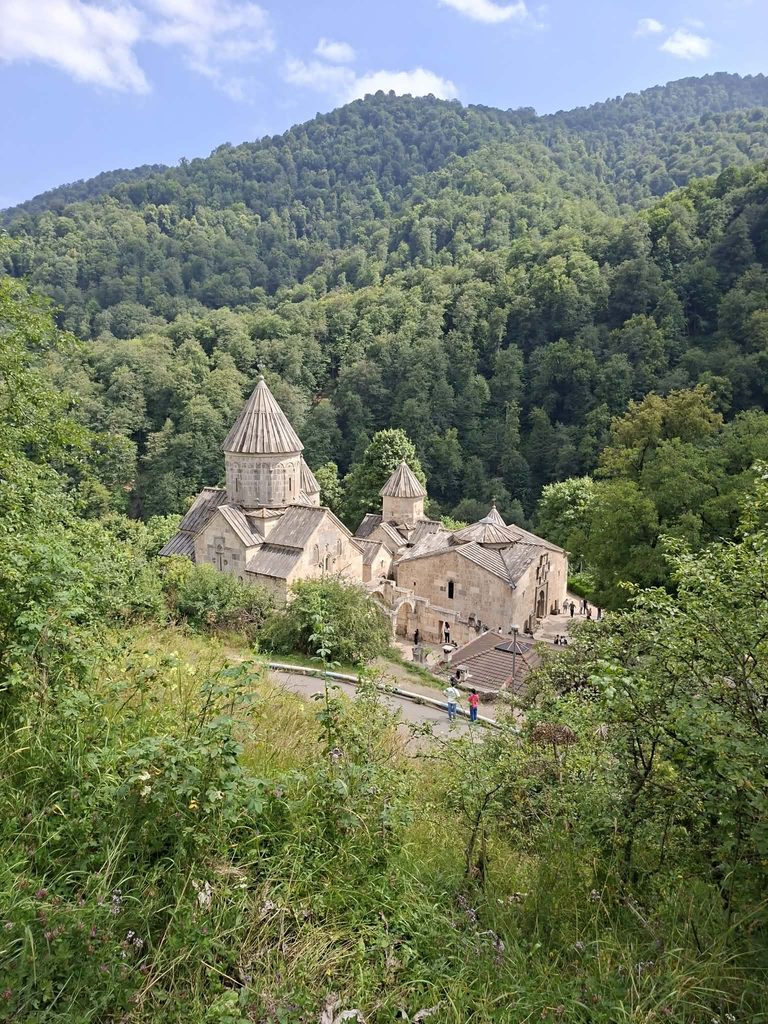
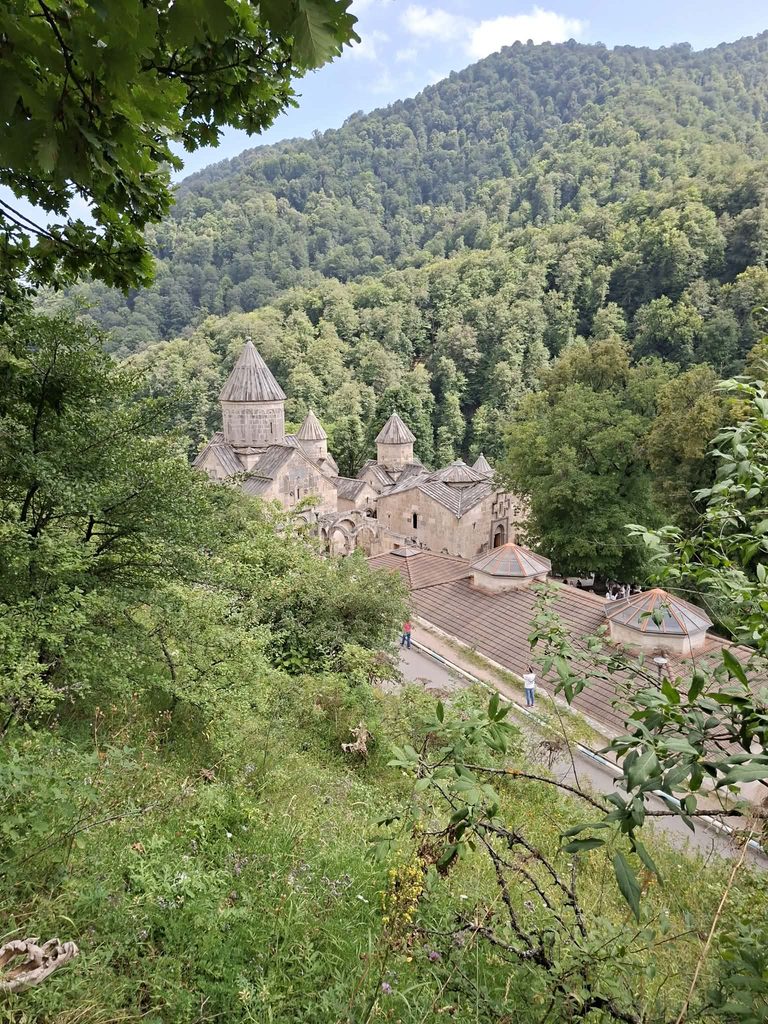
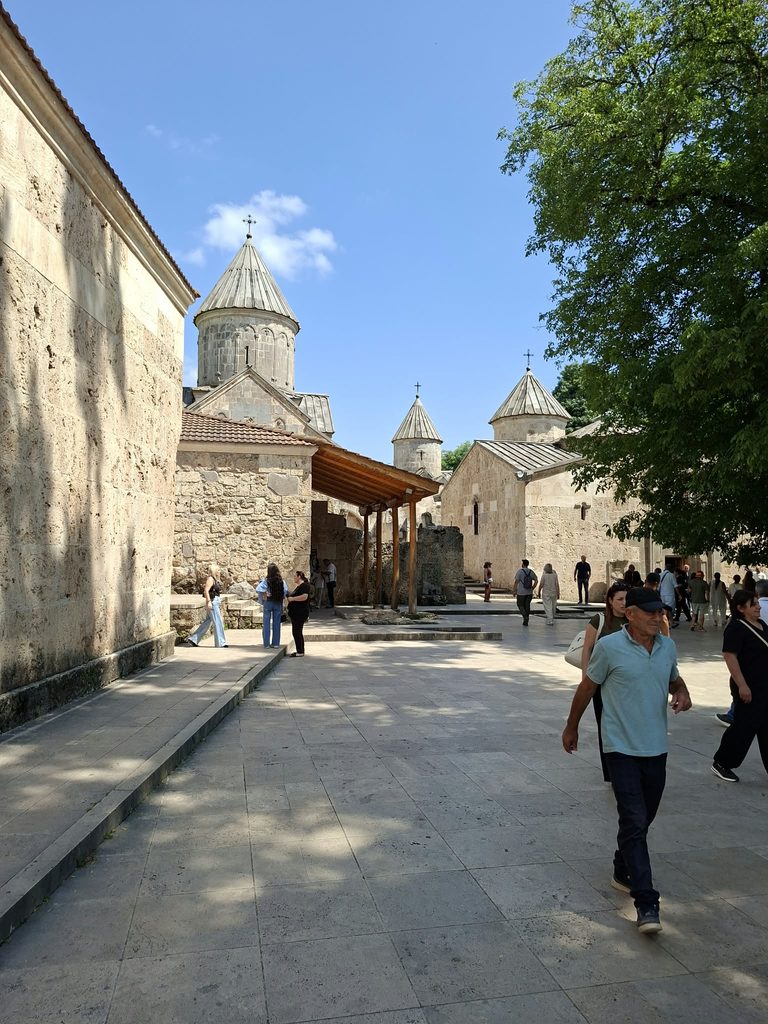
Haghartsin Monastery stands near the town of Dilijan in Tavush Province, Armenia, in the forested mountains of the national park. According to One Way Tour, the complex is about 18 km from Dilijan. Since 2017 it has been part of the Transcaucasian Trail.
Folk etymology links the name to the words khaghats’ (“played”) and artsiv (“eagle”); scholars do not regard this etymology as scientific.
History
The exact date of foundation is unknown; the monastery is thought to have existed by the 10th century, under the Bagratids. There are no written records of its founding. In the 11th century the monastery was almost entirely destroyed by the Seljuks. It was then restored by the princes Zakare and Ivane Zakarian (from 1184). After the death of his brother Zakare in 1213, Ivane left a dedicatory inscription about building the zhamatun at the church of Surb Grigor, noting that the brothers had chosen Haghartsin as their family burial ground.
The abbot of Haghartsin was the outstanding musician Khachatur Taronatsi; Kirakos Gandzaketsi writes about him, and also credits him with the monastery’s reconstruction and expansion. The church of Surb Grigor housed an important school of church music; Tamara Minasyan has studied the monastic school in the Banber Matenadarani (Bulletin of the Matenadaran).
Architecture
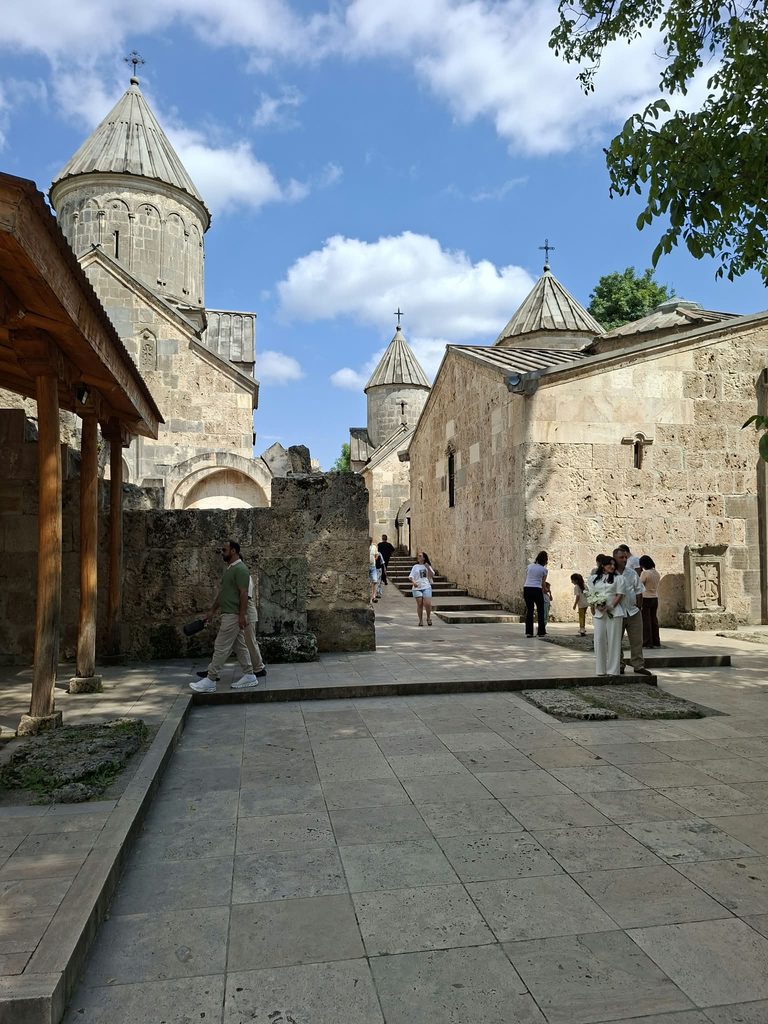
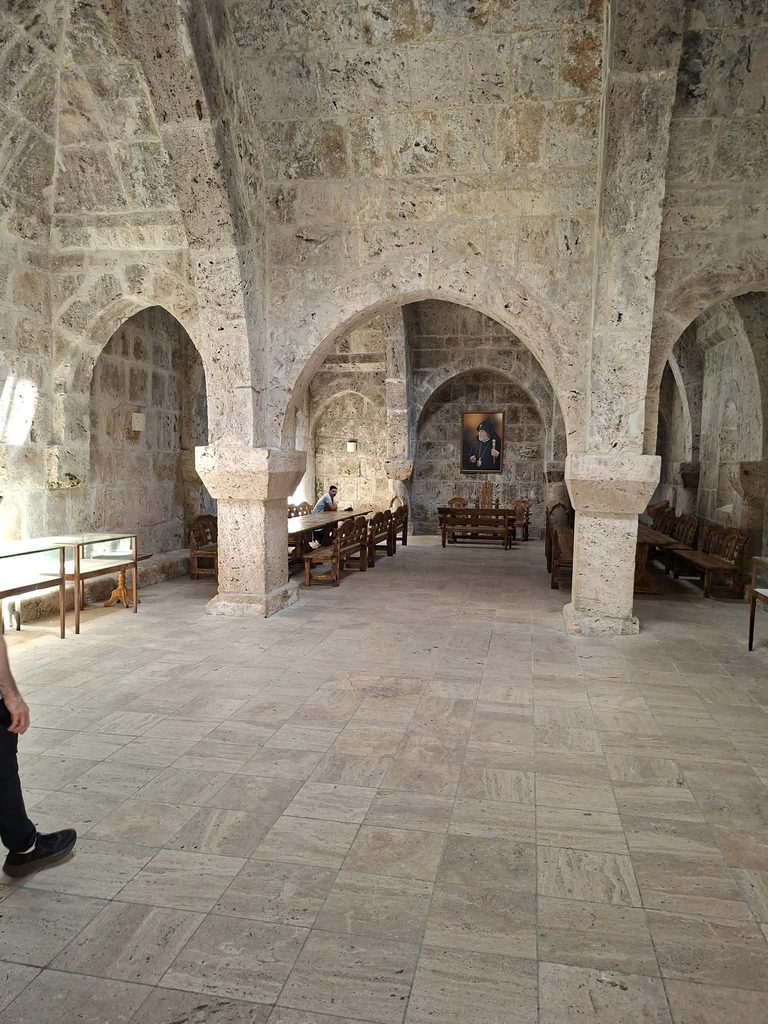
- Surb Grigor — the oldest large building of the complex (presumably 10th century), with an octagonal dome drum.
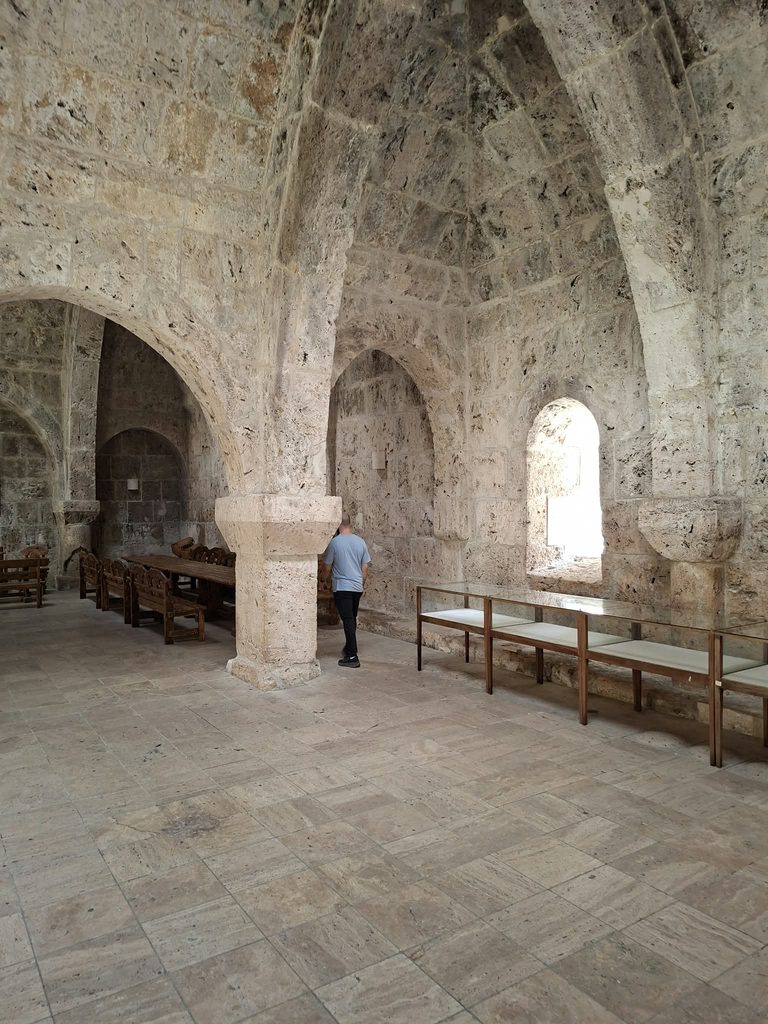
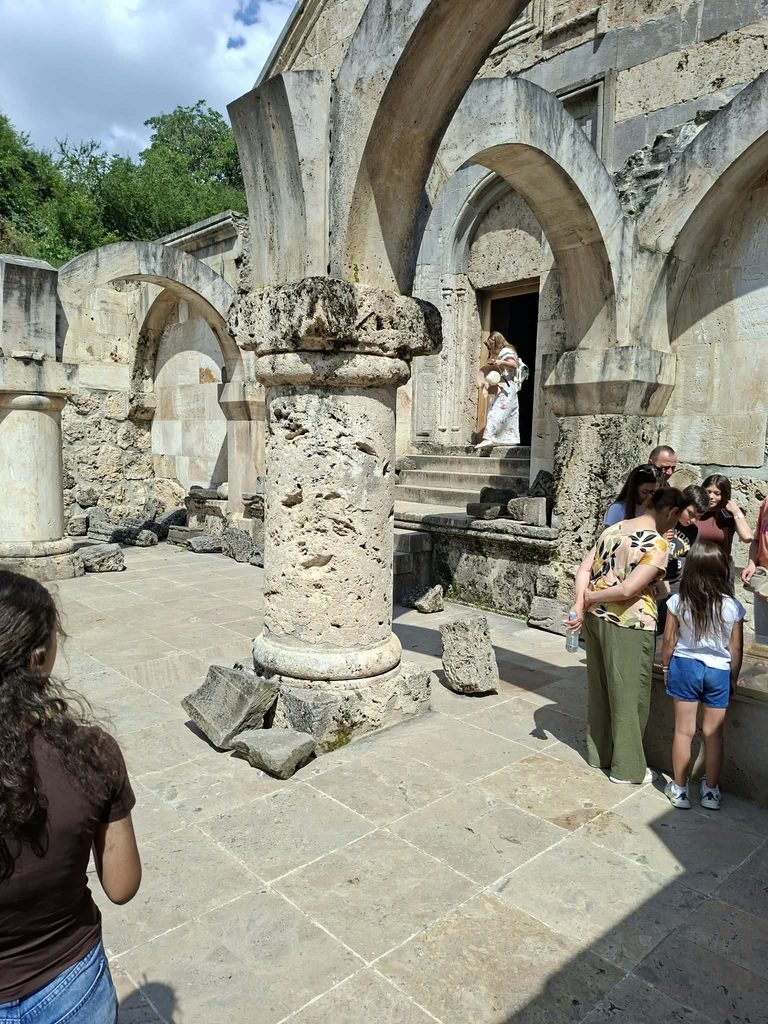
- The zhamatun (gavit) of Surb Grigor — 12th to early 13th century; in its corners are sculptures of monks with crosses, staffs, and birds.
- Surb Stepanos — a small church of 1244; on its wall is a relief of a lion (the Bagratid emblem) and a sundial.
- The refectory — built by the architect Minas in 1248.
- Surb Astvatsatsin — the largest church, 1281, with a sixteen-faced dome; on its east façade is a relief of two monks with a model of a church and a dove.
- A khachkar by the master Poghos (13th century) by the south door.
According to legend, one of the half-columns of the gavit is hollow: monastery treasures were hidden in it during invasions. In 2011 the monastery underwent a major restoration supported by the Armenia Fund and a donation from the ruler of Sharjah.
The Royal Burial Chapel
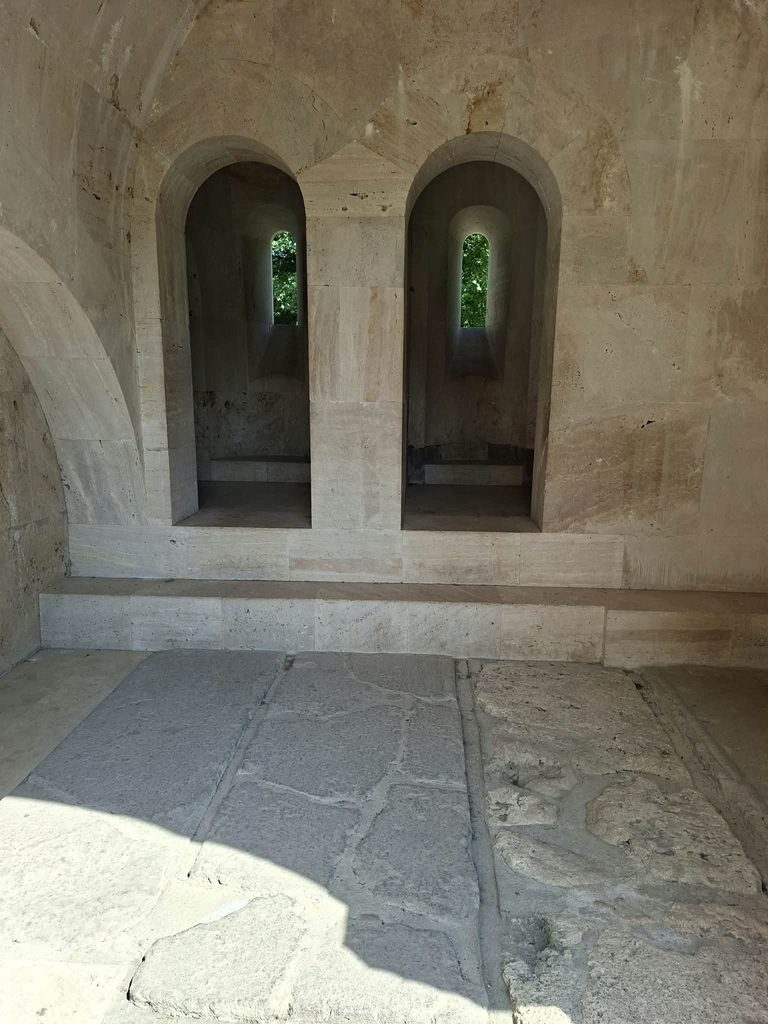
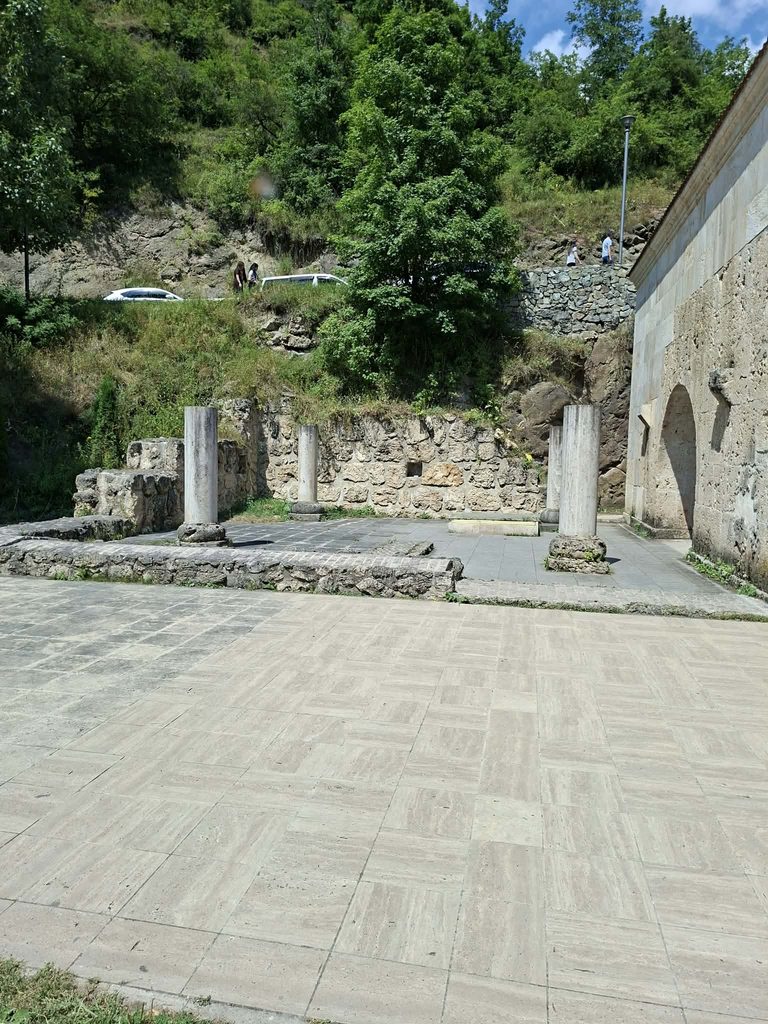
Next to the south wall of the gavit of the church of Surb Grigor stands the royal sepulchre. According to the description on Wikipedia:
- Between 1865 and 1895 the abbot tore down the walls of the sepulchre and used the stones for other buildings; the foundation survives.
- There were once three gravestones; two survive, with partly legible inscriptions.
- One reads “This is the grave of the kings G…”, the other “King Smbat”; in the 19th century Sargis Jalaliants read the first as “This is the grave of the kings Gagay and Gawgay.”
Who Is Buried There: The Competing Views
Precision matters here, so that the argument withstands scrutiny.
- The Kyurikids. The most widespread assumption is that kings of the Kyurikid dynasty, a branch of the Bagratids, are buried in the sepulchre.
- Smbat II and Gagik I. According to another view, the Bagratids Smbat II (977–990) and Gagik I (990–1020) are buried here. A modern sign at the site, as Travelers and Dreamers reports, names precisely them. However, the historian Stepanos Asoghik reports that Smbat was buried in Ani, so this version is disputed.
- Inconsistency in popular sources. Some tourist sites name the buried king as Smbat I (One Way Tour), others as Smbat II. For a serious publication it is better to cite scholarly works, including Manuk-Khaloyan’s study mentioned above.
Conclusion for the article: Haghartsin undeniably contains a royal burial chapel with gravestones whose inscriptions mention kings. The exact identification of those buried remains a subject of scholarly discussion. This is not a weakness of the argument but the normal state of the sources for an era nearly a thousand years ago.
How to Answer “Show Us the Tombs”
In brief, the answer has four points:
- Many tombs can be shown. Aghtsk (Arsacids), Sanahin and Haghartsin (Kyurikids), and Vahanavank (kings of Syunik) are in the present-day Republic of Armenia.
- Part lies in Western Armenia. The rock-cut tombs of Van, Horomos, Bagaran, and Ani-Kamakh are in Turkey; their condition and accessibility is a question of politics, not of the “absence” of monuments.
- Loss does not refute history. The Arsacid tombs were opened as early as the 4th century (according to Faustus of Byzantium); this does not negate the existence of the dynasty.
- The thesis is not an argument. The antiquity of a people and a state is established by the sum of written, epigraphic, and archaeological evidence, not by the presence of a “tourist” mausoleum.
Sources
- Arshakid Mausoleum — Wikipedia
- Haghartsin Monastery — Wikipedia
- Haghartsin — One Way Tour
- Haghartsin — Travelers and Dreamers
- Haghartsin — arak29.org
- Minasyan T., The Monastic School of Haghartsin — Banber Matenadarani
- Sanahin — UNESCO
- Sanahin — Courtauld Institute
- Horomos — Wikipedia
- Edda Vardanyan, Horomos — Heidelberg
- Bagaran — Wikipedia
- Manuk-Khaloyan, “In the Cemetery of their Ancestors” (REArm 35, 2013)
- Vahanavank — Armeniapedia
- Vahanavank — Armland
- Kapan Regional Museum — Mirror-Spectator
- Tushpa — World History Encyclopedia
- Tushpa/Van Fortress — UNESCO Tentative List
- Rock monuments of Van (Horhor) — Max Planck Research Library