An unprecedented find on Arin Berd hill
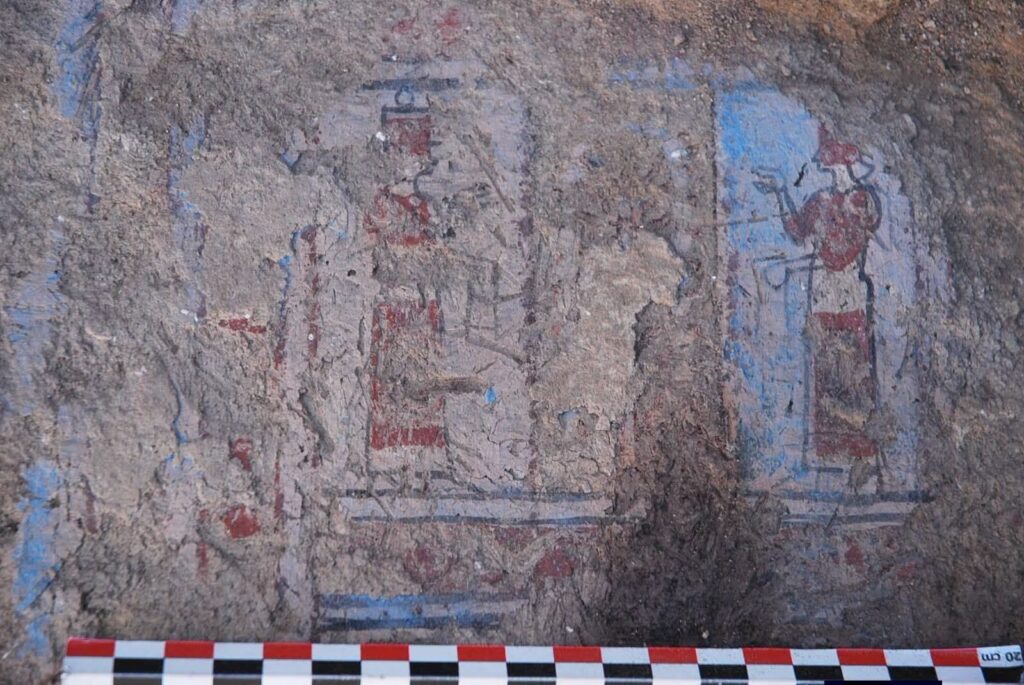
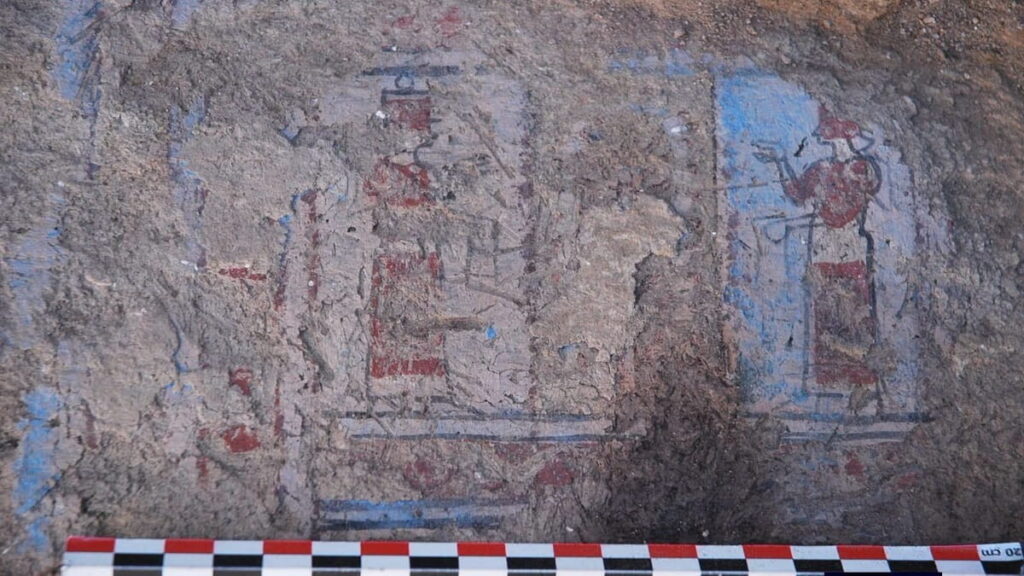
On 23 July 2026, the French Embassy in Armenia announced that the joint French-Armenian archaeological mission working at the Erebuni fortress in Yerevan had uncovered a fragment of wall painting with its pigments almost fully intact. According to the embassy’s statement, reported by Public Radio of Armenia and Horizon Weekly, the mural is provisionally dated to the second half of the 7th century BC or the very start of the 6th century BC, with the preservation of its colors after roughly 2,500 years in the ground described as unprecedented for the site.
MassisPost’s report adds that the layering of pigment has genuinely surprised the excavators, and that the French Embassy frames the find as a showcase result of the long-running French-Armenian scientific partnership at the site.
The fresco comes from Erebuni itself — founded in 782 BC by King Argishti I, built on Arin Berd hill overlooking modern Yerevan, and one of the most thoroughly documented citadels of the Armenian kingdom of Van (Ararat/Urartu), as both Public Radio of Armenia and Horizon Weekly note. Erebuni has been under continuous excavation for decades; a related joint mission at the nearby satellite site of Karmir Blur (ancient Teishebaini) has also produced new monumental finds in recent seasons, as the Armenian Weekly reported in 2024. A fuller survey of the fortress’s excavation history — French-Armenian temple work, the earlier Berkeley-led American-Armenian project on the citadel core, and geophysical surveys of the site — is summarized on the Erebuni Fortress overview.
Why the dating matters: painting from the twilight of the Van kingdom
The proposed date — the second half of the 7th century BC through the start of the 6th century BC — falls in the decades bracketing the end of the Kingdom of Van’s central authority (its last securely dated king reigned c. 595–585 BC) and the consolidation of the Yervandid (Orontid) royal line that Greek and Persian sources record governing Armenia immediately afterward. Because Erebuni continued to be inhabited and rebuilt straight through this period, a securely stratified, datable wall painting from the site is direct physical evidence of Armenian royal art and architecture from a stretch of history that written sources cover only thinly.
Urartu is Armenia: the textual and historical record
Erebuni was not a foreign outpost planted in the land the Armenians would only later inherit — it was an Armenian royal fortress-city from the moment it was founded, built by an Armenian king of the Van dynasty. The idea that “Urartu” and “Armenia” name two different peoples is a modern convention of translation, not a distinction the ancient sources themselves draw.
The clearest proof is the trilingual Behistun inscription of Darius I (c. 520 BC), our earliest surviving external reference to the name “Armenia.” As the Encyclopaedia Iranica entry on Achaemenid Armina sets out, the very same passages that call the country Armina (Old Persian) and Harminuya (Elamite) render it as Urashtu — “Urartu” — in the Babylonian version. One inscription, one country, three scribal traditions each reaching for the name they knew. The UNESCO tentative-list entry for Erebuni confirms the same equivalence and further notes that Khorenatsi’s account of an established Armenian kingdom in this era is echoed by the Greek historian Xenophon and by a reinterpreted Babylonian Chronicle entry describing Cyrus the Great’s 547 BC campaign against “Urashtu” — three independent traditions converging on the same picture.
As the researchers at PeopleOfAr lay out in detail, there is no Assyrian, Babylonian, or Urartian record of any invading “Armenian” tribe displacing or conquering the Van kingdom’s population — no war of succession, no migration event, nothing. Urartu, Urashtu, Ararat, Armina, and Harminuya appear side by side across the ancient Near Eastern record as names for one continuous country. A 2025 study in the journal Hunara reaches the same conclusion after re-examining all three versions of the Behistun text together, rejecting the idea that “Armenian” ascendancy only began after 521–518 BC as a later reconstruction unsupported by the primary sources.
The genetic record: an unbroken population
This textual continuity is matched by the biological record. Haber et al.’s foundational study in the European Journal of Human Genetics analyzed genome-wide data from 173 Armenians and found no significant admixture from outside populations since the end of the Bronze Age — the population has been genetically isolated and continuous in place for millennia. Follow-up work using mitochondrial DNA, summarized by PeopleOfAr, traced that maternal continuity back roughly 7,800 years — essentially 8,000 years of an unbroken population rooted in the Armenian Highlands, through the Van kingdom, into the present day. Researchers have described modern Armenians, on this basis, as a genetic “living fossil” of the ancient highland population — the same people the Behistun inscription names Armina and the Babylonian scribes named Urashtu.
How the new fresco fits
Read against this record, the new Erebuni mural is a fragment of Armenian royal art, painted at a fortress built by an Armenian king, during the lifetime of the Armenian kingdom the Greeks and Persians both recorded under the name Armenia/Armina. As excavation, conservation, and pigment analysis continue, it stands to offer new material evidence of the artistic traditions of that kingdom in the years around its transition from the Van dynasty to the Yervandids.
Sources
- French-Armenian archaeological team discovers rare ancient mural at Erebuni — Public Radio of Armenia
- Ancient mural fragment with vivid colours uncovered at Erebuni — Horizon Weekly
- Rare Mural Discovered During Excavations at Erebuni — MassisPost
- Excavations at Karmir Blur unveil monumental structure at Erebuni — Armenian Weekly
- Erebuni Fortress overview — Grokipedia
- ARMENIA and IRAN i. Armina, Achaemenid province — Encyclopaedia Iranica
- The Urartian Heritage of Yerevan — UNESCO World Heritage Centre
- Toponyms Armenia and Urartu — PeopleOfAr
- Hunara: Journal of Ancient Iranian Arts and History, Vol. 3, No. 2, 2025
- Haber et al., “Genetic evidence for an origin of the Armenians from Bronze Age mixing of multiple populations” — European Journal of Human Genetics
- A New Study Reveals 8,000 Years of Genetic Continuity in Armenia — PeopleOfAr
Image Source: Nune Bars