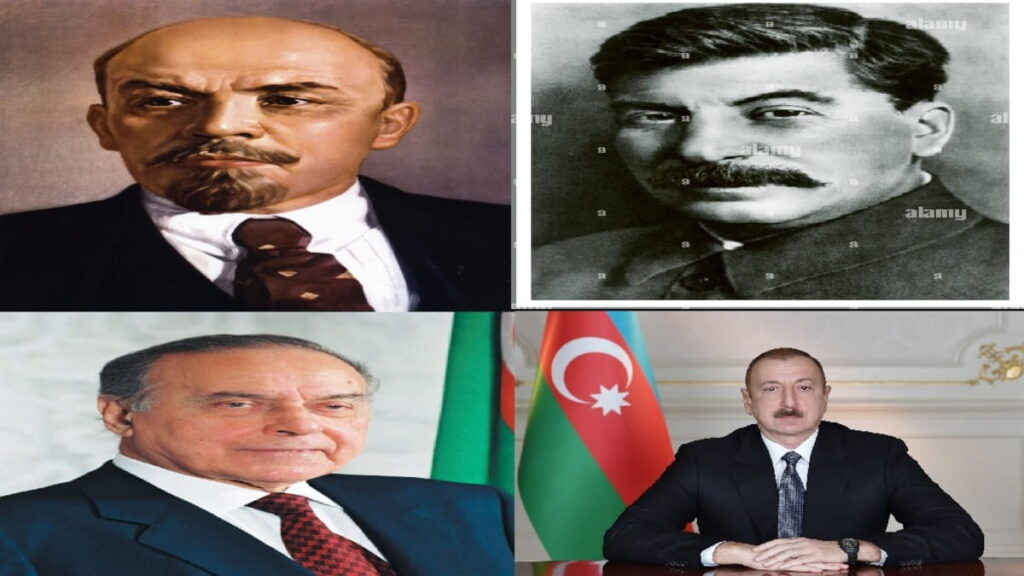
Lenin: Soviet nationalities policy, Azerbaijan SSR founded 1920, Stalin: Constitution and census fix the ethnonym “Azerbaijani”, Heydar Aliyev: Directed historians to build the “Albanianization” case, Ilham Aliyev: Djulfa demolition, “Western Azerbaijan” claims.
A note on scope: this article presents the case made by Armenian historians, Western Caucasus scholars, and international bodies who describe Azerbaijani state historiography as revisionist. Azerbaijani officials reject this characterization and describe Armenian claims to the contrary as politically motivated. Readers should treat this as one side of an active, unresolved political and historical dispute, and are encouraged to consult the primary academic sources linked throughout.
The Armenia–Azerbaijan conflict is fought not only over land but over the historical record itself. Over the past several decades, a substantial body of peer-reviewed scholarship — much of it from non-Armenian, non-Azerbaijani specialists — has documented a state-backed effort in Azerbaijan to reshape the history of the South Caucasus: minimizing or denying the historic Armenian presence in the region, reclassifying Armenian monuments as belonging to a different, non-Armenian civilization, and altering primary-source texts. This article walks through the documented pieces of that record.
1. A state, and a name, born in 1918
The name “Azerbaijan” itself is comparatively recent as applied to the territory of the modern republic. Historically, the term referred to a province of northwestern Iran, south of the Araks (also known as Aras) river; the region north of the Aras — the territory of today’s Republic of Azerbaijan — was historically known by other names, including Arran and Shirvan, while its Turkic-speaking inhabitants were generally recorded by Russian imperial authorities and outside observers as “Tatars,” not “Azerbaijanis” (Armeniapedia, citing standard historiography).
The name was first applied to this territory only when the Azerbaijan Democratic Republic (ADR) was proclaimed on 28 May 1918 by the Musavat party, following the collapse of the Transcaucasian Democratic Federative Republic. Historical encyclopedias and Caucasus historians confirm it was the first state in history to carry the name “Azerbaijan” (Eurasianet; Wikipedia, Azerbaijan Democratic Republic). The choice of name was itself a political and territorial statement, since it implicitly extended toward the Iranian province of the same name.
2. Building an ethnonym: from “Turk” to “Azerbaijani” (1936–1939)
Even after 1918, the Turkic-speaking titular population of Soviet Azerbaijan continued to be classified in official Soviet documents and censuses as “Türk” (Turkic/Turkish), not “Azerbaijani.” According to a peer-reviewed study in Iranian Studies, Soviet publications and official records referred to the titular nation of the Azerbaijan SSR as Tiurk in Russian until 1937 (Iranian Studies, Vol. 46 No. 4).
The shift to “Azerbaijani” as an ethnic (not merely political) designation coincided with Stalin’s 1936 Constitution and the Great Terror of 1937–38, a period in which, according to the same research, well over 100,000 Azerbaijani intellectuals were purged, many on charges of pan-Turkist sympathies (Baku Dialogues / ADA University biweekly). The 1939 Soviet census was the first to systematically register “Azerbaijani” as an ethnonym at scale; NKVD internal reports as late as 1939 still contained no such category (Noravank Foundation analysis; Wikipedia, Census in Azerbaijan). A 1992 editorial note appended to a reprint of the 1939 census explicitly states that many Turks in the USSR were registered as “Azerbaijani” that year as part of a policy of Azerbaijanization dating to 1926 (Baku Dialogues, “Azeri vs. Azerbaijani”).
This is not a fringe claim — it is documented in mainstream Western academic journals, including by scholars who are themselves sympathetic to Azerbaijani national identity formation as a normal 20th-century nation-building process rather than a conspiracy. The relevant point for this article is narrower: the ethnonym “Azerbaijani,” as an officially fixed designation for the region’s Turkic-speaking population, is a 20th-century Soviet-era construction, not an ancient continuity.
3. The “Caucasian Albania” theory and the “Albanianization” of Armenian heritage
The central pillar of Azerbaijani historical claims to Nagorno-Karabakh and other historically Armenian-populated areas is the theory that the region’s true, indigenous population was not Armenian but the ancient “Caucasian Albanians” — a distinct Caucasian people whose kingdom existed in antiquity — and that today’s Azerbaijanis, not Armenians, are their heirs. Critics call this project “Albanianization” or “Albanianizing theory.”
According to a 2023 academic handbook on Caucasian Albania published by De Gruyter, and reviewed in the journal of Yerevan State University’s political science faculty, this theory has been used systematically “to interconnect the historical trajectories” of Azerbaijan with the Armenian heritage of Nagorno-Karabakh in order to dispute Armenian claims to it (ResearchGate review of Caucasian Albania: An International Handbook).
The theory’s foundational text was Ziya Buniyatov’s 1965 book Azerbaijan in the 7th–9th Centuries, which reattributed Christian Armenian-language authors of medieval Caucasian Albania to an “Azerbaijani” cultural sphere. In 1985, Azerbaijani architectural historian Davud Akhundov presented these ideas at the All-Union Archaeological Congress in Baku, provoking a walkout threat from the Armenian delegation and condemnation from Leningrad scholars as pseudo-scientific. American archaeologist Philip L. Kohl, in his study Nationalism, Politics, and the Practice of Archaeology (Cambridge University Press), concluded the presentation was a deliberate political provocation designed to construct a knowingly false origin myth for the Armenian khachkars of Karabakh and Nakhichevan (Google Books excerpt via Wikipedia citation).
Central to this theory is the renaming of the khachkar — the carved Armenian Christian cross-stone, inscribed by UNESCO on its Representative List of Intangible Cultural Heritage — as “khachdash,” reframed as an Albanian artifact fused with pre-Christian Zoroastrian and Mithraic symbolism. Soviet-era Russian art historian Anatoly Yakobson directly rebutted this, noting that the supposed Mithraic imagery Akhundov identified on Julfa’s 16th–17th century khachkars was, to any specialist, unmistakably the standard Christian iconography of the Four Evangelists — lion, bull, eagle, and angel (summarized in Wikipedia, “Falsification of history in Azerbaijan,” §Caucasian Albania).
4. Altering the primary sources
Perhaps the most concrete, checkable category of evidence concerns direct alterations made to published editions of historical primary-source texts — manuscripts whose original versions still exist for comparison.
Abbas Qoli Aqa Bakikhanov’s Gulistan-i Iram. Bakikhanov, a 19th-century Muslim scholar from the territory of modern Azerbaijan (the country’s national History Institute is named for him), documented a substantial Armenian population in Transcaucasia. Iranica encyclopedia contributors Willem Floor and Hasan Javadi found that Ziya Buniyatov’s Russian translation of this text quietly deleted references to Armenian-inhabited territory without disclosure, concluding this “falsif[ied] history” and violated Bakikhanov’s own stated commitment to writing without ethnic or religious prejudice (cited in Wikipedia, sourced to The Heavenly Rose-Garden, Mage Publishers, 2009).
Mirza Jamal Javanshir’s Tarikh-e Qarabagh (“History of Karabakh”). Historian George Bournoutian of Iona College, an author for the Encyclopaedia Iranica, compared a 1989 Baku reprint against the original 19th-century manuscript and found systematic removal of the word “Armenian” in passages describing Karabakh’s Armenian districts and melik princedoms (Bournoutian, “Rewriting History,” archived via Library of Congress web archive).
Mirza Adigozal-Bek’s chronicle and other Karabakh sources. In his book Two Chronicles on the History of Karabagh (Mazda Academic Press, 2004), Bournoutian published annotated translations of two 19th-century Muslim historians of Karabakh, explicitly marking where he found material had been expunged from Soviet and post-Soviet Azerbaijani editions of the same texts, and concluded that without a certified facsimile of the original manuscript, such editions must be treated by scholars as unreliable.
Johann Schiltberger’s 15th-century travel account. Armenian source-critic P. Muradyan documented that Buniyatov’s edition altered a passage in which the medieval Bavarian traveler describes spending time “in Armenia,” subtly changing the geographic reference in translation.
Robert Hewsen’s warning to scholars. In his authoritative Armenia: A Historical Atlas (University of Chicago Press, 2001), the American historian Robert Hewsen included an explicit methodological warning that Soviet and post-Soviet Azerbaijani editions of Azeri, Persian, Russian, and Western European primary sources “have been edited to remove references to Armenians,” and advised researchers to seek out pre-Soviet editions wherever possible (cited in Wikipedia, sourced to Hewsen 2001, p. 291).
This pattern was not limited to one scholar. Soviet-Russian historian and anthropologist Victor Schnirelmann, in his study Wars of Memory: Myths, Identity and Politics in Transcaucasia (Academkniga, 2003), documents the same technique across dozens of reprinted primary sources: the systematic substitution of the phrase “Armenian state” with “Albanian state,” among other silent edits (Schnirelmann, full Russian text).
5. Erasing the physical evidence: the Djulfa cemetery
Textual revisionism was accompanied by the physical destruction of Armenian heritage sites. The best-documented case is the medieval Armenian cemetery of Old Djulfa (Jugha) in Azerbaijan’s Nakhchivan exclave, once home to an estimated several thousand khachkars dating to the 15th–17th centuries.
In December 2005, an Armenian bishop and film crew, filming from across the border in Iran, recorded more than 100 uniformed men using sledgehammers, cranes, and trucks to demolish the remaining monuments and dump the fragments into the Aras river (RFE/RL retrospective). The American Association for the Advancement of Science’s Geospatial Technologies and Human Rights Project subsequently compared high-resolution satellite images from September 2003 and May 2009 of the same site, finding the terrain transformed from a field dense with standing monuments to a flattened, bulldozed surface, consistent with the destruction reports (AAAS case study; AAAS press release). The International Council on Monuments and Sites (ICOMOS) documented the phased destruction in 2003 and 2006–07 reports, and a European Parliament delegation seeking to investigate on site in 2006 was refused entry by Azerbaijani authorities, as was the U.S. Ambassador to Azerbaijan in 2011.
Azerbaijan’s government has consistently denied the events occurred. President Ilham Aliyev has publicly called the reports “absolutely false and slanderous,” attributing them to what he termed the “Armenian lobby” (Armenian Weekly, citing Aliyev’s public statement); an Azerbaijani parliamentarian stated in a 2008 government news agency interview that no Armenian graves had ever existed in Nakhchivan territory. Caucasus Heritage Watch, a satellite-monitoring project run out of Cornell and Purdue universities, has continued similar documentation of sites in Nagorno-Karabakh since the 2020 war (CHW Special Report #1).
6. Territorial narratives: “Western Azerbaijan”
Since roughly 2010, President Aliyev has periodically referred to Yerevan (using the term “Irevan”), Lake Sevan (“Göyçə”), and Armenia’s Syunik province (“Zangazur”) as historically Azerbaijani lands. This has developed into an organized irredentist framework known as “Western Azerbaijan,” which characterizes the entire territory of the modern Republic of Armenia as land from which Azerbaijanis were displaced and to which they have a right of return (Wikipedia, “Falsification of history in Azerbaijan,” §Territorial Claims). In December 2022, Azerbaijan launched a “Great Return” campaign built on this premise.
International analysts have characterized this framework as ahistorical. Stefan Meister of the German Council on Foreign Relations described it as part of “a maximalist approach” that will not stop expanding absent external constraints, in comments to the watchdog group Genocide Watch, which itself labeled the concept “ahistorical” and “expansionist” (Genocide Watch statement).
7. International and scholarly recognition of the pattern
This is not solely an Armenian grievance. Several international bodies and independent scholars have formally characterized Azerbaijani state historiography and heritage policy as revisionist or worse:
- The European Parliament adopted a resolution in March 2022 specifically addressing the destruction of Armenian cultural heritage in Nagorno-Karabakh (full text).
- Alexandra Xanthaki, the UN Special Rapporteur in the field of cultural rights, expressed concern over what she called an “ongoing pattern of destruction and appropriation” of Armenian sites and an “organised reinterpretation of the history of Nagorno-Karabakh,” warning this combination could amount to cultural cleansing.
- The International Association of Genocide Scholars issued a 2022 statement describing the rewriting of history and cultural destruction together as classic hallmarks of genocide (full statement, PDF).
- The French sociologist and Caucasus scholar Claude Mutafian, in the 2023 Brill volume Monuments and Identities in the Caucasus, summarized Azerbaijani state argumentation as resting on two disputed claims — indigenous Azerbaijani continuity and Armenian “newcomer” status — that he says are contradicted by the documentary record when examined directly.
A note on the other side of this dispute
It is important for readers to understand that Azerbaijan’s government and many Azerbaijani historians reject all of the above characterizations. Baku’s official position holds that Caucasian Albania, not historic Armenia, is the legitimate ancestral civilization of the region north of the Aras; that Armenian settlement in Karabakh and the wider South Caucasus significantly postdates 1828, following Russian-organized resettlement after the Russo-Persian wars; and that claims of systematic falsification and heritage destruction are themselves a politically motivated fabrication by the “Armenian lobby.” Readers researching this topic should weigh both the extensive documentary record cited above and Azerbaijan’s own published historical and archaeological literature, and should be aware that this remains a live, unresolved dispute between two states embroiled in an active territorial conflict — not a matter of settled international consensus in the way, for instance, the Armenian Genocide of 1915 is recognized by most historians.
Selected sources for further reading
- “Falsification of history in Azerbaijan” — Wikipedia (extensively sourced overview with links to underlying scholarship)
- Azerbaijan Democratic Republic — Wikipedia
- AAAS: Satellite imagery of Djulfa cemetery destruction
- George Bournoutian, “Rewriting History: Recent Azeri Alterations of Primary Sources Dealing with Karabakh”
- Iranian Studies: “The Soviet Union and the Construction of Azerbaijani National Identity in the 1930s”
- Caucasus Heritage Watch — satellite monitoring reports
- European Parliament resolution on cultural heritage destruction in Nagorno-Karabakh (2022)