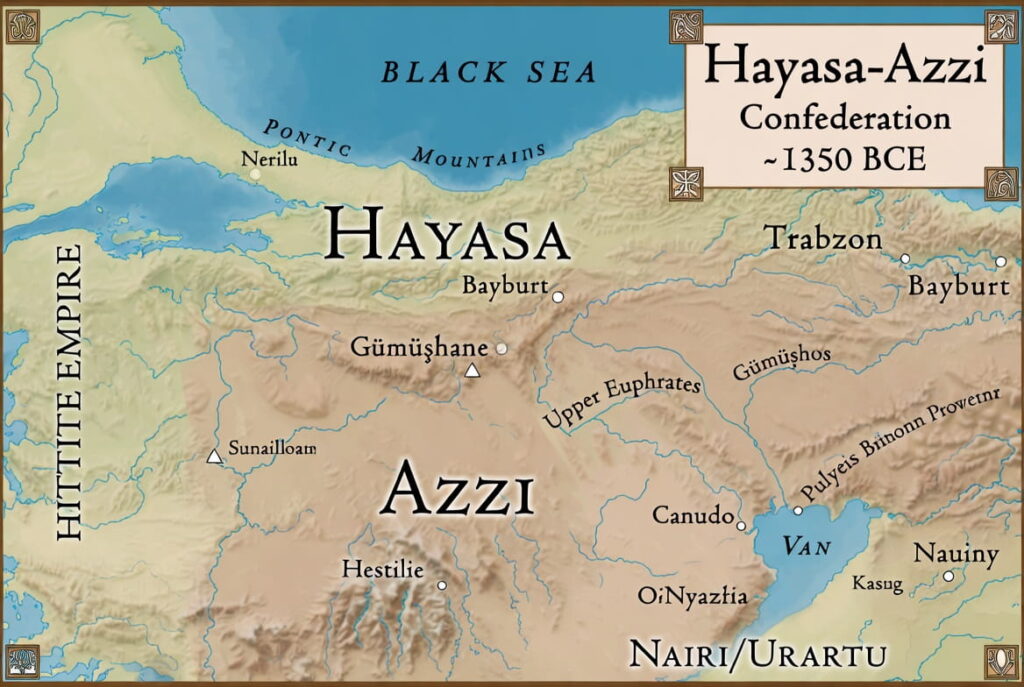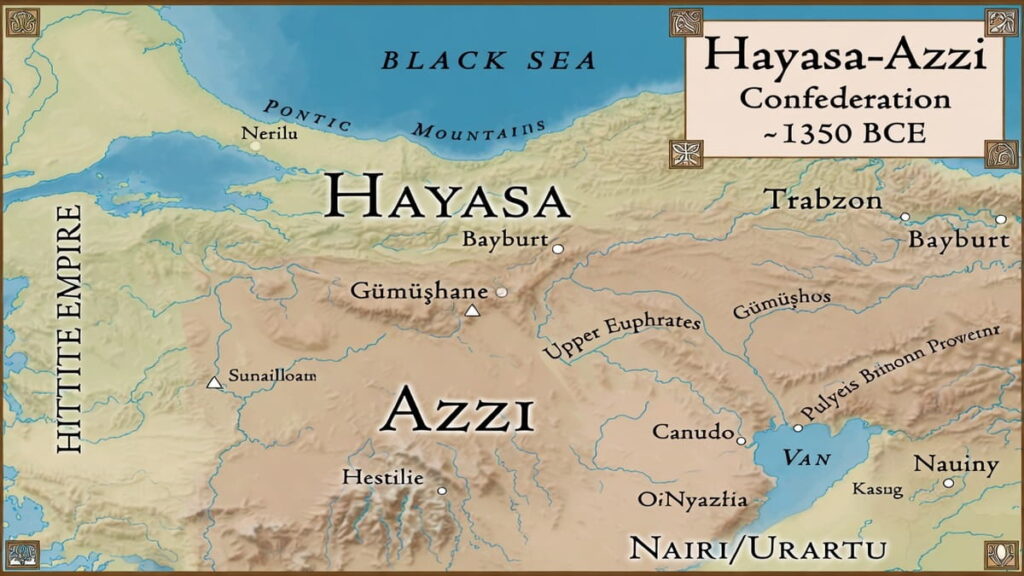
Among the earliest known states of the Armenian Highlands, few are as historically important as Hayasa-Azzi — an ancient political and military confederation mentioned in Hittite cuneiform archives during the 2nd millennium BCE. Located in the upper basins of the Euphrates and Chorokh rivers, northwest of Lake Van, Hayasa occupied territories that formed part of the historic Armenian Highlands.
Many historians and linguists have pointed to striking linguistic and historical continuity between the name “Hayasa” and the Armenian self-designation “Hay” (Հայ), from which the modern Armenian name for Armenia — “Hayastan” (Հայաստան) — derives.
Discovery of Hayasa in the Hittite Archives
Knowledge of Hayasa-Azzi comes primarily from thousands of cuneiform tablets discovered in the ruins of Hattusa, the capital of the Hittite Empire, near modern Boğazköy in central Turkey.
The excavations were conducted by German orientalist Hugo Winckler beginning in 1906. The tablets contained royal annals, diplomatic correspondence, treaties, and military reports of the Hittite kingdom.
According to Encyclopaedia Britannica – Bedřich Hrozný, these discoveries transformed the study of the ancient Near East.
Decipherment of the Hittite Language
At first, scholars could read the cuneiform signs but could not understand the language itself. This changed thanks to Czech linguist Bedřich Hrozný.
In 1915, Hrozný demonstrated that Hittite belonged to the Indo-European language family. His work allowed historians to read the royal archives of Hattusa and uncover references to neighboring kingdoms, including Hayasa-Azzi.
Britannica – Hittite language decipherment explains how Hrozný’s breakthrough opened “a major path to the ancient history of the Near East.”
Hayasa in the Armenian Highlands
Most scholars place Hayasa-Azzi within the Armenian Highlands, particularly around the upper Euphrates basin and the regions surrounding modern Erzincan and Kemah.
World History Encyclopedia – Hayasa-Azzi identifies Hayasa as a confederation located in the Armenian Highlands during the Late Bronze Age.
The capital of Hayasa is generally identified as Kummaha (later Kemah), near modern Erzincan. Hittite records describe Hayasa as a strong and organized political power capable of resisting repeated Hittite invasions.
Unlike modern politically motivated terminology such as “Eastern Anatolia,” ancient sources consistently place Hayasa within the historical Armenian Highlands — the mountainous plateau long associated with Armenian civilization in classical and medieval geography.
The term “Anatolia” itself derives from the Greek word Anatolē, meaning “east” or “sunrise.” Therefore, the expression “Eastern Anatolia” literally means “Eastern East,” a modern geopolitical term introduced centuries after the ancient civilizations of the Armenian Highlands had already existed.
Wars Between Hayasa and the Hittite Empire
The Hittite annals describe numerous wars between Hayasa and the Hittite kingdom during the 14th–13th centuries BCE.
Several Hayasian rulers are mentioned in Hittite texts, including:
- Mariya,
- Karanni,
- Hukkana,
- Anniya (Anania).
According to surviving Hittite sources, Hayasian forces repeatedly:
- invaded Hittite frontier territories,
- burned military settlements,
- resisted Hittite campaigns,
- and occasionally forced Hittite armies into retreat.
World History Encyclopedia – Hayasa military conflicts notes that Hayasa-Azzi became one of the principal rivals of the Hittite Empire in the Armenian Highlands.
One of the most important documents is the treaty between the Hittite king Suppiluliuma I and the Hayasian ruler Hukkana. The treaty established military obligations, dynastic marriage arrangements, and mutual recognition, demonstrating that Hayasa was treated as a major regional state.
The Connection Between “Hayasa” and “Hay”
One of the most significant aspects of Hayasa for Armenian history is the possible connection between the word “Hayasa” and the Armenian self-designation “Hay.”
This theory was first proposed by Swiss Assyriologist Emil Forrer and later developed by German philologist Paul Kretschmer.
In his 1933 study Der nationale Name der Armenier Haik, Kretschmer argued that the Hittite name “Hayasa” likely meant “land of the Hay people.”
Later, prominent Armenian scholars such as:
- Nikolay Adonts,
- Grigor Kapantsyan,
- Rafael Ishkhanyan,
supported the connection between Hayasa and Armenian ethnogenesis.
Armenian linguist Gevorg Jahukyan argued that the Armenian element likely played a dominant role within the Hayasian confederation.
The Armenian name for Armenia — “Hayastan” — still preserves the root “Hay” today.
Armenian Continuity in the Armenian Highlands
After the collapse of the Kingdom of Van (Urartu) in the 6th century BCE, the region appears in Persian inscriptions as Armenia (Armina), while Armenians themselves continued using the self-designation “Hay.”
Many scholars see this as evidence of long-term continuity of the Armenian population in the Armenian Highlands.
The influential Indo-European studies of Tamaz Gamkrelidze and Vyacheslav Ivanov placed the Proto-Indo-European homeland near the Armenian Highlands.
Their work challenged earlier migration theories suggesting Armenians arrived late from Europe.
Encyclopaedia Britannica – Armenian language recognizes Armenian as an independent branch of the Indo-European language family with deep historical roots in the region.
Political Attempts to Disconnect Armenians from Hayasa
In modern historiography, debates surrounding Hayasa often extend beyond purely academic questions.
Contemporary Armenian historian Armen Ayvazyan argues that attempts to disconnect Armenians from ancient states such as Hayasa and Urartu frequently carry political motives aimed at weakening Armenian indigenous claims in the Armenian Highlands.
At the same time, even scholars who remain cautious about definitive conclusions generally acknowledge several key facts:
- Hayasa-Azzi undeniably existed,
- it was located in the Armenian Highlands,
- it fought extensive wars with the Hittites,
- and its name bears a remarkable resemblance to the Armenian endonym “Hay.”
Conclusion
Hayasa-Azzi remains one of the most important ancient states associated with the Armenian Highlands. Through the decipherment of Hittite archives, historians uncovered evidence of a powerful kingdom that existed centuries before Urartu and occupied territories historically connected with Armenian civilization.
The linguistic similarity between “Hayasa” and “Hay,” the continuity of Armenian presence in the region, and the preservation of the name “Hayastan” through millennia continue to make Hayasa central to discussions about Armenian origins and identity.
Although scholarly debates continue regarding every aspect of Bronze Age ethnography, the historical existence of Hayasa in the Armenian Highlands is firmly established by Hittite sources, and its connection to Armenian identity remains one of the most compelling subjects in the ancient history of Armenia.
Based on the status: Levan Tonaganyan in the group Հայաստան Armenia Armenia