A Coalition Beneath the Mountain
Among the oracles of judgment collected in the Book of Jeremiah, one verse names a highland kingdom that modern readers instantly recognize by its mountain’s silhouette:
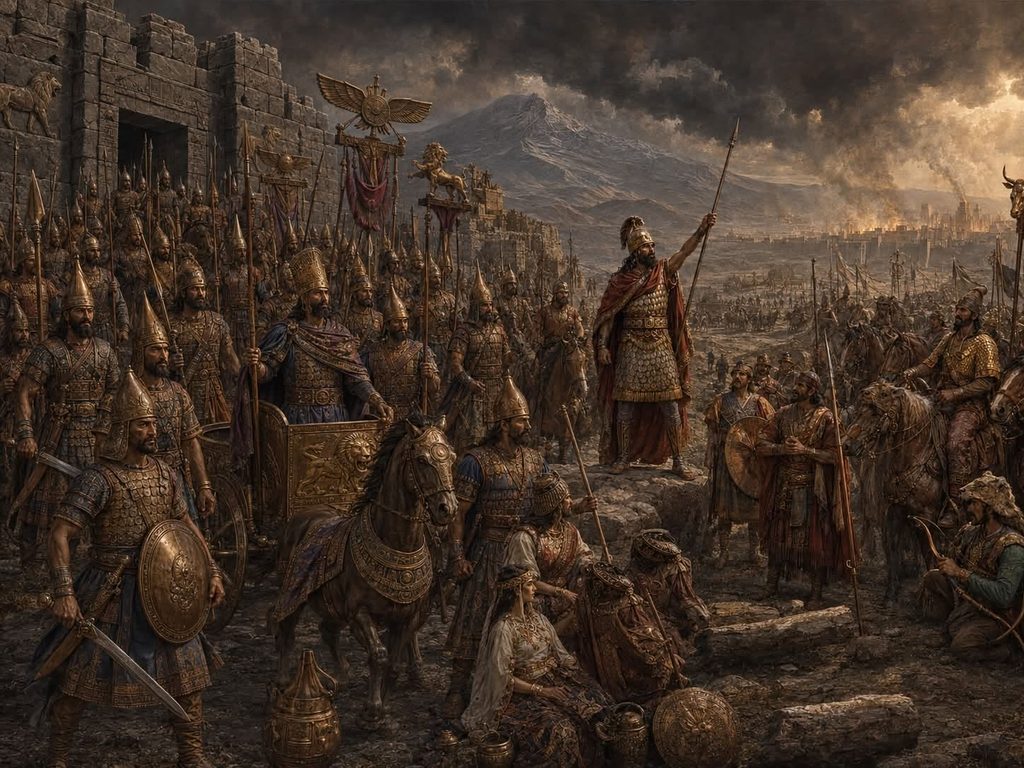
“Lift up a banner in the land! Blow the trumpet among the nations! Prepare the nations for battle against her; summon against her these kingdoms: Ararat, Minni and Ashkenaz. Appoint a commander against her; send up horses like a swarm of locusts.” — Jeremiah 51:27 (NIV; parallel translations)
The chapter is part of a long poetic oracle (Jeremiah 50–51) announcing the destruction of Babylon, and verse 27 is a call to arms: three named kingdoms of the north are summoned as instruments of that destruction, with the Medes explicitly identified as the driving power one verse later — “Prepare against her the nations, the kings of the Medes, their governors and all their prefects” (Jeremiah 51:28; see the BibleHub context reading).
Three names, three kingdoms of the Iron Age highlands: Ararat, Minni, and Ashkenaz. All three have a documented historical identity outside the biblical text, and all three converge, geographically and politically, on the mountainous arc running from Lake Van and the Ararat plain to Lake Urmia — the historical Armenian Highland.
Ararat: The Hebrew Name for Urartu
The identification of biblical “Ararat” with the Iron Age kingdom the Assyrians and Babylonians called Urartu is not a modern or apologetic guess — it is a philological equation established already in nineteenth-century Assyriology and repeated in every standard reference work since. As the Assyriologist A. H. Sayce put it in his account of “The Kingdom of Van,” commissioned for the Cambridge Ancient History: the Vannic kingdom “was known as Urartu to the Assyrians and Babylonians, Ararat in Hebrew” (Sayce, “The Kingdom of Van (Urartu)”).
The consonantal skeleton is identical: Akkadian ú-ra-ar-ṭu and Hebrew ʾărārāṭ are the same word transmitted through two different scribal traditions. The Eerdmans-affiliated reference summary states it plainly: “The Babylonian name was Urartu, the consonants being the same in both words,” adding that the King James Version’s rendering of the cognate references in 2 Kings 19:37 and Isaiah 37:38 as “Armenia” “correctly represents the region designated” (BiblicalTraining, “Ararat”). The Oxford History of the Ancient Near East volume on the Assyrian age opens its chapter on the kingdom bluntly: “The kingdom of Urartu (biblical Ararat) is known as Biainili in the local cuneiform sources” (Oxford Academic, The Kingdom of Urartu).
This kingdom — centered on Tushpa (Van) after Sarduri I moved the capital there in the ninth century BC (Wikipedia, Sarduri I) — controlled the Armenian Highland from the Araxes basin around Yerevan and Lake Sevan to the upper Euphrates and the shores of Lake Urmia, precisely the territory later Greek and Roman writers, and the Old Persian inscription of Darius I at Behistun, would call Armenia. The Achaemenid trilingual inscription itself equates the two names directly: where the Old Persian text reads “Armina,” the accompanying Babylonian version of the same passage reads “Urashtu” (Urartu) — the same land under its Iranian and its Mesopotamian name, carved in stone by the same royal hand a generation after Jeremiah’s oracle was written down.
Two of the earliest ascents of the mountain that still bears this name were themselves framed as returning to the site of the prophecy: the summit of Mount Ararat was first climbed in 1829 by the German naturalist Friedrich Parrot, traveling with the Armenian scholar-monk Khachatur Abovian, as noted in the standard reference entries on the mountain’s identification with the biblical land (Insight on the Scriptures, “Ararat”).
Minni: The Mannaean Kingdom South of Lake Urmia
“Minni” is likewise not an obscure or invented name. It corresponds to Mannaea (Neo-Assyrian Mannāyu), a kingdom that flourished from roughly the tenth to the seventh century BC on the southern and southeastern shores of Lake Urmia, immediately adjacent to Urartu’s eastern frontier. The Encyclopaedia Iranica entry on Mannea notes explicitly that the name is the “Old Testament Minni” (Encyclopaedia Iranica, “Mannea”), and the identification is treated as settled in the broader reference literature: “Together with Ararat and Ashkenaz, this is probably the same Minni from the Assyrian inscriptions, corresponding to Mannea” (Wikipedia, “Mannaea”).
Mannaea sat at the crossroads of three empires — Assyria to the west, Urartu to the north, Media to the east — and its rulers, insofar as their names and titles survive in Assyrian and Urartian texts, appear linguistically close to Urartian and Hurrian (Britannica, “Mannai”; Iranian Tours, “Mannaeans”). Older Jewish sources went further, folding Minni directly into Armenia: the Jewish Encyclopedia (1906) recorded that “according to the Peshitta and Targum Onkelos, the ‘Minni’ of the Bible (Jer. 51:27) is Armenia — or rather a part of that country, as Ararat is also mentioned… as a part of Armenia,” a reading echoed in the possible etymology of the very word “Armenia” as ḪAR-Minni, “the mountains of Minni” (Wikipedia, “Mannaea,” citing the Jewish Encyclopedia).
Ashkenaz: The Iron Age Scythians of the Highland Frontier
The third name, Ashkenaz, has the most eventful later history — it became the medieval Hebrew name for Germany and, by extension, for Ashkenazi Jewry — but its Iron Age referent is well established in modern scholarship. Ashkenaz is almost universally derived by philologists from the Akkadian Aškuzai / Iškuzai, the Assyrian name for the Scythians, the Iranian-speaking horse nomads the Greeks called Skythai (Language Log, “Ashkenazi and Scythians”; CBE International, “The Scythians”; Onomastikon, “Iškuza”).
This is not incidental to the geography of the other two kingdoms. Assyrian records place the Scythian confederation, under chieftains such as Bartatua, operating precisely in the borderlands north and west of Mannaea and Urartu in the seventh century BC — the same “Armenian area of the Upper Euphrates” from which they are recorded expelling the Cimmerians (Language Log, citing Ivantchik’s Les Cimmériens au Proche-Orient). The Encyclopaedia Iranica article on Mannea independently confirms the same neighborhood: “The neighbors of Greater Mannea in the north and northwest were the Urartians and the Scythians” (Encyclopaedia Iranica, “Mannea”).
Read together, all three kingdoms summoned by the prophet occupy one contiguous belt of highland and steppe-frontier territory: Ararat/Urartu on the Van–Ararat–Sevan axis, Minni/Mannaea just to its southeast around Lake Urmia, and Ashkenaz/Scythia operating across their shared northern marches. Jeremiah is not listing three unrelated, far-flung peoples — he is naming the powers of a single interconnected highland zone north of Assyria and Babylonia.
The Historical Destruction of Babylon, 539 BC
Jeremiah 51:28 names the driving force behind the summons explicitly: “the kings of the Medes.” This matches the historical record with unusual precision. Babylon fell not to a coalition storming its walls in pitched battle but through a swift, largely bloodless collapse in October 539 BC, when the combined Medo-Persian forces under Cyrus the Great — after defeating the Babylonian army at Opis and receiving the surrender of Sippar — entered the city under the general Ugbaru (Gobryas). The principal contemporary source, the Nabonidus Chronicle, records the event in its characteristically terse style: “On the sixteenth day, Ugbaru, governor of Gutium, and the army of Cyrus entered Babylon without battle” (Updated American Standard Version, “The Nabonidus Chronicle”; see also the overview at World History Edu and Ancient Origins). The same episode underlies the biblical narrative of Belshazzar’s fall in Daniel 5.
The Medo-Persian army that carried out this conquest was itself a composite force drawing on the peoples of the former Median sphere — precisely the northern “kingdoms” Jeremiah’s oracle addresses. Modern commentators wrestling with the verse’s chronology note that Urartu and Mannaea had, by the late seventh century, already been absorbed into the expanding Median orbit, which is exactly how their forces came to march under Median—and ultimately Cyrus’s—command against Babylon a half-century later: “What God is saying in this passage, through Jeremiah, is that the ‘barbarians’ from the North will be involved in destroying the Babylonian Empire. In this case, it was the Persians and the Medes who led the armies” (Evidence for Christianity, on Jeremiah 51:27).
Ararat/Urartu as a Named Political Actor on the Assyro-Babylonian Stage
It is worth stressing what the inclusion of Ararat/Urartu in this verse actually reflects: by the time Jeremiah’s oracle was composed, the Kingdom of Van was not a legendary or peripheral name to Near Eastern scribes — it was a recurring, named rival power in the royal annals of Assyria for over two centuries. Shalmaneser III’s Monolith Inscription records a campaign against “Sugunia, the stronghold of Aram of the land of Ararat” as early as the ninth century BC (Wikipedia, “Sugunia,” citing the Monolith Inscription), and Urartu appears under kings Ishpuini, Menua, Argishti, and Sarduri in a continuous royal line through the eighth and seventh centuries (Wikipedia, “List of kings of Urartu”). Assyrian scribes had been calling the mountain kingdom north of them “Urartu” for four hundred years before Jeremiah’s generation; the prophet’s audience did not need it explained.
Reading the Verse in Its Iron Age Setting
Placed side by side, the philological and historical record converges on a single reading of Jeremiah 51:27:
- Ararat = Urartu, the kingdom of Van, centered on the Armenian Highland between Lake Van, the Araxes valley, and Mount Ararat itself.
- Minni = Mannaea, the kingdom immediately southeast of Urartu around Lake Urmia.
- Ashkenaz = the Scythians (Assyrian Iškuza), operating across the northern frontier shared by both.
- The summoning power = the Medes (v. 28), whose later fusion with Persia under Cyrus produced the army that took Babylon on 16 Tishri, 539 BC, as recorded independently in the Nabonidus Chronicle.
The oracle, in other words, calls on the assembled highland world of what would become historical Armenia — its mountain kingdom, its eastern neighbor, and the steppe warriors of its frontier — to serve as the instrument by which Babylon’s six-century imperial run in Mesopotamia was finally brought to an end.
Related Reading
- Behistun trilingual inscription and the “Armina”/”Urashtu” toponymic equation
- The Kingdom of Van (Urartu): kings, capital, and territorial extent
- Urartian religion and the cult of Ḫaldi
- The rise of the Medo-Persian Empire and the policy of Cyrus toward subject peoples
Image Source: Նարեկ Գասպարյան