If you have ever climbed the Cascade in Yerevan and looked up at the tall, tapering stele crowned with stone “wings” at the very top of the complex, you have already met one of the oldest architectural ideas the Armenian Highland ever produced. Most guidebooks will tell you it is a Soviet-era obelisk — and it is. But the shape itself, the tower rising from a square base toward a sharpened point, is not a Soviet invention at all. It is a direct descendant of a building type the Armenians of the Kingdom of Van were already raising to their gods more than 2,700 years ago: the susi, or as it is more comfortably transliterated into Armenian, shushi.
What “Susi” Actually Meant
In the cuneiform inscriptions of the Kingdom of Van — the state modern historiography usually calls Urartu, though its rulers, script, and territory belong to the same unbroken Armenian historical continuum as everything that came after it — the word susi appears again and again next to the verb “to build.” Kings from Minua onward boast of erecting a susi for the great god Khaldi, alongside palaces, gates, and irrigation canals. For a long time scholars were unsure what the word meant: a sanctuary, a tent-shrine, a cult enclosure. The philologist Mirjo Salvini eventually anchored the debate in a bilingual Assyrian-Urartian inscription from Kevenli, where the Assyrian term standing in for susi is isītu — “tower” or “pile.” That reading fits the archaeological evidence almost too neatly: wherever a susi has been excavated — at Upper Anzaf, at Ayanis, at Kef Kalesi, at Körzüt — it takes the form of a small, almost obsessively standardized square structure, close to five meters on each side, built as a solid or near-solid tower rather than an assembly hall. It was not a building people gathered inside. It was a raised, sealed shrine — a stone reliquary reaching upward, meant to be seen and approached, not entered by crowds. Later research folds the susi into the broader family of Near Eastern “tower temples,” structures whose entire theological purpose was verticality itself: a built axis connecting the citadel below to the god above. Read more on the susi as tower-temple →
This is why Armenians who grew up near the Erebuni hill in Yerevan will sometimes tell you, half as folklore and half as etymology, that shushi simply means “a chamber, a cell, a small one-room sacred tower.” The claim tracks closely with what the cuneiform record actually shows: a square-plan, single-cell shrine dedicated overwhelmingly to Khaldi, the supreme god of the Kingdom of Van, distinguished from ordinary temples precisely by its tower form and its jealously guarded, restricted interior.
The Susi of Erebuni
Every Yerevan resident has walked past a susi without necessarily knowing it. On the Arin Berd hill in the city’s south-east, inside the fortress of Erebuni — founded in 782 BC by King Argishti I, an event commemorated by the very cuneiform inscription now called “the birth certificate of Yerevan” — archaeologists uncovered not one but two temple complexes. The larger one, built around a hall with a wooden parquet-like floor and painted blue walls, was the temple of Khaldi. Immediately beside it, opening off the same peristyle courtyard used by Argishti I and his retinue, stood a small, compact, tower-like structure that excavators labeled the Susi temple. Erebuni Fortress overview →
Here the specialist and the mainstream accounts diverge a little, and it is worth being honest about that fork. Most museum texts today describe the Erebuni Susi as dedicated to a minor, non-Urartian deity — variously transliterated as Iuarsha, Ivrash, or Iushba — a god borrowed from the Hurro-Luwian population that the Kingdom of Van absorbed as it expanded across the Ararat plain, and built here, some argue, as a gesture of religious accommodation toward that population. Other researchers push back on this reading, pointing out that across the kingdom as a whole the susi form is used almost exclusively for Khaldi’s own cult, and that a small “national” cella tucked next to the ruler’s own reception hall fits more naturally with a royal, Khaldi-centered rite performed by the king in person than with a concession to a subject population’s household god. Whichever reading one favors, the architectural fact is not in dispute: Erebuni preserved, better than almost any other Urartian site, the compact tower-shrine type that the sources call susi — one of the reasons its facade is singled out among the best-preserved elements of the whole fortress. Erebuni Museum details →
A Tower on Every Royal Bowl
The clearest proof that the susi mattered — that it was not just one shrine type among many but a genuine emblem of Van-Armenian kingship — comes from an unexpected place: drinking bowls.
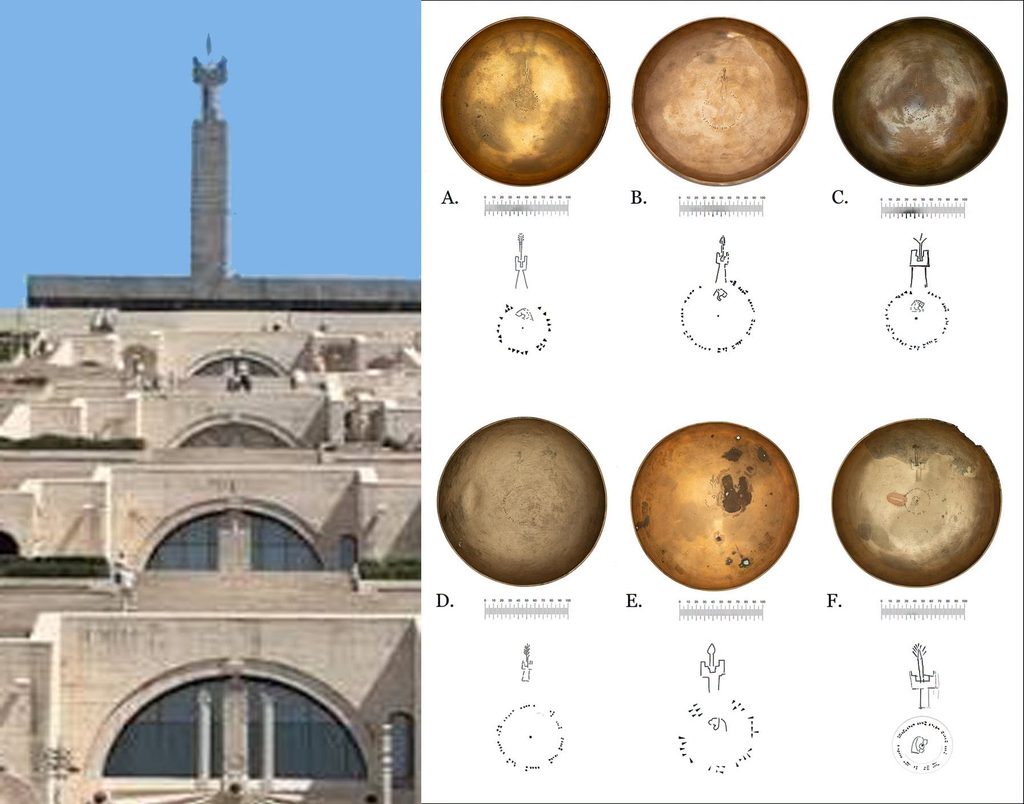
At the fortress of Karmir Blur (Teishebaini), just across the Hrazdan gorge from Erebuni, Soviet archaeologists led by Boris Piotrovsky recovered dozens of bronze bowls stacked inside storage jars in a single room, later joined by more found in follow-up excavations — over a hundred vessels in total, each stamped in its center with a short cuneiform inscription naming the reigning king. A 2026 study in the journal Antiquity traced how the decoration on these royal bowls evolved over roughly two centuries. Under Minua, the inscriptions stood alone. Under his son Argishti I, engravers began framing the royal name with a small pictorial device — first a stylized square with a bird’s head, then, as the design “crystallized” under later kings named Sarduri and Rusa, a fixed pair of symbols: a tower topped by a spear, set opposite a roaring lion’s head. Researchers reading these bowls today interpret that tower-and-spear device as nothing other than a shorthand image of the susi itself — the tower-shrine rendered as a compact royal seal, stamped onto an object a king might have raised at his own table. The team behind the 2026 study is explicit about this reading: the design that stabilizes on the later royal bowls shows a tower crowned with a spear — understood by most specialists as a depiction of the susi temple — paired with the roaring lion’s head, and both became fixed emblems of Van-Armenian royal iconography. Read the full study on Cambridge Core → · Plain-language summary →
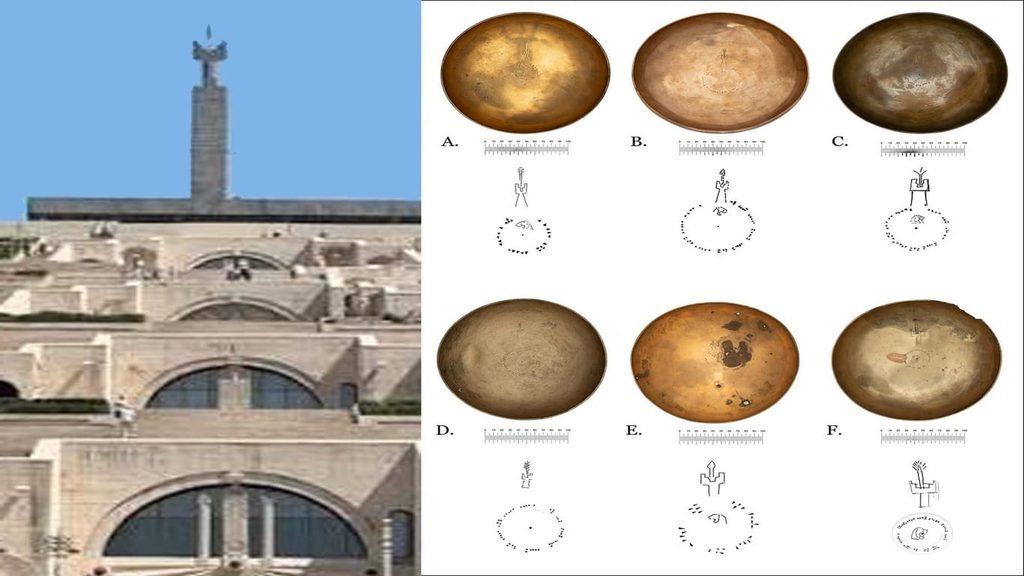
Set the six bowls side by side, as the study’s illustrations do, and the pattern is unmistakable: a narrow, stepped tower rising from a rectangular plinth, sometimes flanked by faint circling marks that read as a ring of votive or ritual figures around its base, sometimes accompanied by the crouched lion motif that never quite leaves Van-Armenian royal iconography. It is the same silhouette — base, shaft, crowning point — that a modern visitor meets again the moment they lift their eyes to the top platform of the Yerevan Cascade.
The Obelisk Above the Cascade
The stele that crowns the Cascade is, in the official record, the Monument to the 50th Anniversary of Soviet Armenia, raised in 1970–71 to a design credited to the Cascade’s own architectural team, and known locally as “Revived Armenia.” At 56 meters it dominates the skyline of the upper city, standing on its own two-terraced platform above the fifth level of the staircase, close to the later Cascade Memorial to the Victims of Soviet Repression. On the Cascade and its Monumental Terrace → · On the memorial and its Charents inscription →
That is the museum-label description. There is also a second, unofficial one, carried by people who actually grew up in the neighborhoods below it — and it deserves recording, because it is exactly the kind of vernacular knowledge that formal archaeology tends to lose. Residents of the Cascade district remember that the monument’s real meaning was never fully spelled out to the Soviet censors who approved its construction under the tidier heading of a “fiftieth-anniversary” project — because if the committee had understood what was actually being built above the city, permission for a shrine of this scale would never have been granted. As children, some of those residents climbed the tower itself: an internal staircase — closed today — once let visitors go all the way to the top, past a base decorated with the four-armed eternity sign, the arevakhach, on every face. Carved into the monument’s front is a line every Armenian will recognize even out of context — “Բոլո՜ր նրանց, ում որ հոգին վառվում է վառ” (“To all those whose souls burn bright”) — drawn from Yeghishe Charents’s poem The Frenzied Crowds, written by a poet who was himself murdered in a Soviet prison in 1937. Read the Charents poem in the original →
Understood only later, in adulthood, that combination — a tower, an eternity symbol at its base, a dedication “to all those whose souls burn bright” — reads less like a generic Soviet jubilee marker and more like a susi built in modern dress: a sealed, vertical shrine raised over the city, on the same axis of sight that once ran from the Erebuni citadel toward Ararat, carrying the same idea the Van-Armenian kings pressed into their bronze bowls thirty centuries earlier — a tower standing for the presence of something sacred that a name alone, no matter how carefully it is filed under an anniversary decree, cannot fully disguise. It happens, too, that the obelisk’s official 1968 companion project — the Erebuni-Yerevan 2,750th anniversary program, which gave the city both its Arin Berd museum and a monumental “Tree of Life” stele in Saryan Park — was timed to the very anniversary of the citadel that once held Erebuni’s own susi, closing a loop that spans from Argishti I’s tower-shrine to the hill above the modern Cascade. The 2,750th-anniversary “Tree of Life” monument →
A Shape That Would Not Disappear
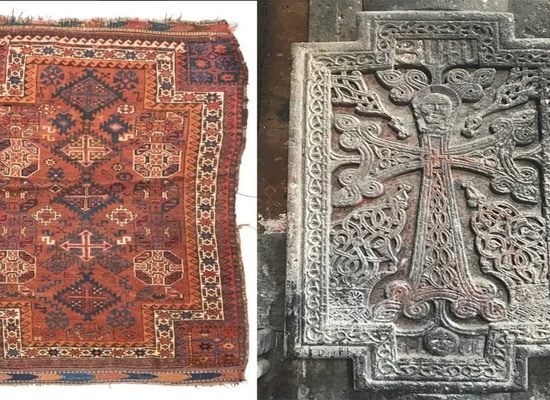
None of this requires believing in an unbroken ritual chain running literally from Argishti I to the Brezhnev-era planning committee. What the record does support is something quieter and, in its way, more interesting: a single architectural silhouette — square base, narrowing shaft, sharpened crown — that Van-Armenian builders fixed as the visual signature of sacred kingship, stamped it onto the bronze bowls their kings drank from, raised it in stone over their most important citadels, and left standing long enough that the descendants of those same highlands, without necessarily intending to, reached for exactly that shape again when they needed a monument tall enough to be seen from every quarter of their capital. Whether one calls it susi in ninth-century cuneiform or shushi in twentieth-century Yerevan slang, the tower on the hill has never really stopped being built.
Related reading: [Erebuni Fortress and the Cuneiform Founding of Yerevan] · [The Bronze Bowls of Karmir Blur and the Memory of Van-Armenian Kings] · [The Tree of Life in Armenian Highland Art, from Urartu to the Khachkar]
Based on the status: Sukias Torosyan and comments: Manvel Takhverdyan