A 19th-century Baluch rug beside a 13th-century khachkar from Hovhannavank: a shared design logic, and the long record of Armenian carpets being renamed
Two crosses, six centuries apart
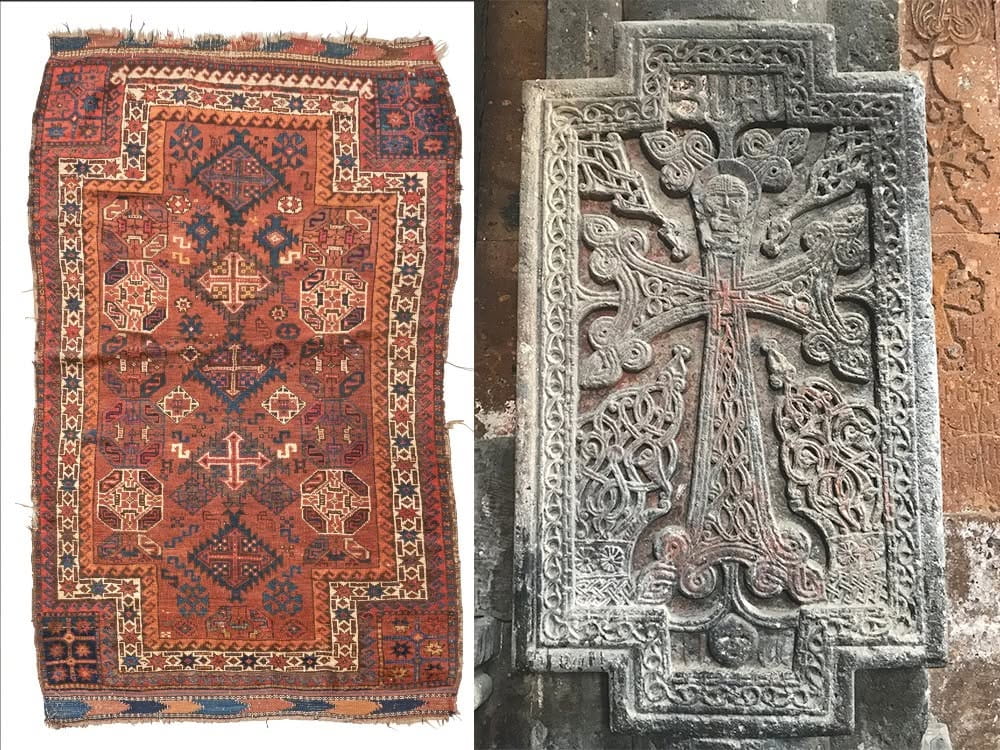
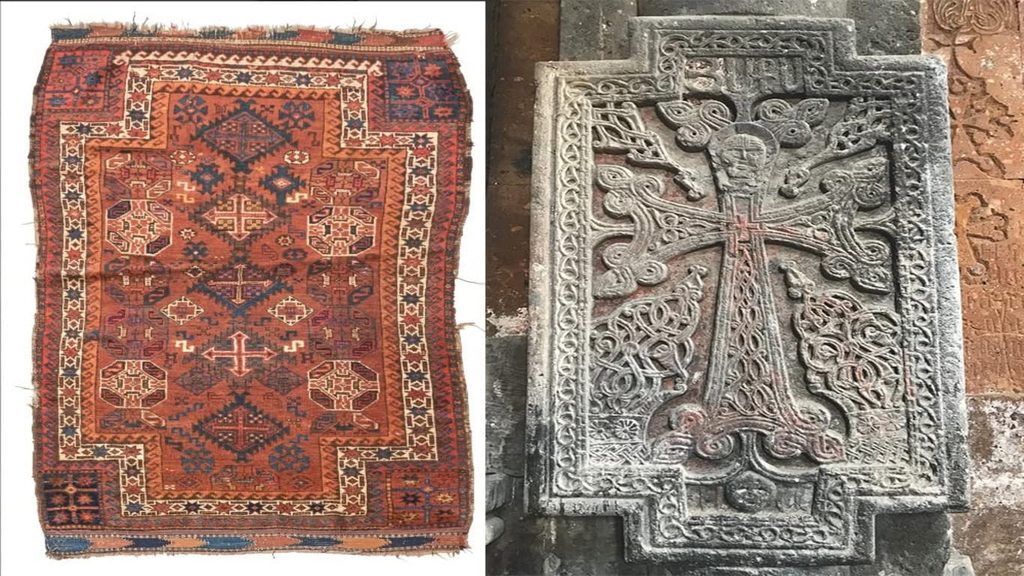
On the right: a cross-stone from the monastery of Hovhannavank in Ohanavan, Aragatsotn. The main church of St. Karapet was built in 1216–1221, and the monastery’s monument record lists a winged khachkar and khachkars set into its walls. The History Museum of Armenia holds a 13th-century Hovhannavank cross-stone fragment: a cross with double-trefoiled arms, a large carved rosette below it, and interlace and cross-shaped quadrangles around it.
On the left: a late-19th-century Baluch rug, a type that museums catalogue as Bahlul-group weaving from northeast Persia.
Placed together, the two share a composition. Both are built on a stepped, cruciform silhouette. Both fill the interior with repeated crosses and rosette-like medallions inside geometric frames. Both close the field with a separate patterned border. The stone predates the rug by about six hundred years, and the stone’s grammar is the older one.
The grammar of the khachkar
The khachkar is a codified design language. A cross, often resting on a rosette or sun disc, with a stylised tree of life and arms ending in triple loops, sits within what the Smithsonian Folklife Festival calls a version of the Tree of Life, with sprouting and blooming motifs. A Yerevan State University study of 13th-century examples reads each stone as an ordered cosmos: stepped pedestal or rosette below, the cross as Tree of Life, a cornice above, and non-repeating interlace across the field. UNESCO inscribed khachkar art on the Representative List of Intangible Cultural Heritage in 2010.
The same organising ideas (centre, field, protective border) appear in Armenian carpets. A HSE University study argues that Armenian carpet composition expresses archaic cosmological ideas (a sacred centre, an ordered field, and a belt that guards it from chaos) that continued into Christian culture. The History Museum of Armenia’s collection shows the cross and the Tree of Life moving between media: an apron carrying a flower-adorned cross framed by equal-armed crosses and stars, and a carpet whose central motif is a tree of life with apple-bearing branches.
Armenian weaving is documented, and it is old
- Dickran Kouyumjian’s survey records that Greek, Armenian and Arabic sources repeatedly describe fine rugs woven in Armenia, and that Marco Polo praised the rugs Armenians wove.
- The Armenian word for a pile carpet, gorg, is first recorded in a 1242–43 inscription on the Kaptavan church in Artsakh. The 13th-century historian Kirakos Gandzaketsi, from the same region, praised the weaving skill of the princess Arzu-Khatun and her daughters.
- Medieval Arab geographers wrote regularly about the Armenian carpets of Dvin and Qali-qala.
- The Armenian Weekly cites the 1202 “Yerrakhoran” carpet with a dated Armenian inscription among the earliest securely dated Armenian pieces.
- The earliest dated Armenian rug in Kouyumjian’s survey is the Kohar carpet, woven in Karabagh in 1700 with the weaver’s name and date, and Artsakh retained the dragon design into modern times, with a number of dragon rugs carrying Armenian inscriptions.
- Hundreds of inscribed Armenian rugs have now been recorded and several major exhibitions organized around them.
The renaming of Armenian carpets
The scholarly record shows how Armenian weaving lost its name. A 2019 article on Dragon carpets begins from the observation that many regional rugs were originally attributed to Armenian weavers but, from the second quarter of the 20th century onwards, were reclassified as Turkish (Azeri) or Persian. The author traces the reclassification to a historiographical debate, including the 1925 essay “The myth of the Armenian dragon carpets”, a position later challenged, for example by Kouyumjian’s study of the Berlin Dragon-Phoenix carpet and its probable Armenian origin.
Kouyumjian himself describes the outcome: Armenian carpets have in this century been gradually subsumed under the heading of Islamic or Turkish carpets, and “until very recently, scholars have dismissed the possible Armenian origin” of the dragon carpets.
Collectors describe the same pattern in the market. Hratch Kozibeyokian, whose family wove carpets for four generations, told Hyperallergic that rugs produced by Armenians were often incorrectly presented as Turkish, Oriental, or simply Caucasian. The same report notes that Azerbaijani officials allege there is no such thing as Armenian carpets and that Armenians learned weaving from Azerbaijanis. Since 2010, Azerbaijani-style carpet making has been on UNESCO’s Representative List, and the Karabakh group is presented within it as Azerbaijani.
The Armenian Rugs Society has publicly protested what it calls a campaign to claim Armenian textiles, citing an article “Revival of Azerbaijani Carpet” that it says reproduces passages from its own 1980 publication Weavers, Merchants, and Kings with the words “Armenia” and “Armenian” replaced. Armenian Weekly’s guide to identification reports that at international auctions and museums, carpets with geometric patterns, dragon motifs and stylised crosses are frequently mislabelled “Anatolian,” “Caucasian” or “Azerbaijani”.
How an Armenian carpet is recognised
Because motifs travel, the strongest evidence for Armenian authorship is not a single shape. The 1985 Weavers, Merchants, and Kings exhibition reasoned that most motifs in these carpets are not exclusively Armenian, but occasional Christian crosses, Christian dates and, above all, inscriptions in Armenian establish origin. The Armenian Weekly’s guide adds the Armenian double knot, the red of Armenian cochineal (vordan karmir), and the presence of birds, horses, humans and crosses. A rug with a cross, a date or a weaver’s inscription in Armenian is Armenian on its own evidence.
What the pairing shows
The khachkar-and-rug pairing makes the central point visual: the cross-in-frame, stepped-contour, rosette-and-border composition is the khachkar’s own grammar, fixed in stone by the 13th century, and it reappears on a textile six centuries later. The Armenian stone tradition is dated, signed and inscribed. The rug’s attribution is the open question, and the long record of renamed Armenian weaving is the reason it deserves to be asked.
The practical conclusion for researchers, curators and dealers is the same one Kouyumjian reaches: attribute by evidence (inscriptions, dates, structure, dye, provenance), and stop defaulting to “Caucasian,” “Anatolian” or “Azerbaijani” when the evidence is Armenian.
Sources
Hovhannavank and the khachkar
- Hovhannavank, Wikipedia
- Hovhannavank, Hushardzan monument register
- Cross-stone/Khachkar from Hovhannavank, History Museum of Armenia
- Davtyan, “The Ornaments of the 13th Century Khachkars” (YSU)
- Smithsonian Folklife Festival, “Khachkar”
- Bradt Guides, “The meaning behind Armenia’s khachkars”
Armenian carpets
- Kouyumjian, Armenian textiles survey (Fresno State)
- Karabakh carpet, Wikipedia
- Armenpress, Armenian carpet history
- Armenian Weekly, “Artsakh Carpets as Historical Memory”
- HSE Journal of Art & Design, composition of Armenian carpets
- History Museum of Armenia, wool/carpet collection
Attribution and misattribution
- Pollio, “Reconsidering dragon carpet origins” (2019)
- Hyperallergic, “A War Over Patterns, Symbols, and the Cultural Heritage of Karabakh’s Carpets”
- Armenian Weekly, “Five ways to identify Armenian carpets”
- Christian Science Monitor, “A people’s culture: Rugs of Armenia” (1985)
- ANCA, “Stealing Culture: Azeris Launch Campaign Claiming Armenian Carpets As Their Own”
Baluch rug reference
Image Source: Arto Tavukciyan