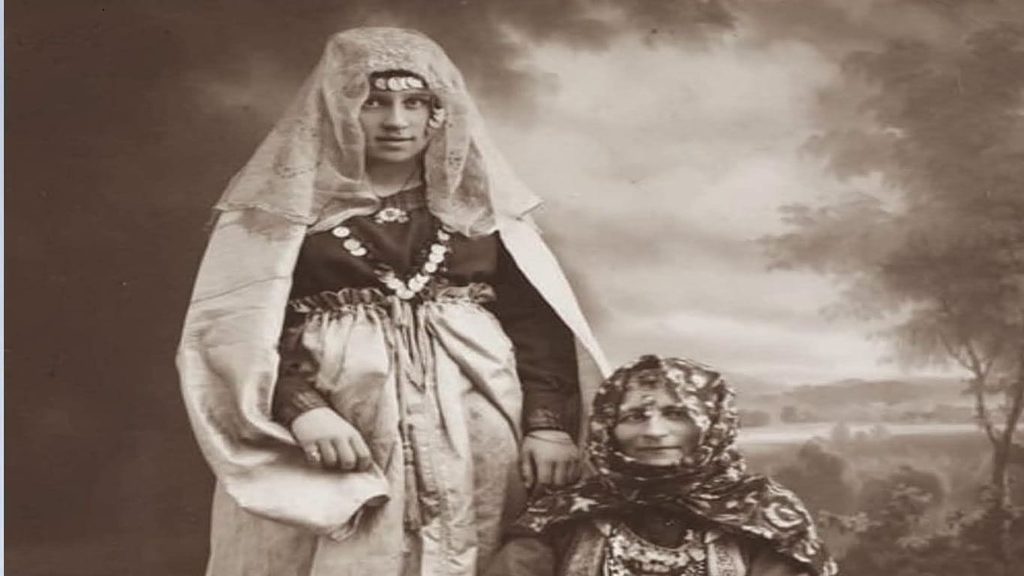
A portrait from the Armenian highlands
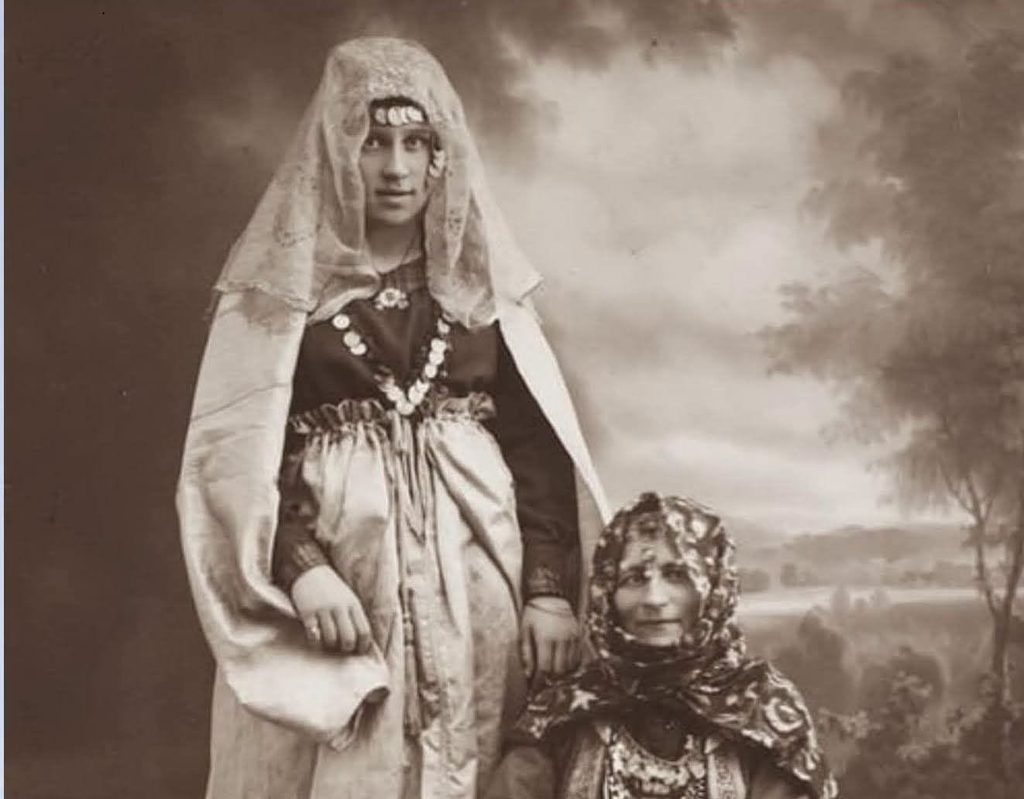
Two women stand before a painted studio backdrop of clouds and trees. The taller one, a young woman, wears a sheer lace-like veil over her head and a band of coins across her forehead. Silver or silver-toned coins run down the front of her dark bodice, and a long silk cloak falls from her shoulders to the ground. Beside her, lower in the frame, sits an older woman in a patterned headscarf. The pair are identified in the archive as an Armenian bride and her sister, from Kharberd.
This photograph belongs to the archive of the Danish missionary organization KMA and is held by the Danish National Archives (Rigsarkivet) in Copenhagen. It is a rare visual record of how an Armenian bride from the Kharberd region presented herself in the years before the Armenian Genocide.
Where the photograph is preserved, and what the record says
The picture is reproduced in the article “Harput – Missionaries” on Houshamadyan, a project that reconstructs Ottoman Armenian town and village life. Its caption reads: KMA archives, pre-genocide, “Armenian bride and her sister”, with the source given as Rigsarkivet/Danish National Archives, Copenhagen. The article’s editorial note says the photographs, apart from a few, were provided by the Danish archival historian Matthias Bjørnlund from the Danish National Archives.
The same page shows other KMA material that helps place the photograph. It includes a KMA postcard of “Young Armenian women in national costumes” (ca. 1910) and photographs of Armenian orphans and missionary staff taken around 1908–1912. For the institution itself, see the Danish National Archives.
Who the KMA were, and why their archive holds such images
KMA stands for Kvindelige Missions Arbejdere (“Women Missionary Workers”). According to Bjørnlund’s introduction, the organization was founded in Copenhagen in 1900. It was spurred largely by news of the Hamidian massacres of the 1890s. Armenians remained its main focus until it was dissolved in 1981.
The KMA founded the orphanage Emaus in Mezreh (present-day Elazığ) in November 1902. Danish missionaries then worked across the Kharpert province for years. They included the nurse Maria Jacobsen, who worked from 1907 as head nurse for the American Board in Mezreh and Kharpert, and Karen Marie Petersen, who led Emaus. Their photographs, postcards and annotated prints went back to Denmark and were preserved in the KMA archives. Many carry captions in Danish, written on the back by the missionaries themselves. Jacobsen’s own diaries are a major source on Kharpert; the English edition is Diaries of a Danish Missionary: Harpoot, 1907–1919 (Gomidas Institute, 2001), edited by Ara Sarafian. The Armenian Genocide Museum-Institute notes that part of her materials are in the Danish KMA archives.
Kharberd: the place
Kharberd (Harput/Kharpert) is an Armenian town on a hill above a fertile plain. Houshamadyan’s demographic study by George Aghjayan explains that the seat of government moved in the early 1800s to the lowland settlement of Mezire, later called Mamuretül Aziz.
The same study gives the main figures:
- The Armenian population of the Kharpert district stayed at about 40,000 for almost a century.
- In 1914 the town of Kharpert had 4,248 Armenians in 714 households.
- Armenians made up around a third of the town’s population.
- The district had about 70 villages with Armenian inhabitants.
This is the milieu in which the bride lived: a dense, long-established Armenian community with its own churches, schools, craftsmen and customs.
Reading the costume
Armenian dress is region-specific, so it is worth being careful about what a photograph can prove. Houshamadyan’s article on Harput religious customs, by Vahé Tachjian, describes the girl’s wedding clothes, based on Manug Dzeron’s account of the village of Perchendj. They consist of a coloured silk apron (zubun), a jacket sewn with gold thread (çuha salta) and a long veil (chite). Another account (Shahbazian, on Tankaran) gives the bride a coloured headscarf (yazma), a silk dress, a cloth over the bosom (khutni), a woollen coat, many braids and embroidered shoes.
The article also records that engagement gifts included a string of gold coins (khatar of gazis). Betrothal and festival gifts could include a decorated belt (kemer), a woman’s cap (lachag) and a decorated silk cloth.
Several elements of the portrait are consistent with this picture:
- the long sheer veil and the silk outer garment;
- the coins worn on the forehead and down the bodice;
- the decorated belt or apron with hanging cords.
This is an interpretation by comparison. The archive caption does not itemize the garments, and the sources above describe village and plain customs and differ from place to place. The photograph is best read as a studio portrait in festive or bridal attire, not as a standardized “Kharberd bridal costume”. On the broader history, the Armenian Museum of Fresno and EVN Report note that the unified traditional Armenian wedding took shape in the 18th–19th centuries, and that the white wedding dress became established in Armenian culture only after the Second World War. Brides in photographs like this one therefore wear colour, silk and coins, not white.
The studio setting
The painted clouds and trees are a standard photographic-studio backdrop. The portrait was posed, so the clothing was probably chosen and arranged for the camera, as often happened when families had formal portraits made for engagements, weddings or souvenirs. That does not make the costume “staged” in the sense of invented, but it does mean the photo records how the sitters wished to be seen.
Dating
The archive’s caption says “pre-genocide”, that is, before 1915, and gives no year. The KMA presence in Kharpert began in 1901, and the related KMA photographs on the same page date from about 1908 to 1912. That makes the first decade of the 20th century plausible. A date in the late 19th century cannot be excluded from the visible evidence alone, so “late 19th or early 20th century” is a reasonable but unproven range. Establishing a date requires the original print, its verso and the KMA catalogue entry.
Why it matters
After 1915 the Armenian quarters of Kharpert were destroyed. Aghjayan’s study states that the Armenian part of the town lies in ruins and that no one lives there today. Photographs from missionary archives therefore form part of the visual record of the community. Jacobsen’s own diary, with photographs interleaved between its pages, is regarded as an important source on the events of 1915; for a short overview see the Aurora Prize profile. The bride in this picture and her sister are not named. Whether they survived is not known from the sources consulted.
Sources
- Harput – Missionaries (Houshamadyan, M. Bjørnlund), source of the photograph’s caption and archival attribution
- Harput – Religious customs (Houshamadyan, V. Tachjian)
- Harput – Demography (Houshamadyan, G. Aghjayan)
- Maria Jacobsen, Diaries of a Danish Missionary: Harpoot, 1907–1919 (catalogue record)
- Maria Jacobsen (Wikipedia) and the Armenian Genocide Museum-Institute biography
- Danish National Archives (Rigsarkivet)
- EVN Report on Armenian wedding traditions
Image Source: Javakheti Georgia