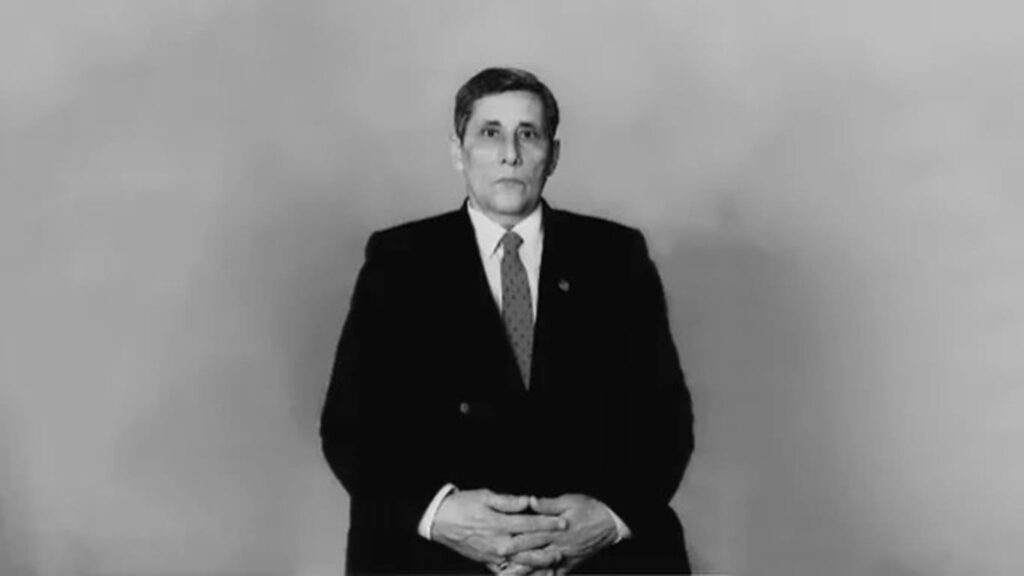
Rafael Baghdasaryan (1930–1993) lived the life of a professional criminal and died a hero of Armenian urban legend. People readily tell how he helped Armenia during the blockade and the Karabakh war, but almost none of it can be verified. This article sorts out what is known, what is plausible, and what remains folklore.
In Brief
Svo Raf was a thief-in-law (vor v zakone) from Yerevan who, according to tradition, received that rank while still a teenager. He spent about 34 years behind bars and died in Moscow’s Lefortovo pre-trial prison in June 1993, when Armenia was under blockade and war was raging in Karabakh.
In Armenian memory he has a reputation as a man who used his Moscow connections to send food, clothing, money, and weapons to his homeland. These stories rest on memoirs, books, and popular journalism. I could not find documents in open sources that confirm them, so every claim below is tied to its source.
The Man: From a Yerevan Street to Lefortovo
Childhood and “Coronation”
According to the biography retold in a copy of the Russian Wikipedia article, Rafael Mkrtychevich Baghdasaryan was born in 1930. He left school early, and in 1945, at 14, he was “crowned” a thief-in-law. By the same account he committed his first theft at 11. His strict father, as his sister Alla recalled (her words are quoted in Cyclowiki), tried to raise him with harsh methods, without success.
Details of his early biography differ between sources:
- Place of birth: Yerevan (Wikipedia copy, Lenta.ru) or Oktemberyan, today’s Armavir (Cyclowiki).
- Date of birth: 10 February or 11 February (English Wikipedia draft).
Way of Life
All his life he followed the “thieves’ code”: in the camps he refused to work or submit to the regime, gave no testimony, and signed no protocols. He had 15 convictions and about 34 years of imprisonment in total. According to the same sources, he accumulated no luxury: no palace, no expensive cars.
This is worth remembering so as not to write of him as a philanthropist or a fighter. His standing was that of a criminal-world authority, and the help to Armenia described below came from that world.
The Principal “Biographer”
The main source of information about him is the Armenian author Sergey Galoyan, who published several books about Svo Raf. One of them, Svo Raf (2020), is listed in the gir.am catalog. Galoyan’s books are not scholarly studies but collections of stories and recollections, and many later articles simply retell them.
The Era: Armenia Under Blockade
To understand where the stories of aid came from, one has to picture the country in the early 1990s.
From 1991–1992 Armenia was almost cut off from the world. Azerbaijan blocked gas transit and the railways, Turkey closed its border, and the conflicts in Abkhazia and South Ossetia complicated the route through Georgia. In Yerevan, electricity was supplied for only a few hours a day. This is described in a blog about the “dark years” of 1992–1995; in English, see this overview of the energy crisis. According to it, by 1993 more than half of the country’s hospitals had stopped functioning for lack of resources.
The war itself was under way in parallel. For a general overview, see the First Nagorno-Karabakh War; one of the key events of spring 1993 was the Battle of Kalbajar.
In such conditions, informal supply channels (through Moscow, the diaspora, personal connections) really did matter. It is in this context that the stories about Svo Raf are placed.
What Is Said About His Help
The General Picture
Most texts say roughly the same thing. Through his Moscow connections Svo Raf got around the blockade: food, clothing, and money reached Armenia, and the militia supposedly received about 14 million rubles. Lenta.ru and Art-A-Tsolum both report this. In both, the sum is presented as a rumor, and that caveat should not be lost in retelling.
The Story of the Weapons Trucks
The most vivid episode is retold by Art-A-Tsolum from Levon Soghomonyan’s interview with Sergey Galoyan.
Soghomonyan was living in Moscow with an acquaintance in an apartment in the city center and noticed something odd: large trucks drove into the yard every day and left the next morning. The guards, who were Azerbaijanis, did not leave the vehicles even in severe frost. It turned out that shipments of weapons were arriving in Moscow from the Tula Arms Plant and were then being sent on to Azerbaijan.
Soghomonyan and like-minded people, with Svo Raf’s support, decided to intercept the cargo. On a foggy day an armed group overpowered the guards and drove off with the trucks. The cargo was handed over at a place Svo Raf had indicated, and from there it was sent on to Armenia. The guards were held at a dacha outside Moscow until the weapons had reached their destination.
When it happened. Soghomonyan dates the episode to late 1990. Lenta.ru says “in the late 1990s,” but that is an obvious error: Svo Raf died in 1993. So the story took place in Soviet times, before the collapse of the USSR and before the full-scale phase of the 1992–1994 war. It can be called “help during the First Karabakh War” only with this caveat.
The Azerbaijani Thread
The most unusual detail: Svo Raf’s right-hand man is said to have been an Azerbaijani, Fikret Magheramov. This is reported by Art-A-Tsolum and the English Wikipedia draft, citing Galoyan. The latter also states that Azerbaijani thieves-in-law helped send weapons to Karabakh, and that Svo Raf himself said the criminal world did not need this war and that Armenian and Azerbaijani authorities cooperated closely.
If true, this is an interesting example of criminal networks crossing borders that were front lines for states. But it can only be confirmed by memoir sources.
Other Claims
The English draft adds that Svo Raf organized several detachments (one Armenian and two Russian) to help Artsakh, and did not like to talk about it. This is a single claim with no clear attribution.
Arrest and Death
On 23 December 1992 Baghdasaryan was detained in Moscow’s Minsk Hotel. According to Lenta.ru, an American submachine gun was found during the search. Journalists link the arrest to his aid to Armenia, but that is interpretation, not established fact. He was placed in Lefortovo pre-trial prison.
He died on 23 June 1993. What actually happened is unknown. There are several versions:
- a cellmate beat him severely, after which internal bleeding began;
- he developed bleeding for health-related reasons, and emergency surgery did not save him;
- relatives did not believe in a natural death, and a cousin claimed that organs had been removed to hide traces of a beating (per Lenta.ru).
The Wikipedia copy gives the cause as “murder,” but there is no independent forensic report in open sources.
The Funeral: The Best-Known Part of the Legend
The farewell took place in Yerevan, and on 27 June 1993 Svo Raf was buried at the Tokhmakh cemetery. This funeral made him a figure known even to people who have heard nothing else about him.
What Is Said
- For the duration of the farewell, blockaded Yerevan was allegedly supplied with electricity around the clock for three days (Wikipedia copy, Cyclowiki).
- According to Lenta.ru, the fuel oil for the power plant was sent from Baku by the deceased’s Azerbaijani friends. Four Azerbaijani authorities came to Yerevan, for which air service between the warring countries was temporarily restored.
- Guests included representatives of criminal circles from Germany, Italy, Turkey, and the US. Lenta.ru gives a figure of 150–200 foreigners and several hundred thieves-in-law. The English draft speaks of eight airplanes.
- The priest Ter Gurgen of St. Gayane Church, as retold in the draft, spoke of the deceased in very solemn terms. There is no exact quotation and no verifiable source.
What Is Exaggerated
The Lenta.ru headline about how the authority’s death “stopped the war” is journalistic hyperbole. There was no ceasefire because of the funeral: fighting continued in April 1993, Kalbajar fell, and a ceasefire agreement was signed only in May 1994. At most one can speak of a symbolic episode against the backdrop of war.
The arrival of guests from Azerbaijan and the three days of electricity also rest on stories alone, with no documents cited.
What Can Be Asserted and What Cannot
Reasonably reliable:
- Rafael Baghdasaryan was a real person, a thief-in-law who died in Lefortovo on 23 June 1993.
- He had a very long criminal record: 15 convictions and about 34 years in custody.
- In Armenian memory he remains a man who helped his homeland.
Only as “according to testimony”:
- the episode of the hijacked weapons trucks and its participants;
- the sum of 14 million rubles;
- the scale of aid (detachments, regular shipments);
- the role of Azerbaijani friends and assistants;
- the circumstances of his death, details of the funeral, guest numbers.
Not to be written without caveats:
- that his death “stopped the war”;
- that the aid fell in the years of the 1992–1994 war, if the story belongs to 1990.
How to Read This
The story of Svo Raf shows how popular memory forms in a crisis. When the state is weak and the country is under blockade, informal survival networks become part of the shared history, and their figures acquire legends. This does not make him a “hero of defense” in the state sense, but it also does not allow the phenomenon to be simply dismissed.
For a history website a sensible position is this: tell the legend while marking what it rests on; call him a criminal without denying that for many Armenians he was “one of their own”; and do not take attractive details (three days of light, the end of the war) for established facts.
Sources
Biography
- Svo Raf — copy of the Russian Wikipedia article
- Rafael Baghdasaryan — Cyclowiki
- Draft: Rafael Baghdasaryan — English Wikipedia (draft)
- Rafael Baghdasaryan (Svo Raf) — Timenote
Aid to Armenia
- The Delicate Operation of Svo Raf to Supply Armenia with Weapons — Art-A-Tsolum
- Thief-in-law Svo Raf became the godfather of Armenia — Lenta.ru via Rambler (27 April 2026)
- Sergey Galoyan, Svo Raf (2020) — gir.am
Context of the era
- First Nagorno-Karabakh War — overview
- Battle of Kalbajar (1993)
- 1990s Armenian energy crisis
- The “dark years” of Yerevan, 1992–1995 — blog
- Media.am — “The Devoured Mazut” case
See also
- Britain and Armenia: the real record
- The First Karabakh War: chronology
- Armenia in the “dark and cold years”
Editor’s note: some links lead to Wikipedia mirrors and copies because the originals were unavailable at the time of preparation.
Read Also: The Delicate Operation Of Svo Raf To Supply Armenia With Weapons
One thought on “Svo Raf: The Thief-in-Law Whom Armenia Remembers as a Protector”