About a 10-minute read
In Brief
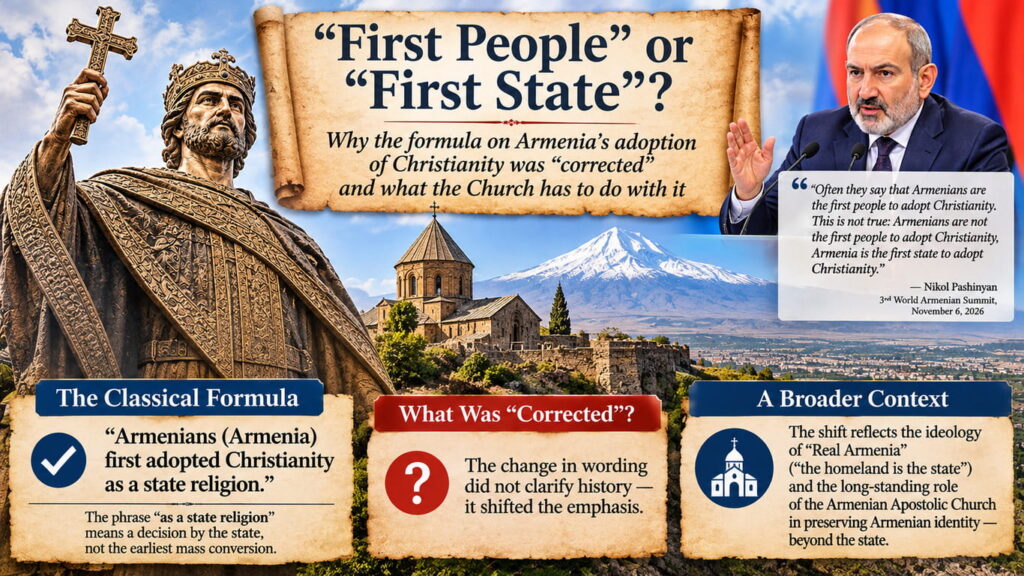
- The classic formula reads: “The Armenians (Armenia) were the first to adopt Christianity as a state religion.” The words “as a state religion” already tell us that this was a decision of the state. It does not mean that every Armenian became a Christian before everyone else.
- On 6 November 2026, at the third Pan-Armenian (World Armenian) Summit, Pashinyan said: “It is often said that Armenians were the first people to adopt Christianity. That is not so: Armenians were not the first people to adopt Christianity; Armenia was the first state to adopt Christianity.” The remark caused indignation in the Armenian media (NEWS.am, in Russian, video, in Armenian).
- There was nothing to correct. In the full formula, “the Armenians” already means Armenia as a state. Swapping the words does not refine history; it shifts the emphasis.
- That emphasis is tied to the “Real Armenia” ideology (“the homeland is the state”) and to the government’s conflict with the Armenian Apostolic Church, which for centuries preserved Armenian identity even without a state.
1. What Actually Happened in the Early Fourth Century
The main account of how Armenia became Christian is the History of the Armenians by Agathangelos, a fifth-century work. In brief: King Tiridates III regained his throne with Roman support, at first persecuted Christians, and threw Gregory, the future Illuminator, into the Khor Virap pit. Tiridates was then healed, was baptized with his court, and Gregory became the first head of the Armenian church. A detailed discussion of the sources is available in the article Christianization of Armenia (with references to the work of Nina Garsoïan and Robert Thomson), in the Russian-language article Христианизация Армении, and in the article on Tiridates III.
Three facts matter for our question.
- It was a decision of the authorities. Robert Thomson, one of the leading experts on early Armenian Christianity, calls Tiridates’ step “an act of state.” Historians explain it in political terms: Armenia was squeezed between Rome and the Sasanian empire, and the new faith strengthened royal power and distanced the country from Iran.
- The people were not baptized in a day. According to Thomson, the conversion of the country was a long process, and four million Armenians were not baptized in a week. Things moved faster after Mesrop Mashtots created the alphabet around 405 and the Bible was translated into Armenian. In 451, at the Battle of Avarayr, the Armenians defended their faith against an attempt to impose Zoroastrianism on them.
- The Church became the pillar of the people. It was the Church that preserved the language, the script and the memory when the Armenians had no state of their own. Historians say so (Wikipedia), and so do Armenians themselves; see, for example, this opinion piece on russia-armenia.info (in Russian).
This is why the formula contains the words “as a state religion.” They point directly to an act of the state.
2. “The Armenians” in This Formula Means Armenia
In the standard formula, the word “Armenians” stands next to “state religion,” and together they mean one thing: Armenia, as a state, adopted Christianity. That is how the formula is used by the Church, by historians and by the world press.
- In a 2015 homily, Pope Francis said that the Armenian people were “the first to adopt Christianity as a state religion” (Vatican Radio, retold by Panorama.am, in Russian).
- A 2023 Vatican piece calls Armenia the “first kingdom” to adopt Christianity as its state religion (Vatican News).
- The Russian-language Wikipedia says Greater Armenia became the first state in the world to proclaim Christianity its state religion (article “Армения”).
- The BBC, in a piece on the history of Christianity in Armenia, wrote that the country was the first to adopt Christianity as a state religion, in 301 (retold by verelq.am, in Russian).
No serious source claimed that the entire Armenian nation became Christian before any other. So the “correction” does not fix an error that was never made. It removes the word “people” and moves the word “state” to the front.
3. The Speech of 6 November
On 6 November 2026, at the third Pan-Armenian Summit, Pashinyan gave a speech whose text was published by NEWS.am (in Russian; there is also a video in Armenian). The headline of the report: “Our state is our identity, and our identity is our state.”
He said that the essence of the “Real Armenia” ideology is that the state is “the most important thing we can have as a people.” Then, responding to critics who say the ideology replaces identity, he said it does the opposite: it protects identity. He asked what we mean when we say “Armenian.” In his words, people usually recall three things: Christianity, the Armenian Apostolic Church, and the script and language. “I did not mention the state,” he added. Then came the key passage:
“It is often said that Armenians were the first people to adopt Christianity. That is not so: Armenians were not the first people to adopt Christianity; Armenia was the first state to adopt Christianity. In 301 our king Tiridates III decided that we were Christians. We became Christians by a state decision.”
He then offered two more examples in the same vein. The Church’s independence, he said, exists because in 373 King Pap insisted that the Catholicos be elected in Armenia rather than ordained in Caesarea. The alphabet came about because King Vramshapuh set the task for Mesrop Mashtots after it became clear that, a century after the adoption of Christianity, the population remained largely pagan. The conclusion of the speech: “Our state is our identity, and our identity is our state.”
Note how the argument is built. He quotes the phrase without the qualifier “as a state religion,” declares it a mistake, and “corrects” it to “state.” But the full formula, as shown above, already speaks of the state.
The phrase “first state” itself is not new for Pashinyan. He has said similar things before:
- February 2025. “Armenia is the first country in the world to adopt Christianity as a state religion,” 301, King Tiridates III (primeminister.am).
- Christmas 2026. “Today we reaffirm ourselves as the first state to have adopted Christianity” (Armenpress).
What was new in November is that the phrase was presented as a correction of the generally accepted one. That correction became part of a programmatic speech about identity, and that is why it drew a reaction.
4. The “Real Armenia” Ideology: Why the Word “State” Matters So Much
To understand where this emphasis comes from, one has to know what Pashinyan calls his guiding ideology. In his February 2025 address, he described “Real Armenia” as the Republic of Armenia within its internationally recognized territory of 29,743 square kilometres.
- The 14-point draft published by NEWS.am (in Russian) contains formulas such as “The homeland is the state: if you love the homeland, strengthen the state” and “a nation becomes a people through the state.”
- According to Pashinyan, the ideology equates the homeland with the internationally recognized state, and patriotism with the interests of that state (JAMnews, Arminfo; both in Russian).
- Among the national values listed in the draft are both the Armenian Apostolic Church and Christianity (RealTribune, in Russian).
In the 6 November speech, this idea is stated outright: the state is named a fourth element of Armenian identity alongside Christianity, the Church and the language, and is then declared identical to identity. If “the homeland is the state,” it is convenient to describe the adoption of Christianity as an act of the state as well. The implication is that the decisive role in preserving identity belongs to the authorities, not to the Church, the diaspora and historical memory.
5. How This Relates to the Criticism of the Church
The conflict has been going on for years. Here are its main milestones, confirmed by sources.
- After 2020. Catholicos Garegin II called on Pashinyan to resign, and the Church criticized the government’s policy on Artsakh, security and concessions to Azerbaijan (Jamestown).
- June 2025. Pashinyan publicly accused the Catholicos of breaking his vow of celibacy and demanded his resignation; the Catholicos rejects the accusations. At the same time, Archbishop Bagrat Galstanyan was arrested on charges of plotting to seize power, and was later sentenced to two years (2025 chronology, AP).
- December 2025 to January 2026. By December, four senior clergymen had been arrested, and ten church figures had called on the Catholicos to step down. In January the prime minister announced “reforms” of the Church (Garegin II reference page). At a Christmas rally on 6 January he said the Church must be “returned to the people” (SOVA, in Russian).
- August 2026. A trial began of the Catholicos and six clerics for failing to comply with a court decision to reinstate the defrocked Bishop Gevorg Saroyan; each faces up to two years in prison. Pashinyan has accused the Church of ties with Russia but, as Al Jazeera, citing Reuters, notes, has provided no evidence. The opposition, church leaders and a number of human rights advocates call the case politically motivated.
- 24 August 2026. In parliament, Pashinyan again demanded the Catholicos’s departure and named the Church’s prayers for Artsakh among the reasons (Horizon Weekly; the outlet is critical of the prime minister). Church reform has been included in the government programme for 2026–2031 (301.am; this outlet is also close to the opposition).
The Logic of the Connection
The traditional formula ties together the people, the Church and Christian identity. In it the Church is the keeper of national memory, including outside the Republic of Armenia. If the state is declared the chief bearer of identity, the Church ceases to be the sole or highest symbol of the nation and becomes one of the organizations subordinate to the logic of the state. That is why the change of the word from “people” to “state” reads as part of a larger shift: it is not the Church but the state that defines what it means to be Armenian.
What the government says. The prime minister and his supporters maintain that the government is not acting against the Church but “following it,” that the state recognizes and protects Christian values, and that the reform is needed to free the Church from being “captured” by a narrow group of hierarchs (Armenpress). In their version, the complaints against the Catholicos concern law and discipline, not faith.
What critics say. The Church states that the prime minister has violated the constitutional principle of separation of church and state (Novaya Gazeta Europe, in Russian). Critics outside Armenia write of a campaign against an independent institution that remains a moral authority (The Hill, Horizon Weekly). These texts are opinion journalism, not scholarly work.
6. The Bottom Line
- The full formula, “the Armenians adopted Christianity as a state religion,” already means the state of Armenia. There is nothing in it to correct.
- The truncated version without the qualifier is indeed inaccurate, which is exactly why it is not used in church or scholarly texts. Refuting that version means arguing with something nobody claimed.
- The word “state” in place of “people” does not refine history. It moves the center of gravity from the people and the Church to the modern state, which fully matches the “Real Armenia” ideology.
- In the 6 November speech, Pashinyan himself showed the link: he “corrected” the formula about Christianity and then declared the state and identity one and the same. That is why his words were taken as part of a policy toward the Church rather than as a history lesson. The reaction of the Armenian media showed it.
Sources
Sources marked “(in Russian)” are available only in Russian.
History of the Christianization
- Christianization of Armenia (Wikipedia, with bibliography: Garsoïan, Thomson, Agathangelos)
- Христианизация Армении (Russian Wikipedia) (in Russian)
- Tiridates III of Armenia
- The Early Christianization of Armenia (World History Encyclopedia)
- Battle of Avarayr
How the formula is used
- Vatican Radio on the words of Pope Francis (Panorama.am) (in Russian)
- Vatican News, 2023
- BBC on the history of Christianity in Armenia (retold, verelq.am) (in Russian)
- Армения (Russian Wikipedia) (in Russian)
Pashinyan’s statements
- NEWS.am: “Our state is our identity…”, 6 November 2026 (speech text) (in Russian)
- Video of the speech in Armenian, 6 November 2026 (Facebook)
- Speech at the International Religious Freedom Summit, 5 February 2025 (primeminister.am)
- Armenpress: Christmas 2026 speech
- SOVA on the rally of 6 January 2026 (in Russian)
“Real Armenia”
- NEWS.am: the 14-point draft ideology (in Russian)
- JAMnews: political scientists’ views (in Russian)
- Arminfo on the discussion of the ideology (in Russian)
- RealTribune: list of national values (in Russian)
The conflict between the state and the Church
- Jamestown Foundation: Pashinyan Escalates Tensions With Armenian Apostolic Church
- 2025 in Armenia (chronology with links to BBC and AP)
- AP: archbishop sentenced to two years
- Garegin II (reference page)
- Al Jazeera / Reuters: trial of the Catholicos, 7 August 2026
- Novaya Gazeta Europe: “An Ultimatum, Armenian Style” (in Russian)
- Horizon Weekly: speech in parliament, 24 August 2026
- 301.am: the Catholicos case and the “crisis” report
Opinion journalism (read as opinion)