Status as of 6 November 2026. This is an analytical piece, not legal advice.
The peace agreement between Armenia and Azerbaijan has been initialed but has not yet entered into force. Its Article XV provides for the mutual withdrawal of interstate claims. For the Armenians expelled from Nagorno-Karabakh (Artsakh) in September 2023, and for residents of Armenian border villages where Azerbaijani troops remain, the central question is which legal tools survive if the state-level cases are closed.
This article examines the treaty text, the status of the cases, the parties’ positions, and the avenues that remain open to individuals. Assessments that are presented in public debate as self-evident are attributed here to the people who make them.
1. What the treaty says
Article XV requires the parties, within one month of the agreement entering into force, to withdraw, terminate or otherwise settle all interstate claims and proceedings concerning matters that existed before signing. New such claims are prohibited. The parties must also not become involved in any way in similar proceedings brought against the other party by third parties (text published by Armenia’s Foreign Ministry; MassisPost).
Article II records that the parties have no territorial claims against each other and will not advance any (JAM News). Under Article XVI, the agreement enters into force after the parties exchange notifications that their internal procedures are complete (MassisPost).
The text is not secret: Armenia’s Foreign Ministry published it on 11 August 2025. Critics make a different complaint: the authorities have not explained publicly what price Armenia is paying and what it receives in return.
Three facts shape everything that follows:
- The agreement is not yet in force. Government representative Lilit Makunts said that withdrawal of the claims is possible only after the final signing of the agreement (Armenpress).
- By its text, the withdrawal is mutual, not unilateral.
- The article speaks of interstate claims. It says nothing about individual complaints.
2. Two layers of claims: Artsakh and Armenia’s own territory
These topics are often conflated, but legally they are distinct.
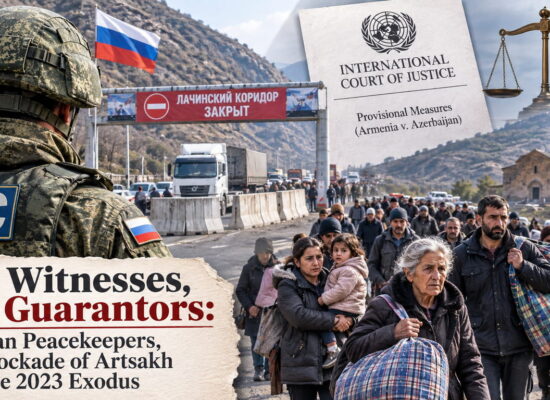
First layer: Nagorno-Karabakh. The blockade of the Lachin Corridor, the military operation of 19–20 September 2023, and the exodus of more than 100,000 people. This is the subject of the case before the International Court of Justice and of Armenia’s fourth interstate application at the European Court of Human Rights (Strasbourg Observers).
Second layer: Armenia’s sovereign territory. Since May 2021, Azerbaijani forces have entered Armenian territory and remained there. The largest escalation took place on 12–13 September 2022: at least 207 Armenian and 80 Azerbaijani servicemen were killed, and Azerbaijan occupied more than 200 sq km of Armenian territory (JICJ, 2026). According to open sources, about 7,600 civilians were displaced (Wikipedia).
The figures differ. According to a CivilNet investigation based on open data and satellite imagery, as of October 2025 at least 241.4 sq km of Armenian territory was under Azerbaijani control, while Armenia controlled about 21 sq km of territory attributed to Azerbaijan (CivilNet). EVN Report also gives roughly 241 sq km. Earlier estimates ranged from 50 to 215 sq km (Wikipedia). The border has not been delimited, so the parties assess the exact lines differently, and any publication of these figures should say so.
PACE monitors reportedly recorded Azerbaijani positions inside Armenian sovereign territory, including on commanding heights above the Yerevan–Iran highway (Wikipedia, citing PACE).
3. How this fits into the logic of the process
The logic of what is happening is best described as a clash of two arguments, not as a verdict handed down in advance.
The Armenian government’s argument. A peace treaty, border delimitation and an end to the threat of a new war matter more than protracted litigation. Makunts said that Armenia “will never abandon defending its interests in international bodies,” while the withdrawal of claims is possible only after the agreement is signed (Armenpress). The Security Council secretary stated that Armenia’s sovereign territory — 29,743 sq km — will neither shrink nor grow through delimitation (Armenpress). In November 2025 Prime Minister Nikol Pashinyan wrote that, as a result of delimitation, Armenia must regain Artsvashen and other occupied sovereign territories (EVN Report).
The critics’ argument. Withdrawing the claims deprives Armenia of legal leverage at a time when Azerbaijani troops are still on Armenian soil, and in April 2024 Armenia had already handed Azerbaijan about 6.5 sq km in Tavush, including four former Azerbaijani villages (CivilNet). They point out that delimitation is proceeding asymmetrically: Azerbaijan withdrew from a small number of positions, Armenia from considerably more (EVN Report). The outlet 301.am, which is close to critics of the government, quotes Pashinyan’s “the conflict is over” at a campaign event and reproaches him for readiness to make new concessions while Azerbaijani forces remain (301.am, May 2026).
What matters for the reader. Armenian officials acknowledge that Armenia also controls several areas that de jure belonged to the Azerbaijan SSR (EVN Report). The delimitation commissions continued to meet in May 2026, but the timetable and sequencing are barely disclosed publicly (same source). Conclusions about who will ultimately gain or lose remain a forecast.
Azerbaijan’s approach to Karabakh should also be presented accurately. Baku regards the operations of 2020 and 2023 as the restoration of sovereign control over a separatist entity and says Armenians may return. Lawyers disagree on the lawfulness of the use of force, but the JICJ authors stress that this dispute does not justify deportation, persecution, starvation of civilians or indiscriminate strikes (JICJ). Human Rights Watch wrote that Azerbaijan has taken no real steps toward safe return and restoration of property rights (World Report 2025).
4. What is at stake in the interstate cases
International Court of Justice. On 12 November 2024 the Court rejected Azerbaijan’s objections and found that Armenia’s case under the Convention on the Elimination of All Forms of Racial Discrimination may be examined on the merits (Armenpress; judgment on Jus Mundi). In the parallel case Azerbaijan v. Armenia the Court also accepted jurisdiction but upheld two of Armenia’s three objections, narrowing the claim (OC Media). There is no decision on the merits yet, including on how to characterize the events of 2023. An important caveat: the case rests on the racial discrimination convention and does not directly resolve territorial occupation. That is my inference from the subject matter of the case.
Under the provisional measures indicated on 17 November 2023, the Court found plausible the right of people not to be forced from their homes solely because of their Armenian origin, and the right to safe return (EVN Report).
European Court of Human Rights. Six interstate applications between the two countries are pending. The third concerns violations on Armenia’s own sovereign territory; the fourth concerns the blockade of the Lachin Corridor and the displacement of Artsakh’s population (Strasbourg Observers).
Withdrawal here is not automatic. Under Rule 43(2) of the Rules of Court, a Chamber may strike a case out if the parties agree, while Article 37 of the Convention requires the examination to continue if respect for human rights so requires. Lawyer Igor Mirzakhanyan suggests considering admitting human rights organizations as “representative successors” of the withdrawing state, and himself acknowledges that there is no precedent (Strasbourg Observers).
In my reading, Article XV also covers interstate claims relating to the occupied areas of Armenia, because it refers to all matters that existed between the parties before signing. The text does not say so literally, so this is an interpretation.
5. What avenues remain for individuals
5.1. Individual applications to the ECtHR
This is the most realistic avenue. The application is filed by the person, and only that person may withdraw it. The Armenian government cannot do so.
- According to ECtHR data, more than a thousand individual applications connected with the conflict are pending (ECHR fact sheet).
- In Sargsyan v. Azerbaijan the Court confirmed Azerbaijan’s jurisdiction over an abandoned village in a disputed zone, in a dispute over access to property (ECHR fact sheet).
- In Narayan v. Azerbaijan Azerbaijan was held responsible for a violation of the right to life (Völkerrechtsblog).
- Refugees from Artsakh have been filing applications since late 2024 about loss of property and the right of return, and a human rights centre stresses the importance of recognizing a collective right of return (PAN.am).
For residents of Armenia’s border villages a path also exists, and in my assessment it is legally simpler: the land in question is under the actual control of Azerbaijani forces and is not territory of disputed status. One direction is complaints concerning property and home. Time limits, jurisdiction and admissibility require a lawyer’s individual analysis.
Practical risks:
- Time limit. After Protocol No. 15 the deadline for lodging an application is four months. Check the current text of the Convention. For continuing violations the time limit is calculated differently.
- Jurisdiction. Azerbaijan may contest the applicability of the Convention to particular events. The outcome depends on the facts of each case.
- Caseload. Thousands of individual applications instead of six interstate ones take the Court longer to process (Strasbourg Observers).
5.2. The International Criminal Court
Armenia ratified the Rome Statute (in force since 1 February 2024) and lodged an Article 12(3) declaration accepting the ICC’s jurisdiction from 10 May 2021 (JICJ). Azerbaijan has not ratified the Statute.
The two situations rest on different legal bases:
- Crimes on Armenian territory (the execution of prisoners and the desecration of bodies of servicemen in September 2022) occur on the territory of a state party, so territorial jurisdiction is direct. Armenia has opened domestic investigations but has no real ability to bring Azerbaijanis to account (JICJ).
- Deportation from Artsakh. The JICJ authors rely on the Pre-Trial Chamber’s decision in the Bangladesh/Myanmar situation: if forced displacement ended with the crossing of a border into a state party, the ICC may exercise jurisdiction. By analogy, as they argue, it could examine the deportation and persecution of Artsakh’s residents if the act was completed in Armenia. This is scholarly argument, not an ICC decision.
Individual communications to the Prosecutor under Article 15 have already been filed, for example by lawyers Zimeray & Finelle and by Rerooted. Only the Prosecutor decides whether to open an investigation. The sources I used contain no information that one has been opened.
The JICJ authors believe that Article XV presupposes that Armenia will refrain from referring the situation to the ICC, and so propose that other states parties make the referral. That is their assessment, not a direct provision of the treaty.
5.3. National courts of third countries
A German administrative court, as ASIL reports, recognized refugees from Nagorno-Karabakh as stateless persons, pointed to systematic discrimination against Armenians in Azerbaijan, and granted the family refugee status (ASIL Insights). Such decisions are useful for status and protection.
5.4. What cannot be done
Individuals cannot be parties before the International Court of Justice: only states appear there. UN treaty bodies accept individual communications only against states that have recognized the procedure. Whether Azerbaijan has made the relevant declaration must be checked separately for each body. I have not verified this.
6. The evidence base
| Subject | Source |
|---|---|
| Blockade, exodus, human rights | Council of Europe Commissioner for Human Rights, January 2024 |
| Chronology 2020–2024 | Freedom House et al., Fact-Finding Report |
| UN assessment of the scale of the exodus | UN News, 2 October 2023 |
| Characterization as genocide (the author’s position) | L. Moreno Ocampo, expert opinion |
| Deportation and persecution | Rerooted, No Choice But To Flee |
| Blockade | Zovighian Public Office, From Blockade to War |
| Destruction of heritage | ACLED; Bellingcat |
| Obstacles to return | HRW, World Report 2025 |
| ICJ measures of 17 Nov 2023 | EVN Report |
| Occupied areas of Armenia | CivilNet mapping; EVN Report on enclaves and delimitation |
| Treatment of prisoners, September 2022 | Human Rights Watch; Bellingcat |
Individual applicants need personal documents: proof of former residence, property rights, and testimony about the events. This is a practical recommendation, not a conclusion drawn from the sources.
7. Conclusion
If the agreement enters into force, withdrawing the interstate claims will close the largest judicial channels, including those concerning Artsakh and the occupied areas of Armenia. It will not close every avenue. Individual applications to the ECtHR remain with the applicants themselves, anyone may send communications to the ICC while the Prosecutor decides whether to act on them, and national courts of third countries remain available.
These routes are slower and harder than interstate cases, and no result is guaranteed anywhere. But the claim that withdrawal of the state-level lawsuits legally ends the matter is inaccurate: by the treaty’s text it concerns only interstate claims.
Whether the current course serves Armenia’s interests remains a matter of political dispute. Some see in it the price of a lasting peace; others regard it as a concession while the occupation continues. The evidentiary side of that debate — texts, court decisions and observers’ data — is set out above, and readers can check it for themselves.