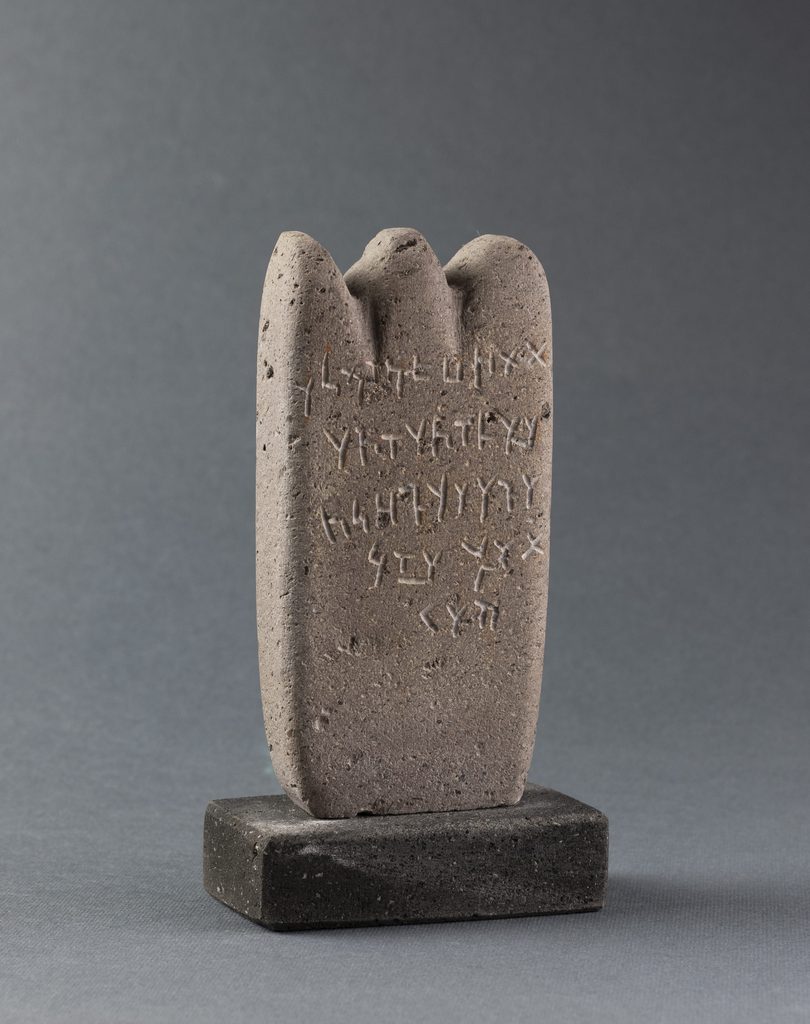
In the university textbooks titled History of the Armenian People there are two photographs. They show boundary stones with short inscriptions, and the caption under each reads: “Boundary stone of Artashes I. Aramaic inscription.” The Armenian edition and the Russian edition print them the same way. Most readers turn the page without a second thought. The physicist and researcher Paris Herouni stopped at exactly these photographs and asked a question that grew into his entire hypothesis.
Who Paris Herouni was
Paris Herouni (1933–2018) was an Armenian physicist and radio engineer who worked for many years at the Byurakan Observatory and in the National Academy of Sciences of Armenia. The wider public knows him mostly for his work on Karahunj (Zorats Karer), the ancient stone complex in the south of Armenia, which he considered an observatory about seven and a half thousand years old. In his book Armenians and Ancient Armenia he set out his views on the history of the Armenian Highland, including a chapter on the so-called Aramaic script.
Herouni came to philology as a man of the exact sciences. He did not look in inscriptions for beauty or symbolism. He compared signs the way an engineer compares drawings: shape against shape, frequency against frequency.
The two stones of Artashes
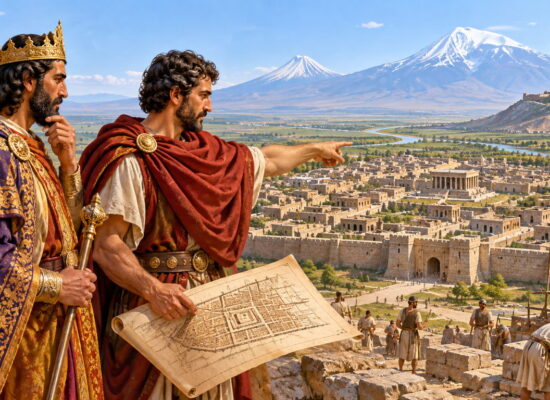
Artashes I (called Artaxias in Greek sources) ruled Greater Armenia from about 189 to 160 BC. It was he who founded Artashat, the capital on the bank of the Araks in the Ararat Valley. Ancient tradition going back to Plutarch and Strabo links the building of the city with Hannibal, who found refuge at the Armenian king’s court after his defeat by Rome.
Under Artashes the country was marked out with boundary stones. Stones with inscriptions have been found in different parts of the Armenian Highland, and each of them was meant to tell the reader where the royal border ran. The inscriptions on them are usually called Aramaic.
And here Herouni asks: why would an Armenian king, ruler of an Armenian country, carve decrees for his subjects in a foreign language? Who were these stones for? A peasant from the Ararat Valley or from Syunik had to be able to read that this was the king’s land and not a neighbor’s. If the inscription is in a language he does not understand, the stone loses its meaning.
A people without a country
Next Herouni turns to the Arameans themselves. According to the school version, they were Semitic tribes who came from Arabia and lived in the Near East roughly from the 14th to the 11th century BC. Herouni sees a weak spot in this picture. The Arameans, as he reads it, had no country, existed only briefly, and are nevertheless credited with a script that spread from Egypt to India. He asks how it could happen that a small nomadic people created an alphabet, while the ancient Armenian kingdom, with its cities, temples and palaces, managed without one.
The conclusion he reaches is bold: the Arameans as a separate people never existed. They were Armenians living in Armenian kingdoms in the Near East who used the Armenian language and Armenian writing.
The name Aram
Herouni considers the name the simplest argument. Aram is an ordinary Armenian male name, very old and still alive today. Herouni translates it as “son of the sun.” In the Armenian tradition Aram holds a special place: according to Movses Khorenatsi, Aram was a descendant of Hayk, the forefather of the Armenians, and the Greeks took the name “Armenia” from his name. In other words, in the Armenian tradition the name Aram stands at the very source of the people.
Assyrian annals of the 9th century BC mention one more Aram: Aramu, the first known king of Urartu, a state on the Armenian Highland. For Herouni the coincidence is not accidental. People named Aram lived on the Highland long before the “Arameans,” on the school version, came out of Arabia.
The letter tables
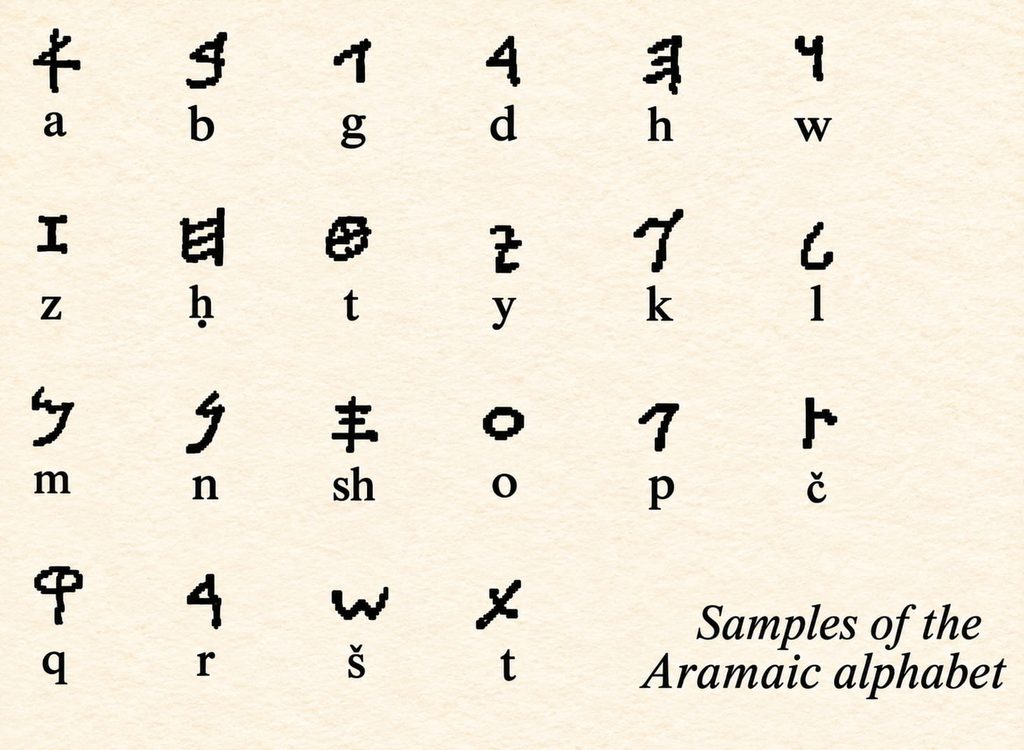
Herouni got his main proof when he sat down with the letters themselves. He copied the signs from the stones of Artashes exactly as they were cut, correcting nothing, and saw that many of them resemble modern Armenian letters. The sign that occurred most often was “a,” which is natural for the Armenian language, where the vowel “a” is the most frequent.
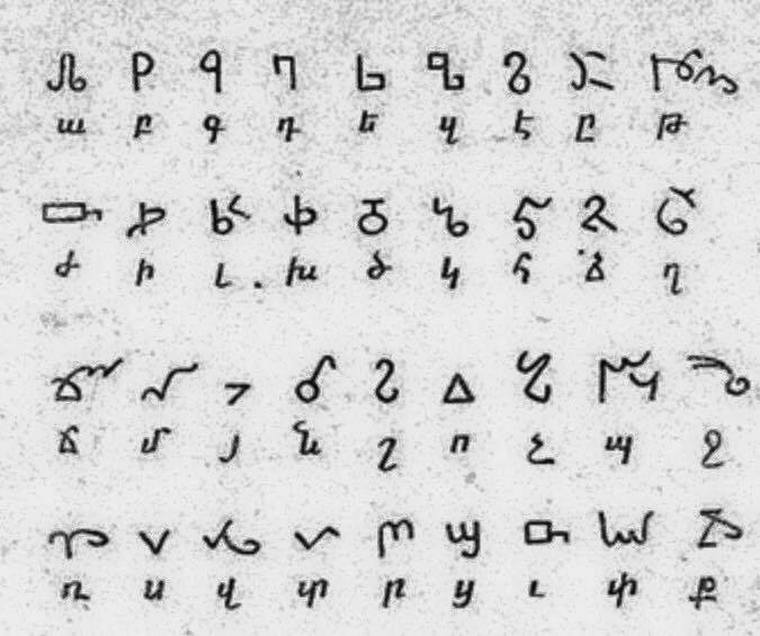
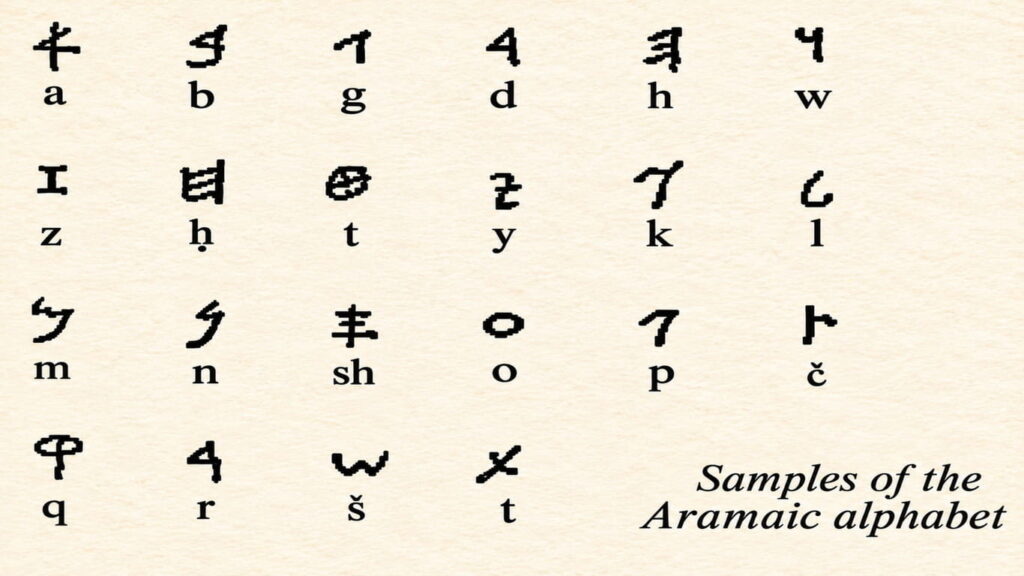
Then he opened books in which the “Aramaic” alphabet is set out in a table, among them Armenian Writing by Academician Gravard Acharyan. There each Aramaic sign is matched with an Armenian letter, most often by position in the alphabet, as is customary when one writing system is compared with another: first with first, second with second. And Herouni noticed something strange. The Aramaic sign that looks exactly like the Armenian “պ” is placed in the table next to “մ.” A sign resembling “լ” ended up opposite “ղ,” a sign resembling “ղ” opposite “հ,” while “փ” and “տ” were both matched with “կ.” The letters in the table seem deliberately shifted.
Herouni arranged the signs anew, by similarity of shape. The result: of the 28 signs he compared (Aramaic together with Phoenician), 17 (61 percent) are identical to Armenian letters, 7 (25 percent) are similar, and 4 (14 percent) differ.
Identical: ա, գ, զ, ի, լ, կ, հ, ղ, մ, ո, պ, ռ, տ, ր, ց, ք, օ, four of them vowels.
Similar: դ, ե, է, ժ, յ, ջ, վ, two of them vowels.
Different: բ, խ, ն, ս, none of them vowels.
In plain words: if you look at the shape of the signs and not at the accepted order, more than half of the “Aramaic” letters turn out to be Armenian.
Why it turned out this way
If the Armenian alphabet existed six centuries before Mesrop Mashtots, that is, roughly two thousand two hundred years ago, the question arises of where the old writing went. Herouni answers in three steps.
Step one: after the adoption of Christianity, Armenian books of earlier centuries were destroyed. Inscriptions on stone were harder to destroy, and some of them survived.
Step two: since it was believed that the Armenians had no writing before Mashtots, the inscriptions had to be explained differently. Thus, Herouni holds, the “Aramaic” language appeared.
Step three: so that the ancient Armenian texts could not be read, the order of letters in the tables was deliberately scrambled.
Herouni adds an observation about the forms themselves. A comparison of modern Armenian letters with the ancient ones shows that the outlines of the modern letters were corrected and changed several times, while the ancient signs cut into rocks and stones stood for centuries under the open sky and suffered badly.
The Hittites, Phoenicia, Cilicia
Herouni’s hypothesis is not limited to writing. He holds that Phoenicia, the Cilician and Hittite kingdoms, and many other countries of Western Asia and Anatolia once belonged to the Armenian kingdom and from ancient times used the Armenian language and alphabet.
In support he cites the history of the Hittite language. In the 19th and early 20th century it was considered Semitic. Excavations of the Hittite capital in Anatolia showed that the language is Indo-European: the decisive step was made by Bedřich Hrozný, who deciphered the Hittite cuneiform, and today Hittite firmly belongs to the Indo-European family. For Herouni this is an example of how a mistaken “Semitic” scheme collapsed once texts appeared. By his reasoning, the same should happen with Aramaic.
What follows from this
Taken together, the links form a coherent scheme. The Armenian kings of Greater Armenia wrote in Armenian on their own stones. People named Aram lived on the Armenian Highland from deep antiquity. The Aramaic alphabet, matched by shape, largely coincides with the Armenian one. Writing before Mashtots existed, but it was destroyed or muddled. If all of this is true, then the “Arameans” turn out to be what they should be, Armenians, and the “Aramaic language” turns out to be Old Armenian.
Source analysis
Each link in this scheme rests on a specific source, and it is worth seeing what each of them actually contains.
The inscriptions of Artashes. The stones exist, were found on the Armenian Highland, are dated to the 2nd century BC, and carry inscriptions in Aramaic script. This is confirmed by publications of the finds and reproduced in the textbooks Herouni refers to. Any investigation of the question should begin with these stones.
The Armenian tradition about Aram. Movses Khorenatsi does call Aram a descendant of Hayk and ties the name “Armenia” to him. This is a written source of the 5th century, and in it the name Aram stands at the beginning of Armenian history. Assyrian inscriptions of the 9th century BC name the Urartian king Aramu. So the name is attested on the Highland very early.
Acharyan’s table. Armenian Writing (1984) gives the Aramaic alphabet with Armenian correspondences. The divergence between the order of letters in the table and the similarity of their shapes is described by Herouni from the book itself, and it can be checked by opening the page and comparing the signs.
The Hittite language. The Indo-European nature of Hittite is confirmed by Hrozný’s decipherment (1915) and by later excavations at Hattusa. It is a real example of the revision of an earlier scholarly scheme.
Writing before Mashtots. Koryun, Mashtots’s pupil, writes that before the creation of the alphabet there existed “Danielian letters,” found by the Syrian bishop Daniel, but they did not suit Armenian speech. So written mention of earlier attempts exists in the Armenian tradition.
What academic scholarship says
Herouni’s position diverges from the generally accepted view, and it is useful for the reader to know exactly where. Linguists place Aramaic in the Semitic group, next to Hebrew and Arabic. This is indicated by the structure of the words, built on triconsonantal roots, and by a grammar that can be compared with other Semitic languages. The Armenian language, as Heinrich Hübschmann showed back in 1875, forms a separate branch of the Indo-European family. The Arameans appear in Assyrian texts from the end of the 12th–11th century BC, and the oldest Aramaic inscriptions, such as the Tel Dan stele, belong to the 9th–8th centuries BC. The later spread of Aramaic script is explained by its becoming the chancery language of the Achaemenid state: documents were drawn up in it from Egypt (Elephantine papyri) to India (Edicts of Ashoka). The inscriptions of Artashes, from this point of view, are written in the language of an imperial chancery that the Armenian kings inherited. The Aramaic alphabet descends from the Phoenician, while the Armenian alphabet of Mashtots is traditionally dated to 405–406.
So Herouni’s hypothesis remains an author’s conception that neither linguists nor historians of writing have so far accepted. It shows well which questions can be put to the “school” version, but resolving them without publication of the read texts and independent verification is not possible.
Sources and links
- Paris Herouni, Armenians and Ancient Armenia (Yerevan, 2004), the chapter on the “Aramaic” script. About Herouni
- Gravard Acharyan, Armenian Writing. The Armenian alphabet
- University textbooks History of the Armenian People (Armenian and Russian editions), photographs of the boundary stones of Artashes. Artashes I
- Movses Khorenatsi, History of Armenia. Movses Khorenatsi
- Koryun, The Life of Mashtots. Koryun
- On the Arameans and the Aramaic language
Read Also: The Armenian Origins of the Aramaic Language – Paris Herouni