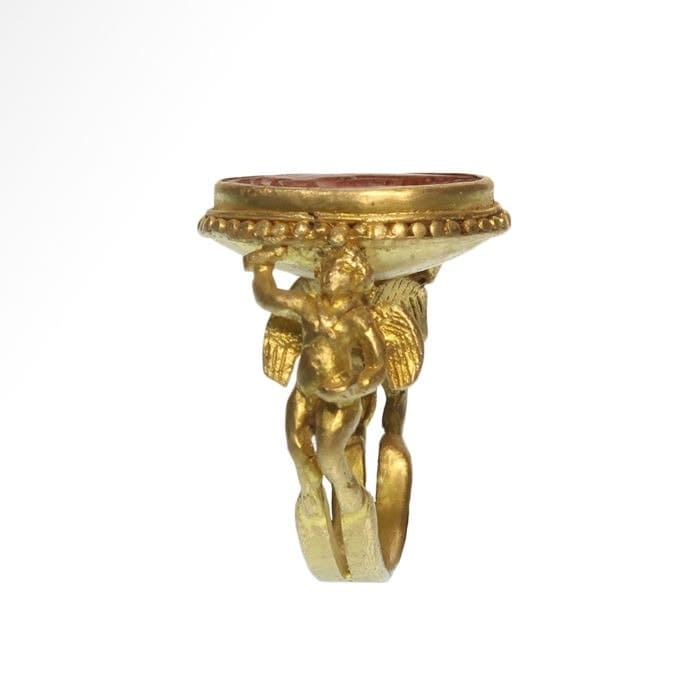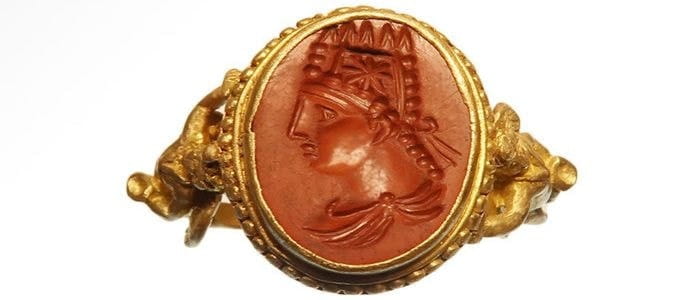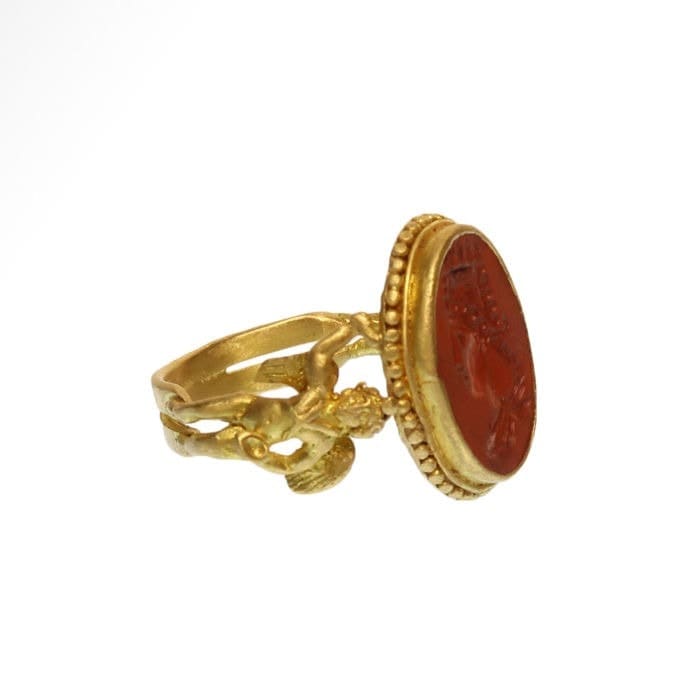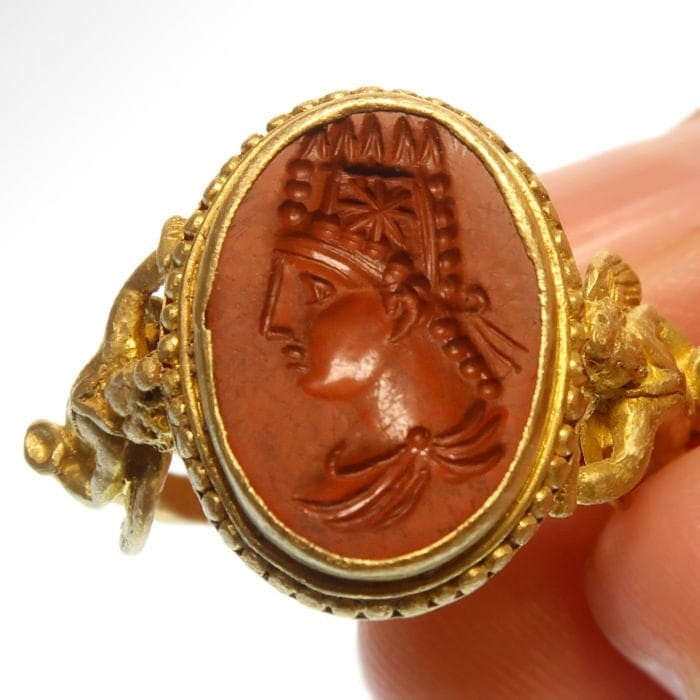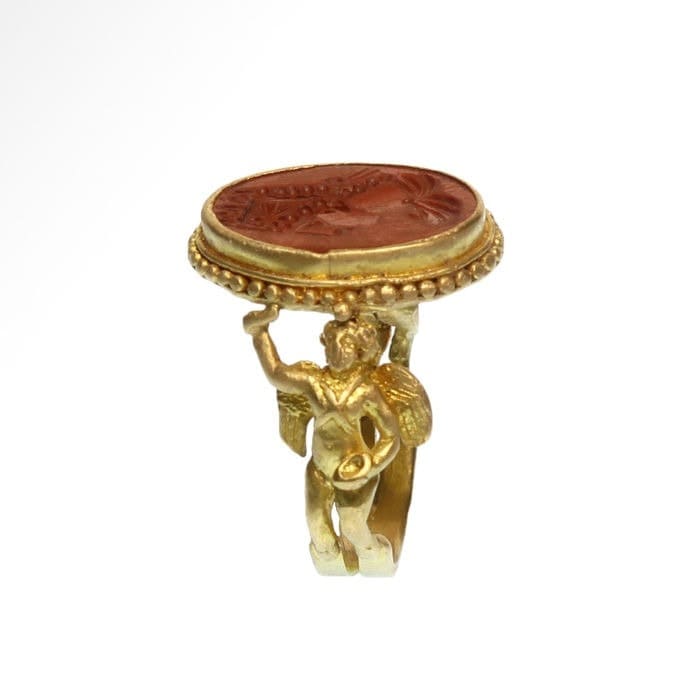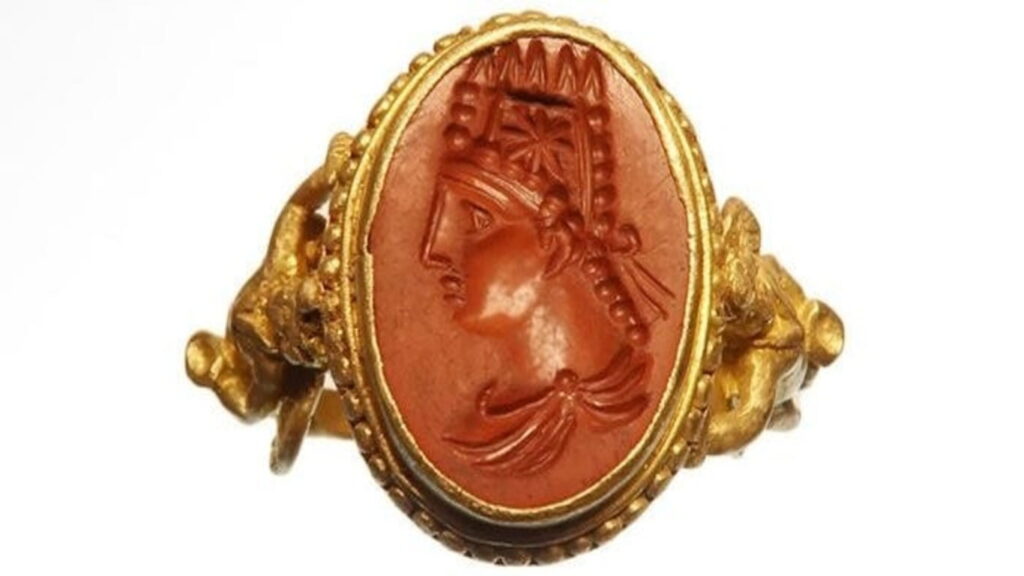
A gold ring set with a jasper seal engraved with a profile in an Armenian tiara. What it shows, when and at which court such an object could have been made, and what is actually known about it.
What lies in the palm
The ring is heavy, and its gold has a deep, warm color. A rim of tiny gold beads, granulation, runs around the oval bezel. The stone itself is red jasper, polished to a brick-red sheen. Where the hoop widens toward the bezel, two winged Erotes sit on the shoulders of the ring. They are not flat appliqués but sculpted figures, worked down to the feathers of their wings. They have put their hands under the bezel and hold it up the way one holds a tray.
A male profile facing left is engraved on the stone. The head is covered by a tall tiara with five points; each point and the whole outline are traced with rows of dots. In the middle of the tiara is an eight-pointed star. Beneath it, curls of hair and two ribbons fall onto the neck. The man has a straight nose, a heavy chin and a calm, slightly haughty face.
Stones like this were not made for decoration. The engraved image was pressed into wax or clay, and the impression took the place of a signature: it closed a letter, sealed a vessel or a storeroom, confirmed an order. Whoever owned the seal spoke in his own name, and if the seal bore a king, in the king’s name as well. That is why a ring with a royal portrait always reads as a sign of power, even when we do not know whose hand wore it.
The king recognized by his tiara
If the profile belongs to Tigranes II the Great, we are looking at a man who lived a life worthy of a novel. He was born around 140 BC into the Artaxiad dynasty. In his youth he was handed over as a hostage to the Parthian king: after the defeat of Artavasdes I, Armenia had acknowledged dependence on Parthia. When his father Tigranes I died in 95 BC, the Parthians released the heir, but not for free. According to Strabo, Tigranes gave them “seventy valleys,” border lands that he later took back (see Nina Garsoian’s article).
Once back, he did what no one expected of him. He annexed Sophene, recovered the surrendered valleys, marched through Media and subdued Gordyene, Adiabene and Osroene. Coins struck after 85 BC call him King of Kings, a title that goes back to the Achaemenid tradition (Iranica, Tigran II). In 83 BC, worn out by the struggles of the last Seleucids, Syria offered him the crown. Antioch became his city, and its mint struck tetradrachms bearing his portrait (Britannica, Gulbenkian).
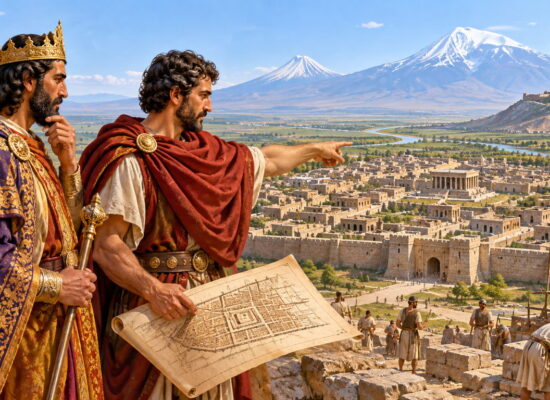
In those same years Tigranocerta rose on the border between Armenia and Mesopotamia. Tigranes gathered there the inhabitants of twelve Greek cities of Cappadocia, Cilicia and Syria and moved all his wealth into the new capital. Alongside buildings in the Hellenic manner there rose a theater, and for its opening he summoned performers from all over the East. Plutarch, who disliked Tigranes, nevertheless describes this in detail: when Lucullus took the city, he found a multitude of actors in it and staged festival games with them (Plutarch, Lucullus, 29). The Greek historian Metrodorus of Scepsis lived at court and wrote the king’s biography (Kurkjian, A History of Armenia).
Court ceremonial was Persian. Tigranes wore a purple cloak and a tunic striped in white and purple, and he did not take off his tiara of precious stones even when hunting. Four vassal kings ran on foot beside his stirrup when he rode out, and stood by with arms crossed when he received envoys (Plutarch, Lucullus, 21).
In 69 BC it all collapsed. The Roman army of Lucullus defeated Tigranes’ far larger force at Tigranocerta, and a year later the old center of Armenia, Artaxata, fell as well. Peace with Pompey left Tigranes his native Armenia, but the Syrian and Mesopotamian conquests had to be given up. He died around 55 BC, a very old man (Britannica). The diadem of Tigranes, captured by the Romans, was carried in the triumph of Lucullus (Plutarch, Lucullus, 36–37).
The tiara as a portrait
In the ancient world a king was recognized by his headgear. On the coins of Tigranes he always wears a tall soft tiara with ear flaps, and beside him stands the city that acknowledged him. On the gem in the Museum of Fine Arts in Boston the same king is cut in red jasper 14 mm long. The museum dates it to the early or middle first century BC and describes it as follows: a tiara with five points, each made of two pellets, one large and one small; the outline traced in dots; an eight-pointed star with a circle at its center in the middle of the tiara, flanked by birds, possibly eagles; and two flaps descending from under the tiara, covering the hair and the ear. The gem was bought in Smyrna in 1900 by Edward Perry Warren and entered the museum in 1901.
The profile on our ring is built the same way: five dotted points, a star in the center, flaps and ribbons. In the Iranian tradition the star on a tiara signifies the king’s divine standing. A crown with a pearl border and a star, as Iranica notes, belongs to the Iranian world, and together with the title King of Kings it shows which tradition Tigranes drew on in building his state (Iranica).
At the same time, the pointed tiara was a mark of the dynasty, not of one man. The coins of his father Tigranes I also show a five-pointed tiara (Tigranes I), and the headgear alone cannot tell us who is before us. What works here is a sum of features: the time in which such stones were made, the style of the carving and the repetition of the Boston scheme.
Erotes on the shoulders
The winged boys on the ring belong to Hellenistic fashion. From the time of Alexander to the Roman era, jewelers decorated gold with Aphrodite and her son Eros, and flying figures of Eros and Nike were a favorite motif for earrings. Jewelry often passed from father to son as a family treasure, and sometimes it was given as an offering to sanctuaries (Metropolitan Museum, Hellenistic Jewelry).
Such a choice speaks of the patron’s taste. The court of Tigranes was Hellenistic in the language of its culture: Greek inscriptions on coins, Greek literature and theater, Greek townsmen in the new capital. The Boston museum attributes its gem to Greek work. The engraver probably spoke Greek, even though the king whose face he cut ruled on the Armenian Highland and in Syria. The golden Erotes on the shoulders of the ring suit exactly this combination: a Greek image of love holds up the portrait of a king in an Iranian tiara.
Whose ring it was
It is impossible to say for certain who wore this ring. There is no inscription on the stone, and no owner’s name. Three options are possible. It could have been the personal seal of the king himself, with which he authenticated his orders. It could have been the ring of an official who received a mark of trust from the court, or who wore the sovereign’s portrait as a sign of loyalty. It could have been an object from the circle of the royal family. All three explanations fit the costly gold and stone, but none is proven. One thing is clear: the owner stood high enough to wear the king’s face on his hand.
The ring’s journey
According to the seller’s description, the ring has been in a private collection in France since 1990. What happened to it before that is unknown: no findspot, no first publication and no collector’s name could be found in open sources. For objects that reached the antiquities market, this is a common story. The Boston gem, for example, reached the museum through a dealer who bought it in Smyrna.
Source analysis
What independent sources confirm. The dates of the reign of Tigranes II (95–55 BC), the title King of Kings on coins after 85 BC, the founding of Tigranocerta and the resettlement of Greeks there, the Hellenistic character of the court, the theater, the lavish ceremonial and the tiara as the king’s chief attribute are all confirmed by Iranica, Britannica and Plutarch. The iconographic scheme of the profile (five dotted points, a star, flaps) matches the gem in the Boston museum, which the museum itself identifies as an image of Tigranes II.
What rests on the seller’s description. The date “first century BC,” the material of the stone, the identification as Tigranes and the information about a French private collection since 1990 all come from the catalog description, and we found no published study in which the ring is examined in detail. The description calls the figures of the Erotes inlaid. In the photographs they are sculpted gold figures forming part of the ring itself.
What remains open. There is no inscription and no archaeological context, so neither the owner, nor the workshop, nor the place of manufacture can be named. There is also a difference from the Boston gem: on the Boston portrait, birds stand on either side of the star, while on our ring they are absent from the visible part of the tiara. This does not refute the attribution, but it shows that the scheme is related rather than copied. A five-pointed tiara is also known from the coins of Tigranes I, so that the figure is Tigranes the Great can ultimately be confirmed only by the stylistic comparison of specialists in engraved gems.
Conclusion. The account above is supported by what is known about Tigranes II and the tastes of his court: in the first century BC exactly such a ring could have appeared at his court, gold, with Greek Erotes, with jasper and a profile in a tiara with a star. But the object remains attributed by resemblance, not by document.
Sources
- Oval gem with head of Tigranes II of Armenia, Museum of Fine Arts, Boston
- Garsoïan N. Tigran II, Encyclopaedia Iranica
- Garsoian N. Tigran (PDF, Internet Archive)
- Tigranes II the Great, Encyclopaedia Britannica
- Tigranes II, World History Encyclopedia
- Tetradrachm of Tigranes II the Great, Calouste Gulbenkian Museum
- Plutarch, Lucullus 21 (Perrin)
- Plutarch, Lucullus 29
- Plutarch, Lucullus 36–37
- Kurkjian V. A History of Armenia, chapter on Tigran
- Hemingway C., Hemingway S. Hellenistic Jewelry, Metropolitan Museum of Art
- Rare gem with Tigranes the Great, PeopleOfAr