How the 2026 Armenian-Italian field season at the Shamiram fortress and necropolis in Aragatsotn adds to the long history of Central Armenia, from Late Bronze Age elites to the Kingdom of Van and the Hellenistic era
In brief
- Who and when. The Joint Armenian-Italian Archaeological Mission worked at Shamiram, Aragatsotn Province, from 26 May to 25 June 2026. It is directed by Varduhi Melikyan (Institute of Archaeology and Ethnography, National Academy of Sciences of Armenia) and Roberto Dan (ISMEO), according to the Institute’s season-closing announcement and the Armenpress report.
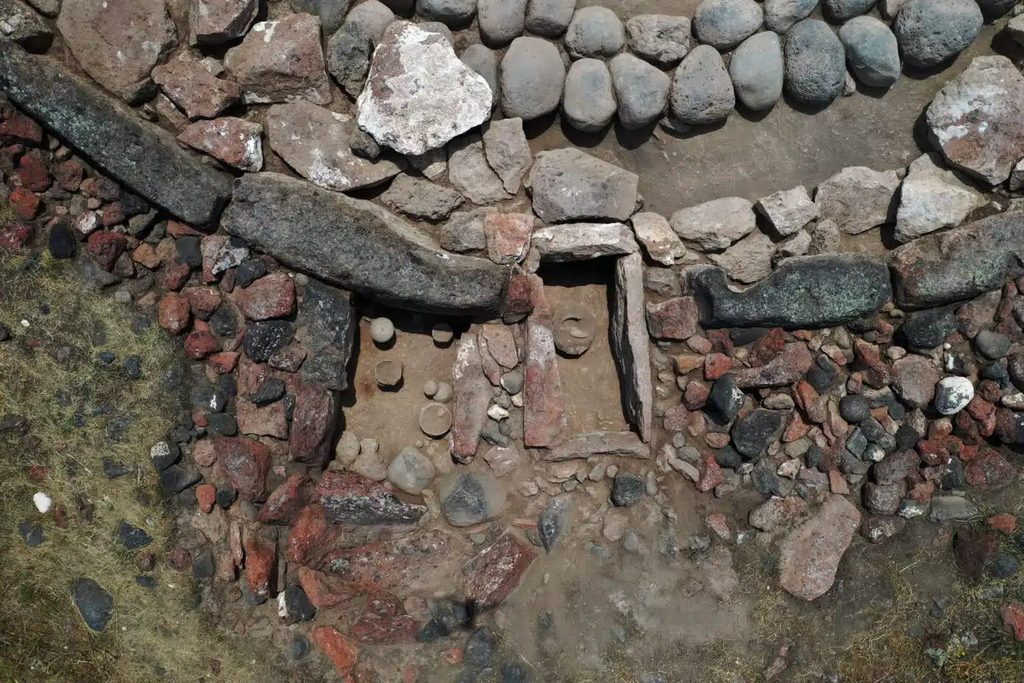
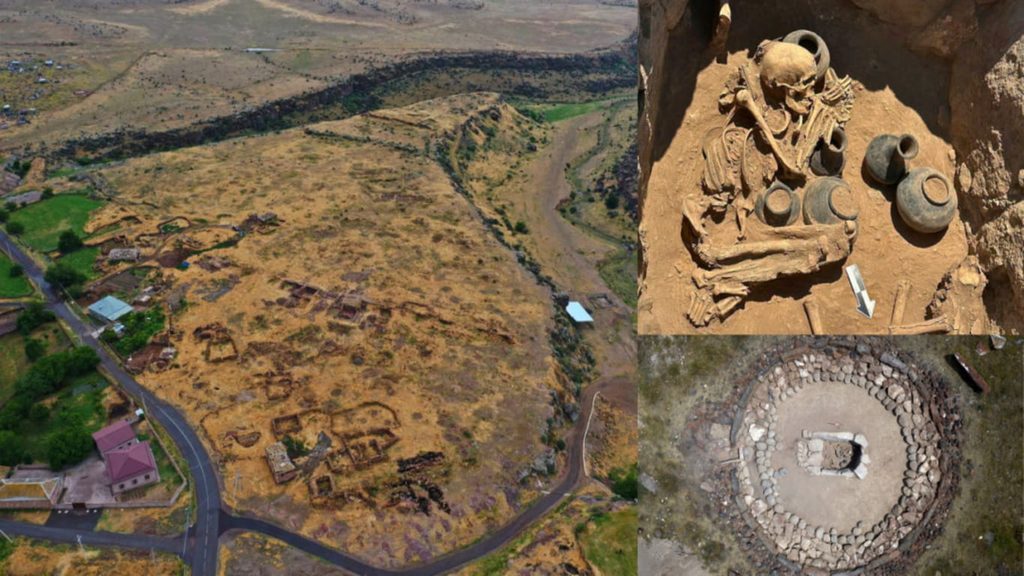
- The headline find. Continued excavation of Tomb No. 3, a monumental Late Bronze Age burial with concentric stone circles, a central stone chamber, bronze weapons, obsidian and metal arrowheads, and the remains of a ritually sacrificed horse (Armenpress).
- A rare stratigraphic sequence. Behind a tower of the Urartian fortress, a Middle Iron Age room with fire and destruction layers was found, together with a burial that is older than the Urartian defensive system (News.am).
- Monumental Urartian masonry. Tower 3 revealed a well-preserved megalithic structure of about 8.5 × 8.5 m (Armenpress).
- Long afterlife. Evidence of reuse and rebuilding from the Hellenistic period through the Late Antique, medieval and post-medieval eras.
- Funding. The project is co-funded by Italy’s Ministry of Foreign Affairs and International Cooperation, with the support of the Italian Embassy in Yerevan (Armenpress).
The site: a fortified plateau and a necropolis of thousands of tombs
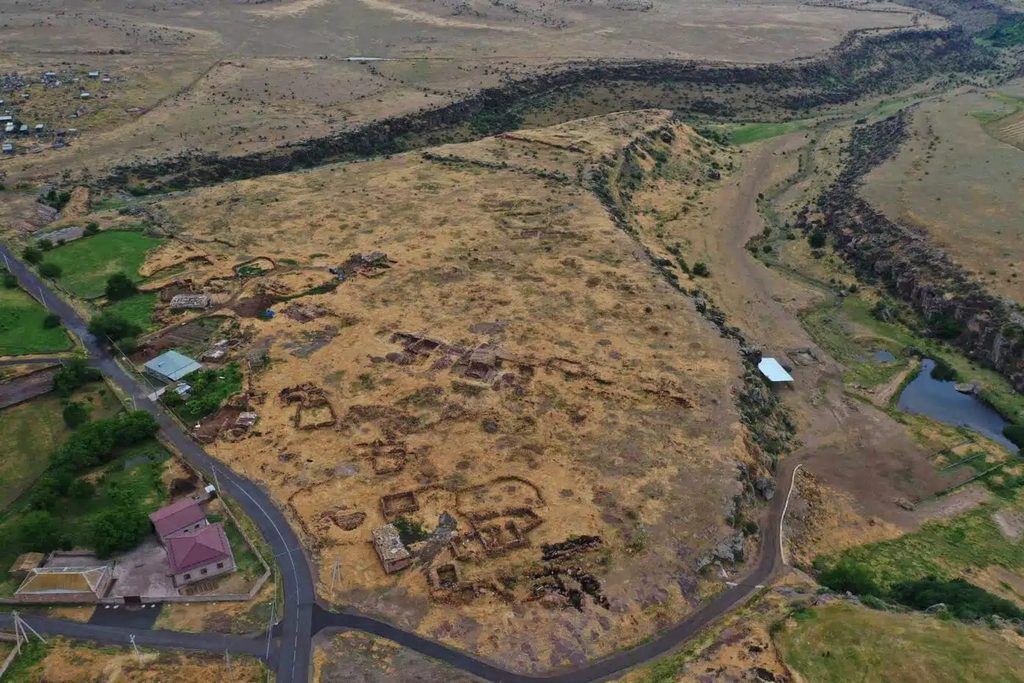
Shamiram lies in the Aragatsotn region of Armenia. Italy’s ANSA news agency, reporting on a June 2026 visit by the Italian Ambassador, describes a fortified complex together with a vast adjoining necropolis of roughly five thousand tombs marked by stone circles on the ground. The same report singles out the fifth defensive wall, attributed to the Urartian period of the 7th century BC, which runs for more than 300 metres and encloses about seven hectares, one of the largest known for that era.
The scale is not new information. An Institute report from the 2020 season already described the fifth wall as 320 m long and 3.5 m wide, with four large towers and wall foundations along the canyon, and noted that excavation of the tomb field on the left bank of the ravine had begun under Varduhi Melikyan. The Institute also recorded that the fortress, originally built in the Urartian period, was used and rebuilt in later centuries, with stones from its walls reused in village houses and outbuildings into the 20th century.
The European Heritage Hub, whose partner SIREH ran a student workshop on site on 23 June 2026, calls Shamiram one of the largest and most complex fortified settlements in central Armenia, with at least six lines of walls across a broad rocky plateau. It adds that recent campaigns exposed a monumental fortification system attributed to the late phase of the Kingdom of Urartu, and evidence of occupation through the Orontid and Artaxiad periods into the medieval era.
The Institute’s own summary of the 2026 results lists an exceptional continuity of occupation: Late Bronze Age, Iron Age, Urartian, post-Urartian, Hellenistic, Late Antique, medieval and post-medieval (News.am).
Tomb No. 3: elite burial and the horse
What was reported
According to the Armenpress account of the Institute’s statement, Tomb No. 3 is a monumental Late Bronze Age burial featuring:
- concentric stone circles;
- a central stone burial chamber;
- rich grave goods, including bronze weapons;
- obsidian and metal arrowheads;
- the remains of a ritually sacrificed horse.
The Institute argues that this provides important new evidence on local elites, funerary practice and the symbolic role of the horse in Late Bronze Age communities of Armenia.
The English-language outlet Greek Reporter dates the tomb to roughly 1600-1200 BC and stresses that the multi-ring design implies careful planning and a considerable labour force. Note that this is the outlet’s own framing: the Institute’s release, as quoted by Armenpress, says only “Late Bronze Age”, and a published radiocarbon or typological dating from the mission is still to come.
The regional context of horse burial
The horse was central to elite identity across the Armenian Highlands long before the Urartian kings.
- At Lchashen on Lake Sevan, excavations from the 1950s exposed hundreds of Bronze Age graves. World History Encyclopedia notes skeletons of horses and oxen linked to carts among the grave goods. A summary of the Lchashen wagon dates the best-preserved four-wheeled canopy wagon to the 15th-14th centuries BC and describes wheeled vehicles accompanying leaders in death.
- A scholarly study of horse sacrifice in Bronze and Early Iron Age Armenian burials argues that the horse was understood as linked to the world of the dead, and possibly as a mediator between worlds.
- At Aghavnatun, on the southern slopes of Mount Aragats, a 2021 paper by Nachmias, Bar-Oz, Nadel, Petrosyan and Gasparyan reported a complete stallion in a 15-metre monumental tomb, radiocarbon dated to about 2130 ± 20 BP (a much later, Hellenistic-period burial), whose morphology resembles the famed Nisean horse. The authors link the burial to horse breeding in the Ararat Depression, and the full text places it within the Highlands’ ancient reputation as horse-breeding country.
Taken together, Shamiram’s Tomb No. 3 sits at the earlier end of a long Highland tradition: Late Bronze Age horse sacrifice near Aragats, then the Lchashen chariot elites, and much later the Aghavnatun stallion. Bear in mind that these are different periods and different burial types; the comparison shows regional continuity of horse symbolism, not a single unbroken rite.
Before the Urartian fortress: a destroyed Iron Age room and an older burial
Among the season’s most scientifically interesting results is the one that attracted the least headline attention. The Institute reports that in the area behind one of the towers of the Urartian fortification, archaeologists found a Middle Iron Age room with substantial destruction layers, followed by a burial that predates the construction of the Urartian defensive circuit. In the Institute’s words, as relayed by News.am, this sequence offers a rare opportunity to examine the transformation of a local Iron Age centre before and during the expansion of the Kingdom of Van in the Ararat region.
Why does this matter? The standard picture of Urartian expansion into the Ararat plain is driven by royal inscriptions. Wikipedia’s summary of Argishti I’s campaigns records raids from about 786 BC, the founding of Erebuni in 782 BC, and the foundation of Argishtikhinili in 776 BC. UNESCO’s tentative-list file on Yerevan notes that Argishti’s conquest of the Ararat Valley is commemorated in his inscription at the Tushpa cliffs. But kings’ inscriptions describe conquest from the conqueror’s side. Stratified rooms and graves tell us what was already there: a settled local community with its own dead, its own buildings, and, at Shamiram, a destruction layer.
The Institute does not say who caused the burning, and this should not be guessed. What can be said is that the new data allow a direct archaeological test of what Urartian expansion meant locally: abrupt violent replacement, gradual incorporation, or something in between. The question has been raised independently by Austrian and Armenian researchers at Aramus, where radiocarbon-dated stratigraphy from the 9th to the 4th centuries BC is argued to offer a new perspective on the nature of Urartian dominance in Armenia.
Tower 3 and the gate of Wall 2
Urartian megalithic building
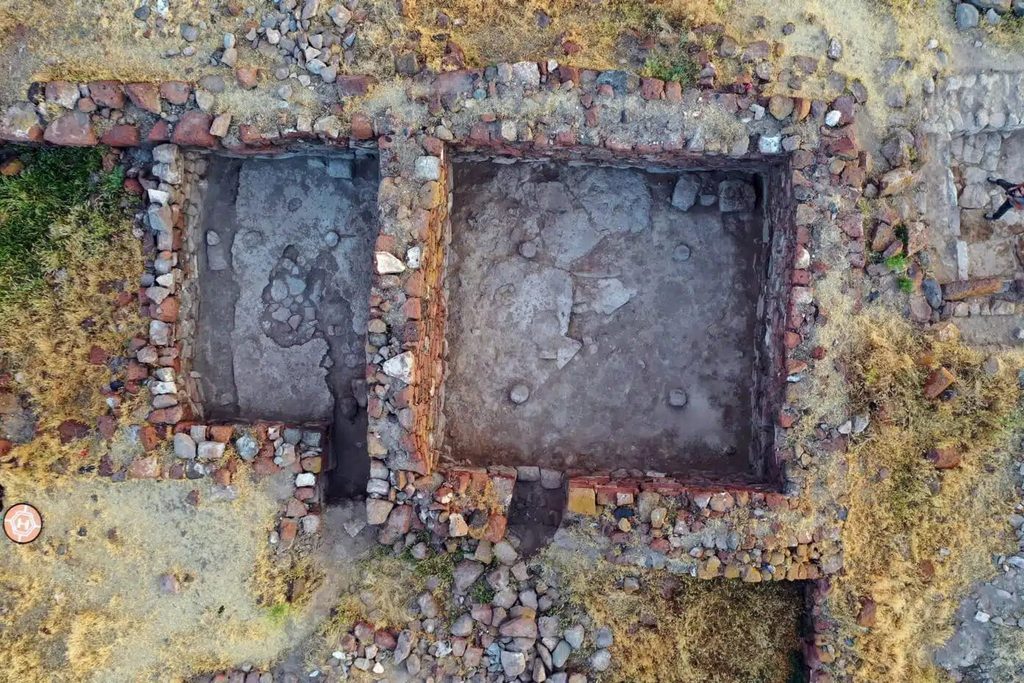
Excavation and cleaning of Tower 3 confirmed the monumental character of the Urartian fortification, exposing a well-preserved megalithic structure of approximately 8.5 × 8.5 metres (Armenpress). Greek Reporter reads this as strengthening the interpretation of Shamiram as a major fortified centre rather than a small rural settlement. That is a reasonable inference from the scale of the walls and towers, though the Institute’s own wording is more cautious.
For comparison, the royal foundation at Erebuni, described by UNESCO as a fortress-city of Argishti I crowning Arin Berd Hill, is documented by 23 stone inscriptions; Shamiram, by contrast, has so far produced a built environment but no comparable royal text in the sources consulted here. That absence is itself worth watching as excavation continues.
The gate of Wall 2: Hellenistic rebuilding
The most interesting architectural result concerns the gate complex of Wall 2. Per Armenpress, the currently visible L-shaped entrance was most likely rebuilt in the Hellenistic period, replacing an earlier Iron Age entrance. In other words, the monument visitors see today is not a pure Urartian gate but an Urartian-era defensive line that was deliberately reworked some four to five centuries later. This fits the picture of a fortress maintained and adapted, not abandoned, after the fall of the Kingdom of Van.
After Urartu: column bases, medieval houses and the persistence of the fortification
The 2026 campaign, the Institute says, opened new perspectives on post-Urartian Shamiram. In Area 7, archaeologists documented column bases, structures abutting the Urartian towers, and well-preserved medieval buildings, which together show how the ancient fortifications continued to shape the spatial organization of the site for centuries (Armenpress).
This post-Urartian chapter connects to the wider history of the region:
- The Orontid (Yervanduni) dynasty, according to the Encyclopaedia Iranica, ruled Greater Armenia, Sophene and Commagene across the Achaemenid and Hellenistic periods. Its capital at Armavir is the successor of Urartian Argishtikhinili, and Armeniapedia notes that the Urartian defensive wall and buildings there were still usable and were reused by the Orontid kings.
- A 2025 article in the journal Aramazd by Syuzanna Muradyan, on Yervandashat-Yervandakert, concludes that after the fall of the Urartian kingdom its heritage found varied manifestations in the culture of Yervandid Armenia.
- In December 2024, Roberto Dan, Varduhi Melikyan and Artur Petrosyan presented a paper at a Rome conference whose title translates as “From protohistoric communities to Urartu and the Orontids: new archaeological discoveries at the site of Shamiram in Armenia” (conference programme, Sapienza University). The mission itself, then, frames the site as a sequence running from pre-Urartian communities through the Kingdom of Van into the Orontid era.
Why Shamiram matters: continuity on one hill
Few places in Armenia allow an archaeologist to follow one locality from a monumental Late Bronze Age tomb, through a destroyed Iron Age room and an Urartian megalithic circuit, into Hellenistic gate-building and medieval houses. The Institute states that the results “once again confirm” Shamiram’s importance for understanding the long-term history of Central Armenia, from Bronze Age funerary traditions and local Iron Age communities to Urartian monumental architecture and later reuse (Institute announcement).
For readers interested in the continuity of the Armenian Highland’s civilizations, three threads stand out:
- The same land, the same elites? Tomb No. 3 documents a powerful local warrior aristocracy centuries before the Kingdom of Van, in the same Aragats-Ararat zone later claimed by Argishti I.
- Urartian construction on an existing settlement. The pre-Urartian burial and Iron Age room indicate that the Urartian circuit was built on a place with an earlier life, not on an empty plain, a point that complicates the inscriptional image of conquest into emptiness. (Argishti’s own Erebuni text, as quoted in one traveller’s account, speaks of a land that was a desert before his works.)
- Reuse across regimes. Hellenistic rebuilding of Wall 2’s gate and the medieval buildings of Area 7 show successive Armenian-era communities inheriting and adapting Urartian stone.
A note on interpretation: specialist and mainstream readings
This site treats the Kingdom of Van (Urartu, Biainili) as an integral part of the Armenian Highland’s continuous history, and the Shamiram sequence is naturally read in that light: same hill, same plateau, successive polities, and a population whose burials and buildings overlap and succeed one another. Readers should know where the evidence ends and interpretation begins.
- What the sources establish. A site continuously occupied across the periods listed; Urartian monumental fortifications; Late Bronze Age elite burial; Hellenistic rebuilding of a gate; medieval reuse. These are statements of the excavators.
- What remains debated in mainstream scholarship. Whether the population of Urartian Shamiram was ethnically and linguistically continuous with the later Armenian-speaking population is a separate question that stratigraphy alone cannot answer. The ethnic and linguistic identity of Urartu’s ruling elite is a long-running subject of academic discussion; for one example, a chapter by Armen Petrosyan, “On the Ethnic Origin of the Ruling Elite of Urartu”, appears in an edited volume co-edited by Avetisyan, Dan and Grekyan. The Italian-Armenian authors of a 30-year review of Italian Urartological archaeology in Armenia likewise tie their work to the broader process of Armenian ethnogenesis, which they treat as a research problem rather than a settled matter.
- What the 2026 data do not yet show. No published radiocarbon dates, osteological identification of the horse, isotopic or DNA results, or detailed excavation plans accompany the press releases. The Institute says anthropological and archaeozoological analyses will continue (Institute announcement).
What to watch next
- Dating of Tomb No. 3: calibrated radiocarbon dates would test the 1600-1200 BC range cited in the press and place the tomb relative to the Lchashen-Metsamor horizon.
- The archaeozoological study of the horse: size, age, sex and any traces of harness or bit would connect it to the Highland horse-breeding tradition discussed above.
- Absolute dating of the destruction layer behind the Urartian tower, which would help determine whether it reflects pre-Urartian conflict, the Urartian conquest itself, or later events.
- Final publication of the Wall 2 gate sequence, to show exactly what Hellenistic builders replaced.
Related articles on this site
- Erebuni and the founding of Yerevan in 782 BC: placeholder link
- Yervand I and the Orontid dynasty: placeholder link
- The Lchashen-Metsamor bronze chariot model: placeholder link
- Urartian fortresses of the Ararat plain, from Karmir Blur to Argishtikhinili: placeholder link
Sources and further reading
Primary announcements by the excavators
- Institute of Archaeology and Ethnography, NAS RA, The 2026 Archaeological Excavation Season at Shamiram Has Successfully Concluded (7 July 2026)
- Institute of Archaeology and Ethnography, Archaeological Excavations Continue at the Fortress and Cemetery Field of Shamiram (2020 season)
- Institute of Archaeology and Ethnography, 2020 season summary and later reuse of the fortress
News reports on the 2026 season
- Armenpress, Armenian-Italian archaeological mission makes new discoveries at Shamiram site
- News.am, Excavations in Armenia’s Shamiram village reveal important data about site’s pre-Urartian phases
- ANSA, Amb. Ferranti visits the Shamiram archaeological site (12 June 2026)
- Greek Reporter, 3,000-Year-Old Tomb in Armenia Reveals Elite Burial With Bronze Weapons, Sacrificed Horse
- Georgia Today, Archaeologists uncover major Late Bronze Age burial complex at Armenia’s Shamiram site
- European Heritage Hub, SIREH workshop at Shamiram
Scholarly and background literature
- Nachmias, Bar-Oz, Nadel, Petrosyan, Gasparyan, “A monumental horse burial in the Armenian Highlands”, Archaeology, Ethnology and Anthropology of Eurasia 49/3 (2021), full text
- “Horse sacrifice in funeral rites (based on the Bronze and Early Iron Age burials in Armenia)”
- Kuntner, Avetisyan, Heinsch, “The Fortress of Aramus in its Historical Context”
- Biscione, Dan, Gasparyan, Hmayakyan, Petrosyan, “Tra il lago Sevan e l’Arasse: Trent’anni di archeologia Urartologica italiana in Armenia (1994-2023)”, Bollettino della Società Geografica Italiana (2023)
- Castelluccia, Dan, La Farina, Petrosyan, Raccidi, “L’attività archeologica italiana dell’ISMEO in Armenia” (2018)
- Muradyan, “Yervandashat-Yervandakert: The Yervandid/Orontid capital and its Urartian past”, Aramazd 18 (2025)
- Encyclopaedia Iranica, “Orontids”
- UNESCO World Heritage Centre, Yerevan tentative list: Erebuni and the Ararat Valley
- World History Encyclopedia, Erebuni and Bronze Age Burial Tomb at Lchashen
- Armeniapedia, Erebuni Fortress and Armavir Ruins
Image Source: 3,000-Year-Old Tomb in Armenia Reveals Elite Burial With Bronze Weapons, Sacrificed Horse