Archaeology · Travel · Syunik, Armenia — October 28, 2026
A routine groundwork job in the southern Armenian village of Shenatagh has turned into one of the more intriguing archaeological stories of the season. While local residents were clearing land beside their house, they broke into an ancient stone burial chamber. Specialists now report at least three large tomb chambers dating, in their field assessment, to the 7th–6th centuries BC, with hundreds of finds already in the laboratory. This article does two things: it sets out what has actually been reported and what it may mean in the context of Syunik’s Iron Age, and it places Shenatagh on a practical heritage route — from Sisian’s Zorats Karer and Shaki Waterfall to the medieval monastery of Tatev — with places to eat and sleep along the way.
A note on sourcing. The facts of the discovery below come from a single broadcast report by the Russian-language channel MIR 24 (correspondent Lilit Madunts), the text of which was supplied for this article; the direct URL of the report was not included, and I could not locate an independent second report or any formal publication from the excavators. Everything about the find itself should therefore be read as a preliminary, field-stage account. Background and travel information is drawn from the linked sources throughout and collected at the end.
1. What was found
According to the MIR 24 report, the discovery took place in Syunik Province during earthworks in the yard of a residential house in Shenatagh. The residents were enlarging their plot to make room for an apiary and had no idea that an ancient cemetery lay under the soil. One villager, Hayk Harutyunyan, told the reporter that the digging exposed a pit containing clay vessels and other objects, and that the family notified specialists straight away; he described the moment as a shock, since nobody had imagined such a monument could lie beneath a home.
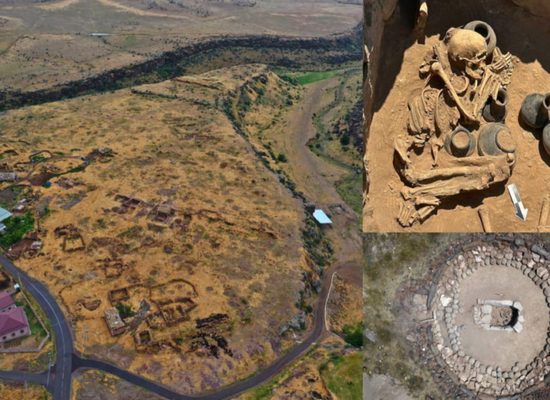
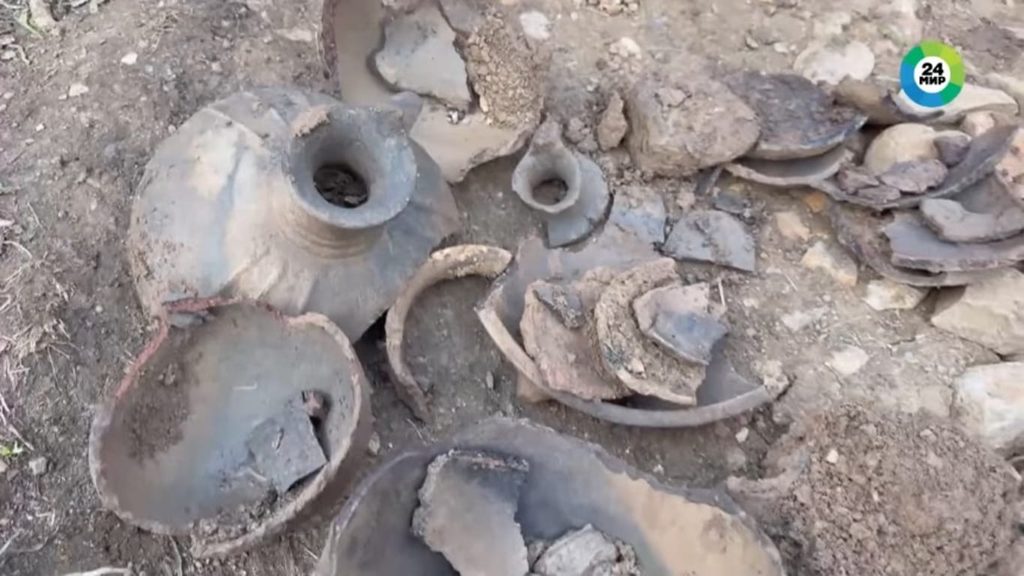
Archaeologists then documented three large burial chambers. The structures are rectangular, built of stone and roofed with massive slabs. Inside, the team recorded a rich assemblage: ceramics, bronze and iron objects, including fragments of weapons and items of personal adornment.
Two specialists from the state Service for the Protection of the Historic Environment and Historical-Cultural Museum-Reserves gave details:
- Asmik Simonyan, anthropologist, said that the team was working at the entrance (dromos) end of one tomb, and that the burial chamber behind it is about eight metres long. It contained more than 100 vessels and human remains that were not lying in anatomical order. In her reading, this points to a collective burial that was probably used repeatedly, with new interments added over time.
- Anna Baghdasaryan, conservator, reported that the laboratory already holds over 200 objects — pottery, arrowheads, knives, bronze bracelets and belt elements — many of them almost fully preserved. She added that, in her estimation, this is perhaps only about one percent of what may still be hidden underground.
All finds have been transferred to the laboratory, where cleaning, classification and detailed study are beginning. Full-scale fieldwork on site is waiting for dry weather.
2. How to read the find
A family or community vault, not a single grave. Disarticulated human remains in a long stone chamber are a classic sign of a tomb that stayed open or was reopened across generations. When a new burial was added, earlier bones were commonly pushed aside or gathered together. That is consistent with Simonyan’s remark about repeated use, and it suggests a community that kept a long relationship with one burial place rather than a short-lived necropolis.
The grave goods. Arrowheads, knives, bronze bracelets and belt parts are the kind of items that fill Iron Age burials across the Armenian Highland, and the presence of both bronze and iron is itself a useful marker of the period. Precise typological parallels will only be possible once the objects are drawn, catalogued and published, so the 7th–6th-century BC date should be treated as an initial field dating that radiocarbon and typology may refine.
An unusually pottery-rich context. In the 2015 southern Syunik survey run by the Armenian Academy of Sciences and NYU’s Institute for the Study of the Ancient World, Dan Potts noted that walls and tombs across the region tended to come with relatively little pottery, which makes dating difficult (ISAW report). A single chamber with more than a hundred vessels, if it holds up under study, could therefore become a valuable reference sequence for the region. That is my inference rather than a claim made by the excavators.
What cannot yet be said. The report does not identify the people buried, their social status, or the settlement they belonged to. No inscriptions, seals or imported luxury items are mentioned. Any ethnic or political attribution would be premature.
3. Syunik in the Iron Age: why this matters
Syunik has long been called under-studied. Onnik Khnkikyan’s monograph on the Bronze and Iron Ages of the province opens by describing the region as a “white spot” on the archaeological map (Khnkikyan, Syunik’ during the Bronze and Iron Ages, 2002), and a recent review of the volume Sacred Landscapes of Syunik during the Bronze and Iron Ages stresses both the exceptional density of sites and the fact that systematic research in the province has only intensified since 2013 (review in Armenian Journal of Near Eastern Studies-type proceedings, arar.sci.am).
The 2015 ISAW–Institute of Archaeology survey, based at Sisian, gives a sense of the landscape in which Shenatagh sits (ISAW):
- Iron Age sites with monumental walls of unworked stone, often perched on the edges of steep ravines, are a feature of the region; one was located on a forested mountainside near Halidzor, on the road south toward Tatev — not far from Shenatagh.
- At Ashotavan the team found a settlement and tombs of the early to mid-1st millennium BC with diagnostic Achaemenid pottery and a Scythian-style bronze arrowhead.
- At Tanahat, an important Urartian inscription was found in 1975 carved on a reused medieval khachkar.
Against that backdrop, Shenatagh adds something the survey could rarely document: a large, richly furnished, multi-use burial structure from the period when the Van Kingdom (Urartu) was in its final phase and the Highland was entering the Achaemenid era.
Interpretive note: how this period is framed
The 7th–6th centuries BC sit across a historiographical fault line. The mainstream academic framework treats this as the late Urartian period, followed by the collapse of the Van Kingdom and the Median–Achaemenid transition, with the Orontid (Yervanduni) satrapy emerging in the Achaemenid period. The line taken on this site — a continuous Armenian Highland civilisation from the Van Kingdom through the Achaemenid-era satrapy to Hellenistic Armenia — would read a burial tradition like Shenatagh’s as local continuity within that sequence. The Shenatagh material cannot by itself settle that debate: it is a burial assemblage whose cultural attribution depends on future comparison with other Syunik, Lake Sevan and Ararat-plain cemeteries. Readers should treat this paragraph as a framing of the question, not as a result of the excavation.
4. Visiting: the Shenatagh–Sisian–Tatev heritage route
First, an important caveat
The tombs are on private residential land, are under active archaeological work, and are not an organised visitor site. Please do not go looking for the courtyard, and do not collect anything from the surrounding fields. The best way to “see” the discovery is the route below — the village itself, the Iron Age and medieval landscape around it, and the museum and monument collections of Sisian. The report does not say where the finds will ultimately be displayed.
Where Shenatagh is
Shenatagh (Շենաթաղ; earlier Shinagat and Lernashen) is a village in the Sisian Municipality of Syunik, at about 39°22′48″ N, 46°07′56″ E, with a recorded population of 422 in 2010. Trail descriptions place it roughly 25 km south of Sisian (Wikiloc, AllTrails), and the same trails connect it on foot to Tatev. It makes sense to treat Shenatagh as the quiet, archaeologically interesting middle stop between the town of Sisian and the monastery of Tatev.
Getting there and road conditions
- From Yerevan: Sisian lies about 220 km south of the capital (Bumpylands) on the north–south M2 highway to Goris, Kapan and Meghri. Public transport: buses run from Yerevan’s Kilikia station to Sisian, and from there onward to Shenatagh by taxi or local transport (Hiking Project).
- Main road: The M2 is a major state highway and is generally passable, but mountain sections around Sisian and Goris are prone to black ice and closures in winter (Armenpress, Armenpress, Sisian–Goris closure). We are now at the end of October, so check the Ministry of Interior Rescue Service road bulletins before leaving, and carry winter tyres from late autumn on.
- Local roads: I could not find a published survey of the surface of the access road to Shenatagh. Treat it as a rural mountain road: drive slowly, expect patches of damaged asphalt or gravel, and ask locally in Sisian before setting out after rain or snow. The Tatev–Ltsen link, built to shorten the Tatev–Sisian journey, is part of a wider road-upgrade programme in the province (ARKA, Armenpress).
- Border region: Syunik borders Azerbaijan and Iran, and some guides advise checking locally before visiting sites close to the frontier (Wikivoyage, Sisian). I have not verified current official travel advisories, so check your government’s guidance and the latest local news before travelling.
Suggested itinerary (2–3 days)
Day 1 — Yerevan to Sisian: the megalithic and natural highlights
- Optional en route: Noravank near Yeghegnadzor, one of the key stops on the way south.
- Shaki Waterfall — a few kilometres north-west of Sisian, just before the town. Guides give its height as around 18 m, though some sources quote higher figures (Bumpylands, Advantour). The local legend tells of a girl named Shaki who leapt from the cliff to escape conquerors, her dress turning into the falls (Absolute Armenia). Wear sturdy shoes; the rocks near the base can be slippery (Unusual Nomad).
- Zorats Karer / Karahunj — the prehistoric stone-circle site on a plateau at about 1,770 m on the left bank of the Dar River, a few kilometres north of Sisian and a short walk from the highway. Over 200 basalt stones, some taller than three metres, stand in circles and lines (Unusual Nomad). It is popularly called the “Armenian Stonehenge”; the astronomical-observatory interpretation is widely repeated but remains debated among specialists. Late afternoon light is best.
- Sisian town — the Sisavan church (St. Gregory / St. Hovhannes, 7th century) and the town museums; the regional history museum displays Bronze Age pottery and finds from Karahunj (Rediscovering Armenia guidebook). This is the best place to see what Syunik’s prehistoric burials look like in a museum case before visiting Shenatagh.
- Overnight in Sisian.
Day 2 — Sisian to Shenatagh to Tatev
- Shenatagh village — see the village centre and its St. Martiros church (preserved since 1704); the surrounding hills hold khachkars, a chapel, the medieval ruins of Tsoraberd and the remains of Fort Tatan and Fort Sagu (trail notes, Wikiloc mirror). Treat the village as a living community and the excavation as off-limits.
- Either drive on to Tatev, or hike. The classic hike runs from a monument at the edge of Shenatagh up toward Mount Aramazd, past an abandoned settlement to Svarants (with its 18th-century St. Hazaraprkich church) and down to Tatev: roughly 18 km (11 miles), rated hard, about 6.5–7 hours, climbing to around 2,500 m (AllTrails, Hiking Project). Do it only in stable weather, with a map and a local contact.
- Tatev Monastery (founded in the 9th century on a cliff edge, per AllTrails), the Wings of Tatev aerial tramway and Devil’s Bridge (Hiking Project).
- Overnight in Tatev.
Day 3 (optional) — Vorotan Valley and the highlands
- Vorotnavank — the monastic complex whose St. Karapet church dates to 1006 and preserves a 14th-century wall painting.
- Tanahat — the monastic ruins where the Urartian inscription was found in 1975 (ISAW).
- Aghitu — a memorial from the 6th–7th century and a nearby Paleolithic cave; also Angeghakot’s rock-cut St. Vardan church (Armenian Weekly).
- Ughtasar petroglyphs — thousands of rock carvings high above Sisian, about 20 km from town (Advantour), reachable only by off-road vehicle, and realistically a summer excursion; hire a local driver.
- Getatagh’s St. Astvatsatsin church (1702), also in the Sisian municipality.
Where to eat
Place data below comes from Google Maps; hours and menus change, so confirm before you go.
Sisian
- Van Tavern — 1 Israelyan St; simple local restaurant with outdoor seating and homemade dumplings; open daily.
- Vega Cafe — 32 Sisakan St; modern café for coffee, desserts and lighter meals.
- Basen Restaurant — 2 Ara Manukyan St; grill-focused menu, attached to the Basen hotel; Armeniapedia has long listed it as a cosy local choice (Armeniapedia).
- Dproci Xachmeruk — 14 Tumanyan St; garden gazebos, khachapuri and barbecue; open late.
- Manveli Mot – Eco Food — in Shaki village near the waterfall; a family garden restaurant where the host cooks from what is fresh that day. Ring ahead on +374 93 770040.
Tatev
- Tatev Authentic Food — family restaurant serving local dishes such as harissa; open daily.
- Most Tatev guesthouses below serve dinner and breakfast on request.
Where to stay
Sisian
- Lalaner Hotel — 29 Sisakan St; central, breakfast included; older rooms, a basic option.
- Dina Hotel — 35 Sisakan St; budget hotel with a small garden.
- Flamenco Hotel — 1 Vorotan St.
- Azoyan Holiday Resort — on the Shaki road, a family-run guesthouse near the waterfall; convenient for the Day 1 stops.
Tatev area
- Old Tatev Guesthouse — family-run, garden with mountain views, home-cooked breakfast.
- Saro B&B — about ten minutes’ walk from the monastery; the family also runs a restaurant.
- Tatev Guest House — a quiet village house with a back garden.
- Harsnadzor Resort — cabin-style resort with strong views, but guest reviews on service and room quality are mixed, so read recent reviews first.
Shenatagh itself has no listed hotels or restaurants that I could verify, so plan your meals and beds in Sisian or Tatev.
Practical tips
- Season: Sisian is high and cold; winters are long, summers pleasantly cool (Armeniapedia). From November, expect ice and possible closures on mountain roads and avoid Ughtasar.
- Cash and fuel: carry cash for village guesthouses and fill up in Sisian, Goris or Yeghegnadzor.
- Guides: a local guide adds a great deal at Zorats Karer, where the on-site interpretation is thin (Wikivoyage, Sisian).
- Etiquette: do not touch or remove material from archaeological sites, even apparently abandoned ones. Chance discoveries should be reported to the heritage service, exactly as the Shenatagh family did.
5. What to watch next
Three things will determine how important Shenatagh turns out to be: the laboratory results (typology, absolute dating and anthropological study of the collective burials); whether the remaining chambers are excavated and published in full once the weather allows; and whether the site is protected and presented — through a museum display in Sisian or on site — rather than being absorbed back into a backyard. The fact that a family reported the find rather than hiding it is a quiet success for heritage protection in the province.
Sources and further reading
- MIR 24 report on the Shenatagh tombs (Lilit Madunts), via mir24.tv — text supplied; direct article link not available.
- Shenatagh — Wikipedia; Shenatagh — Wikidata
- Dan Potts, Archaeological Investigations in Southern Armenia, ISAW/NYU, 2015
- O. Khnkikyan, Syunik’ during the Bronze and Iron Ages, Mayreni Publishing, 2002
- Review of Sacred Landscapes of Syunik during the Bronze and Iron Ages
- Gayane Barseghyan, Fleeting glimpses into Syunik’s villages, The Armenian Weekly, 2024 (partly paywalled)
- Trail guides: AllTrails, Hiking Project, Wikiloc
- Sisian travel: Armeniapedia — Sisian, Rediscovering Armenia — Syunik, Eurasia Travel, Absolute Armenia, Advantour, Bumpylands, Unusual Nomad
- Roads: Rescue Service bulletins, Armenpress, ARKA
- Hotel and restaurant data: Google Maps (links above)