By Vigen Avetisyan
In brief. The claim that present-day Armenia is “historical Azerbaijan” and that Armenians are late settlers from India contradicts independent evidence from genetics, linguistics, epigraphy, archaeology and the written record. So does the claim that Armenian church inscriptions were made in the late medieval or Soviet period: Armenian epigraphy was documented long before the USSR, and early dates are backed by palaeography, building technique, stratigraphy and outside historical sources.
The claims and the evidence at a glance
| Propaganda claim | What independent checks show |
|---|---|
| “Armenians came from India or are Roma” | Armenian is a separate branch of the Indo-European family, and genetic data show local continuity, not late migration from South Asia. See Eight Millennia of Matrilineal Genetic Continuity in the South Caucasus. |
| “Armenia is ancient Azerbaijan” | The historical name “Azerbaijan” belongs to Atropatene in Iran; today’s Azerbaijani identity took shape much later. See Appropriation of Armenian Cultural Heritage of Artsakh. |
| “Armenian churches are Caucasian Albanian or ancient Turkic” | Inscriptions, khachkars, architecture and church tradition are identified through epigraphy and art history. See Armenian Palaeography: Dating the Major Scripts. |
| “The inscriptions were made in the USSR” | Armenian epigraphy was documented long before the USSR; dating rests on palaeography, language, carving technique and architectural context. See the same palaeography study above. |
| “There was no Armenian heritage” | Armenian monuments were destroyed on a mass scale: 108 of 110 sites in Nakhichevan. See Religious Freedom Conditions in Azerbaijan. |
Part 1. “Armenia” in the earliest written sources
The Behistun inscription (c. 520 BC)
The Behistun inscription was carved on the orders of Darius I, who reigned from 522 to 486 BC. It is written in three languages: Old Persian, Elamite and Akkadian (Babylonian). Each version names the same country differently:
| Version | Name of the country |
|---|---|
| Akkadian / Babylonian | Urashtu, a form of Urartu |
| Old Persian | Armina, i.e. Armenia |
| Elamite | Harminuia, i.e. Armenia |
In other words, the land the Assyrians called Urartu was already officially called Armenia in Persian administrative usage. Urartu was a multi-ethnic state, that Armenian political and cultural tradition later developed in. Behistun is the earliest undisputed written mention of the name Armenia, which makes the idea that the name was invented in the late Middle Ages, the Russian Empire or the USSR untenable: the name is documented some 2,500 years before those claims appeared.
The text and its context can be checked at Livius.org, in the Wikipedia article, and in the trilingual text edition from Göttingen (PDF).
Herodotus: Armenians in the army of Xerxes (5th century BC)
In Histories 7.73 Herodotus lists the Armenians among the peoples in Xerxes’ army as a distinct nation, armed like the Phrygians. He calls them Phrygian colonists. That Phrygian origin is a Greek tradition that modern scholarship treats as unproven, so it should not be presented as established fact. What matters here is that Herodotus records the Armenians as a separate people already part of the Achaemenid military and political system, which is incompatible with any story of arrival from India.
Xenophon: a real country with villages and tribute (4th century BC)
In Book 4 of the Anabasis (text; see also the Encyclopaedia Iranica entry on Armenia), Xenophon follows Greek mercenaries across Armenia. A local tells them that the land is Armenia, and Xenophon describes villages, local governors, horse breeding, everyday life and tribute paid to the Persian king. This is independent Greek testimony for Armenia and its population centuries before the Middle Ages, the Russian Empire or the USSR.
Strabo: borders and resources (early 1st century AD)
Strabo’s Geography (Book 11, chapter 14: 11.14.1–4, 11.14.5–9 and 11.14.10–14) describes Armenia in detail: its borders, the Euphrates and Araxes rivers, mountains, climate, cities, horse breeding, gold mines and heavy cavalry. He presents a large, durable country with its own political geography, which is hard to square with the idea of a late, artificial creation. He wrote almost two thousand years before today’s Azerbaijani territorial claims.
Pliny the Elder: Greater Armenia (1st century AD)
In his Natural History (Book VI), Pliny describes Greater Armenia: the Euphrates separates it from Cappadocia, the Tigris from Mesopotamia, and he mentions Artaxata on the plain by the Araxes. For Rome, Armenia was a concrete country that could be placed on a map.
Tacitus and Plutarch: Armenian statehood
Tacitus, in the Annals, Book XV (also available in a mirror edition), repeatedly shows Armenia as a stake in Roman–Parthian politics, including a Tigranes installed by Rome as king. Plutarch, in the Life of Lucullus (Tigranes the Great: sources), portrays Tigranes II as a “king of kings” whose power could cut the Parthians off from Asia, move Greek cities into Media and dominate Syria and Palestine. These sources present Armenia as a sovereign state with kings, an army, diplomacy and international weight.
Summary of the written evidence
| Source | Date | What it records |
|---|---|---|
| Behistun inscription of Darius I | c. 520 BC | Armina / Armenia; in the Babylonian version, Urashtu / Urartu |
| Herodotus | 5th c. BC | Armenians as a distinct people in Xerxes’ army |
| Xenophon | 4th c. BC | Armenia as a country with villages, population, horses and tribute |
| Strabo | early 1st c. AD | Borders, cities, resources and political weight of Armenia |
| Pliny the Elder | 1st c. AD | Greater Armenia, its rivers, borders and cities |
| Tacitus and Plutarch | 1st–2nd c. AD | Armenian kings, dynastic politics and statehood |
| Tekor inscriptions | 480s AD | Armenian church inscriptions long before the USSR |
These sources are independent of one another, and they point the same way.
Part 2. Armenians did not come from India
The claim that Armenians (“Hay”) originate in India, or are “Gypsies”, has no support in academic linguistics, genetics or history. Armenian is a separate branch of the Indo-European family. Romani belongs to the Indo-Aryan group, and confusing two such different branches is an elementary scientific error.
Genetics: 7,800 years of maternal continuity
The key study is Ashot Margaryan and colleagues’ Eight Millennia of Matrilineal Genetic Continuity in the South Caucasus, published in Current Biology in 2017. The authors sequenced complete mitochondrial genomes of 52 ancient individuals from the territory of present-day Armenia and Artsakh, covering 7,800 years, and compared them with 206 mitochondrial genomes of modern Armenians.
Their finding is that maternal lineages in the South Caucasus show continuity over roughly eight millennia: cultural change and migration waves did not replace the local population wholesale. This undermines the propaganda thesis directly. If Armenians had arrived in the region only in the Middle Ages or shortly before, their maternal lineages could not connect continuously with Bronze Age and earlier populations of the same territory. Nor does the study support any scenario of late mass migration from South Asia; it instead links the modern Armenian population with the ancient population of the Armenian Highland. (It is a study of maternal lineages, so it speaks to population continuity rather than settling every question about the origin of the Armenian language or ethnos.)
Part 3. Armenian inscriptions are far older than the USSR
The key caveat
The assertion that “Armenian inscriptions appeared in the late medieval or Soviet period” is a propaganda device, not a historical fact. Armenian stone inscriptions are studied as a discipline of their own, Armenian epigraphy, and they are dated by letter forms, orthography, language, iconography, carving technique, the context of the building and comparison with precisely dated manuscripts (see Armenian Palaeography: Dating the Major Scripts and the overview of Armenian Epigraphy and Paleography).
The accurate statement is this: Armenian inscriptions on churches, khachkars and cemeteries existed in the Middle Ages and earlier, and the Soviet period cannot have been the time of their mass “creation”. In Soviet times many religious monuments were closed, demolished, handed over for economic use or changed function (see Cultural Genocide).
If the inscriptions had really been made in the late medieval period or the USSR, that would not explain their presence on buildings recorded by travellers, church documents, maps, archives and scholarly publications long before the 20th century. Palaeographic research dates some Armenian inscriptions as early as the late 5th century.
The earliest evidence
- The alphabet. Mesrop Mashtots created the Armenian alphabet in the early 5th century. Dated and datable stone inscriptions appear soon afterwards.
- Tekor Basilica. One of the important early examples. The inscription at the west entrance calls the building a “martyrion of St Sargis” and links it with Prince Sahak Kamsarakan and Patriarch Yovhan Mandakuni, which places the monument in the 480s. See Tracing the oldest Armenian script and Oldest Armenian inscriptions: Tekor Basilica. In short, Armenian inscriptions on church buildings existed in the 5th century, roughly 1,450 years before the USSR was founded.
- Greco-Armenian papyrus. A papyrus found in Egypt, dated no later than 640, contains Greek text written in Armenian letters. It is independent evidence that Armenian writing existed and circulated outside Armenia itself.
- Manuscripts. The earliest clearly dated surviving Armenian manuscript is Queen Mlke’s Gospel, made in 862.
- Khachkars. These carved cross-stones are a distinct, instantly recognisable tradition of Armenian memorial art. Their form, carving and epigraphy cannot plausibly be explained as “Soviet forgery”.
The chain of evidence is unbroken: the 5th-century alphabet, stone inscriptions of the 5th–6th centuries, early manuscripts and a book tradition spanning many centuries. Further reading: Tigranes the Great (sources).
Why the “Soviet inscriptions” thesis fails
It would require forging not only thousands of inscriptions but also architecture, building plans, cemeteries, archives, maps, photographs, 19th-century publications and the accounts of foreign travellers. And the Soviet authorities often closed and destroyed religious sites rather than building them.
Part 4. “Armenia is ancient Azerbaijan”: the problem of anachronism
The historical place-name “Azerbaijan” is tied above all to north-western Iran, the region of Atropatene / Adurbadagan. The present-day Republic of Azerbaijan received that name only in the 20th century. Projecting the modern ethno-political label “Azerbaijanis” onto the ancient states and peoples of the Caucasus is retrospective reconstruction, not historical method.
Caucasian Albania was likewise not an “Azerbaijani state” in the modern sense. The Turkic Oghuz tribes who played a central role in forming today’s Azerbaijani population moved into Transcaucasia in large numbers much later, in the Middle Ages. Calling Armenian churches, khachkars and inscriptions “ancient Azerbaijani” is therefore an anachronism.
Researchers describe Azerbaijan’s current policy toward the Armenian heritage of Nagorno-Karabakh as reclassifying Armenian monuments as “non-Armenian”, cutting their link to Armenian identity and constructing a narrative of a long-standing Azerbaijani presence. See Appropriation of Armenian Cultural Heritage of Artsakh.
How to tell that a church is Armenian
Armenian identity of temples, monasteries, cemeteries and khachkars is established by a set of independent features, not by political statements:
- Armenian-language building and memorial inscriptions
- Palaeography and orthography of Armenian script
- Architectural types characteristic of the Armenian church tradition
- Khachkars, a specific form of Armenian memorial art
- Mentions of the monuments in medieval and early modern sources
- Dating of materials, building layers and rebuilding phases
Part 5. The destruction of Armenian heritage
Nakhichevan
The best-documented case is the Nakhichevan Autonomous Republic. Cornell University’s Caucasus Heritage Watch carried out a multi-year investigation using high-resolution satellite imagery and archival data (see Report shows near-total erasure of Armenian heritage sites).
Of 110 identified medieval and early modern Armenian monasteries, churches and cemeteries, 108 were completely destroyed between 1997 and 2011. Researchers describe this as a systematic, state-backed programme of cultural erasure (Religious Freedom Conditions in Azerbaijan). By CHW’s estimate, 98% of the Armenian cultural sites in Nakhichevan that could be located and verified were wiped out (US Researchers Confirm 98% of Cultural Armenian Heritage Sites in Nakhichevan Destroyed by Azerbaijan).
This bears directly on the dispute over authenticity: it was precisely Armenian churches, monasteries, cemeteries and khachkars that were targeted. If these objects were not Armenian, their deliberate disappearance would make no sense.
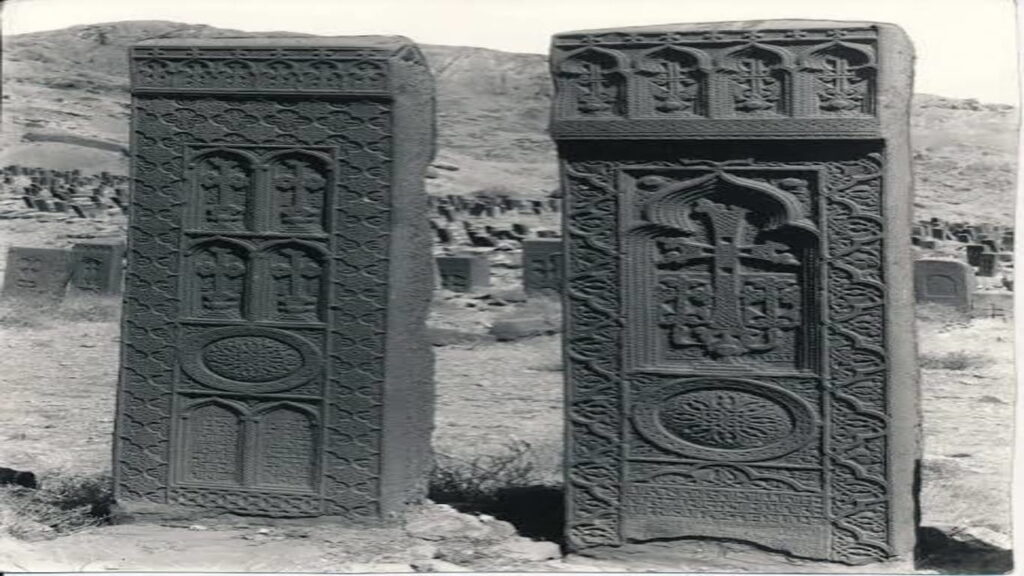
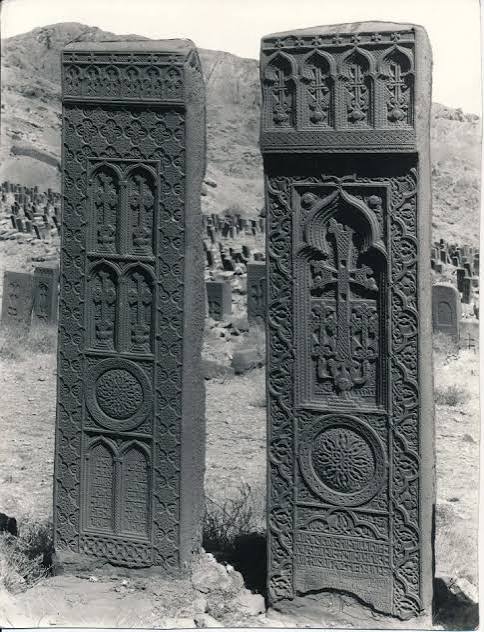
Image: khachkars from the Armenian cemetery in Julfa, Nakhichevan. It held the largest surviving collection of khachkars, most dating to the 15th and 16th centuries, and was destroyed in 2005, according to the caption of the source image.
Karabakh after 2020
Since the 2020 war there have been reports of crosses being removed, khachkars damaged and Armenian churches altered in Karabakh. The UN Special Rapporteur in the field of cultural rights received reports of such acts, including an incident in Hadrut in January 2022 (Appropriation of Armenian Cultural Heritage of Artsakh).
The destruction of the Church of St Sargis in Mokhrenes in 2022 was regarded as the first major violation of the December 2021 order of the International Court of Justice, which required Azerbaijan to prevent vandalism of Armenian cultural heritage (Cornell report).
Physical destruction goes hand in hand with symbolic appropriation: Armenian monuments are renamed, stripped of crosses and Armenian inscriptions, and then presented as “Caucasian Albanian” or “ancient Turkic”.
Turkey
The scale of Armenian heritage losses in Turkey is documented too. According to figures cited from a 1974 UNESCO report, of 913 Armenian historical monuments in eastern Turkey after 1923:
- 464 disappeared entirely
- 252 lay in ruins
- 197 needed urgent restoration
Armenian churches and monasteries in Turkey were often wrecked, used as warehouses, stables or clubs, used for target practice, or converted into mosques (see Cultural Genocide). Even surviving monuments are often stripped of their Armenian identification, which closes a propaganda loop: first an Armenian monument is destroyed or depersonalised, then its absence or “non-Armenian” status is cited as “proof” that there was never an Armenian presence (Appropriation of Armenian Cultural Heritage of Artsakh).
Part 6. Maps
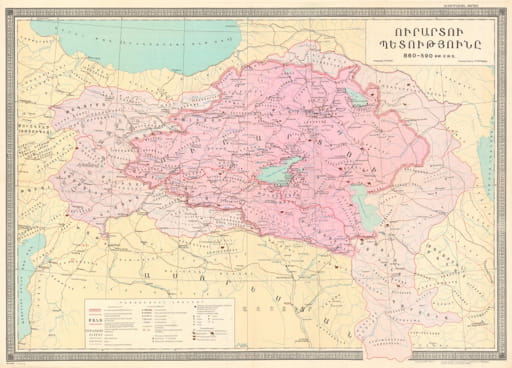
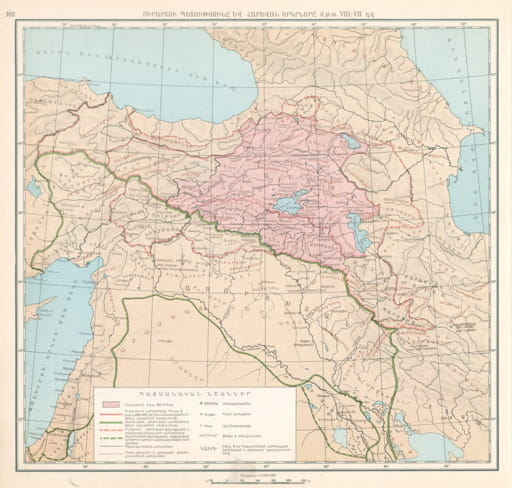
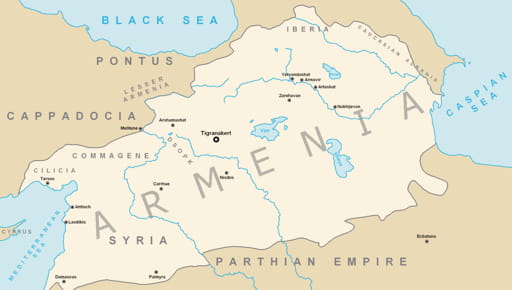
Three maps help to visualise the geography:
- A historical map of Urartu shows the state on the Armenian Highland and its neighbours: Media, Assyria and the area of the Behistun inscription. It is a visual aid for the geographic continuity between Urartu and the later Armenia.
- A second map shows Urartu on the Armenian Highland, which in the Achaemenid period was designated in Persian administration as Armina / Armenia.
- A map of Armenia under Tigranes the Great shows the scale of Armenian statehood in antiquity, long before the toponym “Azerbaijan” appeared and before today’s Azerbaijani identity formed.
Conclusion
The scientifically and documentarily supported picture is the opposite of the propaganda. Armenians are an indigenous people of the Armenian Highland, with maternal genetic continuity demonstrated over at least 7,800 years (study). The name “Armenia” is recorded in the Behistun inscription around 520 BC. The Armenian language, script, church and architecture each have their own centuries-long history.
The claim that Armenian inscriptions were made in the Soviet period is supported neither by palaeography nor by archives nor by the history of the monuments. And the mass destruction of Armenian churches, cemeteries and khachkars in Azerbaijan and Turkey is not the “restoration of ancient Azerbaijani heritage” but a documented erasure of the traces of Armenian presence (Cultural Genocide).
Sources and further reading
Genetics and history
- Eight Millennia of Matrilineal Genetic Continuity in the South Caucasus
- Behistun inscription (Wikipedia)
- Behistun (Livius.org)
- Behistun, trilingual text edition (Göttingen, PDF)
Classical authors
- Herodotus, Histories 7.73 and commentary on the Persian inscriptions
- Xenophon, Anabasis, Book 4 and Encyclopaedia Iranica: Armenia
- Strabo, Geography: 11.14.1–4, 11.14.5–9, 11.14.10–14
- Pliny the Elder, Natural History, Book VI
- Tacitus, Annals XV: Latin Library, mirror
- Plutarch, Life of Lucullus: Tigranes the Great (sources)
Armenian epigraphy and writing
- Armenian Palaeography: Dating the Major Scripts (PDF)
- Armenian Epigraphy and Paleography (Academia.edu)
- Tracing the oldest Armenian script
- Oldest Armenian inscriptions: Tekor Basilica
- Tigranes the Great (sources), further reading
Heritage destruction
- Cultural Genocide (Armenian Ministry of Foreign Affairs)
- Appropriation of Armenian Cultural Heritage of Artsakh (EVN Report)
- Report shows near-total erasure of Armenian heritage sites (Cornell)
- Religious Freedom Conditions in Azerbaijan: Caucasus Heritage Watch testimony (USCIRF, PDF)
- US Researchers Confirm 98% of Cultural Armenian Heritage Sites in Nakhichevan Destroyed by Azerbaijan (Hyperallergic)
- Julfa khachkars image (Reddit)
Maps