By Vigen Avetisyan. Data as of October 29, 2026.
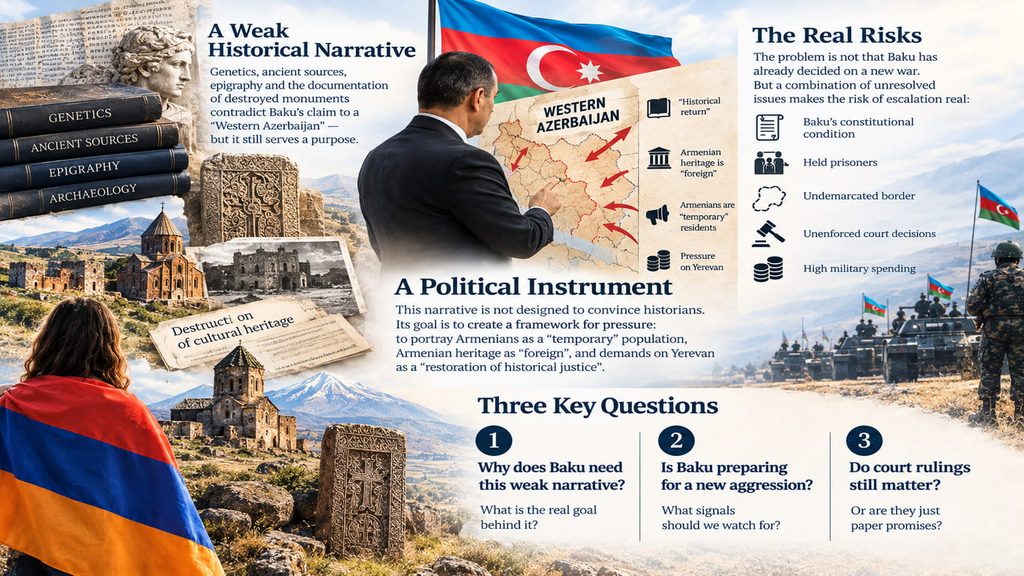
In brief. As a scholarly concept, the Azerbaijani historical narrative has failed: (read also: “Ancient Azerbaijan” and “Armenians from India”: Anatomy of a Propaganda Narrative): genetics, ancient sources, epigraphy and the documented destruction of monuments all contradict it. As a political instrument, however, it can still work, because its purpose is not to persuade historians but to build a frame for pressure: to present Armenians as a “temporary” population, Armenian heritage as “alien,” and demands on Yerevan as “restoring historical justice.” There is no evidence that a decision for a new war has been taken. But the combination of unresolved issues (Baku’s constitutional precondition, detained prisoners, an undelimited border, unimplemented court orders and high military spending) keeps the risk of escalation real. This article examines three questions: why Baku needs a scientifically weak narrative, whether it is preparing the ground for new aggression, and whether court rulings that remain on paper have any meaning. A fourth section covers the territory of Armenia that Azerbaijan is said to hold.
What has changed: the context as of October 2026
Descriptions of this conflict age quickly, so the current frame comes first.
- The Washington Declaration. On August 8, 2025, Aliyev and Pashinyan signed a joint peace declaration at the White House, and the text of a peace treaty was initialed by the foreign ministers (Azatutyun, OSW).
- The treaty is not signed. Baku ties its signature to a change in Armenia’s constitution, while Yerevan says it is ready to sign as soon as possible (Armenpress, October 28, 2026, Hetq). Pashinyan has suggested that signing may be possible in 2027–2028 (Armenpress).
- Transit. On October 21, 2025, Aliyev announced the lifting of all restrictions on cargo transit to Armenia; Kazakh grain was the first shipment (Azatutyun, Reuters via Business Recorder).
- TRIPP. The “Trump Route” of about 43 km is to run through Syunik. On October 28, 2026, Armenia’s parliament ratified the framework agreement with the United States (NT.am, Rio Times: 63 votes to 32).
- Elections. In the June 7, 2026 election, Civil Contract won about 49.7% and kept a majority, but lost its two-thirds constitutional majority, so the path to a referendum remains uncertain (Azatutyun, Armenian Weekly, ConstitutionNet).
It follows that the formula “the Zangezur corridor without Armenian checkpoints” describes Baku’s position of 2021–2024, not the current document. It is more accurate to speak of a dispute over how exactly TRIPP will work and what “unimpeded connection” means (details below).
Question 1. Why does Baku spend resources on a narrative that loses to scholarship?
Because the narrative is not designed to withstand fact-checking. Its audience is the domestic population, diplomatic intermediaries, future negotiators and Armenia itself. For such an audience, repeatability and institutional backing matter more than provability.
This is an infrastructure, not a set of isolated statements. Azerbaijan has developed an official policy of the “Great Return” of Azerbaijanis to Armenia (Eurasianet). Conferences and forums operate in support of it, and state figures say that “Western Azerbaijan” is the “ancestral land” of Azerbaijanis (Azatutyun on the festival-conference in Nakhichevan). Aliyev has repeatedly called much of present-day Armenia “Western Azerbaijan” and demanded that Yerevan answer when and on what terms the “return” will happen (Azatutyun, 2025, PanArmenian). In June 2026 Baku renewed these demands (Mirror-Spectator).
The practical functions of such a narrative boil down to five.
- Delegitimizing Armenian statehood. If Armenia is “not historical,” its borders and sovereignty, including control over Syunik, can be presented as subject to bargaining. Yerevan directly calls “Western Azerbaijan” an attempt to formalize territorial claims (Azatutyun, Pashinyan’s statement); Foreign Minister Mirzoyan warned as early as 2024 that this could be a prelude to a new attack (Azatutyun).
- The mirror argument. Baku uses the “right of return” as a lever of reciprocity: according to Aliyev, the right of Karabakh Armenians to return should be guaranteed “mutually” together with the right of Azerbaijanis who left Armenia (OC Media). In this way the consequences of the 2023 operation are moved onto the plane of counter-demands.
- Justifying the destruction of heritage. If monuments are declared “non-Armenian” in advance, their destruction or alteration can be presented as “restoring” someone else’s heritage (details: EVN Report).
- Domestic mobilization. The theme of “ancestral lands” creates an emotional base for a hard-line policy. Some Azerbaijani analysts also see it as a tool for retaining the loyalty of people who came from Armenia inside Azerbaijan itself (OC Media).
- A legal and political groundwork. A constantly repeated demand for “return” creates a habitual frame in which future claims look like “correcting a mistake” rather than aggression.
What Baku says. Aliyev denies that this amounts to territorial claims: in his account, return does not mean expelling Armenians, and the villages to which Azerbaijanis should return are abandoned (Eurasianet, Azatutyun). Baku insists that thousands of Azerbaijanis left Armenia under pressure in the late 1980s and that Yerevan’s position “obstructs peace.” The Armenian side in turn rejects “expulsion” in that form and calls the issue an artificial addition to the peace agenda (JAMnews). These interpretations remain disputed, and no independent international investigation of the events of 1988–1989 that would satisfy both sides has been carried out.
So the narrative has failed scientifically but works politically. Keeping the two dimensions apart is essential: falsifying history does not make it harmless.
Question 2. Is this preparing the ground for new aggression?
A correct answer has two parts: the propaganda really does serve as political cover for pressure, but the available data do not allow us to claim that a new war is inevitable.
Syunik and TRIPP: the dispute over what “connection” means
The Washington Declaration provides for “unimpeded connection” between the main part of Azerbaijan and Nakhichevan through Armenian territory, on condition that all routes remain under the sovereignty and jurisdiction of the states they pass through (Azatutyun, CivilNet). In January 2026 the agreed framework provided for a development company, 74% owned by the United States and 26% by Armenia, to build about 43 km of railway, road and utilities through Syunik (CivilNet).
The Armenian government insists that the route remains under Armenian sovereignty and that Armenian customs and border services will operate on it (CivilNet). Azerbaijani Prime Minister Ali Asadov, however, said that Armenia had accepted the demand to open a land corridor to Nakhichevan (Azatutyun). The opposition in Armenia believes that the agreement in practice meets Baku’s demand for an extraterritorial corridor and weakens sovereignty over Syunik (Azatutyun, Azatutyun on Kocharyan). Many details of the US–Armenian memoranda were not disclosed immediately (Azatutyun), and analysts stress that the question of “unimpeded access” remains politically sensitive (New Eastern Europe).
US involvement in the project gives Armenia additional protection, because any attack on Syunik would now affect American investment and Washington’s political leadership. Critics, however, point out that security guarantees are not written into the documents.
The constitutional precondition as a lever
Baku demands that the preamble of Armenia’s constitution drop its reference to the 1990 Declaration of Independence, which mentions the 1989 act of unification of Armenia and Nagorno-Karabakh (OSW, Azatutyun). Yerevan rejects the thesis of territorial claims, but the draft of a new constitution prepared in March 2026 provides for dropping such references (Caspian Policy Center).
The problem is that after the election the ruling party cannot take the constitutional question to a referendum on its own: two thirds of parliament are needed (ConstitutionNet). That creates a convenient asymmetry for Baku: as long as the condition is not met, the treaty remains unsigned and the pressure continues. Azerbaijani experts themselves acknowledge it is unclear whether Baku is ready to move forward without a referendum (Kiprinform/Reuters).
Military spending: an argument that must be read in full
Azerbaijan’s spending rose from about $3.8 billion in 2024 to almost $5 billion in 2025, which is 6.5% of GDP (Eurasianet). For 2026, 8.71 billion manats (about $5.1 billion) is budgeted for defense and security, 3.8% more than in 2025 (PanArmenian, OC Media). According to SIPRI data for 2025, Azerbaijan ranks sixth in the world by military burden on the economy, and Armenia seventh with 6.1% of GDP (PanArmenian).
Two clarifications matter for an honest assessment. First, Armenia has also increased spending (about $1.7 billion in 2025), although in 2026 it cut it to roughly $1.47 billion (Eurasianet, Caspian Post). Second, Azerbaijan’s medium-term budget provides for a gradual decline in defense spending by 2029–2030 (PanArmenian). The figures alone do not prove preparation for an offensive: they show that Baku retains a substantial military advantage while maintaining negotiating pressure.
What restrains escalation
Several factors work against a scenario of rapid war.
- The American stake. TRIPP ties Washington to the security of Syunik: an attack on the route would hit a project the United States regards as its own achievement (NT.am).
- Baku’s own interest. The route spares Azerbaijan from shipping fuel to Nakhichevan through Iran and offers new sources of income at a time of declining oil output (OSW, Caucasian Knot).
- Practical rapprochement. The transit ban has been lifted; in January 2026 Azerbaijan released four Armenian prisoners (Reuters via The Star); and on June 14, 2026 Aliyev’s aide Hikmet Hajiyev traveled to Dilijan for talks with the secretary of Armenia’s Security Council (Azatutyun). Mirzoyan says that de facto peace already exists and shows in cross-border trade and transport (Hetq).
What is alarming
- None of the causes of the conflict has been closed legally: the treaty is unsigned, the border is undelimited, and prisoners are still held.
- The 2023 precedent showed that Baku is able to settle an issue by force after prolonged pressure, and that international reactions were limited.
- Baku still insists on the theme of “return” and on changing the constitution, that is, it keeps two levers open at once.
- Access for independent observers has shrunk: the International Committee of the Red Cross office in Baku has been closed since September 2025, and since then no international organization has visited the Armenian prisoners (Caucasian Knot).
Conclusion on the second question
On the basis of open data, it can be argued that Baku’s historical propaganda serves as political and informational cover for pressure on Armenia. It cannot be argued that a decision on a new full-scale aggression has been taken: over the past year Baku has also taken concrete steps toward Armenia. The most accurate description is a strategy of coercion with a persisting risk of escalation. Indicators worth watching:
- Whether new state institutions and budget programs for “Western Azerbaijan” appear, and whether the theme of “return” turns into concrete demands on the border.
- How construction of TRIPP proceeds and whether Armenian customs and border services remain on the route.
- Whether a path to changing the constitution is found now that the ruling party has lost two thirds of the seats.
- Whether there are incidents on undelimited sections of the border and reports of new positions.
- Whether the remaining prisoners are released and access for international organizations is restored.
Question 3. Do the court rulings on the Lachin Corridor mean anything if no Armenians remain in Artsakh?
They do, but not what they meant when they were issued. Courts record violations and create a legal basis for future claims, but they do not replace a mechanism of enforcement. It is important to distinguish what was actually decided.
The Lachin Corridor. On February 22, 2023, the International Court of Justice ordered Azerbaijan to take all measures to ensure unimpeded movement of people, vehicles and cargo along the corridor in both directions; the vote was 13 to 2 (ICJ press release). The blockade continued, and on April 23, 2023 Azerbaijan set up a checkpoint on the corridor, saying this was how it was complying with the court’s order (Mirzoyan’s OSCE speech).
The July 6, 2023 order. An inaccuracy is often repeated here. The Court unanimously found that the circumstances did not require modifying the February measure (Armenia had asked it to require withdrawal of personnel from the corridor), and unanimously reaffirmed the February measure (text of the order, press release). The operative part contains no finding that the checkpoint “plausibly” constitutes racial discrimination. Armenia reads the order as confirming that the measure is binding; Azerbaijan reads it as recognition that the checkpoint is legitimate (Azerbaijani Foreign Ministry); the merits have not yet been decided (ASIL).
After September 2023. After the Azerbaijani operation of September 19–20, 2023, more than 100,000 ethnic Armenians left Nagorno-Karabakh (AP, Al Jazeera). On November 17, 2023, the Court ordered Azerbaijan to ensure the safe, unimpeded and swift return of those who wish to return (EVN Report). These measures have not been implemented: there is no mass return. The Armenian side and a number of researchers describe what happened as ethnic cleansing (Just Security, testimony of Luis Moreno Ocampo). Baku denies coercion and says people left voluntarily; the term “ethnic cleansing” has no separate definition in international law (Völkerrechtsblog). It is therefore legally correct to write about a mass exodus that the Court treated as a humanitarian crisis, and to document the circumstances without substituting a legal qualification.
The fate of the cases. The initialed treaty obliges the parties, within one month of its entry into force, to “withdraw, close or otherwise settle” all interstate claims (Article 15) (Armenpress). Armenia’s representative says that no decision on withdrawal has been made (OC Media). Supporters of the approach say that peace is impossible without mutual closing of claims (Baku also has cases against Armenia) (Strasbourg Observers). Critics believe that dropping the cases would entrench impunity and deprive Armenia of leverage on the prisoners and on return (Armenian Weekly, E-IR).
The prisoners
After four people were released on January 14, 2026, 19 Armenian prisoners remain in Azerbaijan (Armenpress). On February 17, 2026, a military court in Baku sentenced Ruben Vardanyan to 20 years, and former Karabakh leaders received sentences ranging from 15 years to life; the defense and Amnesty International say the trials fell short of fair-trial standards (PanArmenian, News.am). In April 2026 the prisoners were moved to the Umbaki prison (Mirror-Spectator). Baku treats them as defendants accused of war crimes and terrorism. The European Court of Human Rights required reports on their detention and health, and relatives reported inadequate medical care (Caucasian Knot). On October 28, 2026, Mirzoyan said that the path on this issue runs through dialogue with Baku (NT.am).
Question 4. Is Azerbaijan holding territory of Armenia?
Armenian officials and independent researchers say that Azerbaijani forces are on territory of Armenia recognized under Soviet-era borders. Estimates of the area diverge widely: from 50 to 215 square kilometers in early estimates (Wikipedia, overview of estimates), about 240 in Armenian government statements (Azatutyun), and at least 241.4 by the count of journalist Hayk Hovhannisyan (CivilNet, CivilNet, sections by district). In Tavush, these include areas near the villages of Berdavan, Voskepar and Kirants (EVN Report).
Baku says it has never occupied Armenian territory because the border has not been delimited (Mirror-Spectator, CivilNet). The Armenian side acknowledges that its forces are also on sections of de jure Azerbaijani territory; by the same count, about 21 sq. km outside enclaves (CivilNet). In April 2024 Armenia handed Azerbaijan about 6.5 sq. km and four villages in Tavush as a first step of delimitation (Eurasianet, Azatutyun). Yerevan’s position as of October 2026: Armenia must have a territory of 29,743 sq. km, without enclaves or exclaves, and any exchange of sections must be equal in area (Armradio, Azernews).
What follows for Armenian policy
The conclusions depend on which strategy one favors, and in Armenia they are genuinely disputed.
The government’s arguments. Peace is already producing tangible results: transit, trade, the release of four prisoners, American engagement and legally framed sovereignty over the route. Delay on the constitution, Yerevan argues, gives Baku an opportunity to claim that Armenia is rejecting peace; a new constitution is also something Armenia needs for its own reasons (Caspian Policy Center, Armenpress).
The critics’ arguments. The opposition and some experts believe that concessions (the constitution, a possible withdrawal of cases, the TRIPP regime) are being made before Baku delivers anything on prisoners, territory and return, and that the treaty lacks adequate guarantees (Azatutyun, Armenian Weekly).
Between these positions lies a practical field for public policy: sequencing, reciprocity and verification. The questions worth putting to all sides point to it: when and which prisoners will be released, which sections of the border will be delimited and in what order, whether provisions on Armenian services on TRIPP will be fixed in writing, and what will remain of the court proceedings if the cases are withdrawn. A separate task for Armenia and the diaspora is to document the circumstances of the exodus from Karabakh and the destruction of heritage, so that this material is preserved regardless of diplomatic circumstances (see Cultural Genocide).
Caveats and disputed points
- Military budget data come from ministry statements and SIPRI estimates; dollar figures depend on the exchange rate.
- The area of “held” territories is disputed: figures from different sources are not comparable without a common map and an agreed delimitation.
- The characterization of the events of 2023 as “ethnic cleansing” is contested by Baku; the Court so far has found a risk of irreparable harm and a failure to implement provisional measures, but has not ruled on the merits.
- Arguments about the “voluntary” departure of Armenians and about the forced “expulsion” of Azerbaijanis from Armenia in the late 1980s remain a subject of political dispute, and no independent international investigation acceptable to both sides has been conducted.
- The situation changes quickly: the treaty may be signed or may stall for good, and data on prisoners, territory and military spending are updated.
Summary table
| Claim | What is confirmed | What is disputed or unclear |
|---|---|---|
| “Western Azerbaijan” is used as a political instrument | Conferences, forums, Aliyev’s statements, the demand for “return” | Whether this amounts to territorial claims (Yerevan) or only a right of return (Baku) |
| Baku is preparing a new aggression | Rising military spending, pressure through the constitution, prisoners, delimitation | A decision for war is not proven; there are also steps toward Armenia (transit, releases, TRIPP) |
| A “Zangezur corridor” outside Armenian control | Baku’s original demands | The final TRIPP regime; preservation of Armenian sovereignty and services |
| The ICJ’s July 6, 2023 order found the checkpoint discriminatory | No: the Court reaffirmed the February measure and declined to modify it | The merits have not yet been decided |
| Armenians left Karabakh under compulsion | The exodus of more than 100,000 people; the Court’s measures of November 17, 2023 | The causes and the legal qualification (ethnic cleansing / voluntary departure) |
| Armenian prisoners are held in Baku | 19 people after January 2026; sentences from 15 years to life | Conditions of detention (no access for independent organizations) |
| Azerbaijan holds territory of Armenia | Armenian data; estimates of 50–241 sq. km | Baku denies it; the border is not delimited; Armenia also controls some sections |
Conclusion
Azerbaijani historical propaganda loses the scholarly argument but serves a political purpose: to lend pressure on Armenia the appearance of historical justice and to leave Baku able to advance new demands. By itself it does not prove preparation for war. Together with the unresolved constitutional precondition, the prisoners, the undelimited border, the unimplemented judicial measures and high military spending, it forms a frame of coercion whose risk cannot be ignored. At the same time, the past year has shown the opposite as well: transit, releases, an American project and diplomatic contacts. The right approach is therefore to record facts, name violations, check promises against results, and accept neither the thesis of inevitable war nor the thesis of a completed peace.
Sources and further reading
The peace process, TRIPP, elections
- Armenpress: Mirzoyan, October 28, 2026
- Armenpress: Pashinyan on the timing of signing
- Hetq: readiness to sign the treaty
- Azernews: the 2031 timeline and the territory formula
- Armradio: Pashinyan on the peace treaty
- NT.am: TRIPP ratification and the prisoner question
- Rio Times: the balance of power in Armenia
- Azatutyun: sovereignty over the route
- Azatutyun: Asadov’s statement
- Azatutyun: the opposition on TRIPP
- Azatutyun: the US–Armenia memorandum
- Azatutyun: Kocharyan on the Washington agreements
- CivilNet: customs control on the route
- CivilNet: the TRIPP framework, 74/26
- New Eastern Europe: TRIPP and the people of the region
- OSW: lifting the transit blockade
- OSW: the US in the Caucasus
- Business Recorder (Reuters): cargo transit
- Azatutyun: Kazakh grain
- Azatutyun: election results
- Azatutyun: Hajiyev’s visit to Dilijan
- Azatutyun: the constitution and the preamble
- Armenian Weekly: election results
- ConstitutionNet: uncertainty over constitutional change
- Caspian Policy Center: after the election
- Kiprinform (Reuters): the election and the peace treaty
- Caucasian Knot: TRIPP
“Western Azerbaijan”
- Eurasianet: the “Great Return”
- Azatutyun: the festival-conference in Nakhichevan
- Azatutyun: Aliyev on “return”
- Azatutyun: Pashinyan on territorial claims
- Azatutyun: Mirzoyan on the risks
- PanArmenian: Aliyev’s statements
- Mirror-Spectator: Baku renews its demands
- OC Media: Aliyev and “Western Azerbaijan”
- JAMnews: Yerevan’s position
- EVN Report: appropriation of Artsakh’s heritage
- Armenia MFA: Cultural Genocide
Military spending
- Eurasianet: Armenia and Azerbaijan in SIPRI data
- PanArmenian: the 2026 budget
- PanArmenian: the medium-term plan
- PanArmenian: SIPRI
- OC Media: the 2026 budget increase
- Caspian Post: Armenia’s budget cut
Courts and Karabakh
- ICJ: press release of July 14, 2023 (PDF)
- ICJ: order of July 6, 2023
- Azerbaijani Foreign Ministry: comment on the order
- Mirzoyan at the OSCE
- ASIL Insights: the ICJ cases
- Just Security: the ICJ cases
- EVN Report: the measures of November 17, 2023
- AP: the ICJ order
- Al Jazeera: the UN mission and the exodus
- Völkerrechtsblog: the Armenian exodus
- Testimony of Luis Moreno Ocampo (PDF)
- Armenpress: Article 15 of the treaty
- OC Media: withdrawal of the cases
- Strasbourg Observers: withdrawal of cases at the ECtHR
- Armenian Weekly: dropping the cases
- E-IR: TRIPP and interstate claims
Prisoners
- Reuters (The Star): release of four prisoners
- Armenpress: 19 prisoners
- PanArmenian: Vardanyan’s sentence
- News.am: chronology of the cases
- Mirror-Spectator: transfer to Umbaki
- Caucasian Knot: the ECtHR and the prisoners’ condition
- Caucasian Knot: closure of the ICRC office
Territory and the border
- CivilNet: the count of territories
- CivilNet: sections by district
- CivilNet: Baku’s position on delimitation
- Azatutyun: delimitation and 240 sq. km
- Azatutyun: four villages in Tavush
- Eurasianet: the handover of villages
- Mirror-Spectator: Baku’s position
- EVN Report: delimitation
- Wikipedia (mirror): overview of estimates
Additional reference sources (not cited above)


One thought on “Why Baku Promotes “Western Azerbaijan”: Historical Propaganda, Coercion and the Risk of Escalation”