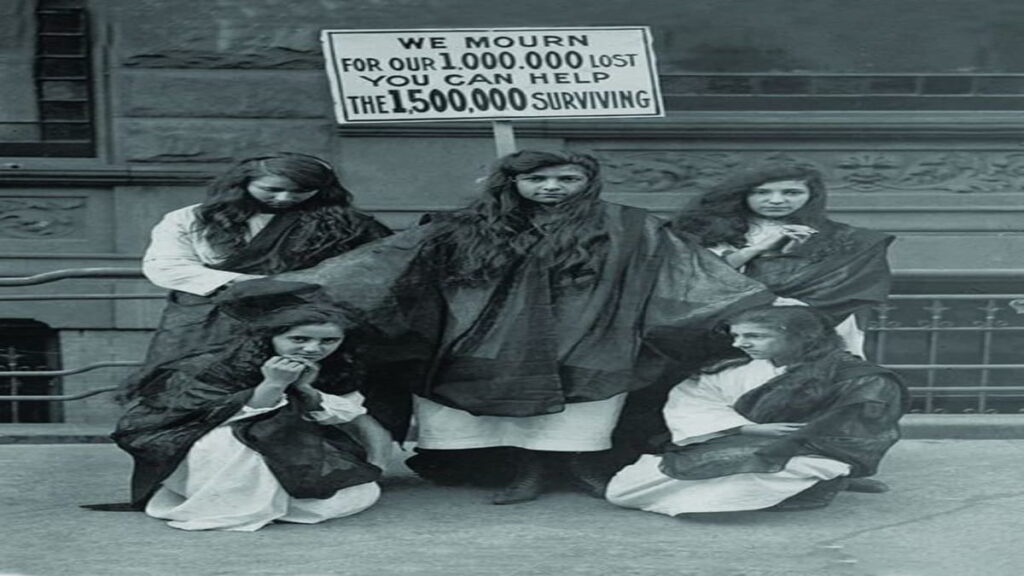
In 1917, at the height of global upheaval during World War I, a small but determined Armenian community in New York City organized a striking public action to draw attention to one of the greatest humanitarian crises of the era—the aftermath of the Armenian Genocide.
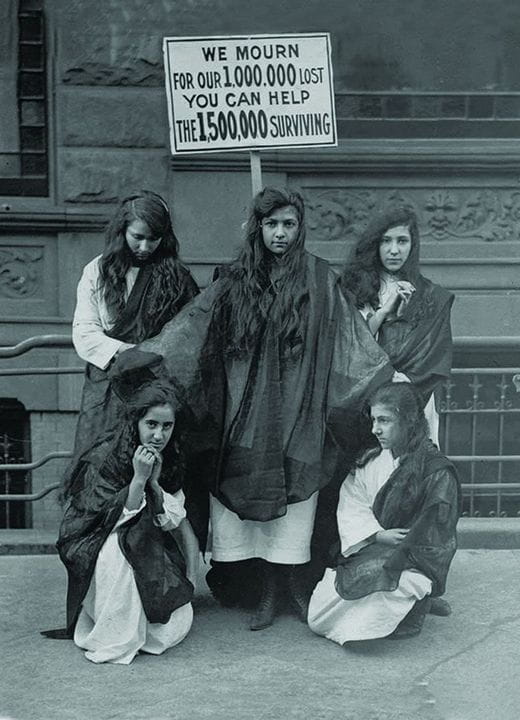
The photograph above, preserved in the collection of the Armenian Genocide Museum-Institute, captures a group of Armenian orphan girls staged in symbolic roles. Some are dressed to evoke “Mother Armenia,” while others represent orphaned survivors. They hold a stark and emotionally charged sign:
“We mourn for our 1,000,000 lost. You can help the 1,500,000 surviving.”
This was more than a performance—it was a direct appeal to the conscience of American society.
A Public Appeal in the Streets of New York
By 1917, reports of mass deportations, starvation, and killings of Armenians in the Ottoman Empire had already reached the United States through diplomats, missionaries, and journalists.
The New York demonstration reflected:
- the urgency of the humanitarian crisis
- the agency of Armenian survivors and diaspora communities
- the growing awareness among Americans
The message on the sign illustrates how early Armenian advocates framed the tragedy in both moral and practical terms: mourning the dead while calling for immediate assistance to the living.
For detailed historical background, see:
The Role of the United States: Government and Civil Society
The response in the United States to the Armenian crisis was unprecedented for its time.
1. Government Awareness and Diplomatic Reporting
American diplomats, including Ambassador Henry Morgenthau Sr., documented the atrocities and reported them to Washington. Morgenthau famously described the events as a “campaign of race extermination.”
Learn more:
2. Near East Relief: America’s First Major Humanitarian Campaign
In response, the U.S. helped establish Near East Relief (originally the American Committee for Armenian and Syrian Relief).
This organization:
- raised over $100 million (equivalent to billions today)
- provided food, shelter, and medical aid
- established orphanages for tens of thousands of Armenian children
At its peak, it cared for over 100,000 orphans—many of them survivors like the girls in the photograph.
Further reading:
3. American Citizens and Grassroots Mobilization
The Armenian cause became one of the first large-scale international humanitarian movements in the U.S.:
- nationwide fundraising campaigns
- church-led charity drives
- public demonstrations like the one in New York
Newspapers widely covered the suffering of Armenians, helping to mobilize public opinion.
The Armenian Diaspora: Organized Compassion
Alongside American institutions, the Armenian diaspora played a critical role.
Communities across the U.S.:
- organized relief committees
- hosted refugees
- coordinated with international aid networks
In cities like New York City, Armenian immigrants—many of whom had lost relatives—became both witnesses and activists.
Their efforts demonstrate that humanitarian aid was not only a top-down initiative but also a community-driven response rooted in shared trauma and responsibility.
Where the Survivors Went
Following the genocide, Armenian survivors were dispersed across multiple regions:
- Middle East (especially Syria and Lebanon)
- Greece
- South Caucasus (including Eastern Armenia)
Many orphaned children were placed in institutions funded by Near East Relief and other organizations, where they received education and care.
For more on survivor displacement:
The Power of an Image
The 1917 photograph is not just a historical artifact—it is a powerful piece of visual advocacy.
It reveals:
- how survivors participated in shaping their own narrative
- how symbolism (Mother Armenia, orphan figures) conveyed national trauma
- how early humanitarian campaigns used imagery to mobilize action
Most importantly, it reminds us that behind statistics were real individuals—children who endured loss yet stood publicly to demand recognition and aid.
Conclusion
The image of Armenian orphan girls in New York in 1917 captures a pivotal moment when tragedy met activism.
It reflects a convergence of:
- survivor testimony
- diaspora mobilization
- American humanitarian engagement
Together, these forces helped launch one of the earliest international relief movements in modern history.
More than a century later, the message on that sign still resonates:
remembrance must be accompanied by responsibility.