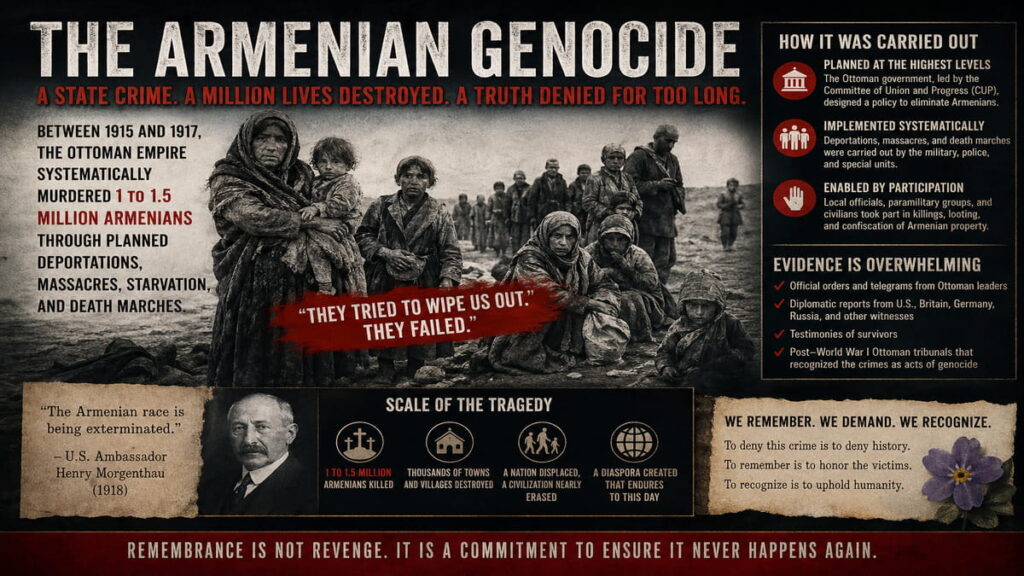
The Armenian Genocide (1915–1921 …) was not an accident of war, nor a tragic byproduct of chaos. It was a deliberate, centrally organized campaign of destruction, conceived and executed by the leadership of the late Ottoman Empire. The scale, coordination, and intent behind these events place them firmly within the definition of genocide as understood in modern international law.
A Crime Planned at the Highest Levels
At the center of the genocide stood the ruling elite of the Ottoman Empire, particularly figures such as Talaat Pasha, Enver Pasha, and Djemal Pasha. These leaders of the Committee of Union and Progress (CUP) directed a systematic campaign aimed at removing Armenians from Anatolia.
Evidence from multiple independent sources confirms intent and coordination:
- The United States Holocaust Memorial Museum documents how deportations were designed to lead to death through starvation, exposure, and violence:
https://encyclopedia.ushmm.org/content/en/article/the-armenian-genocide-1915-16-in-depth - The so-called Talaat Pasha telegrams, published and analyzed in academic studies, explicitly discuss population reduction and deportation policies.
- Post-war Ottoman tribunals (1919–1920) concluded that the massacres were state-organized crimes, sentencing key officials in absentia (see analyses in Oxford University Press publications:
https://academic.oup.com/book/26719/chapter/195544723)
These were not isolated acts. They formed a coherent policy of destruction.
Mechanisms of Extermination
The genocide unfolded through a series of coordinated steps:
- Disarmament and execution of Armenian soldiers
- Arrest and elimination of intellectual elites (notably on April 24, 1915)
- Forced deportations into the Syrian desert
- Mass killings carried out by military units and irregular forces
Scholarly work available via JSTOR demonstrates that these steps followed a recognizable genocidal pattern:
https://www.jstor.org/stable/j.ctvw04g61
The deportations themselves were often death marches. Survivors’ testimonies and diplomatic reports describe starvation, mass violence, and systematic abuse along the routes.
Mass Participation: Beyond the State
While the genocide was planned at the top, it could not have been executed without participation at multiple levels of society.
Research shows involvement by:
- Local officials implementing deportation orders
- Paramilitary groups such as the Special Organization
- Civilians who took part in looting, violence, or denunciations
Economic incentives played a major role. Confiscated Armenian homes, land, and businesses were redistributed, creating material motivation for participation. According to the Holocaust Encyclopedia, this redistribution was a structural component of the genocide, not a side effect.
Yet the historical record is not one-dimensional. There are documented cases of:
- Ottoman officials refusing orders
- Turkish and Kurdish families sheltering Armenians
- Individuals risking their lives to protect victims
These exceptions are crucial—they demonstrate that participation was widespread, but not inevitable.
The Scale of Destruction
The human toll was catastrophic. Estimates indicate that between 1 and 1.5 million Armenians perished.
According to Encyclopaedia Britannica:
https://www.britannica.com/event/Armenian-Genocide
The genocide resulted in:
- The near-total destruction of Armenian presence in Anatolia
- The permanent displacement of survivors across the globe
- The loss of cultural, religious, and historical heritage accumulated over millennia
Denial and Its Mechanisms
Despite the overwhelming body of evidence, the Armenian Genocide has long been subject to denial. Scholars identify recurring strategies:
- Reframing deportations as “relocation”
- Denying intent to destroy a population
- Minimizing the number of victims
Academic analysis in journals indexed by Springer explores how denial functions as a continuation of the original crime by obscuring its reality:
https://link.springer.com/article/10.1007/s10502-025-09516-7
Responsibility vs. Collective Guilt
The historical evidence is unequivocal regarding responsibility:
- The Ottoman state leadership designed and directed the genocide
- Institutions of the state carried it out
- Segments of the population participated or benefited
However, serious historical analysis draws an important distinction:
Responsibility is not identical to blanket, transgenerational guilt assigned to an entire modern nation.
The past cannot be understood through simplifications that erase:
- Internal dissent
- Acts of rescue
- The diversity of experiences within society
Memory, Acknowledgment, and Moral Reckoning
Recognition of the Armenian Genocide has grown globally, with many countries and institutions formally acknowledging it. Scholars widely agree that acknowledgment is essential for historical justice.
This includes:
- Accepting the documented reality of events
- Preserving evidence and testimony
- Supporting open historical research
The question is not whether the genocide occurred—the evidence is overwhelming. The question is how societies today engage with that history.
Conclusion
The Armenian Genocide stands as a stark example of how state power, ideology, and societal dynamics can converge to produce catastrophic violence. It was a crime initiated from above, carried out through institutions, and enabled—though not universally—by participation from below.
Understanding this history requires clarity, evidence, and precision. Simplifications—whether denial or indiscriminate generalization—obscure the truth rather than illuminate it.
A rigorous, evidence-based approach does not weaken the moral weight of the genocide. It strengthens it.