Introduction
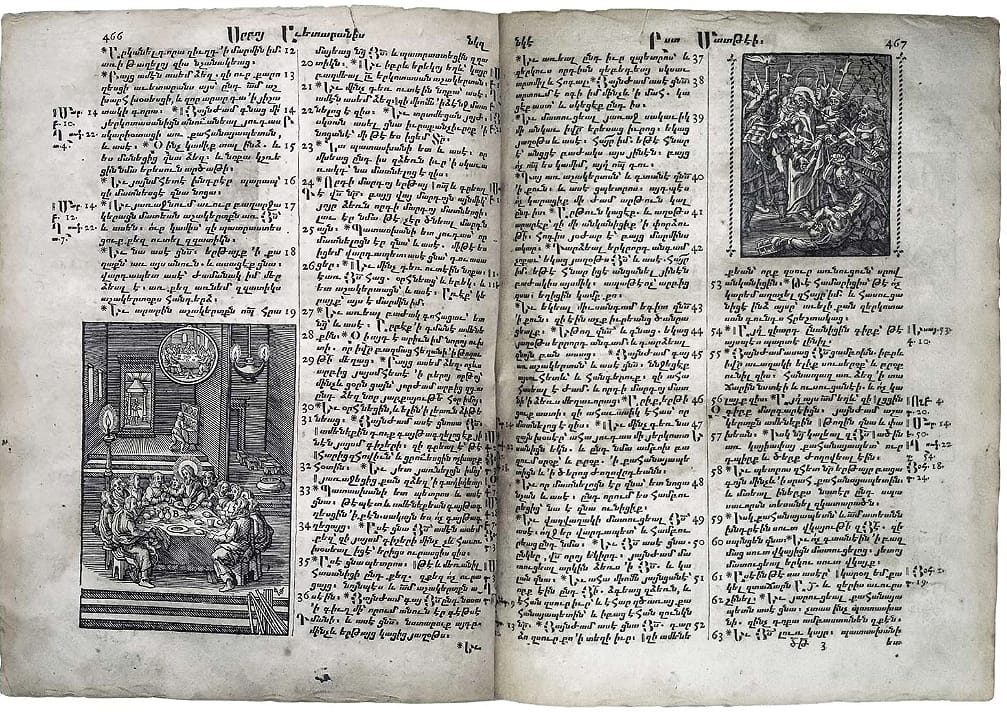
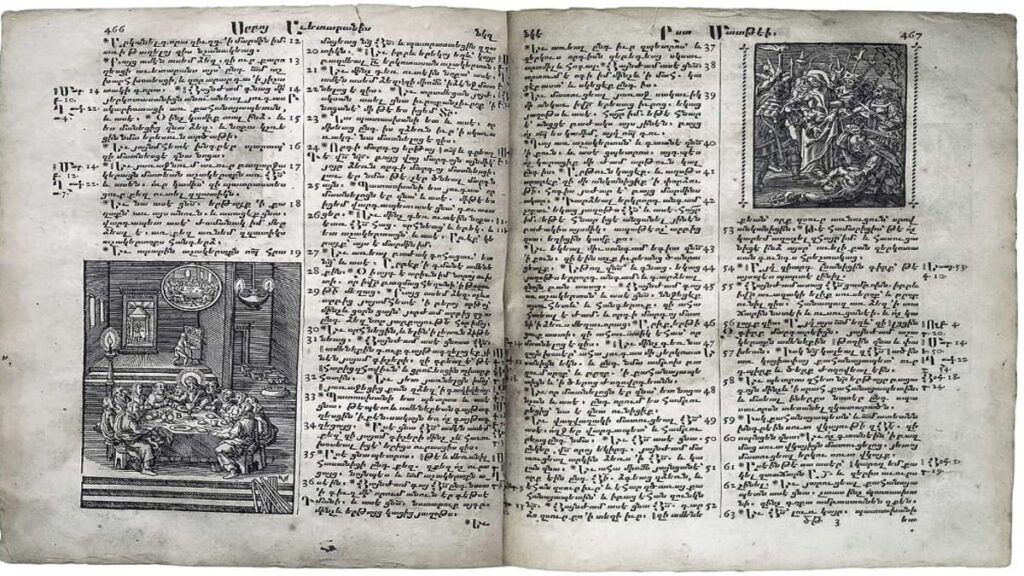
The first printed edition of the Bible in the Armenian language stands as one of the greatest achievements of early modern Armenian culture. Published in Amsterdam between 1666 and 1668 by the Armenian printer Voskan Yerevantsi, it marked the transition from manuscript tradition to large-scale printing and became a symbol of the intellectual and spiritual revival of the Armenian diaspora.
According to scholars, this edition is considered one of the finest examples of early Armenian typography (en.wikipedia.org).
Historical Context: Armenian Printing Before the 17th Century
Before the advent of printed books, Armenian literature was transmitted primarily through manuscripts. Beginning in the 16th century, Armenians actively adopted European printing technology:
- the first Armenian printed book — Urbatagirk (1512, Venice);
- the development of printing centers in Venice, Rome, and other European cities;
- the emergence of a “printing diaspora” as a means of preserving cultural identity.
By the 17th century, the need for a complete printed Armenian Bible accessible to a wider audience had become evident.
The Publisher: Voskan Yerevantsi
Voskan Yerevantsi (1614–1674) was one of the most prominent Armenian publishers of his time. He originated from the Armenian community of New Julfa (Isfahan) and was educated within a religious environment.
In 1665–1666, he moved to Amsterdam—one of Europe’s leading centers of printing—where he began work on the Bible (en.wikipedia.org).
The Printing Process
The publication of the Bible was a large-scale and technically complex project:
- the work lasted 2 years and 7 months (artsandculture.google.com);
- it began in 1666 and was completed on October 13, 1668 (deanderekaart.amsterdam);
- the print run amounted to approximately 3,000–5,000 copies (artsandculture.google.com).
The text was based on earlier manuscript traditions, including a 1295 copy from the time of King Hetum II of Cilician Armenia (deanderekaart.amsterdam).
Structure and Artistic Features
The edition was distinguished by its high artistic and technical quality:
- approximately 1,462 pages (commons.wikimedia.org);
- double-column layout;
- 159 engraved illustrations (commons.wikimedia.org);
- decorative initials and ornamental elements.
The illustrations were created using engravings by the Dutch artist Christoffel van Sichem, reflecting strong cultural connections between Armenians and European artistic traditions (deanderekaart.amsterdam).
Amsterdam as a Center of Armenian Printing
The choice of Amsterdam was not accidental. In the 17th century, the city was:
- a major commercial and publishing hub;
- home to an influential Armenian merchant community;
- a place of relative religious and intellectual freedom.
It was here that Armenian printers could realize ambitious projects that were difficult to undertake in their homeland due to political constraints.
Significance of the Edition
1. Cultural Significance
The first printed Armenian Bible:
- made the Holy Scriptures accessible to a broader audience;
- contributed to the standardization of the text;
- strengthened the role of the Armenian language as both literary and liturgical.
Scholars note that this achievement “elevated Armenian printing to an international level” (lratu.sci.am).
2. Religious Significance
The publication reinforced the Armenian Apostolic Church by providing:
- a unified canonical text;
- wider dissemination of liturgical traditions;
- stronger spiritual ties within the diaspora.
3. Historical Significance
The Bible became a symbol of:
- Armenian intellectual independence;
- the cultural power of the diaspora;
- the transition from manuscript to print civilization.
Preservation and Modern Research
Today, copies of the Bible are preserved in major research institutions, including the Matenadaran.
Some copies are considered unique works of art, featuring silver bindings and elaborate decoration (panarmenian.net).
Modern scholarship continues to explore:
- cataloging and digitization;
- typographic and textual analysis;
- the study of artistic features (journal.nla.am).
Conclusion
The first printed Armenian Bible (1666–1668) is not merely a religious text but a remarkable monument of world culture. It embodies:
- the spiritual heritage of the Armenian people;
- the achievements of European printing;
- the resilience of a diaspora preserving its identity.
The work of Voskan Yerevantsi remains a milestone in Armenian civilization and is still regarded as one of the masterpieces of early printing.
Sources
- Voskan Yerevantsi – Wikipedia
- Study of the First Armenian Printed Bible (NLA)
- Armenian Bible in Matenadaran
- Armenian Bible in Amsterdam
- History of Armenian Bibles
Image Source: Taron Saharyan