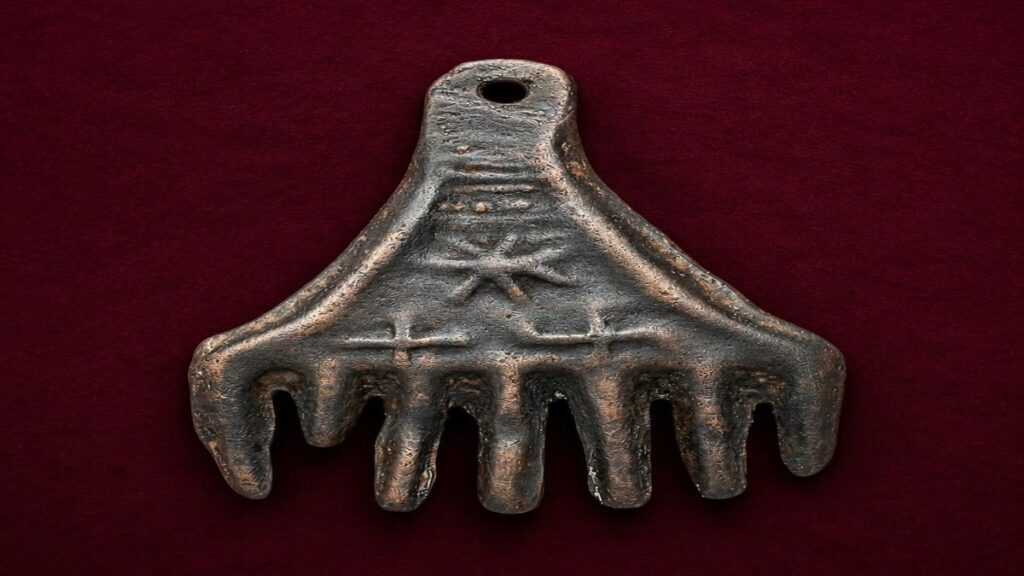
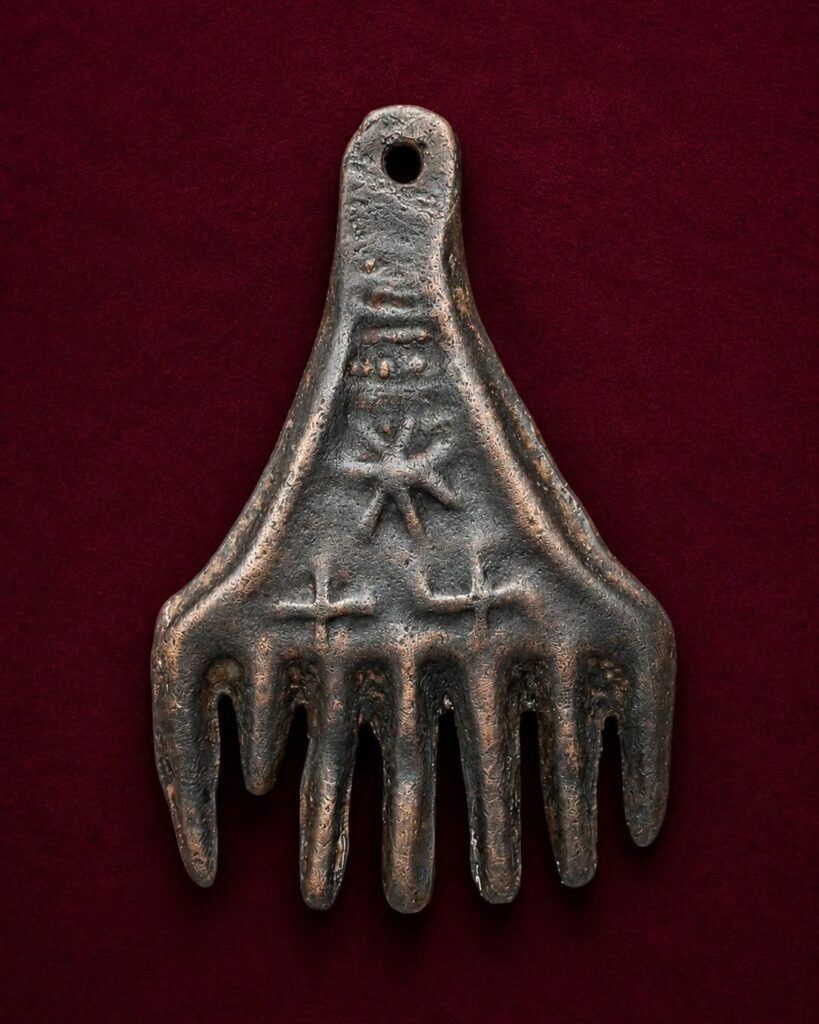
Pendant (Amulet) in the Shape of a Human Hand | 7th–6th centuries BC | Yeghvard Village, Armenia
An Object That Outlasted Its Empire
Among the most evocative artifacts to emerge from the ancient Armenian highlands is a small bronze pendant shaped like a human hand — seven downward-pointing fingers splayed wide, a triangular palm decorated with engraved symbols, and a suspension loop at the top so it could be worn close to the body. Discovered at Yeghvard, a site in what is now the Kotayk Province of Armenia, this pendant dates to the 7th–6th centuries BC — the twilight years of the powerful Kingdom of Urartu, the Iron Age civilization from which Armenian culture is directly descended.
It is, in essence, a hand that refused to let go of history.
The Kingdom of Urartu and the World That Forged This Object
To understand this pendant, we must first understand the civilization that produced it. The Kingdom of Urartu — also known as the Kingdom of Van — flourished in the Armenian highlands from the 9th to the 6th century BC, centered around Lake Van and reaching into what are now eastern Turkey, northwestern Iran, and Armenia. At its peak it was one of the most formidable powers of the Near East, a rival capable of confronting even the might of Assyria.
Urartian craftsmen were among the most skilled metalworkers of the ancient world. As the World History Encyclopedia notes, they “cut, cast, embossed, engraved, and inlaid metal to produce such ornate goods as jewellery of all kinds, helmets, shields, quivers, pectorals, small seals and amulets… belts, buckles, figurines, and candelabra.” Bronze was their signature medium: hard, durable, capable of holding intricate detail, and associated with prestige and power.
Armenian jewelry of this period “dates back to the Urartian period (9th–8th centuries BC)” and was not merely decorative. Shapes, materials, and patterns “were connected to the folk beliefs and national lifestyles” — jewelry was a portable theology, a wearable statement of identity, protection, and cosmic order.
The 7th–6th century BC, when this pendant was made, was a time of extraordinary tension. The Urartian kingdom faced mounting pressure from Assyrian armies to the south and Scythian and Cimmerian raiders from the north. The fortress of Karmir Blur (Teishebaini), built by King Rusa II in the 7th century BC precisely to defend against those nomadic incursions, stood just kilometres from sites like Yeghvard. It was a world in which the desire for divine protection was not abstract — it was urgent.
The Site: Yeghvard and Its Archaeological Context
Yeghvard is a settlement with roots stretching back at least as far as the 6th century, nestled at an elevation of approximately 1,330 metres in the Kotayk region of Armenia, southwest of the provincial centre of Hrazdan. The surrounding landscape was deeply inhabited during the Urartian Iron Age, and multiple major archaeological sites in this corridor — including the necropoleis near Karmir Blur, Lchashen, and Metsamor — have yielded thousands of burial goods from the same period.
The necropolis near Karmir Blur, excavated in rescue digs since 2013, revealed over 500 graves containing individuals of different social classes, along with “iron daggers, a quiver with iron arrowheads, bronze bracelets and stone beads.” Artifacts like the Yeghvard hand pendant were characteristic burial or votive goods — objects placed with the dead or worn by the living as protective charms against misfortune and malevolent spirits.
The nearby site of Lchashen on Lake Sevan, excavated after the lake waters receded in the 1950s, similarly produced bronze figurines, sophisticated pottery, and personal ornaments demonstrating the high level of craft skill and symbolic complexity of Iron Age Armenian culture. The Metsamor site, excavated by an Armenian-Polish team over multiple seasons, has added further understanding of the so-called “Lchashen-Metsamor cultural horizon” — the shared material world to which the Yeghvard pendant belongs.
Anatomy of the Pendant: What We See
Looking closely at the object itself reveals a great deal:
Form: The pendant is cast bronze with a rich, dark patina — that greenish-brown surface oxidation that develops over millennia and is itself a kind of testimony to age. The overall silhouette is a downward-pointing hand: a narrow triangular “wrist” narrows to a suspension hole at the top, while the lower portion splays into seven distinct finger-like projections. The choice of seven — rather than five — is significant and is discussed below.
Engraved decoration: The triangular palm section bears incised markings: horizontal lines near the suspension loop, and below them what appear to be schematic cross or star motifs, possibly representing celestial symbols, protective signs, or specific deity attributes. Similar schematic engravings appear on Urartian belts, plaques, and votive objects across the region.
Suspension loop: The hole at the narrow top confirms this was worn as a pendant — hung on a cord or chain and kept against the body. This was not a decorative object for display on a shelf; it was intimate, personal, and intended to be carried.
The Hand as a Symbol: A Deep and Ancient Language
The hand-shaped amulet belongs to one of the oldest and most geographically widespread categories of protective object known to archaeology. To understand why this shape was chosen, we need to look at the broader symbolic tradition.
Across the ancient world, amulets were “worn by their owners for the sake of protection.” They depicted “living things, such as animals or parts of the body.” The human hand — with its ability to grasp, to gesture, to create, to ward away — was among the most potent of all body-part symbols.
In Mesopotamia and Babylon, amulets representing the hand of Ishtar were used “to prevent evil or disease from entering a building.” The open hand as protective symbol was “very common in the Near East” and widely regarded as apotropaic — that is, capable of deflecting evil. An Iron Age tomb at Khirbet el-Qom in ancient Judah bears an engraved hand associated with a protective inscription, from almost the exact same period as the Yeghvard pendant.
This tradition extends forward in time to the famous Hamsa — the open five-fingered hand still worn today across Jewish, Islamic, and Christian communities as protection against the evil eye. “The open hand has been utilized as a protective symbol for thousands of years,” with archaeologists finding hand-shaped amulets in Mesopotamia, North Africa, and the Mediterranean. The Yeghvard pendant is a direct ancestor of this global tradition.
Seven Fingers: The Significance of Number
One of the most striking features of the Yeghvard pendant is its seven projections rather than the anatomically standard five. This was almost certainly deliberate, not a quirk of manufacture. Seven was among the most sacred numbers in the ancient Near East:
- There were seven celestial bodies visible to the naked eye (Sun, Moon, Mercury, Venus, Mars, Jupiter, Saturn), each associated with a deity.
- Seven governed cycles of time in Mesopotamian cosmology.
- Urartian religious practice drew heavily from Mesopotamian traditions, including the worship of multiple planetary deities.
A seven-fingered hand would therefore not have been seen as monstrous or incorrect — it would have been understood as superhuman, as the hand of a deity or divine force, more powerful than any mortal hand. It transformed the object from a representation of a human body part into a representation of divine protection itself.
Incised Symbols: Writing in Bronze
The engraved marks on the pendant’s palm — the horizontal registers near the top, the cross-like figures below — follow a tradition of schematic, symbolic marking found across Urartian metalwork. Urartian craftsmen were expert engravers, and similar geometric symbols appear on bronze belts, helmet cheekpieces, and votive plaques from sites across the Armenian highlands.
These marks may represent:
- Celestial symbols (stars, the sun’s rays) invoking divine protection
- Cult marks identifying the pendant with a specific deity or temple
- Personal marks indicating ownership or dedicatory purpose
Without an accompanying inscription — a luxury rarely afforded to small portable objects — the precise meaning remains open to interpretation, which is itself part of what makes this pendant so captivating to modern eyes.
Who Wore It, and Why
Ancient amulets were made in a wide variety of shapes and “could be worn as necklaces, rings, bracelets, or anklets.” Their designs connected the wearer to protective powers and to the divine. In the Iron Age Caucasus, such objects were placed in graves alongside the dead — whether to protect the deceased on their journey to the afterlife, or because objects of such personal significance were buried with their owners rather than passed on.
In Urartian society, jewelry was passed down through families and carried social meaning: “each social group had the right to wear a specific type of jewelry.” A pendant of this quality — cast bronze, carefully engraved, deliberately symbolic — suggests a person of some standing: not necessarily royalty, but someone with access to skilled craftsmen and a meaningful connection to the ritual life of their community.
The pendant may have been worn in life for personal protection, then interred with its owner at death — accompanying them, in the beliefs of the time, into whatever came next.
A Timeless Object in a Modern World
Three millennia after it was made, this small bronze hand continues to speak. It speaks of a civilization — Urartu, the direct predecessor of Armenian culture — whose craft skills, cosmological beliefs, and artistic vocabulary were among the most sophisticated of the ancient world. It speaks of the universal human need for protection: from enemies, from evil, from the unknown. And it speaks of continuity: the same impulse that led an Iron Age craftsman at Yeghvard to cast a seven-fingered hand in bronze is the same impulse that leads people today to hang a Hamsa above their doorway or wear a protective charm around their neck.
The hand, it seems, has always reached out across time. This one, found in the Armenian highlands, has been reaching for 2,700 years.
Further Reading
- Urartu Art — World History Encyclopedia
- Armenian Jewelry — Wikipedia
- Hamsa: History and Origins — Wikipedia
- Excavating Iron Age Armenia: A Race Against the Clock — PeopleOfAr
- The Lchashen Settlement — Ancient Origins
- Iron Age Necropolis Near Karmir Blur — Ancient Origins
- Apotropaic Art: Amulets in Ancient Cultures — Ancient & Oriental
- Urartian Bronze Belt Discovery — Ancient Origins
- History of Amulets in Ancient Jewelry — Alexis Menten
- Karmir Blur Excavation — The Armenite
Image Source: Կապանի երկրագիտական թանգարան ՊՈԱԿ

One thought on “A Hand Reaching Through Three Millennia: The Bronze Pendant from Yeghvard”