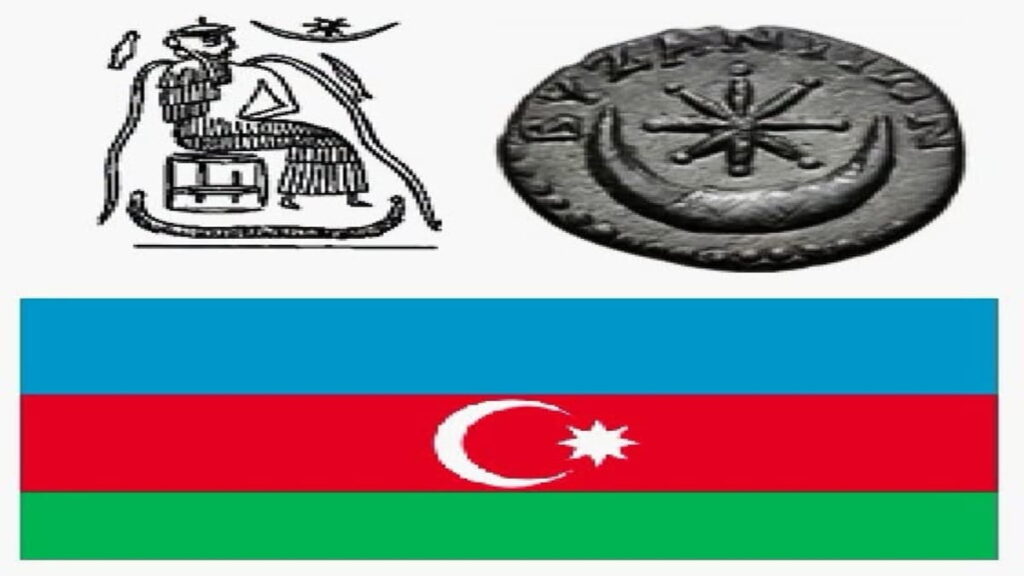
The combination of a crescent moon and a star is one of the most recognizable symbols of the modern world, closely associated today with the Islamic world and the national flags of Turkic countries. Yet this emblem has a far older and far more layered lineage. Long before it appeared on banners, the crescent and star were a language of the sky — a way for the ancient peoples of the Near East and the Armenian Highlands to represent their celestial deities. Tracing its path means tracing the history of an entire cultural region, of which Armenia was a part for millennia.
I. Skies over Mesopotamia: The Birth of the Symbol
The pairing of a lunar crescent and a star is one of the most persistent compositions in Sumero-Akkadian iconography. As early as the 3rd millennium BC, the crescent was regularly associated with the moon god Nanna, known in Akkadian as Sin, while the star — usually eight-pointed — represented the goddess Ishtar (Sumerian Inanna), the personification of the planet Venus. A solar disk representing the god Shamash was often added to this pair, and together the three symbols formed the classic astral triad seen on boundary stones (kudurru) and seals from the second half of the 2nd millennium BC — for example, on the stele of King Meli-Shipak I (Wikipedia: Sin (mythology)).
A rare but historically important example is the boundary stone of the Babylonian king Nebuchadnezzar I (12th century BC), where Ishtar’s star is placed directly inside Sin’s crescent — very close to the form in which we know the symbol today (Star and crescent — Wikipedia). The composition of “star within crescent” can later be traced on the coinage of the Pontic kings Mithridates III and, especially, Mithridates VI, whose dynasty claimed descent from the Achaemenids, and afterward on the coins of the Parthian rulers Orodes II and Phraates IV, who — as scholars note — inherited “traditional Mesopotamian symbols” from a much older tradition (History of the Star and Crescent — Steemit).
II. The Armenian Highlands: Local Sky Gods — Khaldi, Teisheba, Shivini
From the mid-9th century BC, the Armenian Highlands formed the core of the kingdom of Urartu (known to its own people as Biainili), whose religious and artistic culture was closely intertwined with that of Mesopotamia. The supreme Urartian triad — Khaldi (the chief god and patron of royal power), Teisheba (god of thunder and war, a counterpart of the Hurrian Teshub), and Shivini (god of the sun) — largely mirrors the logic of the Mesopotamian astral triad of Sin, Ishtar, and Shamash (Armenian Museum of Moscow: The Urartian Pantheon; The Religion of Urartu).
Shivini’s emblem is believed to have been a winged solar disk, iconographically identical to the Assyrian symbol of Shamash and frequently found on Urartian cult seals (Urartian Mythology — Mythological Encyclopedia). Notably, the Urartian name Shivini survives in Old Armenian in the form “Artinis,” meaning “rising sun” (Shivini — the Urartian Sun God), a clear demonstration of continuity in the religious-astral vocabulary of the Armenian Highlands long before the rise of the Hellenistic kingdoms there.
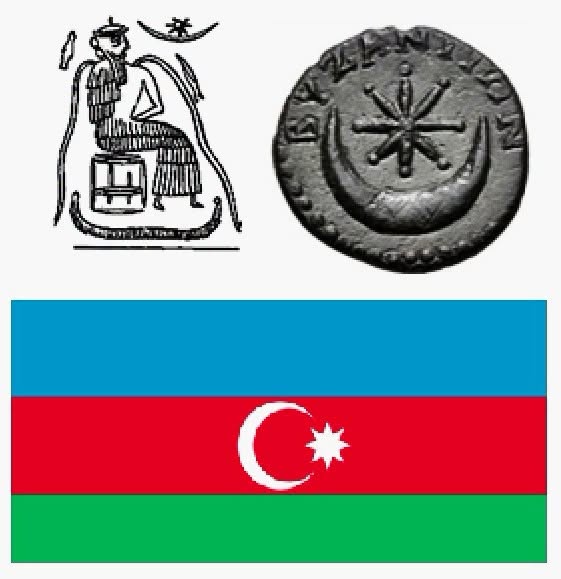
Depictions of deities on archaic Near Eastern reliefs — a seated figure holding a scepter on a pedestal, accompanied by astral emblems above the head — represent a characteristic composition of precisely this cultural sphere: this is how Mesopotamian and Anatolian deities were shown, their presence marked by celestial signs placed in the upper register of the scene.
III. Hellenistic Armenia: The Artaxiad Tiara and the Eight-Pointed Star
The most vivid and best-documented Armenian embodiment of astral symbolism is the tiara of the Artaxiad dynasty, the headdress of the Armenian kings from Tigranes II the Great (95–56 BC) to Artavasdes II. The tiara was a peaked, cone-shaped headdress wrapped in a diadem bearing an eight-pointed star, flanked on either side by two eagle heads facing outward. This star served as the dynastic emblem of the Artaxiads and, according to scholars, symbolized the ancient Armenian sun god Mihr (Mher), heir to the earlier Iranian-Zoroastrian Mithra (The Armenian Tiara — Wikipedia; Armenian Museum of Moscow: The Armenian Tiara).
The scholar G. A. Tiratsyan traced the origin of the Armenian tiara to a fusion of the Achaemenid royal crown with a local satrapal headdress that had existed on the Armenian Highlands since at least the 5th century BC — while the star-rosette and the flanking eagles were, in his view, a genuinely Armenian addition absent from the Achaemenid prototypes.
This star-crowned tiara appears on numerous coins of Tigranes the Great, minted in Artaxata, Tigranocerta, Antioch, and Damascus. In 2004, astrophysicist Vahe Gurzadyan and historian Ruben Vardanyan published a paper in the journal of the Royal Astronomical Society proposing that the unusually shaped star with a curved “tail” seen on Tigranes’ later coins (the Damascus mint) might depict Halley’s Comet, observed in 87 BC (Armenian Museum of Moscow: The Armenian Tiara; The Armenian Dram — RosInvest). This hypothesis remains a matter of scholarly debate, but the consistent use of the star as a royal and solar emblem in 1st-century BC Armenia is, by contrast, thoroughly and reliably documented — unlike many later legends attached to this symbol.
IV. Byzantium: A City Under the Protection of Hecate
A separate and well-studied strand of the symbol’s history belongs to the Greek city-state of Byzantium — the future Constantinople. A crescent moon paired with a star (or several stars) appears on the city’s coinage from roughly the 1st century BC onward. Ancient tradition attributed the symbol’s origin to the cult of the goddess Hecate, identified with Artemis: according to legend, in 340/339 BC Hecate saved the besieged city from the forces of Philip II of Macedon by lighting up the sky and thereby revealing the enemy’s movements. The 7th-century historian Stephanus of Byzantium refers to Hecate as “light-bringing” (phosphoros) (History of the Star and Crescent — Steemit; Crescent Moon and Star — La Brújula Verde).
Modern scholars remain skeptical of the legend of the moonlit rescue (some ancient sources explicitly describe a cloudy, not moonlit, night), but agree that the symbol reached Byzantium from the broader Anatolian–Near Eastern tradition of lunar and stellar veneration — likely by way of the cult of Aphrodite at Paphos on Cyprus, and through the Pontic coinage of Mithridates VI, who briefly controlled Byzantium in the 80s BC (The Ancient Star and Crescent — MENA Symbolism).
It is precisely this Byzantine coin — inscribed “BYZANTION,” with an eight-rayed star above a crescent moon — that became one of the most recognizable ancient examples of the symbol in numismatics.
V. From Rome and the Sasanians to the Ottoman Empire
The symbol continued to circulate in imperial iconography throughout late antiquity. It appears on Roman coins from the reigns of Hadrian, Caracalla, Septimius Severus, and Geta, where the star is typically shown inside the crescent (Star and crescent — Wikipedia). In Sasanian Iran, from the 5th century onward, the star and crescent appear on royal crowns (beginning with Yazdegerd I) and in the margins of coins — which, according to numismatist Andrea Gariboldi, may have been a response to the growing prominence of the same symbol on Byzantine coinage of the period (The Ancient Star and Crescent — MENA Symbolism).
In medieval Europe, the crescent (less often paired with a star) was frequently used in heraldry and on Crusader coinage from the 12th century onward, often combined with a cross, and only later — roughly from the 13th–14th centuries — did it begin to be associated with the Islamic world. The Ottoman Empire adopted the crescent as a state emblem after the conquest of Constantinople in 1453, inheriting it from the earlier civic symbolism of Byzantium; the star was added later, and the combined “star and crescent” was firmly established as an element of Ottoman military and state heraldry by the 18th century (Crescent Moon and Star — La Brújula Verde; Star and crescent — Wikipedia).
VI. The Present Day: The Symbol on Regional Flags
From Ottoman state symbolism, the star and crescent passed onto the flags of numerous countries that had once been part of the empire or that experienced waves of pan-Turkic and pan-Islamic nationalism in the 19th and 20th centuries: Turkey, Tunisia, Algeria, and later Pakistan, Malaysia, Mauritania, Azerbaijan, and others. Variations in the orientation of the crescent’s horns and in the number of the star’s points across different flags are attributed by scholars partly to the moon’s observed position at different latitudes, and partly to later symbolic reinterpretations — for instance, a five-pointed star representing the five pillars of Islam (Crescent Moon and Star — La Brújula Verde).
It is worth emphasizing: the fact that a modern Turkic state’s flag features a star and crescent does not mean the symbol was “stolen” from any single ancient people. As the history outlined above shows, the emblem passed through the Sumerians, Babylonians, Urartians, Armenians, Pontic Greeks, Parthians, Romans, Sasanians, and Byzantines long before it became associated with Ottoman and Turkic statehood — it is a shared inheritance of the entire Near Eastern cultural sphere, not the exclusive property of any one civilization.
Conclusion
The history of the crescent and star is, at its core, the history of the astral religion of the ancient Near East and the Armenian Highlands — a cult of the moon, the sun, and Venus known under different names as Sin and Ishtar, Shivini and Khaldi, Mihr and Hecate. The Armenian chapter of this story — from the Urartian triad of sky gods to the eight-pointed solar star on the tiara of Tigranes the Great — is relatively well documented and deserves to be as widely known as the later, Ottoman and Turkic, chapters of the same symbolic tradition.
Related Articles (Armenian/Russian site sections)
- The Artaxiad Tiara and Royal Symbolism of Ancient Armenia
- The Urartian Pantheon: Sky Gods of the Armenian Highlands
- Halley’s Comet on the Coins of Tigranes the Great: A Scientific Hypothesis
- Mithra–Mihr: The Cult of the Sun God from Persia to Armenia
Further Reading (English)
- Star and crescent — Wikipedia
- Sin (Mesopotamian moon god) — Wikipedia
- Crescent Moon and Star: The Islamic Symbols That Actually Date Back to Ancient Mesopotamia — La Brújula Verde
- History of the Star and Crescent — Steemit
- The Ancient Star and Crescent — MENA Symbolism
Image Source: Hamlet Martirosyan
Read Also: ՀԱՅՔԻ ՍՐԲԱԶԱՆ ԱՆՑՅԱԼԸ ԹՈՒՐՔԱԿԱՆ ԴՐՈՇՆԵՐԻ ՎՐԱ

One thought on “The Crescent and the Star: The Journey of an Ancient Near Eastern Symbol — From Mesopotamia and the Armenian Highlands to the Present Day”