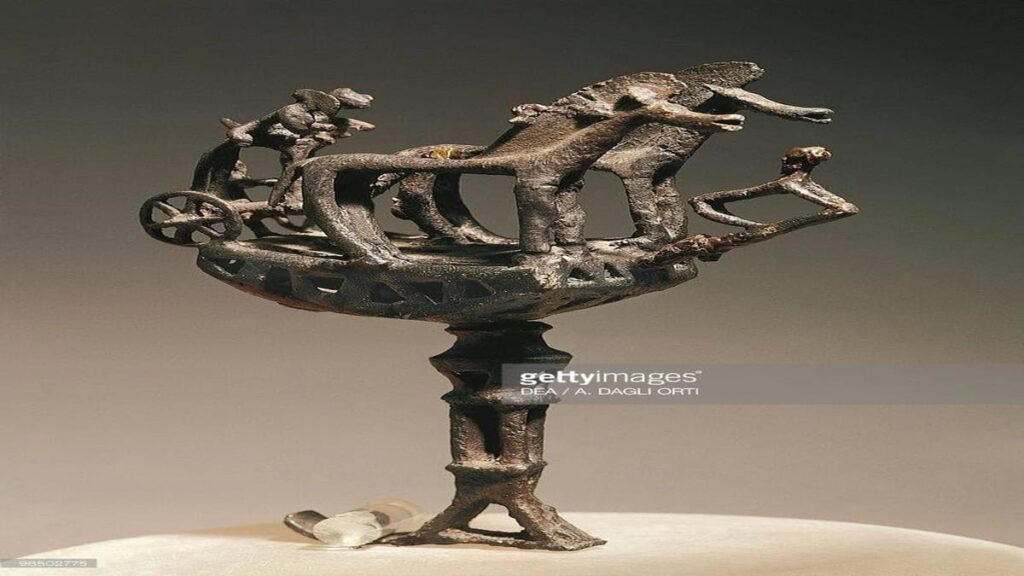
Among the most evocative artifacts to survive from the Armenian Highland’s Late Bronze Age is a small bronze chariot model — a horse-drawn two-wheeled cart mounted on a tall pedestal, its miniature riders frozen mid-journey for more than three thousand years. Pieces of this kind, cast in the workshops of the Lchashen-Metsamor culture around the shores of Lake Sevan and across the wider South Caucasus, are among the earliest surviving representations of wheeled, horse-drawn transport from the Armenian Highland — and among the most striking expressions of elite and ritual life in the region before the rise of Urartu also known as the Kingdom of Ararat or the Kingdom of Van.
Where These Objects Come From
The story of their discovery begins with an engineering project rather than an excavation. In the 1950s, Soviet authorities lowered the level of Lake Sevan to provide irrigation water for the Ararat plain. As the shoreline retreated, it exposed an enormous Late Bronze Age necropolis at Lchashen, eventually yielding several hundred burial mounds. The dropping water level uncovered countless graves and artifacts, and over the following decades roughly 800 burials were documented, most built of stone and dating to the Bronze Age. Grave goods included the skeletons of horses and oxen still harnessed to carts, along with bronze statuettes of animals and jewelry.
The cemetery is famous above all for its full-sized wooden wagons — remarkable survivals of Bronze Age carpentry. Six oak wagons recovered from the site were dated to the 15th–14th centuries BC, each built with four wheels on two axles; four of them carried an elaborate covered superstructure, and one is considered the best-preserved example of an early covered wagon anywhere in the world. The best-known example is held together by at least 70 separate wooden and bronze components, with the canopy frame alone requiring several hundred precisely cut mortise joints.
But alongside these full-scale vehicles, Lchashen and related sites of the same culture produced something rarer still: miniature bronze chariots, cast not as toys but as ritual or symbolic objects. Archaeologist L.A. Petrosyan noted that a distinctive feature of the Lchashen necropolis is the presence, alongside its two- and four-wheeled wagons, of bronze models of war chariots, of the type shown in the photograph above.
Anatomy of a Bronze Chariot Model
These bronze standards follow a recognizable and highly formalized composition, best documented through comparable pieces from Lchashen and the site of Lori Berd in northern Armenia. According to the archaeologist Sona Manukyan, who has studied the corpus of related bronze belts and chariot standards from the region, a bronze model chariot recovered from a tomb at Lori Berd is yoked to two horses and rests on a square, hollow podium pierced with triangular openings along its sides, rectangular at the top. Inside the hollow podium, two small metal balls served as a bell, while the whole stands on a long base terminating in an anchor-like foot. Ahead of the two-wheeled chariot, mounted on a small vertical post, a carved roe deer appears to lead the vehicle forward, and a single warrior stands on each side of the chariot body, one of them shown holding the reins. A closely related example from Lchashen repeats the same composition, substituting a stag for the roe deer on the standard.
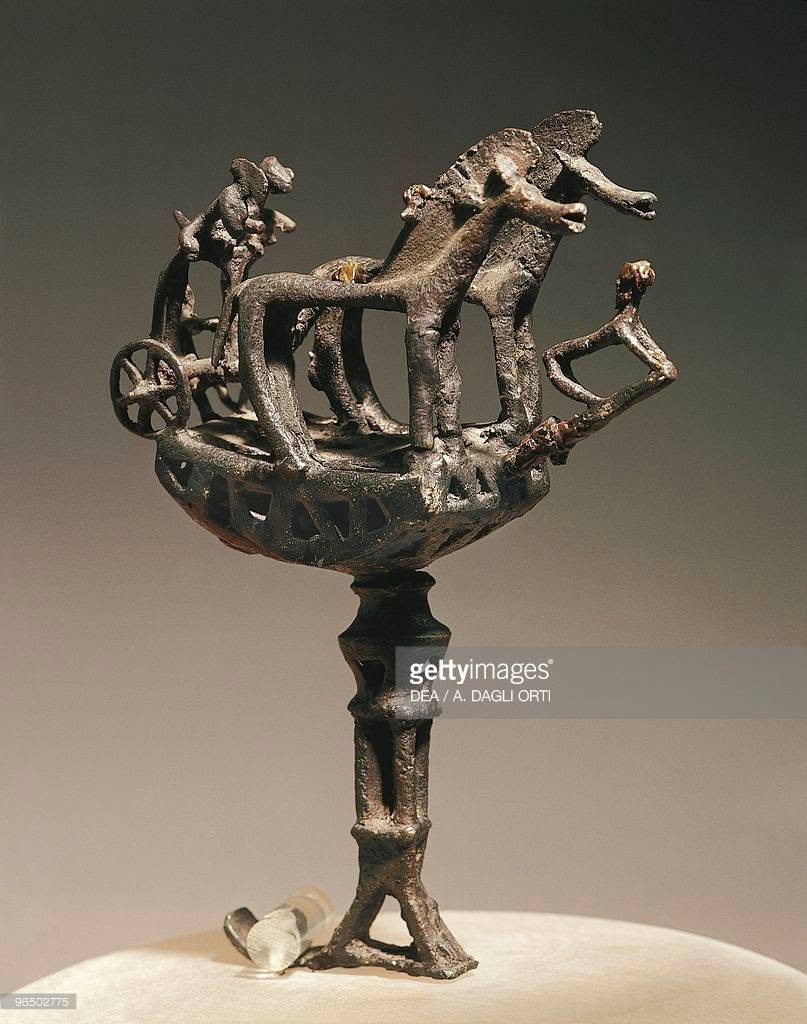
This description matches the essential elements visible in the object pictured here: a pierced, basket-like bowl serving as the platform; a pair of horses yoked to a light two-wheeled car; standing figures at the rail; and a slender pole projecting forward, once crowned by an animal figure that guided the whole ensemble. The entire group is raised on a tall, articulated bronze stand — turning what began as a miniature vehicle into a portable cult object, likely meant to stand upright in a shrine, a chieftain’s dwelling, or beside a grave.
Chariots, Animals, and Solar Symbolism
The recurring pairing of chariot and running deer or stag is not incidental. Across the bronze belts and standards of the Lchashen-Metsamor culture, wheeled vehicles are consistently associated with solar and celestial imagery — sun-discs, horned animals, and birds — suggesting that these objects functioned as much as devotional or cosmological symbols as they did as records of contemporary vehicle technology. On related bronze belts from the same tradition, a masked figure stands on a horse-drawn chariot holding a disc in an outstretched hand, while on another example women stand on similar chariots holding sun-discs marked with a cross. The deer or stag “leading” the chariot on the standards seems to belong to this same symbolic vocabulary — an animal guide bridging the visible world and the sun’s daily journey, a theme paralleled across much of Bronze Age Eurasia, from the Nordic Trundholm sun chariot to the horse-and-solar imagery of the wider steppe.
The bronze-belt tradition to which these chariot standards belong first emerges in the 14th century BC and continues in use through the existence of the Urartian state, into the 7th–6th centuries BC, meaning objects of exactly this type were still being produced and deposited as the region moved from the Lchashen-Metsamor cultural horizon into the age of Van/Urartu — underscoring a real continuity of craft and belief across that transition, even where political structures changed dramatically.
Historical and Archaeological Context
The archaeological record places the emergence of actual chariots — as opposed to solid-wheeled carts — in Transcaucasia at the very end of the 15th and start of the 14th century BC, when rich barrow burials of the period begin to yield bronze fittings and chariot-related equipment. This makes the Lake Sevan region one of the earliest zones in the wider Near East and Caucasus where spoked-wheel chariotry is archaeologically attested, alongside the roughly contemporary evidence from the Hittite and Mitanni world further south. Whether the light chariot technology reached the Armenian Highland from Mesopotamia, from the Hittite sphere in Anatolia, or from steppe cultures to the north remains an open question among specialists; what the Lchashen and Lori Berd finds demonstrate clearly is that, by the 14th century BC, local elites in the Armenian Highland had fully absorbed and locally reinterpreted the new technology — not only using real chariots in life and burial, but recreating them in miniature bronze as objects of ritual power.
Material from the Lchashen cemetery is today divided between the State Hermitage Museum in St. Petersburg and the History Museum of Armenia in Yerevan, where the great covered wagon remains one of the most visited exhibits in the country. Bronze chariot standards of the type discussed here, along with the related corpus of engraved bronze belts, form one of the richest bodies of pictorial evidence for religious life, elite status, and technological change in the Armenian Highland during the Late Bronze Age — centuries before the earliest cuneiform inscriptions of the Kingdom of Van bring the region into written history.
Sources
- Manukyan, S., “Bronze Belts of Lchashen-Metsamor Culture in the Sculptures of the Same Period”, Arvestagir
- “Lchashen Wagon: A 3,500-Year-Old Covered Wagon That Transported a Deceased Chief to the Next World”, Live Science
- “Wagon From Bronze Age Found in Armenia”, The Jerusalem Post
- “Bronze Age Burial Tomb at Lchashen”, World History Encyclopedia
- Pogrebova, M., “The Emergence of Chariots and Riding in the South Caucasus”, Oxford Journal of Archaeology, 2003
- “Lchashen”, Wikipedia
- “Lori Berd”, Wikipedia
Related Reading
- Yervanduni (Orontid) Dynasty and the Origins of Armenian Statehood
- The Ritual Tripod Vessel of Shikaoh: Bronze Age Cult Objects of Syunik
- Urartian Helmets and the Armed Elite of the Kingdom of Van
Image source:Сукиас Торосян

2 thoughts on “The Armenian Bronze Chariot: A Ritual Vehicle of the 14th Century BC”