Long before “clown” became a synonym for children’s birthday parties, the word described a hardened professional performer — one whose stage, on occasion, was not a court hall or a village square but the front line of a battlefield. Armenian tradition remembers these figures as tsaghratsu (ծաղրածու), the comic actors of the medieval Armenian stage, and holds that the least talented among them were sent to stand before the enemy and provoke them with grating voices and crude jokes. It is a claim that sits at the intersection of theater history, military custom, and folklore — and it becomes a good deal more interesting once it is placed against what we actually know about medieval Armenian performance culture, and against a strikingly similar practice recorded for the courts of medieval Western Europe.
From sacred lament to public comedy
Armenian theater did not begin with clowns; it began with mourning. The earliest professional performers documented in Armenian sources are the gusans, itinerant bards and reciter-musicians who accompanied major public and courtly occasions with sung verse. According to the tradition preserved in later Armenian scholarship, the gusans who specialized in funerary rites — the dzaynarku or voghbergak, the “lamenting” or “mourning-singers” — announced a nobleman’s death, recounted his deeds, and imitated his voice and gestures so vividly that the performance shaded into what became Armenia’s tragic theatrical genre, a form so closely tied to native ritual that Armenian never adopted the Greek word “tragedy,” keeping instead the indigenous term voghbergutyun.
Comedy developed along a parallel, more festive track. Ceremonial spring and resurrection rites gave rise to katakergutyun, comic-cheerful singing, and to the professional katakagusan — literally “comedian-bard” — while women performers in this tradition were known as vardzak. By the time Hellenistic drama reached Armenia, the country already possessed a mature indigenous comic and tragic idiom, which is why Armenian preserved native terms for both genres rather than simply transliterating Greek ones. Roman-era Armenia briefly rivaled the Mediterranean world in this respect: according to Plutarch, King Tigranes the Great built a public theater at Tigranakert in 69 BC, predating Pompey’s theater in Rome by fourteen years, and his son Artavazd II reportedly wrote Greek tragedies himself.
The medieval stage: masks, mimes, and moral panic
Theatrical life persisted through the Middle Ages, particularly in Vaspurakan, in the Bagratid capital of Ani, and later in Cilician Armenia, where — according to the same tradition — troupes performed on Lake Van’s Aghtamar Island. Physical evidence for this survives in stone: the tenth-century church on Aghtamar carries carved reliefs showing two categories of Armenian theatrical mask, one for domestic comedy and one for clown characters, making it one of the only surviving visual records of medieval Armenian performance costume. Between the eleventh and fourteenth centuries, Cilician Armenian theater is said to have refined itself further: mime shed its cruder content, tragedy absorbed material from the national epics, and comedy turned to social satire, a period that also produced the earliest surviving Armenian dramatic texts, including a poem attributed to Hovhannes Yerznkatsi and Arakel Syunetsi’s “Book of Adam.” The tradition went into decline only with the fall of Cilicia’s last Armenian dynasty, the Lusignans, in 1375.
The Armenian Church, meanwhile, was rarely at ease with any of this. The fifth-century Catholicos Hovhan I Mandakuni preached directly against theatrical performance, associating it with pagan excess, even as some clergy tolerated the “morally edifying” comedies of Menander and the heroic tragedies of Euripides while rejecting purely mythological farce. This tension between ecclesiastical suspicion and popular appetite runs through the entire history of the Armenian circus and folk-theatrical tradition, which included tightrope walkers, wrestlers, and acrobats performing as itinerant troupes across Armenian lands. That article records a striking external testimony: in 1248, a French crusader knight named Jean de Joinville, traveling toward Jerusalem, encountered pilgrim jugglers and acrobats from Greater Armenia — independent confirmation that Armenian popular performers were mobile, recognized abroad, and active well outside any court setting.
The clown as weapon
It is against this backdrop — a living, socially embedded tradition of professional comic performers ranging from palace to public square — that the claim about battlefield clowns should be read. Armenian oral and popular historical memory holds that the tsaghratsu who failed to make the grade as court or public entertainers were given a grimmer assignment: they were marched to the front line before a battle, where their unpleasant voices and unfunny material were turned into a tactic, designed to rattle and enrage the enemy rather than delight an audience. This specific custom is not easy to pin to a single surviving medieval Armenian chronicle in the sources readily available today, and it should be treated as part of Armenian popular historical tradition about the tsaghratsu rather than as a settled, footnoted fact — the kind of vivid detail that circulates in national memory even when the paper trail is thin.
What makes the claim plausible, however, is that it describes almost exactly a documented practice from medieval Western Europe, worked out independently and for the same psychological reasons. Court jesters and fools attached to noble households were regularly brought to the field when their lords went to war. Chroniclers and later historians describe them marching or riding in the space between two arrayed armies, singing, juggling weapons, and — crucially — mocking and insulting the opposing side to provoke anger and reckless, premature attacks, while simultaneously boosting their own side’s morale before the fighting began. The same role is described as a recognized form of psychological warfare: fools taunted opposing troops from in front of their own lines specifically to bait hot-tempered soldiers into breaking formation, and the English-language Wikipedia entry on jesters likewise records that fools “rode in front of their troops” to provoke or mock the enemy and to serve as battlefield messengers — a role dangerous enough that an insulted commander might return a jester’s body, or only his head, as an answer to unwelcome terms.
Set side by side, the Armenian and Western European traditions describe the same military logic: comic performers, expendable in status if not in courage, deployed as a form of morale warfare that operated on both sides of the front line at once — heartening one’s own soldiers and needling the enemy into a mistake. Whether or not a specific Armenian text records this in so many words, the practice fits comfortably within a broader medieval habit of turning entertainers into instruments of war, one attested from Western Europe to the Iranian world, where the gusan tradition itself contributed, by a related genealogical route, to the figure of the clown in later Iranian traditional theater.
Reading the miniature
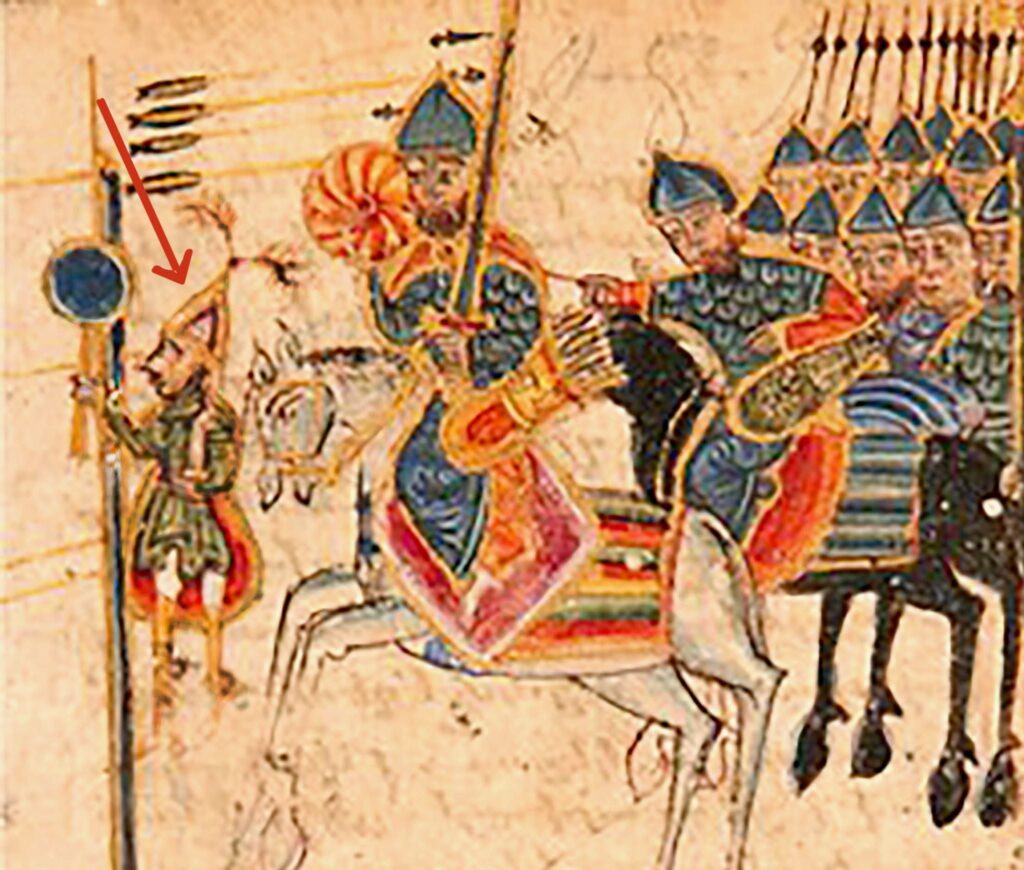
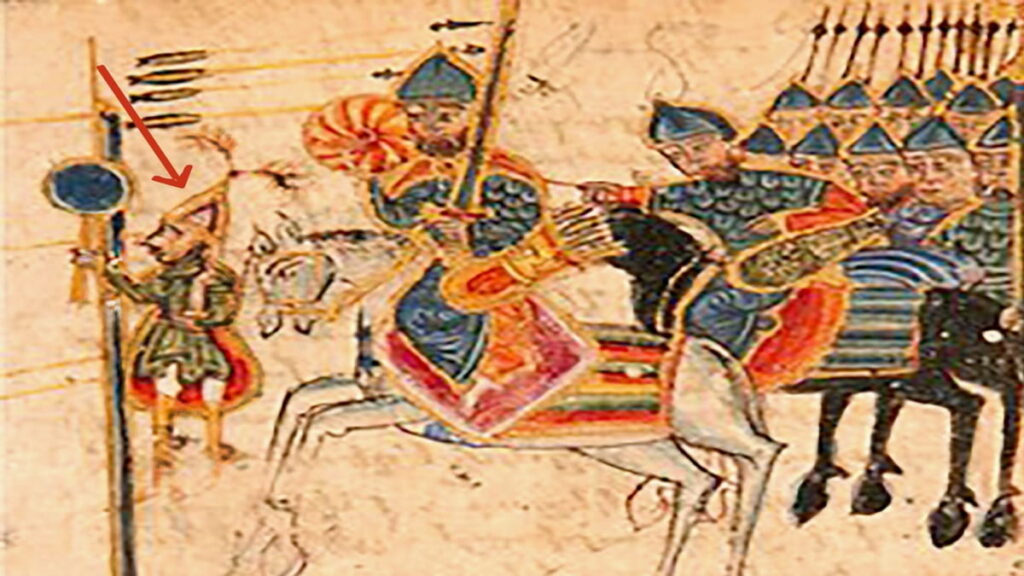
The manuscript illustration accompanying this article belongs to this same visual world of medieval Near Eastern military life, even if its precise attribution requires caution. It shows an armored, turbaned commander on horseback flanked by helmeted soldiers and a dense array of spears, in the style typical of thirteenth- and fourteenth-century Perso-Islamic manuscript painting — a period when Armenian, Georgian, Seljuk, Mongol, and Mamluk armies were in constant contact and shared much of the same military material culture, from lamellar armor to composite bows. The arrow in the image directs attention to a smaller, distinctly dressed figure beside a standard, holding up a round object beneath the flag — plausibly a herald, standard-bearer, or lesser attendant marching apart from the main body of armored cavalry. Figures of exactly this kind — subordinate, visually set apart, positioned near the army’s banners rather than among its heavy cavalry — are precisely where a chronicler or artist might place a battlefield entertainer or herald sent forward of the main host, the kind of figure that Armenian tradition remembers as the front-line tsaghratsu.
A joke that could get you killed
Whatever the exact texture of the historical record, the core image is a memorable one: a society that took its comedy seriously enough to give it a formal function, a hierarchy of talent, and — for its least gifted performers — a genuinely dangerous job description. The gifted katakagusan entertained kings and city crowds; the middling clown worked weddings and festivals; and, according to Armenian tradition, the clown too poor in wit to hold a stage audience was handed a much more literal kind of audience: an armed enemy, close enough to hear every bad joke, and angry enough to charge.
Sources
- Theater of Armenia — Wikipedia
- The Theater of Ancient Armenia — Art-A-Tsolum
- Կրկեսը Հայաստանում (Circus in Armenia) — Armenian Wikipedia
- Between Gusan and Ašuł — Armenia through the Lens of Time (Brill)
- The Genealogy of Clown in the Iranian Traditional Theatre — Journal of Fine Arts: Performing Arts & Music
- Jester — Wikipedia
- The Risky Role of Medieval Jesters on the Battlefield — The Vintage News
- The Role of Fool Was a Staple in Medieval Culture — History Collection
Idea of the article and source of illustration: Sukias Torosyan