Based on the Armenian-language essay “Երևանը տոն է. Արատտայից Երևան” (“Yerevan Is a Festival: From Aratta to Yerevan”) by historian Anzhela Teryan, head of the Department of Archaeology and Medieval History at the Yerevan History Museum (July 2026)
Every summer, Yerevan turns into one long celebration. Trndez and Barekendan announce the end of winter; the Motherhood and Beauty holiday in April honors Mother Anahit and the women of Armenia; the Wine Days festival fills mid-June with tastings and open-air stalls; Vardavar drenches the whole city in water in July; and October brings the Erebuni–Yerevan City Day, marking the founding of the fortress that gave the modern capital its name. According to Teryan, this restless, centuries-deep appetite for celebration is not a modern habit — it is one of the oldest and most persistent threads running through the history of the Armenian Highland, reaching as far back as the Sumerian epic memory of the mountain city of Aratta.
An Epic Echo: “The city that never stops celebrating”
The Sumerian epic Enmerkar and the Lord of Aratta, one of the oldest works of world literature, describes a festival in the city of Aratta that simply never ends:
“In that city [Aratta], the festival does not [end], every day does not [end]…”
Teryan reads the cheerful, almost defiant mood of present-day Yerevan festivities as an echo of this ancient literary memory of unceasing celebration in Aratta — a city many Armenian historians, including Teryan, identify with the highland civilization ancestral to Armenia (a hypothesis that remains outside the scholarly mainstream; most Sumerologists place Aratta more cautiously, somewhere in the Iranian plateau or the wider Caucasus–Zagros zone, without a secure identification). The epic itself survives in Sumerian cuneiform tablets and can be read in full in the University of Oxford’s Electronic Text Corpus of Sumerian Literature (ETCSL) translation.
In the epic, Aratta’s chief patron is the goddess Inanna, and its ruler is described as her devoted priest-king. According to the poem, Inanna organized a magnificent annual festival for the yearly rebirth of her beloved Dumuzi, the shepherd-god associated with the cycle of vegetation. When Dumuzi and Inanna were reunited, the whole land celebrated — with drums, tambourines, reed pipes, flutes and lyres — and the ruler of Uruk, Enmerkar, is said to have sent baskets of grain and herds of livestock to Aratta to be sacrificed during the celebration. Background on the Inanna–Dumuzi festival cycle and its Mesopotamian context can be found in the World History Encyclopedia’s overview of Inanna and the British Museum’s introduction to Mesopotamian religion.
Dancing on the Rocks: The Deep Prehistory of Armenian Festivity
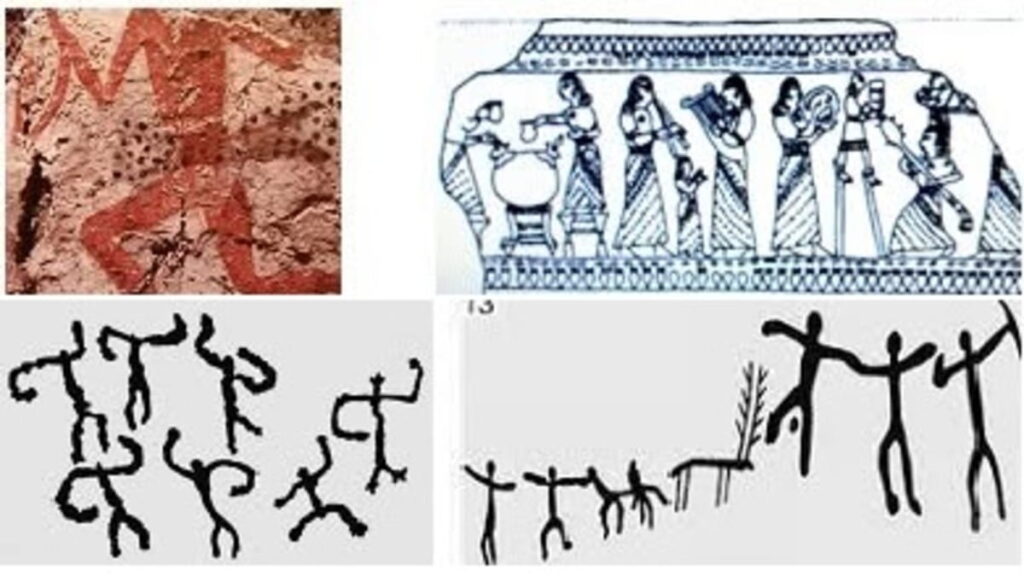
Long before written epics, the people of the Armenian Highland were already leaving records of festive life — not in words, but in stone. The rock art (petroglyphs) of the Geghama, Syunik and Aragats mountain ranges, dated from roughly the sixth to third millennia BC (with some elements possibly older), include numerous images of dancing figures: round dances (shurjpar), war dances, and dancers linked shoulder to shoulder — forms still recognizable in Armenian folk dance today. The petroglyph fields of Ughtasar in Syunik alone contain well over a thousand carved rock surfaces, some tentatively dated to the Paleolithic, most concentrated in the Chalcolithic through Early Iron Age. A solid overview of the site and its dating is available on Wikipedia’s Ughtasar Petroglyphs page and through the Ughtasar Rock Art Project, an ongoing Armenian–British survey. A broader academic survey of Armenian rock art, including its dance and ritual imagery, is available via researcher Karen Tokhatyan’s paper “Rock Carvings of Armenia.”
Çatalhöyük: Bones That Remember Dancing
Teryan draws a striking comparison to Çatalhöyük, the great Neolithic settlement near Konya in central Anatolia — a region the medieval Armenian historian Movses Khorenatsi referred to as Gamirk’ (Cappadocia). Excavated from 1961 by British archaeologist James Mellaart, Çatalhöyük is renowned for its densely packed, ladder-accessed houses built on flat, terraced rooftops that functioned as shared public space — ideal, Teryan suggests, for communal festivity. The site’s official research project maintains a detailed public bibliography and history at catalhoyuk.com.
The specific claim in the essay — that skeletal analysis at Çatalhöyük revealed anatomical changes in the femurs consistent with frequent, vigorous dancing — refers to physical anthropologist J. Lawrence Angel‘s 1971 study, “Early Neolithic Skeletons from Çatal Hüyük: Demography and Pathology,” published in Anatolian Studies (vol. 21, pp. 77–98). The publication itself, including its abstract, can be viewed via Cambridge Core and the Çatalhöyük Research Project bibliography. It is worth noting for readers that Angel’s paper is a technical paleopathological study of the Neolithic population’s health and skeletal stress markers; readers interested in the precise wording of his findings on femoral changes and their proposed link to dance should consult the original journal article, since this is a specific interpretive claim rather than an uncontested consensus finding of the field.
Wine, Grain and Celebration in the Ararat Plain
Teryan situates the Armenian tradition of festivity firmly within one of the region’s most important contributions to world history: viticulture. Long-necked storage vessels, large karas jars, grape pips and skins recovered from Metsamor, Erebuni and Teishebaini (Karmir Blur), dating across the third to first millennia BC, attest to a deep and continuous local tradition of winemaking. This tradition has its most spectacular archaeological confirmation at Areni-1 cave in Vayots Dzor, where an Armenian–Irish–American team led by Boris Gasparyan, Gregory Areshian and Ron Pinhasi uncovered what is currently recognized as the world’s oldest known winery, dated to roughly 4100–4000 BC — complete with a grape-treading basin, fermentation vat, storage jars, and chemically confirmed traces of wine pigment (malvidin). Details are available from Wikipedia’s Areni-1 winery entry, National Geographic’s report on the discovery, and the site’s UNESCO tentative-list description.
Wine and beer, in Teryan’s account, were never the preserve of gods and kings alone — archaeological and iconographic evidence suggests they were shared broadly during festivals, uniting rulers and commoners in the same celebration.
Feasting in the Araratian (Urartian) Kingdom
The Araratian kingdom (Urartu), which flourished in the Armenian Highland from roughly the 9th to 6th centuries BC, has left rich material evidence of court and public festivities. Bronze belts, jewelry boxes, and wall paintings recovered from Urartian sites depict banquet and celebration scenes involving rulers, queens and courtiers. A well-documented example is the Urartian “narrow bronze belt with a banquet scene,” in which a female figure — likely a queen — sits enthroned while attendants serve her; several such belts are held in museum collections and can be viewed through Google Arts & Culture’s Urartian jewelry collection from the Rezan Has Museum. Wine itself played a documented ceremonial role in Urartian religious life, offered and ritually consumed in rites connected to the chief god Haldi and the sun-god Shivini, as described in the Wikipedia overview of Urartian religion. The palace at Erebuni — excavated at the Arin Berd hill on the outskirts of modern Yerevan — preserved more than 2,000 square meters of wall paintings depicting processions, agriculture, and courtly life, described in the World History Encyclopedia’s entry on Urartu art and at the Erebuni Historical and Archaeological Museum-Reserve.
Erebuni itself is central to this story of continuity: founded in 782 BC by King Argishti I as a fortress-city on the Ararat plain, it is now understood by most historians as the direct predecessor of modern Yerevan, whose name is widely regarded as a linguistic descendant of “Erebuni.” This connection is marked every October by the Erebuni–Yerevan City Day, discussed in the Cascade Travel Armenian festival calendar and detailed at the Erebuni Museum’s own history page.
Living Continuities: Vardavar and the Festivals of Today
Teryan’s essay closes by tracing an unbroken thread from antiquity to the present through Armenia’s living festival calendar. Chief among these is Vardavar, the exuberant midsummer water festival most closely associated with Astghik, the pre-Christian Armenian goddess of water, beauty, love and fertility. After Armenia’s Christianization in the early 4th century, the Armenian Apostolic Church folded Vardavar into the Feast of the Transfiguration, while the underlying practice — public water-dousing as an act of joy and purification — survived largely unchanged. A full account of Vardavar’s pagan origins and Christian adaptation is available on Wikipedia’s Vardavar page and through Armenia’s official tourism portal.
Taken together — the Sumerian memory of an endlessly celebrating Aratta, the dancing figures pecked into highland rock faces millennia ago, the world’s oldest confirmed winery at Areni, the banquet scenes on Urartian belts, and the water festivals still splashing through Yerevan’s streets every July — Teryan’s essay argues for festivity itself as one of the most durable threads of continuity in the cultural history of the Armenian Highland, “for as long as the Armenian people and the Mother Land exist.”
On the source and its author
This article is based on the essay “Երևանը տոն է. Արատտայից Երևան” by Anzhela Teryan, historian and head of the Department of Archaeology and Medieval History at the Yerevan History Museum, dated July 2026. Teryan is the author of numerous books and articles on Armenian antiquity, including Հայոց հնագույն աստվածները (“The Ancient Gods of the Armenians,” Yerevan, 2017) and Պատմություն Արարատ երկրի. Մ.թ.ա. IV–I հազարամյակներ (“History of the Country of Ararat: 4th–1st Millennia BC”). A substantial archive of her articles and research notes, including earlier pieces on Aratta, wine culture, and the Sumerian-Akkadian sources concerning the Ararat region, is publicly available on her blog: angelateryan.wordpress.com. As with much of her work, the essay’s central argument — that Aratta, Urartu and Armenia form a single continuous cultural and historical entity — represents Teryan’s own interpretive framework and is not the consensus position of mainstream Sumerology or Urartology, which generally treats the geographic location of Aratta as unresolved and the linguistic relationship between Urartian and Armenian as a matter of ongoing scholarly debate. Readers interested in the wider academic discussion of Urartu–Armenia continuity can consult the Wikipedia article on Urartu for a summary of the debate and its sources.
Related articles
- The Crescent and Star: Ancient Origins of a Living Symbol
- The 2026 Shamiram Archaeological Field Season: An Armenian–Italian Joint Expedition
- The Bronze Chariot Model of the Lchashen-Metsamor Culture
- A Newly Documented Winged Cross from Lorut Village, Lori Region
- Yervand I Sakavakyats and the Orontid Dynasty: Legend and History
- The Tsaghratsu: Theatrical Performers of Medieval Armenia