The bow is one of the most remarkable achievements of humanity. Most scholars attribute its appearance to the early Neolithic era, while others to the Paleolithic times. Indeed, it is from the Paleolithic that ideographic signs – a hunter, a shooter, an arrow – begin to appear and gradually develop in Armenian rock images.
After a sharp increase in the number of Homo sapiens, hunting with spears and darts for large animals became much more difficult – large herds were partially exterminated, partially migrated to more remote or inaccessible places.
The invention of the bow allowed ancient people to hunt smaller game – hares, roe deer, birds – and thus make up for the emerging meat shortage. However, it is quite possible that the bow was invented as a musical instrument, because a tightly stretched bowstring produces a characteristic singing and vibrating sound (because what is a harp, if not a bow with multiple strings?)…
It is noteworthy that in world mythology, the form-image-structure of the bow is suggested and given by the heavenly rainbow. The bow and the archer-shooter are directly associated with both the sky and the earth – with the ancestors-sky dwellers.
From this point of view, the conclusion of A.A. Martirosyan is valuable: “…the ancestor-archers, associated with the moon and the sun, the celestial bodies, the celestial vault, could also have a connection with the constellations, like the legendary Ayk with Orion or the Sasun giants-demigods – with Aries” (article “Primitive Hieroglyphs of Armenia and their Urartian-Armenian Duplicates”).
Almost immediately after its invention, the bow was transformed from a tool into a weapon. And since then its development has been literally rapid. Not only the bow itself was improved, but also the ways of handling it – various ways of stretching the bowstring appeared, the arrows became more differentiated: for hunting birds, large and small animals, fish, etc. The bow as a weapon and tool spread all over the world, or rather – was invented at once in many places.
However, I was always surprised why there are two names for an arrow in the Armenian language. The first and most common is “net”, the second, also well-known, but rarely perceived as a weapon, is “slak”.
Purely by ear, “net” is perceived as something throwable: to throw, to hurl in Armenian is “netel”. However, the ancient Armenians threw not only arrows, but also darts, but the dart had its own name – “teg”.
At the same time, “slak” implies something more rapid than “net” – perhaps, by analogy with the verb “slanal” – “to rush”? Well, besides, since the hands on the clock in Armenian are also called “slak”, it is purely logical to assume that “slak” is smaller than “net”.
(By the way, the Armenian name for a spear – “nizak” – is associated by me with the Russian verb “nizat, nanizivat”, Armenian “sakr”, from which “sakravor” – sapper, – with “axe”, and “tapar” – with axe. Maybe the roots here are indeed common Indo-European?)
Where does such a difference come from? Why? Again, if we reason logically, arrows of different sizes and purposes are widely known in the world. The first thing that comes to mind are arrows for a bow and arrows for a crossbow, better known as “bolt”.
However, I do not remember the actual Armenian name for a crossbow or self-bow – not to consider such a modern word “inknadzik” or the one given in the Russian-Armenian dictionary “dzkazenk” – tension weapon, which is even more absurd than “inknadzik”…
In general, I would like to remind once again about the almost complete absence in Armenian historical science of such a section as armament study. Stepan Esayan’s monographs “Armor of Ancient Armenia” and “Weapons and Military Affairs of Ancient Armenia, III-I millennia B.C.” were published in the 1960s.
The works of Emma Astvatsaturyan “History of Arms and Silver Production in the Caucasus in the XIX – early XX centuries”, “Weapons of the Peoples of the Caucasus”, “Dagestan Weapons”, “Turkish Weapons in the Collection of the State Historical Museum”, “Masters of Arms and Silver Works of the North Caucasus and Transcaucasia”, “Index of Hallmarks of Masters of Arms and Silver Works of the North Caucasus and Transcaucasia” are even less accessible and concern not so much Armenian armament study, but general Caucasian realities, moreover, with rare exceptions, – the era of firearms.
We can also recall a number of other publications on the history of Armenian weapons, for example, the article by Ripsime Janpoladyan-Piotrovskaya “Medieval Saber with Armenian Inscription Found in the Polar Urals”.
Moreover, isn’t the very fact that weapons, even if they are common to the Caucasus, are mainly dealt with by women in our country, surprising? However, it should be said that on some historical forums there were quite lively discussions concerning the military affairs of ancient and medieval Armenia.
Unfortunately, these discussions themselves were largely amateurish (and the author of this article is no exception), and the forums themselves have withered away. Moreover, since many of the sources mentioned above are practically inaccessible due to their rarity and age, and some are completely absent, people have to dig on the Internet, look for analogies, operate with not quite adequate, and even alien concepts and terms.
Regardless, in Armenian history – both ancient and medieval – bows and arrows, as well as archers themselves, hold a very respectable place. And significant. So significant that even the arrows had two names!
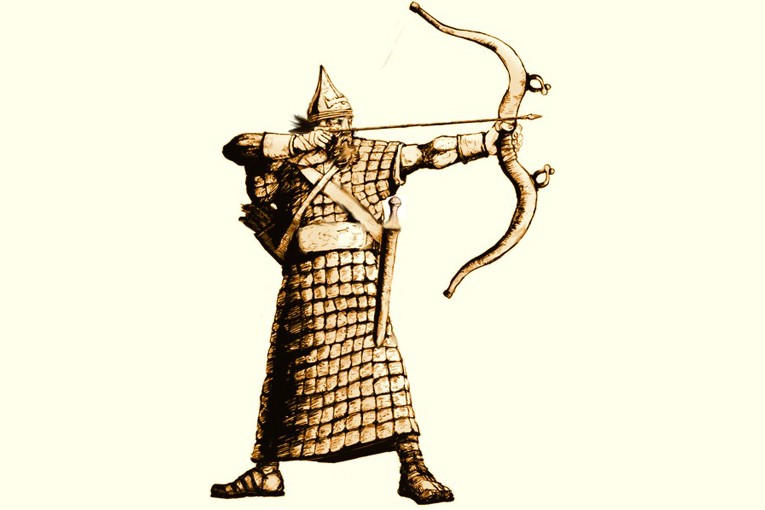
However, what do we really know about the bows of Armenian warriors? Judging by the monument to Hayk the Forefather, our ancestor was armed with a simple long bow. We see exactly the same bows on the petroglyphs of Armenian mountains. These are the very first types of bows, representing a bent stick with a bowstring.
This traditional representation of Armenian bows, strangely enough, has survived to this day. They were made from the wood of yew, ash, juniper, maple, elm, acacia, hickory, walnut, or red cedar – species of trees common in the Armenian Highlands.
These bows were typically quite large (simple bows of smaller size were used almost exclusively for hunting. So, in a burial ground north of Khanlar (the fact that the toponymy is Turkic does not change the belonging of these territories to historical Armenia) E. A. Ressler found a vessel depicting hunting for wild goats. The vessel has two extremely schematically executed figures of hunters holding small bows with arrows already laid.
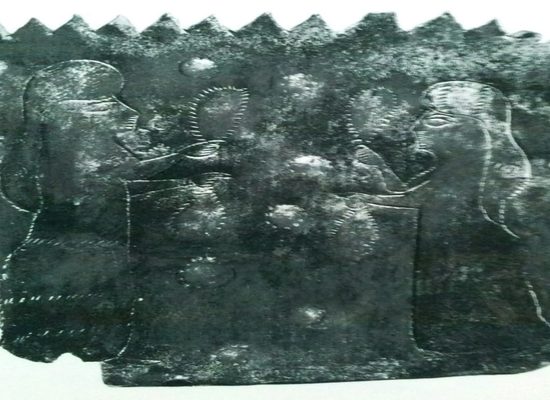
By the way, judging by the images, the bow of the Eastern Transcaucasia, unlike the Central Transcaucasia, was of relatively small size. Such are the bows depicted on black pottery (Kirovabad region), as well as on a bronze belt from the excavations of V. Belka in the Shamkhor region.
But on the combat belts of Central Transcaucasia, we encounter large bows, almost the height of a person – predominantly combat ones. This circumstance, by the way, is confirmed by documentary historical evidence.
As Horenatsi reports, Armenian bows were large (up to 2 meters) and wide, and the arrows – three-feathered and very long, which ensured the range and accuracy of shooting. These arrows were so long that if they fell to the enemies undamaged, they used them as darts.
Apparently, the arrows for such bows were called “net”. The arrowheads were also improved – they were, so to speak, made to be “irremovable” – one of the feathers of the tip was made weak, and it broke in the wound, hindering healing.
“And yet the enemies did not suffer damage,” Dion Cassius sadly notes the rout of Lucullus’s army by Armenian cavalry in the Battle of Aratsani on September 15, 68 BC, “and returning back and shooting the pursuers, they killed many and wounded others.
And the wounds were heavy and hard to heal, for they used arrows with such tips that, being fastened together, quickly killed, whether they remained in the body of the wounded or in the case of extraction, for one of the iron tips, which was not attached, remained in the wound.”
(In another translation, it is directly indicated that the arrows had two tips, one of which always remained in the wound. In another, more modern translation, the translator, apparently not having mastered the subtleties of Dion Cassius’s terminology, simply wrote that the tips were smeared with poison…
In yet another, it says that “the arrows had two ends, specially connected to each other”…) Mastery of all types of weapons was a necessary condition for the education of the nobility. Mastery of the bow was also obligatory for Armenian kings.
“Beautiful in face, skilled archer, brave Vagarshak” – this is how Horenatsi characterizes King Vagarshak. By the way, the rulers of the Ararat Kingdom did not shy away from shooting a bow.
Cuneiform has preserved evidence that Argishti, son of Rus, shot at a distance of about 476 meters – almost half a kilometer! There is also evidence that Armenian archers pressed the lower end of their bows into the ground and pressed them with their foot – their weapon was that powerful and large.
Here is another confirmation of the recognition of the skills of Armenian warriors: “Let the Armenians with Vasak and Arbel be positioned behind the right wing, occupying the very edge of the wing, because all of them are archers (Disposition against the Alans. Flavius Arrian).
The recognition of the importance of archers in the army of ancient Armenia is also evidenced by the fact that the Armenian army, marching with Cyrus, consisted of 4,000 cavalry, 10,000 archers and 10,000 peltasts (warriors armed with darts and slings).
And in one of the Arab-Byzantine wars, Armenian archers in the Byzantine army shot so accurately from bows that most of the Arabs were hit by arrows in the eye. This battle was named “The Battle of Blindness”.
However, let’s get back to the big and small bows. Ancient reliefs and medieval miniatures show that large bows – which are called “lainalich” in Horenatsi (a typical example is the Gaika bow) – were used primarily in defense – on the walls of fortresses or in protected places where it was easier to handle them, and the enemy needed to be hit at the greatest possible distance.
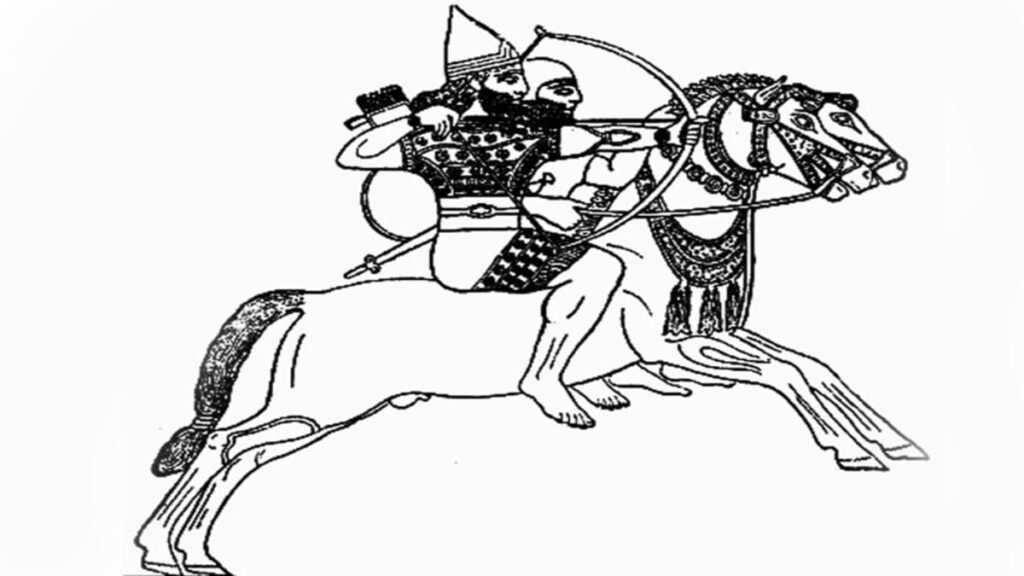
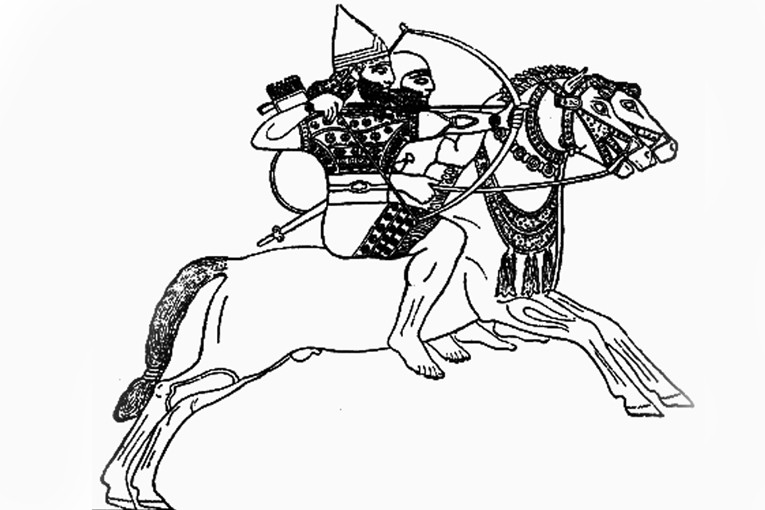
We see large bows in Egyptian, Hittite and Assyrian depictions of battles with chariots. The thing is that usually archers on chariots did not shoot on the move, when there could be no question of aimed shooting (unless by a dense mass of troops), but approached closer and hit the enemy from short stops.
In these cases, the large bow was not an obstacle. By the way, at the early stages of cavalry development, horse archers also shot either from stops (and in these cases they had special grooms holding the horse so that its movements would not “knock off the aim”), or they simply dismounted.
And all because stirrups had not yet been invented, so the horse was not yet a reliable mobile “platform”. And here again, the large bow was not too much of a hindrance.
As for small bows, according to reliefs and miniatures, for a very long time they were not a bent stick with tied string ends, like large bows, but a complex weapon with one or two shoulder bends and special horn plates that increased the strength and elasticity of the bow.
And such bows were already professional weapons. It is quite natural that for complex or composite bows, shorter arrows were needed, as the practice of using a bow and arrows showed that the shorter and lighter the arrow, the more accurate and further it will fly.
But its penetrating power is less and it is effective only at a short distance. So why did the short composite bow in the East – both Far and Near – almost immediately gain such popularity and become the main weapon, especially of the cavalry?
Everything here (as in the case with swords and sabers) boils down to such an epochal discovery of its time as the invention of stirrups. This led to the fact that the horse not only ceased to be simply a means of delivering warriors to the battlefield, but also became an integral part of the combat complex called a cavalry warrior.
The short bow turned out to be perfectly suitable for a rider: with it, it became possible to shoot not only forward, but also to the left and even backwards – the lower shoulder of the bow no longer rested against the horse’s side.
The small bow, reinforced with horn or bone overlays and wrapped with tendons, was not inferior in power to the large one, and the speed of a comparatively lighter arrow, supplemented by the speed of a galloping horse, increased its penetrating ability, especially at comparatively short (50-100 meters) distances.
Such an arrow, also equipped with a faceted armor-piercing tip, was no longer protected by chain mail or other protective weapons. (We will add in brackets that the Japanese, for example, went their own original way here. To prevent the large yumi bow from interfering with shooting from a horse and on the run, they simply reduced the lower shoulder of the bow, which made it asymmetrical).
Our conclusions, derived purely logically, unexpectedly found their confirmation in a very informative article by Anzor Ostakhov “Adyghe Shooting Weapons (XIII – XVI centuries)” (again, let’s not forget that the military art of the peoples of the Caucasus and Transcaucasia developed largely in the same way, and in the Middle Ages they all possessed the same complex of weapons).
So, let’s quote: “… The Circassians had two types of bows – large and small. The sizes of large bows were approximately 130-140 cm, and arrows – 70-75 cm; in turn, the sizes of small bows and arrows were 90-100 cm and 40-50 cm. … According to the data of E.G. Astvatsaturov, the Adygs also had needle-like tips for piercing chain mail.
At the same time, arrows with a small tip had a greater range of flight than arrows with a wide flat tip; this was due to their weight: the former were light, the latter were heavy. …
Large bows were used in a dismounted state for shooting at long distances from safe positions. We made this conclusion based on a number of facts. Firstly, a large bow is inconvenient for horse shooting, as it greatly restricts the movements of the rider and makes aiming difficult…”
It seems clear now why our ancestors had two names for arrows. And no matter how much I dug here and there, I did not find another nation where arrows for long and short bows would be called differently (although I may be mistaken)… And – a notch to remember: the command to shoot from a bow among many peoples sounds somehow like “Fire!” – even among the English! But in the Armenian language, this command is “Zark!”, Which means “hit!”
The small composite bow has another advantage over the simple large one. Due to the design features, the composite bow retains its elastic properties much longer. The string of a simple bow had to be removed as soon as there was no need for this weapon (otherwise the bow loses its shape and elasticity, and a large bow with equipment is quite cumbersome).
By the way, modern rules recommend removing the bowstring even during a half-hour break in shooting! But composite complex bows can be kept with a stretched bowstring for several days.
This was especially important for swift cavalry, because according to historical evidence, putting a bowstring on a bow is not a matter of one or even ten seconds: not every man could bend a powerful composite bow (remember the bow of Odysseus!).
By the way, the power of modern sports bows is 22-25 kg for men and 16-18 for women, while even simple large English bows (longbow) reached 100 pounds, that is, up to 45 kg, so for archers of ancient times even today’s male version will seem highly “childish”…
…Well, since we smoothly moved from bows and arrows to cavalry and horse archers, it is probably the right time to talk about the famous Armenian cavalry – ayrudzi. For it was noticed in ancient times: on whose side the Armenian cavalry fights, that side wins. But about this – next time.
Nelson Aleksanyan
Translated by Vigen Avetisyan