How a promise made to genocide survivors was traded away for peace with Ankara — and how the same pattern of Great Power withdrawal repeated itself a year later on the quays of Smyrna.
Between 1916 and 1922, the fate of two Christian peoples of Asia Minor — Armenians and Greeks — was tied, at different moments, to the same set of French and Allied calculations. In Cilicia, France armed, trained, and then deserted an Armenian force it had itself created. A year after French troops finally pulled out of Cilicia, the world watched a strikingly similar sequence play out in Smyrna, where Allied warships stood at anchor while Greek and Armenian civilians were massacred and burned out of the city. The two episodes are not the same event, but they share a common logic: wartime promises to Christian minorities in the former Ottoman Empire proved negotiable the moment they collided with the postwar interests of the Great Powers.
1. Origins of the Légion d’Orient
The idea of an Armenian fighting force allied with France dates to the earliest months of the First World War. In 1914, Boghos Nubar, head of the Armenian National Delegation in Paris, first raised the idea with British planners during the Allied landing at Alexandretta; London rejected it, fearing it would provoke massacres of local Armenians, and Paris turned down a similar proposal at the end of 1915 (Wikipedia).
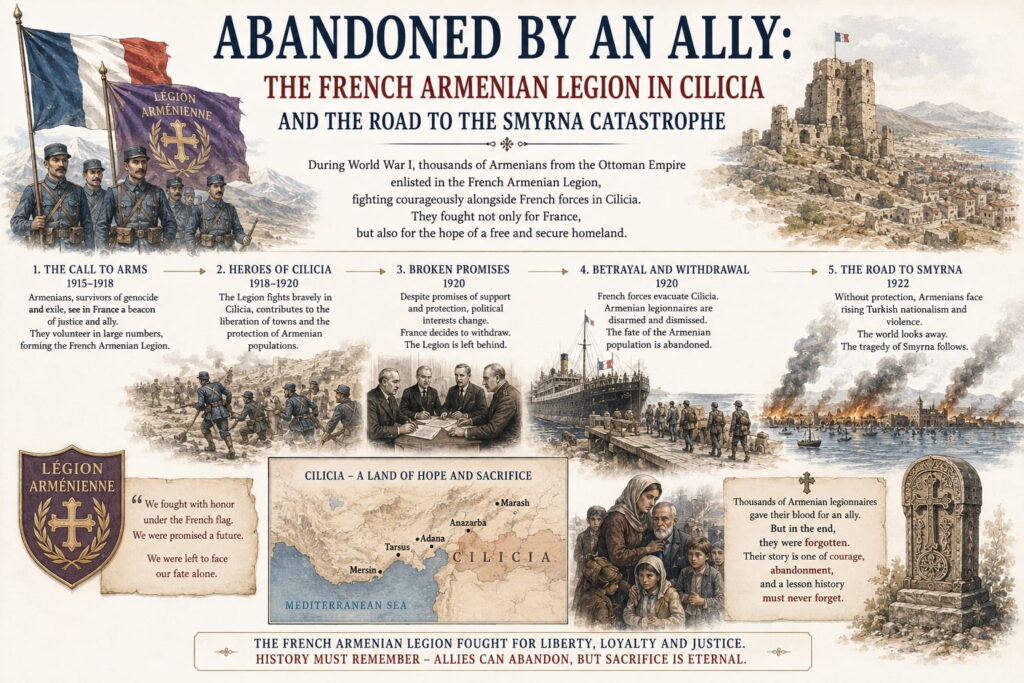
The turning point was the destruction of Ottoman Armenian communities during the Genocide of 1915. That September, the French warship Guichen rescued roughly 4,000 Armenians who had held out against Ottoman forces on Musa Dagh, carrying them to a refugee camp at Port Said, Egypt — the population from which the future Legion would largely be recruited (Armenian Weekly).
After the failed Gallipoli campaign, France and Britain went looking for a new front against the Ottomans, and Nubar Pasha used the moment to negotiate a formal agreement. On November 15, 1916, French War Minister Pierre Roques and Navy Minister Lucien Lacaze signed the order establishing the unit in Paris (Military Wiki); training of the first battalion began at Port Said on November 26, 1916, and was later moved to Cyprus, where volunteers from the United States and Europe swelled its ranks to nearly 5,000 men by early 1917 (Fresno State Armenian Studies).
The deliberately neutral name — “Légion d’Orient,” the Eastern Legion — was chosen so as not to provoke Ottoman reprisals against Armenians still living under Turkish rule (Armenian-History.com). France’s side of the bargain was explicit: in exchange for Armenian participation in the war effort, France would ensure the autonomy of Cilicia under French protection once the Allies had won (Art-A-Tsolum).
In practice, the Legion’s deployment did not go as promised. Although the original agreement confined it to Cilicia, by 1917 the unit was being funneled instead into the Palestine campaign, where French troops were badly outnumbered by the British — a first sign that the Legion’s fate would be decided by Entente politics rather than by the terms under which Armenians had enlisted (Armenian Weekly). It fought at the Battle of Jerusalem in December 1917 and the decisive Battle of Arara (Megiddo front) in September 1918, engagements that helped force the Ottoman collapse and, under the Armistice of Mudros of October 30, 1918, opened the way for the Legion to finally enter Cilicia in December 1918 (Art-A-Tsolum).
2. Cilicia under French occupation, 1918–1920
French and British warships landed the Legion’s battalions at Mersin and Alexandretta; units were stationed across Adana, Tarsus, Jihun, Bozanti, Dörtyol, Osmaniye, and Bagçe, where clashes with Turkish irregulars began almost immediately (Armenian-History.com). Renamed the Légion Arménienne on February 1, 1919, the force became the nucleus around which as many as 170,000 Armenian refugees returned to rebuild their lives in what they believed would be an autonomous Cilician homeland under French protection (Armenian-History.com).
The occupation, however, was troubled from the start. French administrators were, by the account of contemporary Turkish and Western sources alike, poorly suited to the task — many were army officers transferred from North Africa with little understanding of local conditions, others low-level colonial functionaries (Belleten / Turkish Historical Society). Paris never committed more than roughly 20,000 troops to hold both Cilicia and Syria together, a force historians consider to have been inadequate for the task France had taken on (Belleten).
Just as damaging was the political signal sent by France’s own high commissioner. Late in 1919, Georges Picot halted the repatriation of Armenian refugees to Cilicia and then traveled to Ankara to meet Mustafa Kemal in person — a visit that, even by the account of French officers on the ground, contradicted stated Allied policy and effectively told the Kemalist movement that French resolve over Cilicia was weakening (Armenian-History.com). Turkish nationalist attacks on French positions intensified immediately afterward.
By mid-1919, nearly half the Legion’s soldiers had already been discharged as French enthusiasm for the Cilician project cooled; only around 500 legionnaires remained under arms by the time the real fighting began (Fresno State).
3. The Franco-Turkish War and the fall of Marash
What France called the “Cilicia Campaign” and Turkey remembers as the “Southern Front” of its War of Independence broke out in full in early 1920. The French garrison at Marash came under siege by Turkish National Forces on January 21, 1920. After 22 days of fighting, French troops and the local Armenian population were forced to evacuate the city on February 11 — a retreat accompanied by large-scale massacres of Armenian civilians, with casualties numbering in the thousands (Wikipedia).
The circumstances of that withdrawal became one of the most bitter chapters in Armenian memory of the war. Sarkis Torossian, an Armenian Legion officer, recorded in his diary his suspicion that French commanders had handed over weapons and ammunition to the Kemalist forces in exchange for a safe passage out of the city — arming the very side that would go on to massacre the Armenians the French had just abandoned (Wikipedia).
Marash was the first in a sequence: French forces were pushed to surrender Urfa and Pozantı by May 1920, and their military weakness compelled an armistice with the Turkish nationalists that was widely read across the region as the first real recognition of Kemal’s movement as a governing authority (Belleten). In a final, desperate assertion of the promise made in 1916, Armenians in the region proclaimed the short-lived Armenian Republic of Cilician Mesopotamia on August 5, 1920 — a declaration French authorities themselves suppressed almost immediately (SyriacPress).
4. Why France walked away
By 1921, Paris was negotiating directly with the government it had spent two years fighting. The Cilicia Peace Treaty, signed in London on March 9, 1921, between French Foreign Minister Aristide Briand and his Turkish counterpart Bekir Sami Bey, was meant to end the war but collapsed within months (Wikipedia). It was replaced by the Treaty (or Franklin-Bouillon Agreement) of Ankara, signed on October 20, 1921 — the document that formally sealed France’s withdrawal from Cilicia (Wikipedia).
Several converging pressures drove that decision:
- Exhaustion and cost. France emerged from the First World War with a devastated economy and a shattered generation of young men; it simply no longer had the human or financial resources to sustain a colonial-style war in Anatolia on top of rebuilding at home (Keghart).
- Economic interests in Turkey. French capital had staked out major commercial interests in Anatolia before the war — railway concessions, and access to Turkish cotton, silk, grain, and minerals — along with a large stake in the Ottoman Public Debt. Securing those interests through a settlement with Ankara ultimately mattered more to Paris than holding Cilicia by force (Belleten; ResearchGate).
- Debt settlement at Lausanne. France’s later diplomacy at the Lausanne Conference of 1923 confirmed the pattern: Paris prioritized securing repayment of Ottoman debts and protecting its concessions over any territorial or humanitarian claims connected to Cilicia (SyriacPress).
- Splitting the Allies for advantage. By signing separately with Ankara, France became the first Entente power to deal directly with the Kemalist government, a move that gave it leverage over Britain and Italy in the wider carve-up of Ottoman territory but came directly at Armenian expense (Keghart).
The Ankara Agreement ceded the Cilician sanjaks — including Marash, Urfa, and Aintab — to the Turkish nationalists in exchange for vague guarantees about the treatment of the remaining Christian population, guarantees that were never enforced (Grokipedia summary of the treaty). As one recent account puts it bluntly, placing the survivors of a genocide under the protection of the very movement that had just been fighting to expel them was, in effect, handing them back to their executioners (SyriacPress).
5. The second exodus
French troops evacuated Cilicia through the end of 1921, and Kemalist administration was established over the region by January 1922 (Armenian-History.com). Armenians who had returned to their homes on the strength of French assurances now had to flee a second time, following the retreating French columns south toward Syria and Lebanon. Massacres resumed almost immediately in Marash, Aintab, and Adana; villages were burned, and survivors were driven once more into exile (Western Armenia TV). For the Armenians of Cilicia, the promise of 1916 — an autonomous homeland under French protection, purchased with their blood on the Palestine front — had lasted barely three years.
6. Smyrna, September 1922: the pattern repeats
Less than a year after the last French soldier left Cilicia, the same dynamic — a Christian population trusting in Western protection that never materialized — unfolded on a far larger scale in Smyrna, on the Aegean coast of Anatolia.
By the summer of 1922, the Greek army, which had occupied Smyrna since May 1919, was collapsing. Turkish forces, resupplied in part through French and Italian channels after Ankara’s separate peace with those two powers, routed the Greeks at the Battle of Dumlupınar on August 30, 1922 (GreekReporter). Kemalist troops entered Smyrna on September 9, 1922, effectively ending the Greco-Turkish War (Wikipedia).
What followed became known as the Smyrna Catastrophe. Beginning around September 13, Turkish troops and irregulars surrounded the city’s Armenian quarter — home to roughly 25,000 people — and began a systematic massacre, setting the district ablaze (Archons of the Ecumenical Patriarchate). The fire spread through the Greek and Armenian neighborhoods and burned for over a week, until it was largely extinguished on September 22 (Wikipedia). Estimates of the dead range widely across sources, from roughly ten thousand to well over one hundred thousand, while hundreds of thousands of Greek and Armenian refugees were forced onto the waterfront, trapped between the flames behind them and the sea in front of them (Military Wiki).
The most damning detail of the catastrophe is what was anchored just offshore: an international squadron of twenty-one Allied warships — eleven British, five French, two American, one Italian, and others arriving in the following days — sat in Smyrna’s harbor under explicit orders from their governments not to intervene (GreekReporter; Archons). Sailors and officers on those ships watched the massacre and the fire from their decks while their governments withheld any order to land troops or open the port to refugees. It took the private initiative of an American Methodist minister, Asa Jennings, who commandeered Greek and Japanese merchant vessels on his own authority, to organize the evacuation of roughly 300,000 people to Greece before the end of September (Archons).
7. Two abandonments, one lesson
The Armenian Legion in Cilicia and the Allied fleet at Smyrna are separated by geography, by a different set of treaties, and by a different immediate cause of catastrophe. But the underlying mechanism is the same. In both cases, a Western power — or a coalition of them — extended protection to an Ottoman Christian population when that protection served a wartime purpose, and withdrew it the moment the balance of postwar interests shifted: French war-weariness and commercial interest in Anatolia in the case of Cilicia; Allied unwillingness to re-enter a war against a resurgent Turkish nationalist state in the case of Smyrna. In both cases, the price of that shift was paid not by the diplomats who signed the agreements or gave the orders to stand off, but by the Armenian and Greek civilians who had believed the earlier promises.
The Légion d’Orient had begun in 1916 as one of the very few organized responses by an Allied power to the Armenian Genocide already underway — a chance, however imperfect, for genocide survivors to fight for a homeland rather than simply survive as refugees. Its story did not end with the Legion’s own disbandment in 1920 but with the final collapse of Cilician Armenian life a year later, and its echo can be heard again in the silence of the guns on the warships anchored off Smyrna in September 1922.
Selected sources
- French Armenian Legion — Wikipedia
- Franco-Turkish War (1918–1921) — Wikipedia
- Cilicia Peace Treaty — Wikipedia
- Burning of Smyrna — Wikipedia
- The Legacy of the Armenian Legion — Armenian Weekly
- The Armenian Legion — Cilicia 1918–1921 — Armenian-History.com
- Cilicia Under French Mandate 1918–1921 — Armenian-History.com
- Légion Arménienne — Art-A-Tsolum / Allinnet
- A Century Ago, France Let Down the Armenians — Keghart
- France in Cilicia and in Lebanon — SyriacPress
- Abandoned Cilicia — Western Armenia TV
- Turco-French Struggle for Mastery in Cilicia and the Ankara Agreement of 1921 — Belleten (Turkish Historical Society)
- The Struggle for Mastery in Cilicia — ResearchGate
- Treaty of Ankara (1921) — Grokipedia
- The Great Fire of Smyrna: One of the Darkest Moments in Greek History — GreekReporter
- Remembering Smyrna — Archons of the Ecumenical Patriarchate
- Great Fire of Smyrna — Military Wiki
Read Also: