
Letter of Metropolitan Sarkis Hasan-Jalalyan To General A. Yermolov Regarding the Brutal Tortures and Killings Practiced by the Khan and the Looting of the Armenian Church Gandzasar Monastery, May 8, 1823
Your Excellency, Alexei Petrovich, Gracious Sovereign!
On January 5th of this year, I submitted a petition to Your Excellency, in response to which you graciously commanded General Prince Madatov that we present to him the letters granted to my ancestors in 1724 by Emperor Peter the Great and in 1726 by Empress Catherine, and to make copies thereof to be presented to Your Excellency. I would be most fortunate if those letters were now in my possession, as I would hasten to dispatch them to him. However, the circumstances surrounding these letters are as follows:
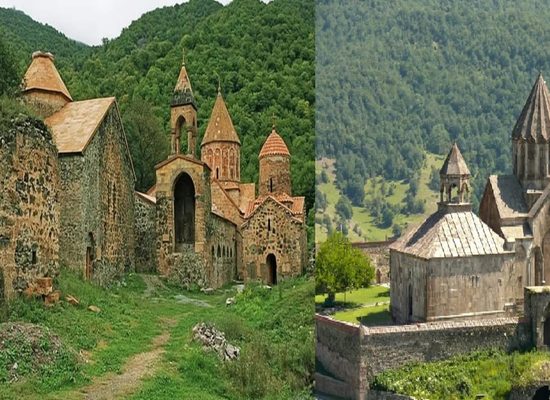
In 1786, the Karabakh ruler, Ibrahim Khan, due to these letters and the loyal service of my ancestors to Russia, arrested me and my four brothers, detaining us in Shusha Fortress for nine months and eight days. He assigned his Tatars, Fetali and Tayra, along with three others, to torture us daily, demanding that we hand over the letters. While we suffered in captivity, Ibrahim Khan dispatched several Tatars to our Gandzasar Monastery and plundered all its sacred items—gold and silver crosses, chalices, and the finest vestments adorned with pearls, amounting to approximately 78,000 rubles. He also confiscated all the copperware and livestock, looted the monastery’s servants, and brutally murdered two of my brothers—Patriarch Hovhannes, who was poisoned, and Commander Daniel Hasan-Jalalyan, who was thrown into a torture pit and later executed by saber. He seized the aforementioned letters along with the monastery’s valuables, but I was unable to determine their whereabouts. The cause of our suffering and the looting of Gandzasar Monastery was these letters and the unwavering allegiance of my ancestors to Russia.
All of Karabakh is aware of these tragic events. The wife of Ibrahim Khan, Biki-aga, who is still alive, intervened on our behalf and secured our release. We returned to our monastery, but out of fear of Ibrahim Khan, I and my surviving brothers and clergy could no longer remain there, dreading that we too might be executed. In 1788, we fled to Elisavetpol to Javad Khan, where we remained for eight years. Then, in 1796, we joined the Russian forces under Commander Zubov and moved to Georgia to King George, where we remained for 13 years in faithful service to Russia. When Ibrahim Khan of Karabakh was slain by the Russian army due to his hostility toward Russia, I received an imperial decree in 1809, appointing me Archbishop of the Karabakh Armenians. In 1812, I moved from Karabakh to our ancestral Gandzasar Monastery. Now, in my old age, I send prayers to the Almighty for the invaluable health of His Imperial Majesty and for all Russians.
Therefore, I humbly implore Your Excellency: if it pleases you to show me your gracious support, you may verify the legitimacy of the letters granted to my ancestors, Patriarchs Isaiah and Nerses, in 1724 and 1726 from the Holy Synod and the imperial manifesto, where their significance is clearly stated. In accordance with them, I beseech you to grant me the fulfillment of my petition in my old age.
A similar letter has been submitted to General Prince Madatov. I remain your devoted servant, Metropolitan of all Aghvan Armenians, Archbishop Sarkis Hasan-Jalalyan
Report of General A. Yermolov to Alexander I, Presenting the Essence of the Dispute Over the Division of the Melik-Beglyarov Estate in Karabakh as a Consequence of the Khan’s Autocratic Rule September 7, 1824
For many years, several villages in the Karabakh Khanate have been under the possession of the Beglyarov family.
The heirs of these landowners, having a dispute among themselves over the division of property, appealed to me with a request to oversee the division of both movable and immovable assets. In Karabakh, under the autocratic rule of the Khan, they did not expect a fair resolution without bias toward one side or the other.
Wishing to put an end to familial discord, I proposed that the division be carried out by mediators. As such, I invited Archbishop Nerses to participate, considering his role as the supreme spiritual leader of the disputing parties and his widely respected authority.
As a result, when the petitioners had selected mediators, properly authorized them, and begun the proceedings, the Khan of Karabakh, during my absence in Saint Petersburg, initiated correspondence with General Velyaminov. In his letters, the Khan sought direct involvement in the division process, citing past traditions, stating that such matters pertained to the residents of his khanate. He further claimed that while the disputing parties had the right to divide property, money, and goods among themselves, they did not have authority over immovable estates or over the Armenian population, whom he argued were not their serfs in accordance with Georgian customs. The Khan insisted that Armenians had merely been under the administration of his predecessors, who appointed Meliks as local rulers, and that the removal of such officials was entirely at the Khan’s discretion.
This claim was rejected. However, following the Khan’s subsequent flight to Persia, the case was submitted to the provincial court of Karabakh. The court ordered the Beglyarovs to present all documents they possessed proving their right of ownership in Karabakh. Upon review of these documents, the court was to determine, in accordance with the established customs of the land, whether they had legitimate ownership of the land and peasants or if they were merely administrators with no right to divide or sell the property.
Now that both the mediation and the provincial court investigation have been concluded, the first is already being implemented in relation to movable property. From this process, the following observations have emerged:
The origins of the petitioners’ ancestors’ ownership of immovable property in Karabakh remain unknown. No documents have been presented proving the acquisition of peasants in a serf-like status through purchase or other means. However, several documents have been submitted regarding the purchase of land, gardens, mills, and other estates from various individuals.
In later years, the entire estate was owned by the petitioners’ great-grandfather, Melik Yusuf. After his death, the property passed to his son, Melik Beglyar, the petitioners’ grandfather, who had four sons: Fridon, Saam, Bagir, and Aga-Bek. Upon Beglyar’s death, Ibrahim Khan confirmed Fridon as Melik. However, due to oppression by the Khan, who was still under Persian rule at the time, Fridon and his brothers fled to Georgia, bringing several Armenian households with them. With this flight, the Beglyarovs’ ownership in Karabakh ceased, and the Khan appointed another Melik in their place.
These exiles were permitted by the Georgian king to establish residences in Bolnisi, near the Georgian-Turkish border. When their Melik, Fridon, traveled to Saint Petersburg, he entered Russian service and petitioned the late Grand Duke Pavel Petrovich for a charter. On June 3, 1799, King George of Kartli and Kakheti granted Fridon permission to allocate land for settlement in Kazakh. However, in Fridon’s absence, the settlers, whether due to hardships or other reasons, dispersed—some throughout Georgia, others returned to Karabakh, while the few remaining individuals were granted permission by me to return to their former residences.
Several years later, when the Khan of Karabakh accepted Russian rule, Fridon Beglyarov returned to Karabakh. Having won the favor of the last Khan, he managed to restore his previous status as Melik. Only one brother, Saam, returned with him (Bagir remained in Georgia, where he died, while Aga-Bek traveled to India). However, Saam, seeking to inherit the Melikship, soon killed Fridon and then fled to Persia, where he also died before achieving his goal.
Upon Fridon Beglyarov’s death, he left behind six minor sons. The eldest, Joseph, was confirmed as Melik by the Khan. Uncertainty regarding the scope of his authority led him to petition the Khan for a formal decree. Before granting it, the Khan dispatched his vizier, Mirza-Jemal, to catalog all properties belonging to the Beglyarovs. Following this, Joseph’s request was granted.
According to this decree issued to the new Melik in 1808, the following vacant lands—locally referred to as villages—were placed under his administration:
- Airkabuda
- Barandata
- Small Signak
- Dishlik
- Kyazy-Kendi …
- Todan
- Makamad
- Yeni-Kend
- Half of Chardusa
- Half of the Kaznam Canal
- Kara-Bulak
- Kara-Chinar
- Tut-Bulak
- Buguluk
- Baris
- Sneft-Alan
- Half of Zeyve
Subsequently, some of these lands were populated: Numbers 14, 15, 16, 17, and 18 were settled by Armenians relocated by the present Melik from various locations; Number 19 by Tatars under the administration of a Bey; and Number 20, which originally belonged to the Khan, has since become state property.
After several years of administration by the current Melik, his uncle, Aga-Bek, returned from India and began to claim a right to the division of the estate, arguing that it should belong to him by inheritance along with his deceased brothers, who had not participated in its division.
Soon after, following the death of Saam, his family returned from Persia—his daughter Solty and son Noy, along with the children of Bagir-Bek: Apov, Alexander, Katevana, Amarnana, and Sophia. They initiated legal proceedings against their uncle, leading to a formal dispute.
The Karabakh Provincial Court, aiming to verify customary land rights based on local traditions and the testimonies of native residents, sought to determine whether the Beglyarov family could claim ownership of the land and its peasants in Karabakh or if they merely held administrative authority without the right to divide or sell them. To this end, the court consulted relatives of the former Khan, including members of his entourage and several respected individuals. Based on their testimony, the court ruled:
That due to the absolute authority of the Khans, inheritance rights were historically disregarded, as land was seized and redistributed at the Khan’s discretion. However, the lands listed—including Talysh and Gulistan, which were implied but not directly mentioned—had been returned by the Khan to Fridon Beglyarov, as he had repented for his earlier flight from Karabakh. The property was reinstated to him alone, and after his death, it was granted as personal property to his children.
The peasants residing on these lands, except those in Karachinar, were not treated as serfs; instead, they were administratively governed by the Meliks. Their status did not extend to ownership; Meliks could enlist them as laborers, levy taxes, and impose punishments, but they had no right to sell or mortgage them—a practice unknown across Asia, except in rare cases involving enslaved individuals.
After reviewing historical customs and the circumstances of the dispute, it was concluded that the Beglyarov family, acquiring land partly through purchase and largely due to the Khan’s favor, had been acting as administrators rather than landowners. The people settled on these lands paid taxes and fulfilled obligations under the Beglyarovs but were not considered hereditary subjects. The court acknowledged that, while the petitioners sought formal inheritance rights, only the division of land among the children of Fridon Beglyarov, along with the peasants of Karachinar (who had been relocated from Georgia), was permitted.
Furthermore, it was ruled that Aga-Bek and the descendants of his brothers, Saam and Bagir-Bek, had no claim to these lands, as their fathers had forfeited their rights by fleeing Karabakh. Allowing the division of Karachinar’s peasants would be contrary to local traditions, as it would impose feudal bondage upon a free population merely because they had followed their ruler to Georgia and later returned. Similarly, dividing the land among all of Fridon Beglyarov’s children was deemed unlawful, as Karabakh did not recognize hereditary landownership, and the estate was traditionally held by a single administrator appointed by the Khan.
Therefore, I seek imperial authorization to uphold this ruling.
To prevent misconceptions among the populace—particularly since they had been assured that imperial administration would preserve local rights and traditions—I request permission to grant Fridon Beglyarov’s children—Subaltern Joseph, the current Melik Subaltern Shamir, Ensign Ivan, Teimuraz, and Beglyarov—full hereditary ownership of the lands specified in previous records, excluding Sneft-Alan and Zeive (as they are settled by people beyond their jurisdiction). Instead, they should receive Talysh and Gulistan, which historically belonged to this estate.
This request is justified by:
- Their ancestors’ purchase of part of these lands,
- Their service to the government,
- Their noble lineage,
- The necessity of preserving local governance structures—where peasants remain free but under Melik administration, similar to other feudal lords.
- The obligation for settlements under their rule to contribute taxes to the state, as other villages do under feudal administration.
However, if the owners were to later settle these lands with purchased peasants, it follows naturally that the latter would belong to them not in their current status, but under full serfdom.
(Source: AKAK, Vol. VI, Part 1, Document 1320. Published in the collection: The Annexation of Eastern Armenia to Russia, Vol. II (1814-1830), Yerevan, 1978, Document No. 107.)
Directive of General A. Yermolov to the Karabakh Provincial Court on the Non-Recognition of Feudal Lords’ Ownership Rights Over the Villages Under Their Administration
September 1824
I fully agree with the court’s conclusion, as outlined in the report dated September 19, 1824, No. 130, which states that all villages providing income to feudal lords are under their administration but do not constitute their property.
I hereby order the court to transfer the administration of Magal Otuz Eka to Kerim-Bek, who was confirmed as Minbash under the Khan’s decree of 1821. Other villages should be placed under the management of district deputies, allowing Kerim-Bek and Mamad-Bek to derive revenues from them in accordance with the previous division under the Khan.
Furthermore, I instruct the provincial court that district deputies cannot be removed or newly appointed without my approval.
(Source: Georgian Central Historical Archive, Fonds 8, Inventory 1, File 1439, Sheet 9. Published in the collection: The Annexation of Eastern Armenia to Russia, Vol. II (1814-1830), Yerevan, 1978, Document No. 107.)
Order of General A. Yermolov to the Commander of the Besieged Russian Garrison in Shusha, Colonel Reutov, on the Role of Armenians in the Defense of the Fortress
August 9, 1826
Defend firmly and fearlessly. The Persians will not take the fortress by force; beware of treachery.
Keep suspicious feudal lords under the strictest guard. Any signs of betrayal should be met with no mercy, and in extreme cases, the offenders must be executed. Confiscate provisions from the Tatars for the troops—they can endure the hardship.
I demand that all possible measures be taken for the defense. Maintain a large number of Armenians under arms—they will fight resolutely.
A time will come, and you shall be liberated.
(Source: N. Dubrovín, History of the War and Russian Rule in the Caucasus, Vol. VI, St. Petersburg, 1888, p. 640.)
Report of General Prince Madatov to the Chief Administrator of Georgia and Commander-in-Chief of the Caucasian Line, General P. Yermolov
No. 116, Camp at the Kendalan River, September 22, 1826
Regarding the troops and Armenians who defended the fortress [Shusha], I consider it my duty to inform Your Excellency that their service is worthy of attention. They all fought with exceptional bravery, endured multiple assaults, inflicted heavy losses on the enemy, disregarded the lack of provisions, and never contemplated surrendering the fortress, even in the face of complete famine.
(Source: AKAK, Vol. VI, Tiflis, 1874, pp. 867-868.)
Report of General Prince V. Madatov to General A. Yermolov on Providing Assistance to Armenian Defenders of Shusha Fortress
September 24, 1826
Due to the upcoming autumn sowing season, the Armenians of the Karabakh province, who defended Shusha Fortress, have appealed to me. They have no cattle, as in addition to losing all their possessions to enemy plunder, Colonel Reutt also requisitioned their remaining livestock for the troops stationed in Shusha.
They request that, in accordance with Colonel Reutt’s assurances and the receipts issued for the confiscated cattle, the treasury compensate them so they may purchase new livestock and obtain the necessary supplies for agriculture. Otherwise, they will face famine.
Recognizing the dire circumstances of these people and wishing to reward their loyalty—having sacrificed their entire wealth for the benefit of Russian troops—I seek Your Excellency’s permission to satisfy their request using funds belonging to the provincial court, in an amount corresponding to the receipts issued by Colonel Reutt.
(Source: AKAK, Vol. VI, Part I, Document 1327. Published in the collection: The Annexation of Eastern Armenia to Russia, Vol. II (1814-1830), Yerevan, 1978, Document No. 131.)
Directive of the Chief Administrator of Georgia and Commander-in-Chief of the Caucasian Line, General P. Yermolov, to General Prince Madatov
No. 400, September 29, 1826
Order the feudal lords detained in Shusha to be held under the strictest guard until I have reviewed their conduct.
As for all other detained feudal lords, confiscate the Armenian villages they control (specifically, those under Muslim feudal lords) and inform the residents that they will henceforth be under permanent state administration—as a mark of gratitude for their unwavering loyalty to His Imperial Majesty.
(Source: AKAK, Vol. VI, Tiflis, 1874, pp. 868-869.)
Report of General Prince L. Sevarsemidze to General K. Benkendorff on Mehti-Kuli Khan’s Desire to Return to Russian Allegiance
Camp near the Fortress of Erivan, May 29, 1827
I consider it my duty to report in detail to Your Excellency that I have received envoys bearing letters from Aslan Sultan of Shadlins and Mehti-Kuli Khan of Karabakh.
The latter, Mehti-Kuli Khan, the former ruler of Karabakh, appeals to me to inform the Commander-in-Chief of his unfortunate situation. He asserts that his departure from his homeland was not due to betrayal of the Emperor or oppression by the Russian government, but rather forced upon him by the severe persecution and blatant injustices committed by General Madatov. Finding no protection or justice from the local authorities, he requests His Imperial Majesty’s safeguard, having been deprived of all means and left with no alternative but to flee his Khanate.
I hereby submit the original letters for Your Excellency’s consideration.
(Source: Georgian Central Historical Archive, Fonds 1025, Inventory 1, File 93, Sheets 4-5. Published in the collection: The Annexation of Eastern Armenia to Russia, Vol. II (1814-1830), Yerevan, 1978, Document No. 155.) 191
Yuri Barsegov “Nagorno-Karabakh in International Law and Global Politics”
Artatsolum
Read Also:
- Ancient and Medieval Sources on Artsakh (Karabakh) as Part of Armenia’s State Territory
- Message from Gandzasar Catholicos Esayi to Peter I August 10, 1716
- Memorandum Issued to Ivan Karapet Along with the Imperial Letter to the Armenian People Regarding Russia’s Readiness to Take the Armenians of Karabakh Under Its Protection June 3, 1723
- Decree of Peter I to the Armenian People Regarding Russia’s Willingness to Offer Protection to the Armenians of Karabakh
- On Armenian Hopes for Russian Assistance
- Report of Minas Vardapet to Peter I
- Contents of the Secret Letters from the Armenian Assembly and the Armenian Army of Karabakh to the Russian Emperor and Chancellor August 1724
- Contents of the Secret Letters from the Armenian Assembly and the Armenian Army of Karabakh to the Russian Emperor and Chancellor August 1724
- State Charter of Peter I On the Acceptance of the Armenian People Under the Protection of the Russian State and Their Resettlement from Karabakh to Newly Acquired Persian Provinces November 10, 1724
- Letters from the Catholicos and the Meliks of Karabakh
- Charter of Catherine I Addressed to the Armenian Assembly
- Message General Mkhitar—to the Russian Government
- The Armenian Assembly’s Request for Military Assistance June 19, 1727
- Result from Russia’s failure to fulfill its promises of assistance to the Armenians March 1736
- On the Issuance of the Decree Appointing Panah Khan
- Letter from General Potemkin to Prince Argutinsky with questions about the liberation of Armenia
- Appeal of Gandzasar Catholicos Hovhannes to Catherine II
- Letter from Melik Apov Iosifov to Provide Assistance to Russian Military Forces for the Liberation of Enslaved Karabakh
- Report of Prince G. Potemkin to Catherine II
- Request of General P. Potemkin to Prince G. Potemkin
- Letter from Archbishop Joseph Argutinsky to General P. Potemkin
- Memorandum to Catherine II on the Project for the Restoration of the Armenian Kingdom
- Decree of Paul I to General Count I. Gudovich
- Letter from Archbishop Joseph Argutinsky
- Report by State Councillor P. Kovalesky
- The Khan’s Vizier, Mirza Jamal Javanshir Karabakhsky
- From the Report of General Marquis Palluci to Alexander I
- The Gulistan Treaty – An Interstate Act of Iran’s Cession of the Karabakh Territory to Russia
- Report of General A. Yermolov to Alexander I Requesting the Waiver of Tax Arrears for the Karabakh Khanate
- LETTER FROM GENERAL A. YERMOLOV TO MEHTI-KULI KHAN
- Directive from General A. Yermolov to General I. Velyaminov
2 thoughts on “Letter of Metropolitan Sarkis Hasan-Jalalyan To General A. Yermolov”