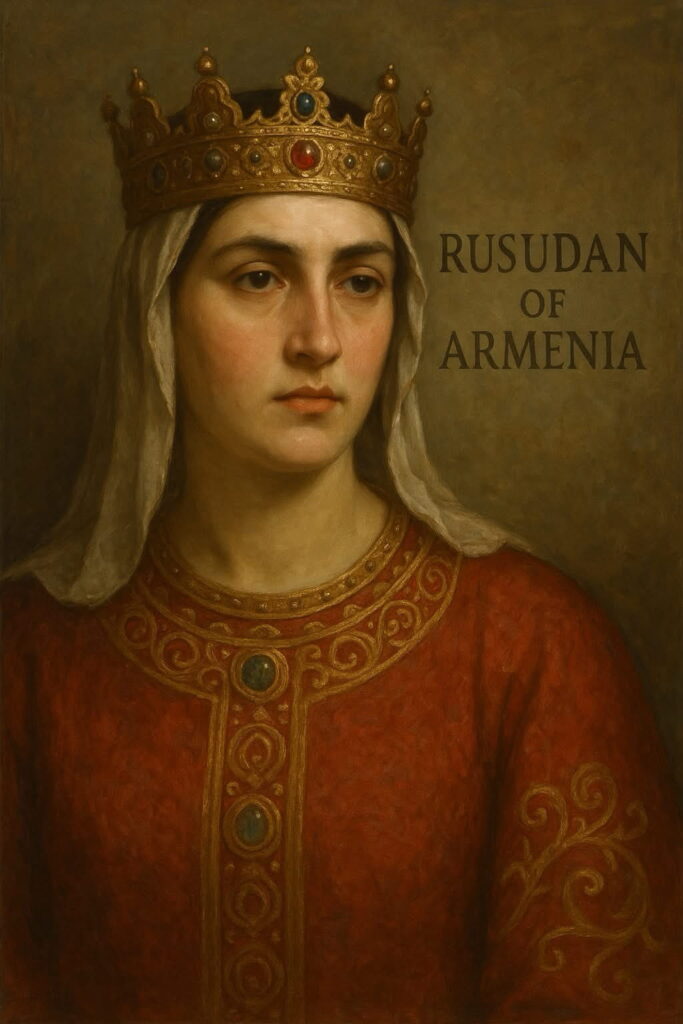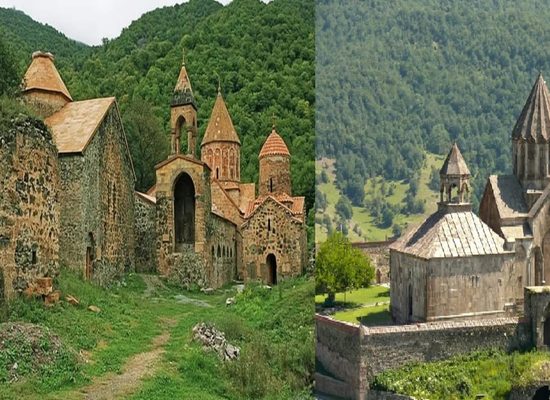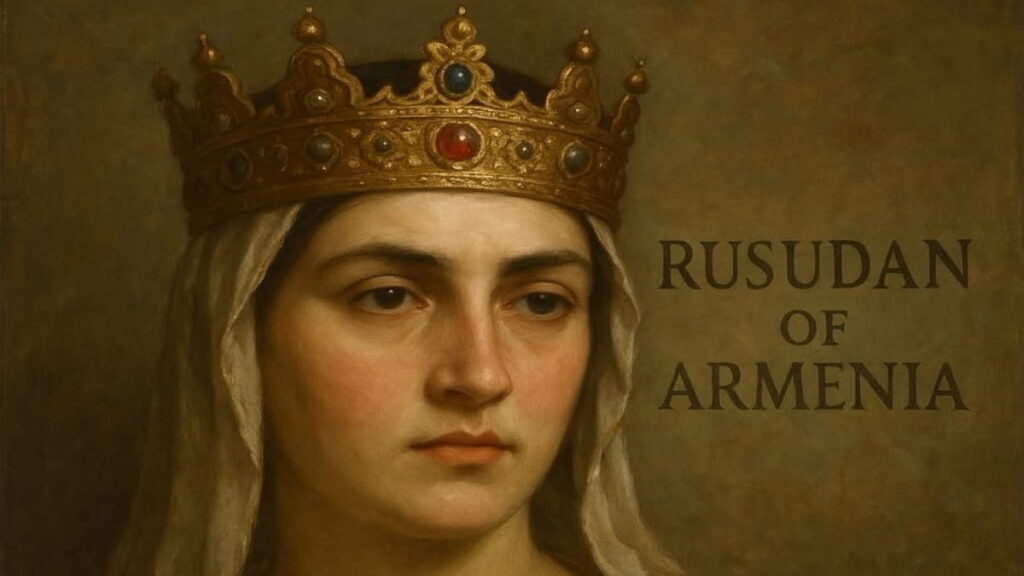
Armenian historical tradition, echoed by a number of modern researchers, identifies Rusudan as an Armenian member of the House of Artsruni — one of the oldest and most celebrated royal families of medieval Armenia. The Artsrunis ruled the Kingdom of Vaspurakan around Lake Van for over a century, with the island of Aghtamar serving as both a royal residence and one of the most important spiritual centers of Armenian life. Encyclopaedia Iranica traces the family back to the Orontid line and documents its long-standing hold over the districts southeast of the lake.
By the close of the eleventh century — the presumed period of Rusudan’s birth — independent Vaspurakan no longer existed. Its last king ceded the realm to the Byzantine Empire in 1021, and the region was later ravaged by Seljuk incursions. In the aftermath, many Armenian noble houses, the Artsrunis among them, resettled in neighboring Georgia and in Cilician Armenia. That migration of displaced Armenian aristocracy created the conditions for dynastic marriages between the Georgian crown and Armenian noble families.
Marriage to David IV the Builder
Armenian tradition, and a number of present-day historians, hold that Rusudan was the first wife of the Georgian king David IV “the Builder.” The union is generally dated to around 1090–1091, at the very start of David’s reign, and is understood as a politically motivated alliance meant to bind the Georgian Bagratid court to the influential, if displaced, Armenian nobility. Genealogical compilations such as Royal Ark and Geni record this first marriage and its dissolution around 1107–1108, after which David remarried Gurandukht, daughter of a Kipchak chieftain.
Contemporary Georgian sources never name David’s first wife. It is the Armenian tradition that attaches her to the Artsruni house.
Mother of King Demetrius I
That first marriage produced Demetrius I, David’s only legitimate son and heir, who ruled Georgia from 1125 to 1156. If the identification of David’s first wife with Rusudan Artsruni holds, then the continuation of the Bagrationi royal line traces, through the maternal side, back to the Armenian royal house of Artsruni. Wikipedia’s overview of David IV’s family likewise notes the modern-day hypothesis, advanced by historian Cyril Toumanoff, that David’s Armenian first wife bore the name Rusudan and was the mother of his children.
The Testimony of Matthew of Edessa
The principal contemporary source on the question is the Armenian chronicler Matthew of Edessa (Matteos Urhayetsi), among the foremost historians of the medieval Caucasus and the Crusader states. Writing in the early twelfth century, Matthew records plainly that David IV’s son Demetrius was born of an Armenian mother. He does not give her name or state which dynasty she belonged to — but his account, composed by a contemporary, remains the most important surviving confirmation that Demetrius I’s mother was Armenian. Matthew’s chronicle is available in English translation, including the version by Robert Bedrosian hosted on Archive.org.
The Silence of the Georgian Chronicles
Unlike the Armenian chroniclers, the medieval Georgian royal annals give neither the name nor the origin of David IV’s first wife. Historians have offered several possible explanations.
One concerns religion. If David’s first wife belonged to the Armenian Apostolic Church, Georgian ecclesiastical chroniclers, writing within the Chalcedonian court tradition, may have chosen not to emphasize the Armenian, and non-Chalcedonian, origin of the future king’s mother.
Another relates to shifting political priorities. David IV’s later marriage to a Kipchak/Alan-linked princess strengthened Georgia’s northern alliances; against that backdrop, his earlier ties to the displaced Armenian aristocracy of a fallen kingdom may have received less attention in official historiography.
More broadly, medieval chronicles were often composed to serve particular political, religious, or dynastic aims, so the silence of the Georgian sources cannot by itself be treated as evidence against Rusudan’s existence or her Armenian origin.
Historical Significance
If the traditional identification is correct, Rusudan occupies a meaningful place in the shared history of Armenia and Georgia. She represents the absorption of the Armenian royal house of Artsruni into the Georgian monarchy during an era of close cooperation between the two peoples against the Seljuks. On this reading, Rusudan was:
- a descendant of the Artsruni kings of Vaspurakan;
- the first wife of King David IV the Builder;
- the mother of King Demetrius I;
- a dynastic bridge between the Armenian Artsrunis and the Georgian Bagrationi.
Conclusion
Matthew of Edessa, writing as a contemporary, states directly that Demetrius I’s mother was Armenian, though without naming her or her dynasty. Later Armenian tradition identifies her with Rusudan of the House of Artsruni, and a number of modern historians consider this plausible given the close political and dynastic ties between Armenian and Georgian nobility after the fall of Vaspurakan. Because the Georgian chronicles are silent on the identity of David IV’s first wife, her precise identification remains a subject of scholarly discussion — but her Armenian origin rests on the testimony of one of the period’s most important contemporary sources, and Rusudan continues to hold a notable place in the study of the intertwined dynastic history of medieval Armenia and Georgia.
Related:
Architecture of Vaspurakan – Armenian Renaissance
Orontid Dynasty – World History Encyclopedia
The Gold Coin of Yervand I – Satrap of Sophene and Mitanni
Idea: Levan Tonaganyan
Image Source: ARMENIANELECTRONICENCYCLOPEDIA