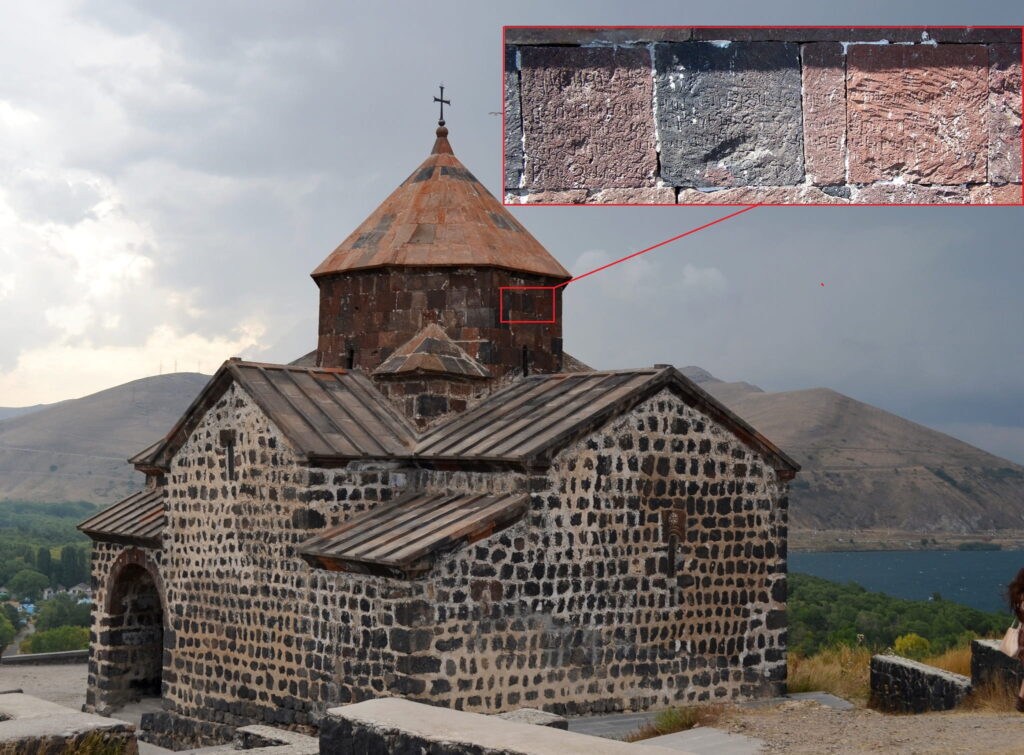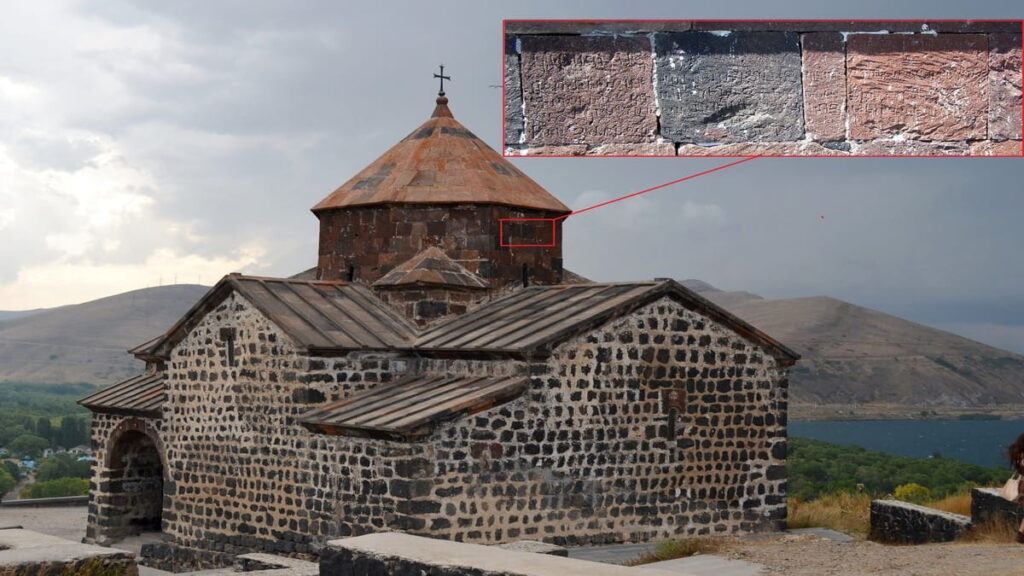
Perched on the rocky peninsula of Lake Sevan, the medieval monastery of Sevanavank preserves one of the most important inscriptions in Armenian history. Beyond its religious and architectural significance, an inscription associated with the foundation of the monastery in 874 AD contains what scholars consider the earliest known mention of Yerevan (Երևան) in Armenian lapidary epigraphy. This remarkable reference predates many later medieval mentions of the city and provides valuable evidence for the continuity of Yerevan’s historical presence in Armenian written sources.
Sevanavank and the Bagratuni Revival
The surviving churches of Sevanavank were erected in 874 under the patronage of Princess Mariam Bagratuni, daughter of Ashot Bagratuni (later King Ashot I of Armenia) and wife of Prince Vasak of Syunik. Contemporary inscriptions record her role in the construction and endowment of the monastery, making them among the earliest surviving Armenian dedicatory inscriptions from the Bagratid revival period.
The monastery’s two principal churches—Surb Arakelots (later known as St. Karapet) and Surb Astvatsatsin—remain among the finest examples of 9th-century Armenian ecclesiastical architecture. Their foundation inscriptions provide crucial information about the political and religious life of Armenia during the struggle to restore Armenian statehood after centuries of Arab domination.
The Inscription and the Mention of Yerevan
The inscription attributed to Ashot Bagratuni and Princess Mariam is partially damaged and has been the subject of scholarly study for more than a century. It was first published by the prominent Armenian historian and epigrapher Levon Melikset-Bek, and later examined by scholars including Karo Ghafadaryan and Arpenik Ghazaryan.
Although parts of the text have been lost or altered over time, the inscription preserves a reference to Yerevan, making it the earliest currently known occurrence of the city’s name in Armenian stone inscriptions. Historians of Armenian epigraphy have long recognized the importance of this evidence for tracing the medieval history of the city.
The mention demonstrates that by the late ninth century Yerevan was already a recognized settlement whose lands and properties could be referenced in ecclesiastical donations and monastic endowments. Such references are particularly valuable because medieval Armenian inscriptions often provide more reliable contemporary evidence than later narrative chronicles.
Why This Matters
Yerevan’s origins reach much further back than the ninth century. The city traces its foundation to the Urartian fortress of Erebuni, established in 782 BC by King Argishti I. However, references documenting the transition from ancient Erebuni to medieval Yerevan are relatively scarce.
The Sevanavank inscription therefore occupies a special place in Armenian historical studies. It helps bridge the gap between the ancient and medieval periods by providing direct epigraphic evidence that the name Yerevan was already in use during the Bagratid era. Later Armenian inscriptions mentioning Yerevan are known from 901, 981, 1201, 1204, and subsequent centuries, but the Sevanavank inscription remains the earliest currently identified example in Armenian lapidary writing.
A Precious Monument of Armenian Epigraphy
The inscription is also important because it belongs to the earliest corpus of surviving Armenian donation and construction records. Such texts illuminate the relationship between noble patronage, monastic institutions, and regional administration during a formative period of Armenian history.
The weathered stones visible today on the walls of Sevanavank continue to preserve information that is invaluable for historians, linguists, and epigraphers. Modern re-readings and scholarly analysis of the inscription promise to refine our understanding of both the text itself and the historical geography of medieval Armenia.
Conclusion
The 874 inscription of Sevanavank’s St. Karapet (formerly Surb Arakelots) Church is far more than a simple construction record. Associated with Ashot Bagratuni and Princess Mariam, it preserves the earliest known mention of Yerevan in Armenian epigraphy and stands as a key document in the historical record of Armenia’s capital. As one of the oldest surviving Armenian dedicatory inscriptions, it remains a cornerstone source for the study of the Bagratid period and the medieval history of Yerevan.
Sources
- Guide for Pilgrims to Armenia – Sevanavank
- ATB Armenia – Sevanavank Monastery
- Visit Armenia – Sevanavank Monastery Complex
- Travel to Armenia – Sevanavank Monastery
- History of Yerevan Explained (discussion of the earliest epigraphic mention of Yerevan)
Based on status: Arsen Harutyunyan