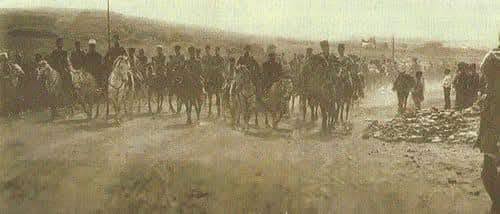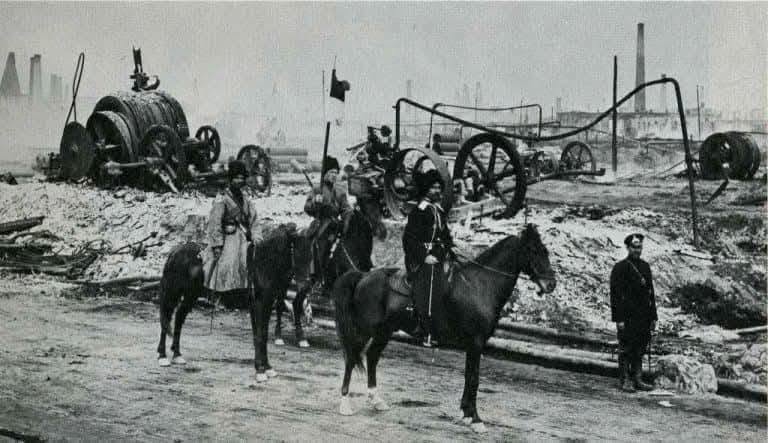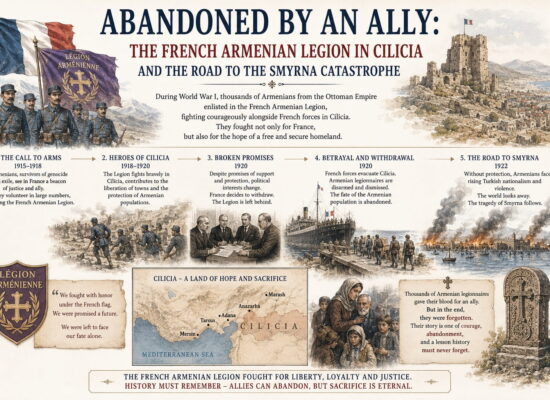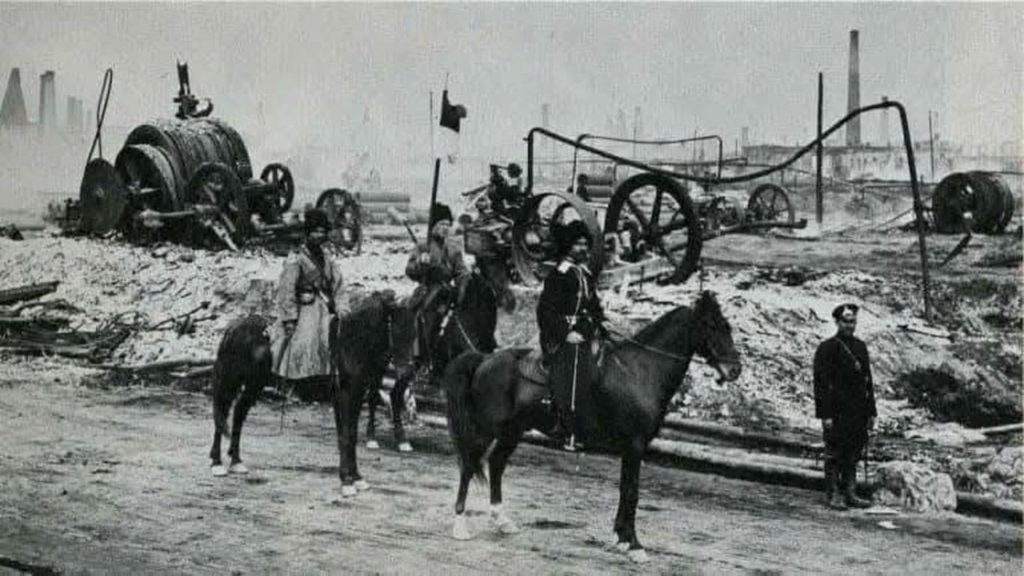
On September 15, 1918, the oil city of Baku fell to a joint Ottoman-Azerbaijani force, and within hours the Armenian quarters of the city became a killing ground. Over the next three days, what survivors and later historians would call the “September Days” (Armenian: Սեպտեմբերյան կոտորածներ) wiped out, in a single stroke, the community that had made Baku the second-largest Armenian city in the Caucasus after Tiflis. The episode is documented in detail on Wikipedia’s overview of the September Days, which draws on eyewitness accounts and the postwar historiography of the event.
The Army of Islam and the Commander Named Nuri
The force that took Baku was the Army of Islam (Islamic Army of the Caucasus), an Ottoman-led corps formed in July 1918 under the nominal authority of War Minister Enver Pasha — one of the chief architects of the Armenian Genocide of 1915. Field command was held by Nuri Pasha (Killigil), Enver’s own half-brother, a detail confirmed by multiple accounts including the Milwaukee Armenians historical summary of the Baku massacre and the Wikipedia entry on the Islamic Army of the Caucasus.
By early September 1918, a combined Ottoman-Azerbaijani force of roughly 15,000–20,000 men had pushed to the outskirts of Baku, brushing aside the thin British expeditionary contingent under General Dunsterville, which evacuated by sea to Enzeli, Persia, on September 14 and left the city undefended. The research collective Aniarc’s detailed account, “Towards Turan and the Armenian Massacres in Baku in September 1918”, cites a wartime German liaison officer, Lieutenant-Colonel Ernest Paraquin, who reported — while the killings were still underway — that the coming massacre had been “planned weeks in advance” and “stood in no relation whatsoever with the tactical operations.” That is, the slaughter was not a battlefield excess; it was premeditated.
A City of Refugees Defending Itself
The Armenians who faced the assault were not only Baku’s own residents. Since the spring of 1918, thousands of Armenian refugees — survivors of the 1915 Genocide who had fled Ottoman territory, and of the earlier Ottoman advance through Western Armenia — had gathered in Baku, swelling the city’s Armenian population and its makeshift self-defense units. These units, drawn from Dashnak (Armenian Revolutionary Federation) volunteers, Bolshevik-aligned fighters, and ordinary residents, had held the front for months as part of the short-lived Baku Commune and its successor, the Centrocaspian Dictatorship. When the city’s defenses collapsed on September 14–15, it was this mixed population of longtime residents, refugees, women, and children that the Army of Islam and its irregular allies turned on.
Three Days of Slaughter
What followed has been described by historians, including French-Armenian scholar Raymond Kévorkian (cited in the Aniarc article above), as an extension of the genocidal logic of 1915 rather than a separate, unrelated event. Ottoman and Azerbaijani irregulars, joined by armed sections of Baku’s Muslim population, hunted Armenians through the streets for three days before martial law was even nominally declared. The Armenian Genocide Museum-Institute’s page on the 1918 Baku massacre and the Islamic Army of the Caucasus entry on Military Wiki both record that thousands of Armenians — the great majority unarmed civilians — were killed in the massacre.
Death toll estimates vary by source, ranging from roughly 10,000 to 30,000, reflecting the chaos of the killing and the destruction of records; the Wikipedia summary gives a range of “10,000–30,000 Armenians killed,” while a contemporary Armenian eyewitness, Sergey Melik-Yolchyan, quoted in the Aniarc piece, put the number at roughly 17,000 in the immediate killing alone, noting that only those sheltered by Baku’s Jewish and Persian neighbors were spared. The Armenian residential quarters of the city were looted and set ablaze, and what had been a thriving Armenian commercial and cultural center — home to churches, schools, newspapers, and the offices of Armenian oil magnates — was left in ruins.
On September 16, Ottoman troops staged a victory parade through the city, “greeted by thousands of cheering Muslims,” as the Aniarc account records, while the surviving Armenians who had not fled by sea faced continued violence, looting, and expulsion in the massacre’s aftermath.
Who Organized It: Khoyski and Javanshir
The killing was not solely the work of an occupying Ottoman army. The government of the newly proclaimed Azerbaijan Democratic Republic, led by Prime Minister Fatali Khan Khoyski, entered Baku alongside the Ottoman command, and Azerbaijani officials are directly implicated in the organization and permission of the violence. According to the Armenian Prelacy’s account of the 1920 assassination of Khoyski, a plan to massacre the Armenians of Baku and surrounding provinces was drawn up at a secret meeting of the Azerbaijani government and the leadership of the ruling Musavat Party, and Minister of Internal Affairs Behbud Khan Javanshir issued a written order to local officials that read, in part: “It is necessary to exterminate the Ar[menians].”
The same eyewitness testimony collected in the Aniarc article states that the massacre and looting were carried out “at Beybut agha Jevanshir’s command and with Khan Khoyskii’s permission.” Khoyski’s government relocated its capital from Ganja to the now-emptied city of Baku within days of the massacre, a move documented on Wikipedia’s page on Fatali Khan Khoyski and on Javanshir’s own Wikipedia biography, which confirms he held the Interior Ministry portfolio through the period of the massacre.
A note on competing narratives: Official Azerbaijani historiography today largely omits or reframes the September Days, instead foregrounding the earlier “March Days” of 1918, in which Baku Bolshevik and Dashnak forces killed Azerbaijani civilians — an atrocity in its own right, documented for instance by Anadolu Agency’s coverage of Azerbaijan’s official March Days commemorations. Readers should be aware that both episodes of intercommunal violence occurred within the same brutal civil-war year of 1918 in Baku; the September massacre is distinguished by direct Ottoman military command, the documented pre-planning described by Paraquin and Kévorkian, and its direct chain of continuity with the organizers of the 1915 Genocide.
Nemesis: A Delayed Reckoning
The men who organized the September Days did not escape consequence indefinitely. In the early 1920s, the Armenian Revolutionary Federation carried out Operation Nemesis, a campaign of targeted assassinations against the architects of the Armenian Genocide and its regional extensions. Two of its targets were drawn directly from the Baku massacre’s chain of command:
- Fatali Khan Khoyski was shot dead in Tiflis on June 19, 1920, by ARF operative Aram Yerganian, who — according to the account preserved by St. John Armenian Church — later also killed Genocide organizer Bahaeddin Shakir. Khoyski is recorded as “the first victim of Operation Nemesis” in a detailed narrative summary published by History Defined.
- Behbud Khan Javanshir, by then a Soviet diplomatic representative, was shot outside the Pera Palace Hotel in Constantinople on July 18, 1921, by ARF operative Misak Torlakian. Both Torlakian’s Wikipedia biography and Javanshir’s own Wikipedia page state explicitly that the killing was “in retaliation for Javanshir’s role in the massacre of Armenians in Baku.” Torlakian was tried by a British military tribunal and found “guilty but not responsible” due to his mental state — a verdict that mirrored the more famous 1921 Berlin trial and acquittal of Soghomon Tehlirian, who had killed Talaat Pasha four months earlier. The full roster of Nemesis operations, including both killings, is catalogued on the Operation Nemesis memorial project site and on Wikipedia’s Operation Nemesis page.
Legacy
The September Days effectively ended more than a century of continuous Armenian presence in Baku as a major community; by the close of the twentieth century, as the Milwaukee Armenians account notes, the city’s once-thriving Armenian population had been “practically wiped out.” The massacre stands today as one of the clearest points of continuity between the 1915 Armenian Genocide and its extension into the Caucasus in the chaotic final months of the First World War — carried out under the command of a Genocide architect’s own brother, and enabled by the government of a state founded that same year.
Sources consulted: Wikipedia (September Days, Islamic Army of the Caucasus, Fatali Khan Khoyski, Behbud Khan Javanshir, Misak Torlakian, Operation Nemesis), the Armenian Genocide Museum-Institute, Aniarc.am, the Armenian Prelacy, Milwaukee Armenians historical archive, St. John Armenian Church, History Defined, and Anadolu Agency (for the contrasting official Azerbaijani narrative).
Image Source: Самвел Меликсетян\