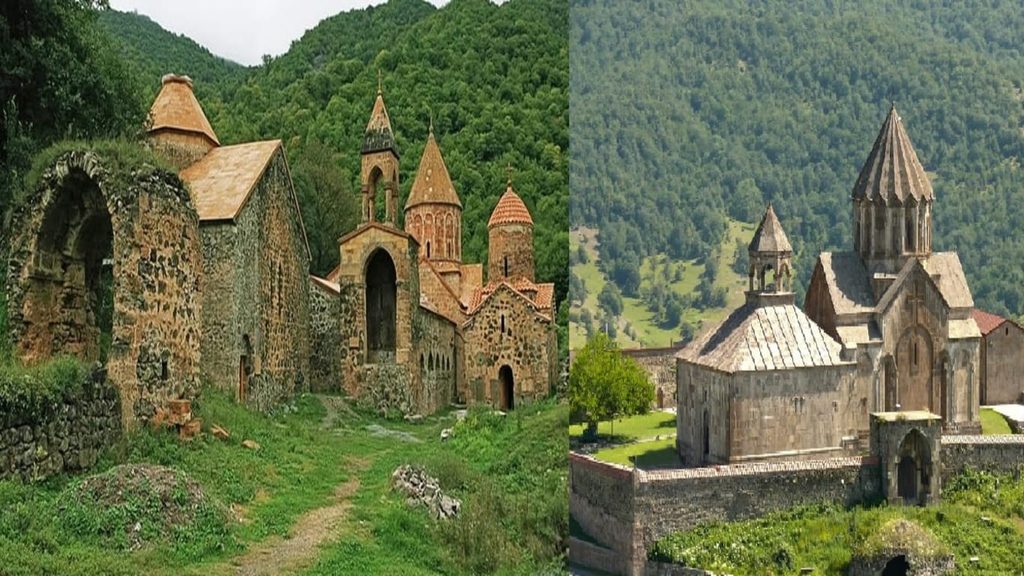
On September 12, 2026, a delegation of some 150 diplomats and representatives from 58 countries, organized by Azerbaijani presidential aide Hikmet Hajiyev, toured Nagorno-Karabakh and stopped at two of the region’s most important medieval churches: Dadivank and Gandzasar. Hajiyev told his guests that both monasteries belonged to the Christian heritage of “ancient Caucasian Albania” — not Armenia — and, according to reporting on the visit, displayed manuscript replicas in a way that cast doubt on the authenticity of Armenia’s own written heritage (OC Media; FIP.am).
It was not a new claim, and it was not a spontaneous one. It is the latest iteration of a state-driven reattribution campaign that Azerbaijan has pursued systematically since the 2020 war, and intensified after occupying Nagorno-Karabakh outright in 2023. This article lays out what Dadivank and Gandzasar actually are, according to the physical evidence on their own walls and the written record that predates the modern dispute by many centuries — and why the “Caucasian Albanian” reattribution does not survive contact with either.
Dadivank: roughly 200 Armenian inscriptions, and no others
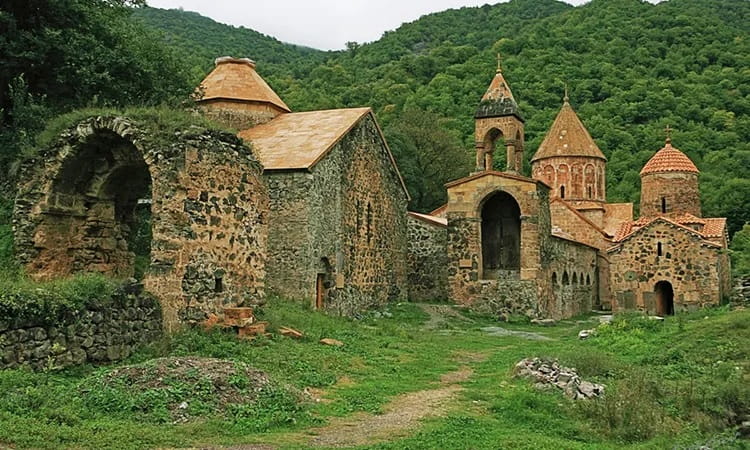
Dadivank (Armenian: Դադիվանք, “Dadi’s monastery”) sits in the Kalbajar region and is traditionally associated with Dadi, a disciple of the Apostle Thaddeus who is said to have preached Christianity in eastern Armenia in the 1st century AD; the site is first securely attested in written sources in the 9th century, and its main surviving structures date from the 9th to 13th centuries, making it one of the largest monastic complexes of medieval Armenia (Wikipedia: Dadivank).
The physical evidence is unambiguous. Monument Watch, the Armenian heritage-documentation platform, records roughly 100–200 inscriptions carved directly into Dadivank’s walls and khachkars (cross-stones) dating from the 12th to 17th centuries — and notes that there is no inscription in any other language or script anywhere on the site (Monument Watch). One of the best-known is the 13th-century donor inscription of Queen Arzu of Haterk, written in Armenian and naming her sons (Wikipedia: Dadivank). Architecturally and artistically, nothing in Dadivank’s design, sculpture, khachkars, or frescoes points to Caucasian Albanian, Udi, or any other non-Armenian tradition (EVN Report).
Dadivank passed into Azerbaijani control at the end of the 2020 war. Within months, a coordinated messaging effort began. On May 5, 2021, a video was released announcing that Christian Udi representatives would hold an Easter service at the monastery — which the video called “Khudavəng,” presented as its “real,” pre-Armenian name. In fact, “Khudavəng” is simply a Persianized rendering of the site’s own Armenian toponym, Khutavank — “khut” (hill) + “vank” (monastery), i.e., “the monastery on the hill.” The same video asserted, with no supporting medieval source, that the complex was founded by Caucasian Albanians in the 6th–7th centuries and that Armenians had “erased” earlier frescoes and inscriptions of local rulers to cover up its Albanian origin — and one participant declared that the Islamic call to prayer should be sounded at the site (Monument Watch; Asbarez).
The claim that the khachkars are recent forgeries produced in a workshop “next to the monastery” has likewise circulated in Azerbaijani state media, alongside a broader campaign narrative — documented by the Armenian “Geghard” Scientific-Analytical Foundation — built on a chain of unsupported assertions: that Armenian inscriptions were added to older Albanian buildings, and that documented Armenian religious use only dates from the 19th century (Asbarez). Western scholarship has been blunt about this pattern. Thomas de Waal, the British Caucasus specialist, has called the Albanian reattribution claim “rather bizarre” and noted that it carries “the strong political subtext” that Armenians “had no claim” to the region in the first place — an argument about property and sovereignty dressed up as a historical debate (RFE/RL). In February 2021, Azerbaijan’s Ministry of Culture announced a committee tasked with removing what it called “the fictitious traces written by Armenians on Albanian religious temples” — prompting the U.S. Commission on International Religious Freedom to publicly warn that it was “deeply concerned” by the plan and to urge Baku to preserve, not erase, the inscriptions (RFE/RL).
Gandzasar: dated, signed, and witnessed in 1216–1240
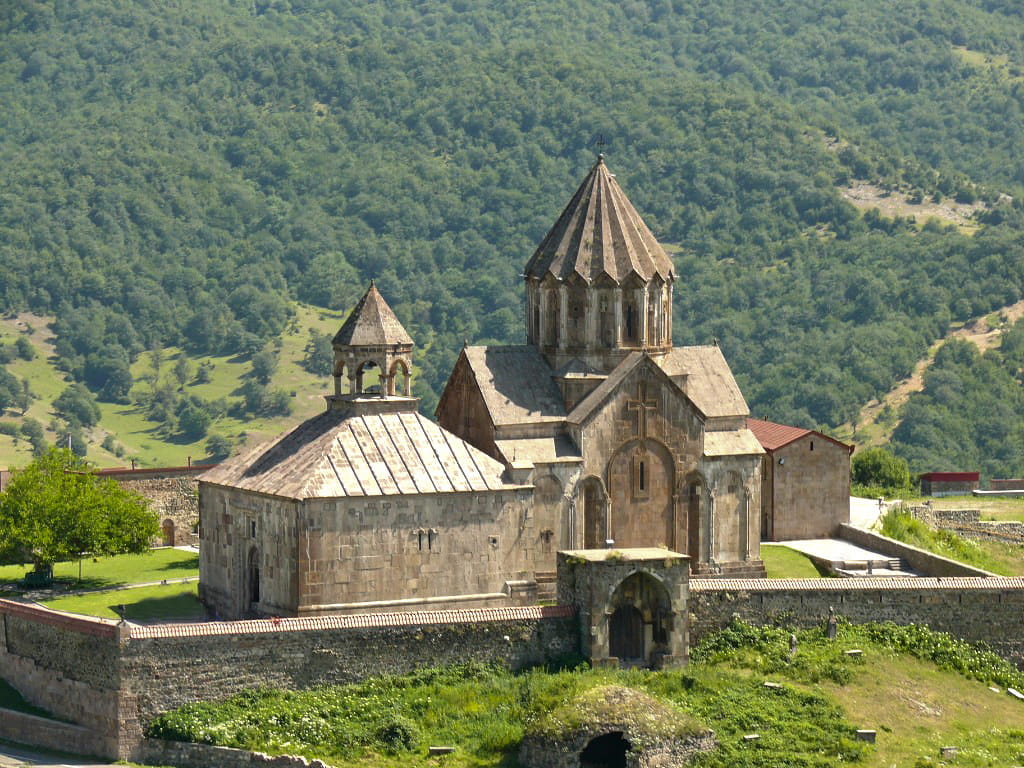
Gandzasar Cathedral, near the village of Vank, has been the most important church of Artsakh (Nagorno-Karabakh) since its construction and, from roughly 1400 to 1816, the seat of an Armenian Catholicos (Wikipedia: Gandzasar monastery). Unlike many medieval monuments, its origin is not a matter of inference — it is documented from multiple independent angles that converge precisely.
The inscriptions. Gandzasar’s own foundation inscription states plainly, in Armenian: “Thus build a church in the cemetery of our ancestors in Gandzasar.” The cathedral of St. John the Baptist was constructed between 1216 and 1238 under the patronage of Hasan-Jalal Dawla, the Armenian prince of Khachen, with the narthex (gavit) added later by Hasan, his wife, and their son Atabek; the building was consecrated on July 22, 1240 (Monument Watch; FIP.am).
The contemporary chronicler. Kirakos Gandzaketsi, a 13th-century Armenian historian who was alive during Gandzasar’s construction — not writing centuries after the fact — describes Hasan-Jalal building “a church adorned with exquisite decorations… right at the location of their burial sites,” and records the consecration ceremony itself, attended by Nerses, Catholicos of Caucasian Albania, along with numerous bishops and archpriests (Monument Watch; FIP.am). This point matters for the modern dispute specifically: Gandzasar did later become the seat of the (ecclesiastical) Catholicosate of Caucasian Albania — a title inherited by the Armenian Church after the historical Caucasian Albanian church had been absorbed into it centuries earlier — but an ecclesiastical title is not evidence of ethnic or architectural origin. As FIP.am’s fact-check states directly: the presence of that title “does not in any way mean that the 13th-century church at Gandzasar was outside the Armenian cultural and ecclesiastical milieu” (FIP.am).
Independent art-historical scholarship. Soviet archaeologist Anatoly Yakobson, in his 1977 study of Gandzasar, placed its sculptural program squarely within “the Armenian architectural tradition of the Bagratuni period” — the 10th century — comparing its animal reliefs directly to other Armenian churches (Yakobson, 1977, via arar.sci.am). Italian researchers Maria Adelaide and Lala Comneno documented the same conclusion in their 1987 study of medieval Armenian architecture in Karabakh, as did Robert Hewsen’s Armenia: A Historical Atlas (University of Chicago Press, 2001) (UChicago Press). Patrick Donabédian of Aix-Marseille University, a specialist in Armenian architecture and the monuments of Artsakh specifically, likewise places Gandzasar within the Armenian tradition (FIP.am). Structurally, Gandzasar’s gavit typology, umbrella-shaped dome, cruciform plan, and vegetal ornamentation match — feature for feature — contemporary Armenian churches such as Harichavank (1201), Haghpat, and Mshkavank, all located within present-day Armenia and never disputed (FIP.am).
The absence of the counter-evidence. No medieval source — Armenian, Albanian, Georgian, or Arab-Muslim chronicle — identifies Gandzasar as an “Albanian” building. As FIP.am’s investigation concluded after reviewing the record: the “Albanian” attribution for Gandzasar was formulated in Soviet Azerbaijani academic and state discourse in the second half of the 20th century, with no medieval documentary basis, and was subsequently promoted as state propaganda (FIP.am).
The September 2026 episode, and the manuscripts
The specific claim from Hajiyev’s September 2026 tour — that manuscripts on display cast doubt on Armenian heritage — collapses on the most basic verification. Ara Khzmalyan, director of the Matenadaran (Armenia’s Mesrop Mashtots Research Institute of Ancient Manuscripts in Yerevan), confirmed to FIP.am that no manuscript ever associated with Gandzasar has an original anywhere other than the Matenadaran’s own holdings, and that the items displayed to diplomats were replicas of manuscripts whose originals remain in Yerevan — a standard conservation practice for light- and humidity-sensitive medieval materials, not evidence of forgery (FIP.am). FIP.am, a fact-checking outlet and signatory of the International Fact-Checking Network’s Code of Principles, rated Hajiyev’s “Caucasian Albanian heritage” claim false (FIP.am).
Why this is not a scholarly dispute
It is worth being precise about what the “Caucasian Albania” theory actually is, versus what Azerbaijani state messaging does with it. Caucasian Albania was a real ancient kingdom in the eastern Caucasus, with its own church and, for a time, its own script — a legitimate subject of historical and archaeological study, and unrelated to the modern Balkan state of Albania. The scholarly dispute ends there. What Azerbaijani state institutions have done since the 1960s–70s — a strategy associated in particular with the Soviet-Azerbaijani historian Ziya Bunyadov, later notorious for a fabricated claim that Armenians had engineered a 1988 anti-Armenian massacre themselves — is retroactively reclassify the entire corpus of medieval Armenian-inscribed churches across historic Artsakh and the wider region as ethnically “Caucasian Albanian,” on the theory that Armenians only settled the area after 1828 under Russian sponsorship (RFE/RL; CEU Center for Religious Studies). This is contradicted by the inscriptions themselves, which are centuries older than 1828 and written in classical and medieval Armenian, not in the Caucasian Albanian script, which is itself only preserved in a handful of surviving religious fragments unrelated to Dadivank or Gandzasar.
This is also, notably, not merely an academic disagreement being fought out in journals. Since the February 2021 announcement of a state committee to “remove… fictitious” Armenian inscriptions, the campaign has had physical consequences: an “illegal restoration”/de-Armenianization process documented at Gandzasar since it came under Azerbaijani control in September 2023, and a parallel pattern already established at Nakhichevan, where Azerbaijan expelled the local Armenian population between 1997 and 2006 and, per satellite and on-the-ground documentation, destroyed an estimated 98% of the region’s Armenian cultural heritage, including the medieval khachkar cemetery of Julfa (itsartlaw.org / Georgetown Journal analysis).
The international legal record
Armenia brought these concerns to the International Court of Justice under the International Convention on the Elimination of All Forms of Racial Discrimination (CERD), to which both Armenia and Azerbaijan are parties. On December 7, 2021, the ICJ issued binding provisional measures ordering Azerbaijan to:
- “protect the right to access and enjoy Armenian historic, cultural and religious heritage, including but not limited to, churches, cathedrals, places of worship, monuments, landmarks, cemeteries and other buildings and artefacts, by inter alia terminating, preventing, prohibiting and punishing their vandalisation, destruction or alteration, and allowing Armenians to visit places of worship”;
- “facilitate, and refrain from placing any impediment on, efforts to protect and preserve” that same heritage; and
- “take effective measures to prevent the destruction and ensure the preservation of evidence” relevant to the case
— an order the Court reaffirmed in a further ruling on November 17, 2023 (ICJ Order, full text (PDF); ICJ press release; ICJ 2023 Order (PDF)). The case remains before the Court, with a public hearing held in April 2024 (itsartlaw.org). The Council of Europe’s Parliamentary Assembly separately condemned Azerbaijan’s shelling of the Ghazanchetsots Cathedral in Shusha during the 2020 war as deliberate damage to cultural heritage (ICJ Order, citing the Assembly’s September 27, 2021 resolution).
The bottom line
Dadivank carries roughly 200 inscriptions in Armenian and none in any other language. Gandzasar carries its own 13th-century Armenian foundation inscription, is described in matching detail by a chronicler who watched it being built and consecrated, and has been independently classified as Armenian architecture by Soviet, Italian, French, and American scholars working decades apart and without coordination. No medieval source of any origin calls either site “Albanian.” The reattribution campaign traces not to a 13th-century document but to mid-20th-century Soviet Azerbaijani historiography, was escalated into official policy after Azerbaijan’s 2020–2023 military takeover of the region, and continues today — as the September 2026 diplomatic tour and its swift debunking demonstrate — as an instrument of territorial and political messaging rather than a historical finding.
Sources
- Wikipedia — Dadivank
- Monument Watch — “Azerbaijan Claims that Dadivank Monastery Belongs to Udi Cultural Heritage”
- Monument Watch — “The Monastery of Gandzasar: General Information”
- EVN Report — “Appropriation of Armenian Cultural Heritage of Artsakh”
- RFE/RL — “‘Forgeries’: The Armenian Art That Azerbaijan May ‘Erase’ From Churches”
- Asbarez — “Artsakh’s Dadivank Given to Azerbaijan’s So-Called ‘Albanian-Udi’ Community”
- OC Media — “Outcry in Armenia as Azerbaijan Portrays Armenian Heritage in Nagorno-Karabakh as Caucasian Albanian” (Sept. 2026)
- FIP.am — “Hajiev Falsely Portrays Gandzasar as Part of ‘Caucasian Albanian’ Heritage” (Sept. 2026 fact-check)
- Wikipedia — Gandzasar monastery
- Wikipedia — Principality of Khachen
- Museum of the Bible — “Gandzasar”
- University of Chicago Press — Hewsen, Armenia: A Historical Atlas
- Yakobson, From the History of Armenian Medieval Architecture (1977), via arar.sci.am
- CEU Center for Religious Studies — Letter of Support for Dadivank Monastery’s Europa Nostra Nomination
- ICJ — Order of 7 December 2021, Armenia v. Azerbaijan (full text, PDF)
- ICJ — Press Release 2021/34
- ICJ — Order of 17 November 2023 (PDF)
- It’s Art Law (Georgetown) — “A New Framework for Cultural Heritage Protection Through the CERD: Armenia v. Azerbaijan”