What independent observers are documenting
The most systematic data on the fate of Armenian monuments in territories now under Azerbaijani control comes from Caucasus Heritage Watch (CHW), a Cornell and Purdue University research initiative that has run continuous satellite monitoring of hundreds of sites since 2021. CHW’s first report, published in 2022, found that between 1997 and 2011, 98% of Armenian cultural heritage in Nakhchivan was completely destroyed — 108 medieval and early modern monasteries, churches, and cemeteries, including the renowned Djulfa cemetery and its khachkars. That episode was not isolated; it set the template later applied elsewhere.
After the 2020 war and the exodus of Karabakh’s Armenian population in 2023, CHW’s satellite monitoring recorded a new wave of destruction: confirmed demolition of the Holy Mother of God Church (Surb Astvatsatsin) in Stepanakert/Khankendi, damage to and removal of the 19th-century St. John the Baptist Church, bulldozing of Armenian cemeteries in Shusha, and construction of a road through the historic Yerevan Gate burial ground. CHW’s June 2024 report recorded a 75% increase in fully destroyed sites and a further 29% increase in threatened sites in a single monitoring season — between fall 2023 and spring 2024, immediately after roughly 120,000 Armenians left the region.
On the ground, this is corroborated by Artsakh’s cultural heritage ombudsman, Hovik Avanesyan, who says that armed forces and other security units, not just propaganda structures, are involved in destroying monuments — evidence, in his view, of state policy rather than spontaneous vandalism. Historian Armine Tigranyan describes it in similarly direct terms: the destruction, appropriation, and reassignment of Artsakh’s heritage to other communities is a deliberate government line that operates independently of the state of hostilities. Internationally, the NGO Christian Solidarity International has called on the UN Human Rights Council to launch a fact-finding mission into the destruction of Christian cultural heritage in Nagorno-Karabakh.
The information war: denial and appropriation
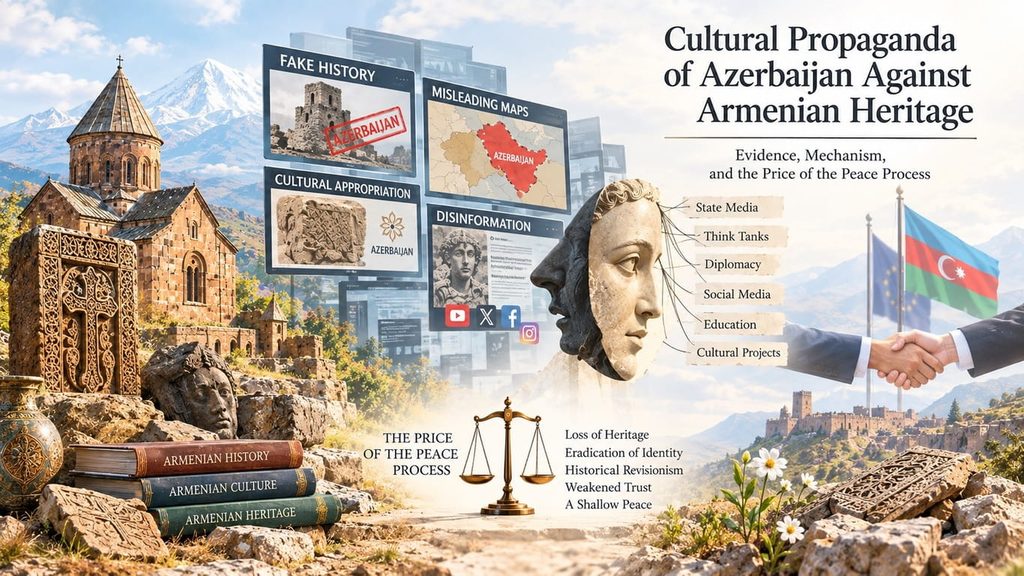
The physical destruction runs alongside a parallel information campaign that denies the Armenian origin of the sites being destroyed. Baku officially describes a number of churches and monasteries as “Caucasian Albanian” heritage — a classification that removes Azerbaijan’s formal responsibility for their fate, since a site that is “not Armenian” cannot, by that logic, be a case of cultural genocide. Azerbaijan runs a mirror-image campaign of its own: it has submitted photographic and archival material to UNESCO alleging destruction of Azerbaijani heritage on Armenian territory, and before the International Court of Justice it has denied engaging in any form of ethnic cleansing, racism, or suppression of the Armenian minority, and denied violating its obligations under the CERD Convention. This symmetry of competing narratives has to be part of the picture — leaving it out makes the piece read as one side’s brief, which makes it easier for Baku to dismiss as propaganda rather than analysis.
Legal classification: where the line actually sits
The central question is whether this campaign can be legally classified as preparation for military aggression. Here the political-science reading and the strict legal reading diverge, and the article should keep them separate.
Under international law, Article 20 of the International Covenant on Civil and Political Rights requires states to prohibit propaganda for war. But for cultural propaganda — denial of identity, appropriation of monuments, claims that a site is “foreign” — to be legally classified as preparation for an attack, it would need to include direct calls to use military force, hate speech inciting violence or discrimination against a national group, or dehumanization of the opposing side, the element that has historically preceded armed conflicts. Where the rhetoric is confined to disputing the historical ownership of territory and monuments, international practice more often treats it as a violation of cultural rights and incitement to ethnic hostility — not, on its own, as a war crime.
That said, the International Court of Justice has already drawn a formal link between this rhetoric and the risk of harm. In Armenia v. Azerbaijan, brought under the CERD Convention, the Court’s December 2021 order required Azerbaijan to protect the right to access and enjoy Armenian historic, cultural and religious heritage, “including but not limited to, churches, cathedrals, places of worship, monuments, landmarks, cemeteries,” by ending and punishing their vandalization or destruction. The Court further ordered Azerbaijan to take all necessary measures to prevent the incitement and promotion of racial hatred and discrimination targeted at persons of Armenian origin — recognizing, in effect, that cultural erasure and the incitement of hatred sit on the same continuum of risk. The Council of Europe’s Parliamentary Assembly had already, in September 2021, condemned damage it said was deliberately caused to Armenian cultural heritage, including what it described as the deliberate shelling of the Ghazanchetsots Cathedral in Shusha. It is worth noting, for balance, that no enforcement mechanism accompanies these ICJ orders, that Azerbaijan denies the underlying allegations, and that both sides presented the December 2021 ruling as a win for their own case.
In military-political scholarship, this kind of campaign is generally described as an instrument of hybrid warfare serving three functions at once: delegitimizing sovereignty by denying a people’s historical presence on given territory, legitimizing future territorial expansion by manufacturing a historical pretext, and mobilizing domestic society by constructing an image of the enemy. It is in this political-science sense — not a strict criminal-law sense — that it is accurate to describe cultural propaganda as ideological preparation for potential aggression. A criminal-law finding of “preparation for attack” under the UN framework or the International Criminal Court would require more direct evidence: military planning, troop concentrations, or explicit official calls to cross borders — none of which has been documented independently of the broader conflict context.
The peace process against this backdrop
On August 8, 2025, Nikol Pashinyan and Ilham Aliyev, with US President Donald Trump mediating, initialed a peace agreement and signed a joint declaration on the need for its ratification. Key provisions remain unresolved. Baku wants changes to the preamble of Armenia’s constitution, which references the declaration of independence and a Soviet-era resolution on the “reunification” with Nagorno-Karabakh; Yerevan says it can only put that to a referendum after the 2026 parliamentary elections. Reuters reported in July 2026 that a senior Azerbaijani official described the two countries as being at “real peace” and rebuilding trade links, while Baku continued insisting on the constitutional change before a final deal could be signed. Russian analysts describe the process of exchanging draft edits to the treaty text as protracted, with little real movement, and note that Azerbaijan’s list of demands appears to keep expanding — a trend some experts cite as grounds for warning of renewed escalation risk. Baku, for its part, has openly said the process has stalled, attributing this to a lack of political will in Yerevan; Pashinyan, meanwhile, has previously said Azerbaijan is using the constitutional narrative to stall the treaty while leaving its own constitution’s territorial claims on Armenia untouched.
Against this backdrop, Pashinyan has publicly insisted that the peace already established between the two countries carries binding legal force — meaning the government treats the process as irreversibly advanced and justified, even as the documented destruction of Armenian heritage in Azerbaijani-controlled territory continues in parallel. Critics of this position — parts of the Armenian diaspora, opposition politicians, and heritage-protection figures — point to a contradiction: negotiations are being conducted as routine diplomacy, while the other side’s conduct in the cultural and information sphere continues to display features that international bodies, including the ICJ, have already linked to a risk of escalating violence. From this vantage point, the government’s public insistence on the irreversibility of peace does not, in critics’ view, square with the situation on the ground — destroyed churches, denial of identity, and an expanding list of Azerbaijani demands — which they read not as the end of the conflict but as its transition into a different phase.
Sources:
- Caucasus Heritage Watch — reports and monitoring
- CHW Report, June 2024
- CIVILNET on CHW’s expanded monitoring
- ICJ Order of 7 December 2021 (full text)
- ICJ Press Release 2021/34
- ASIL: ICJ indicates provisional measures in Armenia/Azerbaijan cases
- Reuters via Arab News: “Azerbaijan at ‘real peace’ with Armenia but wants it to change constitution”
- Jamestown Foundation: “Azerbaijan-Armenia Peace Deal Faces Hurdles”
- Jamestown Foundation: “Constitutional Delay in Armenia Threatens to Derail Peace Talks”