Why the topic is back in focus
Over the past four months, the gas issue in Armenian-Russian relations has gone through several rounds of escalation: from a diplomatic note about a possible denunciation of the base 2013 agreement, to a ten-day technical halt in deliveries, to a report about political demands (allegedly) put forward by Moscow. It is worth untangling, step by step and against primary sources, what here is confirmed fact and what is interpretation or leak.
1. The Tsivilev letter and the denunciation of the 2013 agreement
On May 27, 2026, Russian Foreign Ministry spokesperson Maria Zakharova said the Russian embassy in Armenia had that day handed the Armenian side a letter from Energy Minister Sergei Tsivilev addressed to Armenia’s Ministry of Territorial Administration and Infrastructure. The letter raised the possibility of suspending or unilaterally denouncing the December 2, 2013 agreement on cooperation in supplies of natural gas, oil products, and unprocessed diamonds — should Armenia continue its EU accession course (Kommersant; Vedomosti).
The 2013 agreement is not, strictly speaking, about price — it concerns the indefinite removal of export duties on gas, oil products, and unprocessed diamonds supplied to Armenia for domestic consumption, with a ban on re-export to third countries (Kavkaz Online).
There is a nuance worth noting here. Armenia’s Minister of Territorial Administration and Infrastructure, David Khudatyan, initially said his ministry had received no written communication from Russia’s Ministry of Energy — only for Zakharova to firmly reiterate, immediately afterward, that the letter had in fact been delivered on May 27 (Mail Finance / Zakharova). The Armenian side later confirmed receipt of the letter through its Foreign Ministry (Mail Finance), although earlier there had also been denials at the level of individual agencies (Kommersant). In other words, the existence of the letter itself is confirmed, but the synchronicity and completeness of its acknowledgment on the Armenian side was not as smooth as the Russian account presents it.
On May 27, Pashinyan said a possible rise in gas prices did not frighten him (Vedomosti).
2. The $177.5 price and Putin’s remarks
The current supply price is $177.5 per 1,000 m³. Vladimir Putin has repeatedly and publicly compared this to European benchmark prices (above $600), emphasizing how favorable the terms are for Armenia — including at an April 2026 meeting (RIA Novosti; Ritm Evrazii) — and repeated the same point later, including through Economic Development Minister Maxim Reshetnikov in July (RIA Novosti).
The price is locked in by the current agreement through the end of 2026 into early 2027 (Profile; Neftegaz.ru) — meaning that particular deadline, not some vague future point, is the key moment of uncertainty in this whole story.
3. The ten-day halt of September 15–25: what is confirmed and what is not
On September 15, 2026, Gazprom Armenia suspended gas transport along the North Caucasus–Transcaucasia trunk pipeline, citing scheduled preventive and repair work on the Russian section of the pipe; deliveries resumed on September 25 (Interfax; Lenta.ru; OSN). During the pause, Armenia covered demand from domestic reserves and additional imports from Iran (Abireg).
Importantly: the halt itself is explained by technical causes, and there is no official documented confirmation in open sources of a political motive behind this particular pause. That sets it apart from the Tsivilev letter, where the political motivation is documented in the text of the letter itself.
4. The September 24 “Hraparak” report: significant, but unverified
On September 24, 2026, the Armenian newspaper Hraparak, citing unnamed sources in Russia, reported that Moscow was threatening to fully halt gas deliveries starting November 1 unless Yerevan met four demands:
- stop discussing the future status of Russia’s 102nd military base (Gyumri);
- take no action against assets with Russian capital — specifically the South Caucasus Railway and Gazprom;
- choose definitively between the EAEU and the EU — either repeal the law launching EU integration or set a referendum date;
- stop the prosecution of politicians the paper describes as pro-Russian.
According to the paper’s sources, after November 1 a staged “major accident” or other force majeure event could occur, preventing deliveries from resuming (Zerkalo.az; Yevropeiska Pravda; Oxu.az).
It is methodologically important to flag this clearly: the list of demands is not an official document but information attributed to unnamed sources, published by a single outlet and reproduced by others without independent confirmation. As of this writing, neither Moscow nor Yerevan has officially confirmed or substantively denied this list.
5. The Armenian government’s position: diversification as official policy
At a briefing on September 11, 2026, following a cabinet meeting, Nikol Pashinyan said he did not consider Russian gas cheap, noting that it is specifically the stretch “from the border to the final consumer” where Armenia sees the highest markup compared with other countries. The prime minister stressed that Yerevan would continue diversifying supply regardless of whether the Russian tariff changes (Lenta.ru; Yerevan Today). He also raised the possibility of revising prices on goods Armenia exports to Russia if gas becomes more expensive (Minval).
On September 16, Security Council Secretary Alen Simonyan said Armenia intends to buy gas from whichever side is available — Russia, Azerbaijan, Iran, or Turkey — and has no intention of trading dependence on one country for dependence on another (Profile). After the Hraparak report, on September 24, Simonyan put the position more sharply: Yerevan is no longer willing to depend on “a single pipe” and will not sacrifice its sovereignty to preserve the current gas price (Verelq; EADaily).
6. The Central Bank of Armenia’s response: “Scenario X”
On September 15, 2026, Central Bank Governor Martin Galstyan said a sharp rise in the price of Russian gas would fall outside the standard regulatory scenarios A and B, calling such a development “Scenario X” — an apocalyptic-level scenario requiring a stronger central bank response than a routine rate hike. He said the effect would be twofold: a direct inflationary shock, and a second-order effect via higher costs for businesses that use gas as an input, such as greenhouses and industrial producers (Moskva 24; EADaily).
This is a significant marker: warnings about a sharp price shock are not coming only from opposition media or from Pashinyan, but from the financial regulator itself, for whom this is a direct question of macroeconomic stability.
7. Why $177.5 is not what an Armenian household actually pays
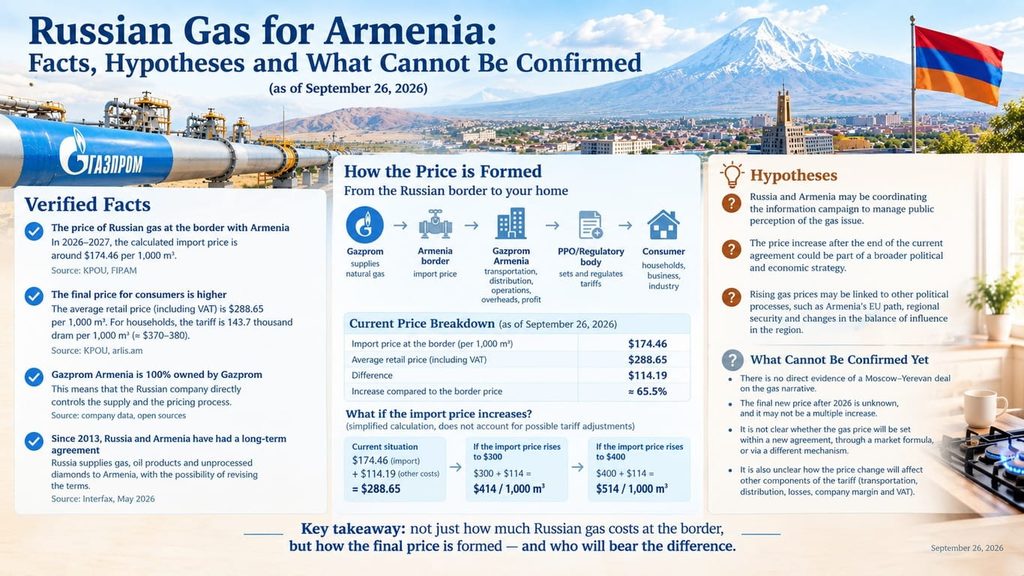
The border price and the tariff paid by the end consumer genuinely are different figures — on this point, the hypothesis raised in the original question is well founded.
The monopoly seller of gas on Armenia’s domestic market is Gazprom Armenia, a wholly owned subsidiary of Russia’s Gazprom (Wikipedia; TASS). The household tariff is set by the regulator — the Public Services Regulatory Commission (PSRC). As of 2026, the residential tariff is roughly 143.7–144 drams per m³ (about $0.30), with a rate of 100 drams for socially vulnerable groups (Vestnik Kavkaza; Azatutyun). This residential rate has been held unchanged by the regulator for an extended period, last revised back in 2024 (Armenia dlya svoikh).
For non-residential consumers — businesses, greenhouses, large industrial users — tariffs are higher and are periodically revised upward by the PSRC on Gazprom Armenia’s request: in one recent cycle, for instance, the regulator approved a 4.6% rise in the weighted-average price instead of the 11% the company had requested (Hetq).
A methodological caveat is warranted here. Some sources discussing the September situation cite specific figures for the gap between the import price (around $174–177) and the weighted-average price across all consumer categories (reportedly around $288 per 1,000 m³, implying a roughly 60–65% markup). The logic behind such a gap is consistent with the market’s structure — regulated markup plus VAT plus transport and distribution costs — but these precise figures could not be confirmed via a direct link to an official PSRC publication during the preparation of this piece. They should therefore be treated as an estimate requiring verification against the primary source (the PSRC website), not as an established fact.
What can be stated firmly: the phrase “Russian gas costs $177.5” does genuinely create a distorted impression, because that is not the bill an Armenian household or business actually receives — the final price is shaped by a regulated but substantial domestic markup, which is exactly the point Pashinyan made on September 11.
8. The Moscow-Yerevan “Tandem”: What Can and Cannot Be Claimed
It may look as though Russian and Armenian authorities are acting in concert, jointly stoking the gas issue in order to justify a future price increase — but as of today, this hypothesis has no direct documentary support. No official or leaked evidence of coordination between the two sides appears in any of the sources.
At the same time, one can objectively identify a structural asymmetry of interests that looks like a convergence of rhetorical lines rather than collusion:
- Moscow — through the Tsivilev letter, Zakharova’s statements, and, according to the unconfirmed Hraparak report, alleged behind-the-scenes demands — is tying both the price and the very continuation of supply to Armenia’s foreign-policy course.
- Yerevan — through Pashinyan and Simonyan — is using the same information backdrop to legitimize a long-overdue diversification policy and to pre-emptively explain to the public a possible future price increase (“Armenia already has the highest markup anywhere”).
- Armenia’s central bank is publicly preparing the public for a possible shock scenario well ahead of its actual occurrence.
This can fairly be framed as a testable political-economic hypothesis: both sides stand to benefit from raising the public salience of the gas issue, even without being in direct collusion. But that is not the same as a proven “tandem” — moving from one claim to the other would require a stronger evidentiary base than currently exists in open sources.
9. What to watch next
- Late 2026 to early 2027 — the expiration of the current $177.5 price agreement; this is the key date for the entire storyline.
- Official PSRC publications on tariff revisions (psrc.am) — that is where the precise tariff-structure figures should be sought, not in media reports.
- Whether the demands reported by Hraparak are confirmed or denied in detail by the Kremlin or Armenia’s Foreign Ministry.
- Progress in talks on supplies from Iran and Azerbaijan, as well as prospects for a pipeline route through Turkey, as referenced by Simonyan.
- Movements in the Armenian dram and statements from the central bank, as an indicator of how seriously Yerevan is treating the “Scenario X” risk.
Sources
- Kommersant: Tsivilev letter, May 27, 2026
- Vedomosti: Armenia receives the letter, May 27, 2026
- Vedomosti: details of the letter, May 28, 2026
- Mail Finance: Zakharova on the letter
- Kommersant: Armenia denies receiving the letter
- RIA Novosti: Putin on the $177.5 price, April 2026
- RIA Novosti: Reshetnikov on prices, July 2026
- Interfax: deliveries resume, September 25, 2026
- Lenta.ru: deliveries resume
- Abireg: reserves during the repair window
- Zerkalo.az: the Hraparak report on demands
- Yevropeiska Pravda: Moscow’s demands
- Lenta.ru: Pashinyan’s statement, September 11, 2026
- Profile: Simonyan on diversification, September 16, 2026
- Verelq: Simonyan on the “political price,” September 24, 2026
- Moskva 24: Galstyan on “Scenario X”
- Vestnik Kavkaza: 2026 residential tariff
- Hetq: PSRC tariff revision
- Official PSRC website
This material was prepared from open sources as of September 26, 2026. Some data points — in particular the exact weighted-average gas price across all consumer categories, and the demands attributed to Moscow via the Hraparak report — lack official documentary confirmation and are presented with the corresponding caveat.