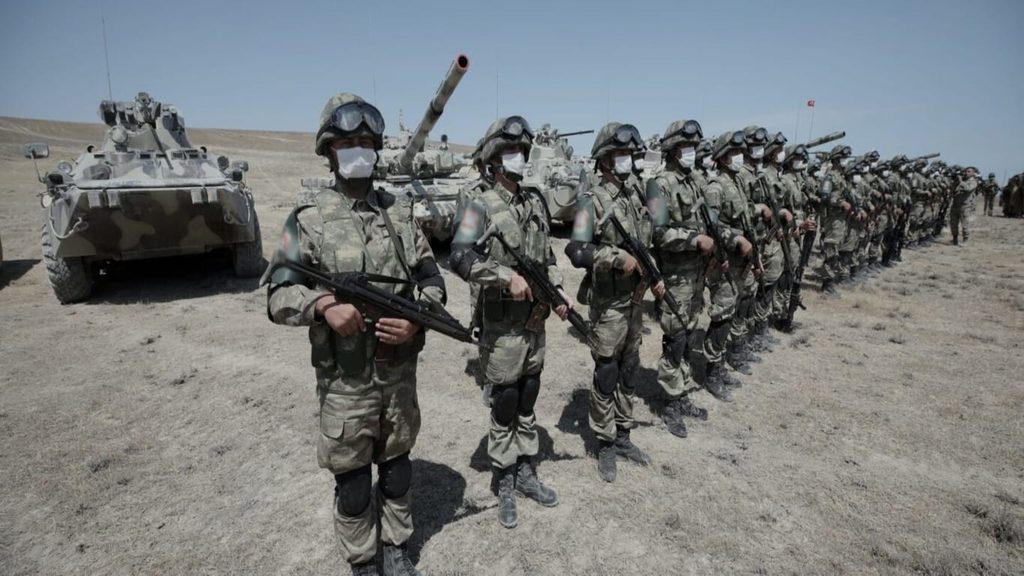
For years, Ankara and Baku publicly denied that Syrian fighters had any role in Azerbaijan’s 2020 offensive against Nagorno-Karabakh (Artsakh). Court records from Armenia, built around the criminal case of two captured Syrian nationals, now provide one of the most granular documented accounts yet of how that denial does not square with the evidence gathered on the ground — evidence that closely tracks what journalists, diplomats and UN investigators were already reporting while the war was still being fought.
This article draws on an investigation published by Nordic Monitor on September 3, 2026, cross-checked against United Nations documentation, US Treasury sanctions records, and contemporaneous reporting from international outlets that covered the war as it unfolded.
The Armenian Criminal Case
The case centers on two Syrian nationals — Muhrab Muhammad al-Shkheri and Youssef Alabet al-Haji — who were captured by Armenian forces during the 2020 war and later sentenced to life imprisonment in Armenia. According to court documents examined by Nordic Monitor, recruitment of both men began months before Azerbaijan’s offensive opened on September 27, 2020 (Nordic Monitor).
Armenian prosecutors identified Muhammad Hussein al-Jasim, widely known by his nom de guerre Abu Amsha, commander of the Turkish-backed Sultan Suleiman Shah Brigade, as a central figure in the recruitment network. According to the case files, Abu Amsha had previously been recruited by Turkish intelligence and was instructed to enlist Syrian fighters for pay to fight Armenian forces.
Al-Shkheri’s route
- Approached in June 2020 and offered roughly $2,000 a month.
- Taken to Sheikh Hadid in northern Syria, where prosecutors said around 500 recruits underwent military training between June and September 2020.
- On October 17, joined a group of roughly 250 fighters near the Syrian-Turkish border and crossed into Turkey near Kilis without passport or identity checks, according to the indictment.
- Moved through Turkish civilian airports, where roughly 50 Turkish military personnel allegedly received the group, before being flown to Azerbaijan on an aircraft bearing Azerbaijani markings on October 18.
- On arrival, met by more than 30 Azerbaijani servicemen and issued Azerbaijani uniforms, Kalashnikov rifles, machine guns and RPGs.
Al-Haji’s route
- Taken to the Bab al-Salam crossing on September 25, two days before the Azerbaijani offensive began, as part of a group of roughly 500 Syrian men aged 20 to 40, each promised about $2,000 a month.
- Crossed into Turkey without passport checks, was moved to an airport, and flown to Azerbaijan.
- On arrival, photographed, issued ID tags, and supplied with Azerbaijani military uniforms and weapons.
A separate investigation by Bytes Europe, also drawing on the Armenian court file, adds that a commander identified as “Colonel Mahmoud” selected 250 men and split them into five groups, and that Turkish border guards allegedly let the entire group cross without requesting identification — an operational detail prosecutors say points to coordination by Turkey’s intelligence service, MIT.
The Alleged Orders: “Do Not Spare Armenians”
The most disturbing allegations in the Armenian file concern the instructions given to recruits once deployed. According to prosecutors, fighters were told not to spare Armenians. In al-Haji’s case, investigators alleged recruits were promised an extra $100 for presenting the severed head of an Armenian and were issued long-bladed knives for that purpose. Prosecutors said the fighters were instructed to attack Armenian settlements, kill servicemen and civilians, and carry out arson and explosions to terrorize the population.
The two men’s defense lawyer told Nordic Monitor that his clients admitted to being recruited as mercenaries but denied committing war crimes.
This Was Not a New Allegation — The UN Raised It in Real Time
What makes the Armenian court file significant is not that it is the first time these allegations surfaced — it is that a criminal investigation, built on interrogations and judicial evidence, now corroborates in detail what international bodies and journalists were reporting in real time during the war itself.
On November 6, 2020, while the fighting was still underway, the UN Working Group on the Use of Mercenaries sent a formal communication to the Turkish government raising the recruitment, financing and transport of Syrian fighters to Azerbaijan. Days later, on November 11, 2020, the Working Group issued a public statement — published by OHCHR and mirrored on ReliefWeb — saying it had received widespread reports that Azerbaijan, with Turkey’s assistance, relied on Syrian fighters to sustain its military operations, including on the frontline, and that their recruitment and deployment appeared to meet the legal definition of mercenary activity under the International Convention against the Recruitment, Use, Financing and Training of Mercenaries, to which Azerbaijan is a state party. The Working Group’s chair, Chris Kwaja, noted the pattern echoed Turkey’s earlier, similarly documented recruitment of Syrian fighters for the conflict in Libya.
According to Nordic Monitor’s review of the UN file, the November 2020 communication specifically named the same Turkish-backed factions that reappear in the Armenian criminal case: the Hamza Division, the Sultan Murad Division, the Al-Amshat faction, and the Sultan Suleiman Shah Brigade.
Turkey’s government rejected the allegations. Its permanent mission in Geneva responded via a note verbale in January 2021 dismissing the Working Group’s findings as based on “black propaganda” and fabricated material, according to Nordic Monitor’s reporting on a related EU dossier. Azerbaijan likewise denied using foreign mercenaries.
What International Media Reported at the Time
The claim that Turkey moved Syrian fighters to Azerbaijan was not a fringe theory — it was reported, cross-checked and in several cases confirmed by some of the world’s largest news organizations within weeks of the war’s start:
- Reuters and The Guardian both published accounts, in late September and October 2020, citing Syrian fighters who described being recruited and transported to Azerbaijan with Turkish coordination, though Reuters noted it could not independently verify every detail of the fighters’ accounts (OC Media summary of the Reuters/Guardian coverage).
- Asia Times reported in October 2020 that word of a new Turkish-organized mercenary opportunity — the second such pipeline after Libya — began circulating in northern Syria on September 1, 2020, with militia commanders registering fighters for Azerbaijan by September 6, three weeks before the war began (Asia Times).
- Foreign Policy documented individual cases of Syrian fighters killed in Nagorno-Karabakh, describing four-month contracts worth $1,500 a month paid in Turkish lira, and reported that the first fighters were moved from southern Turkey through Gaziantep and Ankara before being flown to Azerbaijan starting September 25, 2020 (Foreign Policy).
- French President Emmanuel Macron stated publicly at an EU summit in early October 2020 that he had intelligence establishing with certainty that Syrian jihadist fighters had transited through the Turkish city of Gaziantep en route to Nagorno-Karabakh, and said he would compare notes with Presidents Putin and Trump on the matter (Al Jazeera).
- RFE/RL compiled the broader wave of reporting on the subject, noting that by mid-October 2020 the Washington Post, the Wall Street Journal and a US congressman had all treated the deployment of Syrian mercenaries as established fact, citing figures ranging from hundreds to roughly 1,500 fighters (RFE/RL, via GlobalSecurity.org).
A retrospective published by EVN Report notes that the deployment, despite persistent denials from Ankara and Baku, was ultimately confirmed by senior officials from Russia, Iran, France and the United States, and describes it as one of the most extensively documented aspects of the entire war.
Armenia’s own Investigative Committee said it had identified approximately 300 mercenaries involved in Azerbaijani military operations during the war, and separately charged 31 Syrian nationals — including the leader of an armed group — with mercenary activity, international terrorism, and serious violations of international humanitarian law.
Abu Amsha: From Battlefield Recruiter to US-Sanctioned Militia Leader
Abu Amsha’s name did not disappear from the international record after 2020. In August 2023, the US Treasury’s Office of Foreign Assets Control sanctioned him, his brother Walid al-Jasim, the Sultan Suleiman Shah Brigade, the Hamza Division and its commander Sayf Bolad (Abu Bakr) — but on entirely separate grounds. The Treasury’s designation centered on the brigade’s conduct in Afrin, northern Syria: the forced displacement of Kurdish residents, seizure of their property, kidnapping for ransom, and an allegation that Abu Amsha personally raped the wife of one of his own fighters (US Treasury designation, via GlobalSecurity.org).
Eighty-five Syrian human rights organizations welcomed the sanctions at the time, citing the same pattern of abductions, torture and extortion against Kurdish civilians in Afrin (Syrians for Truth and Justice). The European Union followed with its own sanctions on Abu Amsha in May 2025, again tied to abuses in Syria rather than to Nagorno-Karabakh (Enab Baladi).
It is worth stating plainly, as Nordic Monitor itself notes: the 2023 US sanctions were unrelated to the Artsakh War and do not, on their own, establish Abu Amsha’s alleged role in sending fighters to Azerbaijan. That allegation rests on the separate body of Armenian judicial and UN evidence described above. After the fall of the Assad government in December 2024, Abu Amsha was folded into Syria’s restructured national army with the rank of brigadier general, commanding what is now Division 62 — a promotion that drew criticism from human rights observers given the accusations still attached to his name (Kurdistan24).
A Quiet Postscript: January 2026
In January 2026, Armenia transferred al-Shkheri and al-Haji through Turkey to Syrian authorities, officially so they could continue serving their Armenian life sentences on Syrian soil. Their transfer took place on the same day Azerbaijan released four Armenian detainees, though Armenian authorities have not officially confirmed the two events were connected as part of a coordinated exchange.
Why the Armenian Files Matter
Individually, none of the elements above is new: Reuters and the Guardian reported fighter testimony in 2020; Macron said he had intelligence confirming the transit route; the UN Working Group formally raised the issue with Ankara while the war was still being fought; and the US and EU later sanctioned Abu Amsha for unrelated atrocities in Afrin. What the Armenian judicial file adds is a rare instance of the alleged mechanism itself — recruitment, payment, training, the specific border crossing, the civilian airports used inside Turkey, and the handoff to Azerbaijani forces — being reconstructed through sworn testimony and prosecutorial evidence rather than journalistic sourcing or diplomatic statements alone. Turkey and Azerbaijan continue to reject the allegations in full.
Sources: Nordic Monitor investigation (Sept. 3, 2026) · OHCHR press release, Nov. 11, 2020 · US Treasury sanctions record, Aug. 2023 · Bytes Europe · Foreign Policy · Asia Times · Al Jazeera · EVN Report