Regarding the Appointment of a Temporary Governor-General for the Districts of Zangezur, Shusha, Jevanshir, and Jebrail, and Clarification That This Does Not Constitute a Decision on Their State Affiliation May 6, 1919
The British Command hereby announces to all residents, with mandatory compliance: With the consent of the British Command, Dr. Khosrov Bek Sultanov has been appointed Temporary Governor-General of the districts of Zangezur, Shusha, Jevanshir, and Jebrail. His assistant for civil affairs will be an Armenian.
To administer the region, a council is established under the Governor-General, consisting of three Armenians, three Muslims, and one officer representing the British Mission.
All troop movements shall be carried out with the knowledge of the British Mission. Funding for all officials of the Governor-General’s administration shall be allocated with the consent of the Allies.
The British Mission finds it necessary to reiterate that the question of the state affiliation of the aforementioned regions will be resolved at the Peace Conference.
The British Mission hereby declares that all orders issued by the Governor-General and his institutions must be strictly obeyed by the population. Any resistance will be suppressed with the most decisive measures.
Source: Central State Historical Archive of Armenia, f. 200, op. 1, d. 243, l. 101. Copy. Typescript. Published in: Nagorno-Karabakh in 1918–1923, Yerevan, 1992, doc. No. 122. (Emphasis added by Yu.B.) *Date of copy receipt.
🇦🇲 REQUEST FROM THE ARMENIAN DIPLOMATIC REPRESENTATIVE IN AZERBAIJAN TO THE CHAIRMAN OF THE ARMENIAN GOVERNMENT
Regarding Temporary Administration of Karabakh No. 3352, Shusha, May 7, 1919
General Shuttleworth informed me in Baku that the Armenian government had given its consent to Azerbaijan for the temporary administration of Karabakh and Zangezur, and that it had refused to recognize Shahmazyan.
— Arzumanian
Source: Central State Historical Archive of Armenia, f. 200, op. 1, d. 309, l. 43. Telegram form. Published in: Nagorno-Karabakh in 1918–1923, Yerevan, 1992, doc. No. 123.
❌ DENIAL BY THE OFFICE OF THE CHAIRMAN OF THE ARMENIAN GOVERNMENT
Regarding the Statement by British Military Authorities on Alleged Consent to Temporary Azerbaijani Administration of Karabakh No. 1559, May 7, 1919
The Government of Armenia has never given its consent to anyone. Arsen Shahmazyan remains in his position. The government only agreed to allow the passage of nomadic tribes.
— Secretary General
Source: Central State Historical Archive of Armenia, f. 200, op. 1, d. 309, l. 44. Release. Typescript. Published in: Nagorno-Karabakh in 1918–1923, Yerevan, 1992, doc. No. 124.
🇦🇲 OFFICIAL STATEMENT OF THE GOVERNMENT OF ARMENIA
Declaring That It Has Never Given Consent to Azerbaijani Administration Over Karabakh May 7, 1919
In light of the dissemination—both within Armenia and abroad—of claims that the Armenian government has allegedly agreed to the administration of Armenian Karabakh by an Azerbaijani Governor-General, the Armenian government categorically declares that it has never, under any circumstances, given such consent to anyone.
On the contrary, the Armenian government has always considered and continues to consider Armenian Karabakh an inseparable part of Armenia. This position has been repeatedly communicated to both the British Command and the Azerbaijani government.
Source: Central State Historical Archive of Armenia, f. 200, op. 1, d. 309, l. 45. Release. Typescript. Published in: Nagorno-Karabakh in 1918–1923, Yerevan, 1992, doc. No. 125. (Emphasis added by Yu.B.) *Statement intended for publication in the newspaper “Kayts”.
🇬🇪 REPORT FROM THE ARMENIAN DIPLOMATIC REPRESENTATIVE IN GEORGIA
To the Minister of Foreign Affairs Regarding the British Command’s Demand to Expel Armenian Government Representatives from Karabakh Strictly Confidential – Tiflis, May 8, 1919
On May 6, 1919, General Thomson, whom I visited at his invitation, read to me excerpts from reports by General Shuttleworth and Colonel Monk-Mason concerning the situation in Karabakh.
These British officers report to General Thomson that public order in Karabakh—including the Gerus area and Zangezur district—is being disrupted due to the aggressive policies of Captain Shahmazyan, the representative of the Armenian government. Shahmazyan refers to himself as the Armenian Governor-General of Karabakh, allegedly appointed by the Armenian government, and asserts its authority.
He is encouraging the local population to reject Azerbaijani authority, claiming Karabakh is an inseparable part of Armenia.
After reading the excerpts, the latest dated May 5, General Thomson stated that he can no longer tolerate a situation in which Captain Shahmazyan, unlawfully calling himself Governor-General of Karabakh, undermines the fragile order. Thomson demanded Shahmazyan be recalled to Erivan immediately, or else he would arrest him and subject him to a field court-martial.
General Thomson expressed confidence that Prime Minister Khatissian would comply with the British command’s demand, that Shahmazyan would be recalled and treated as a violator of public order, and that the Dashnaktsutyun Party would cease its activities that foster hostility toward the British command and its policies in Karabakh.
According to General Thomson, Fatali Khan Khoyski has promised full cooperation in securing Muslim recognition of Armenian authority over the districts of Nakhichevan, Sharur-Daralagez, and Surmali. Therefore, Thomson expects a similar policy from Armenian representatives in Karabakh.
Thomson stated that refugees will return to Nakhichevan and other Armenian regions only once Armenians are pacified in Karabakh. He has telegraphed General Davy to this effect. The return of refugees is thus directly tied to the establishment of a British-approved line of conduct by Armenians in Karabakh.
— Diplomatic Representative Yevangulov
Source: Central State Historical Archive of Armenia, f. 200, op. 1, d. 309, l. 51–52. Original. Typescript. Published in: Nagorno-Karabakh in 1918–1923, Yerevan, 1992, doc. No. 129. (Emphasis added by Yu.B.)
🇦🇲 REPORT BY A MEMBER OF THE KARABAKH NATIONAL COUNCIL
To the Central Committee of the Armenian People’s Party on the Situation in Karabakh and Zangezur After May 12, 1919
I wish to inform you of the current situation in Karabakh and Zangezur.
On April 6, in Baku, Mr. Shuttleworth published the decree appointing Sultanov. In Shusha, the British Mission intended to publish the decree, but the National Council objected, stating it would provoke unrest, and proposed convening the Fifth Congress. The Mission agreed.
On April 23, the Congress was held, with Shuttleworth in attendance. Two issues were presented to the Karabakh Congress: the Azerbaijani Governor-Generalship and the passage of nomadic tribes. On the first issue, the Congress again categorically rejected the proposal and reiterated its preference for temporary British administration. On the second issue, the Congress decided to allow passage unconditionally.
Zangezur declared itself a region of the Armenian Republic, refused to recognize Azerbaijan, and rejected the passage of nomads in terms that were strong and arguably inappropriate.
On May 12, Shuttleworth returned to Zangezur to demand the passage of nomads and the removal of Shahmazyan, the Armenian commissioner. He was accompanied by Ishkhan (Argutinsky). Yesterday, Shuttleworth arrived, but Ishkhan has not yet come; the situation there is extremely tense.
We have reports that Zangezur is willing to allow the nomads to pass, but only unarmed. The Mission here claims that in Dygha, Armenians surrounded Shuttleworth with cannons, and in Gerus, armored cars were encircled with artillery and machine guns, and even fired upon.
What exactly happened and how accurate this is remains unclear.
Misha Arzumanov, the Armenian Republic’s representative, is currently here. Upon his arrival, the Mission and Shuttleworth officially announced that Armenia had agreed to Sultanov’s administration in Karabakh. Arzumanov sent an inquiry to Erivan and received a reply from Ter-Akopov stating that this claim was false and that Armenia had not given its consent.
Upon arrival, Ishkhan declared that Armenia (officially) would never renounce Karabakh. Shuttleworth became furious, accusing the Armenian government of duplicity.
Such is this strange and confusing affair. Please help unravel it.
Mikhail Arzumanov, however, is scheduled to leave Karabakh the day after tomorrow at Shuttleworth’s request. His alleged offense is unofficially said to be his unwillingness to cooperate with British plans and that he brought funds to promote the Armenian cause.
— Grigor Bagaturov
Source: Central State Historical Archive of Armenia, f. 201, op. 1, d. 42, l. 17. Certified copy. Typescript. Published in: Bulletin of the Archives of Armenia, 1989, No. 1, pp. 101–102.
🇦🇿 REPORT BY TEMPORARY GOVERNOR-GENERAL SULTANOV
To the Council of Ministers of Azerbaijan Requesting Urgent Military Assistance May 17, 1919
[…] I relay the details of the negotiations. In Dygha, the British detachment with the general was stopped by armed Armenians; the general was then allowed to proceed to Gerus without his detachment.
In Gerus, the National Council convened and categorically refused to recognize Azerbaijan. Shuttleworth demanded the surrender of Shahbazyan, Shirinyan, Osipov, and Kalmakov for deportation. At the appointed time, these individuals appeared before Shuttleworth.
Suddenly, bells rang, a crowd of armed Armenians gathered, three field cannons were rolled out, machine guns were aimed at the general, and cries of “Death to the English!” were heard. They declared that no one would be handed over.
There is no hope in the English. Even the promised weapons have not been sent to me. Without military units and arms for the people’s militia, my presence here is pointless.
The government must either ensure the defense of Karabakh or instruct the population to defend it as best they can.
I urgently request a response: can I expect the delivery of 2,000 rifles, one million cartridges, one artillery battery, and 10 machine guns with sufficient ammunition—or military units—given the impotence of the English?
If refused, I must leave to report to Parliament.
— Governor-General [Sultanov]
Source: Political Archive of the Communist Party of Azerbaijan, f. 4033, op. 5, d. 446, l. 1. Release. Typescript. Published in: Nagorno-Karabakh in 1918–1923, Yerevan, 1992, doc. No. 135. (Emphasis added by Yu.B.)
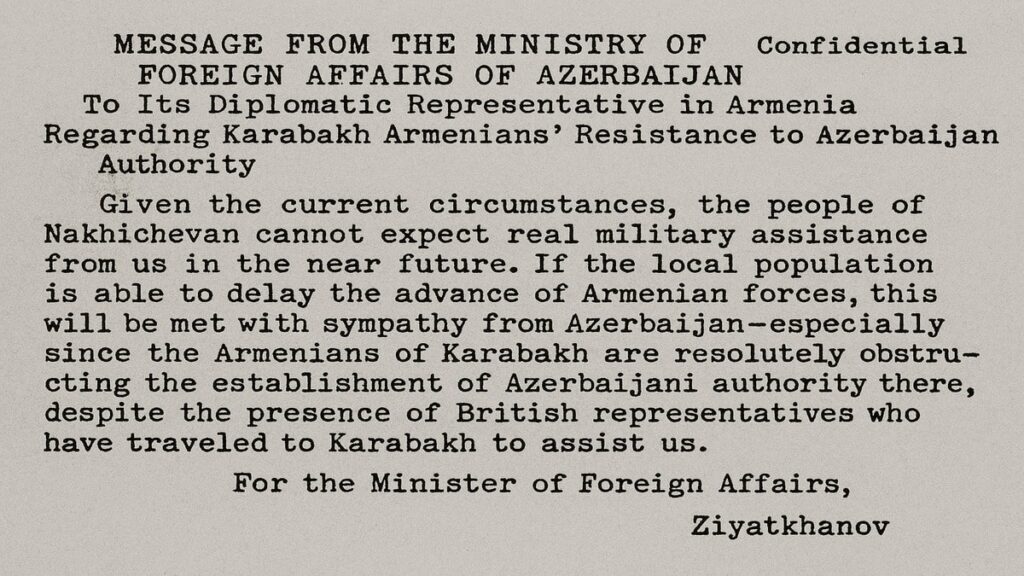
🇦🇿 MESSAGE FROM THE MINISTRY OF FOREIGN AFFAIRS OF AZERBAIJAN
To Its Diplomatic Representative in Armenia Regarding Karabakh Armenians’ Resistance to Azerbaijani Authority Confidential – May 18, 1919
Given the current circumstances, the people of Nakhichevan cannot expect real military assistance from us in the near future.
If the local population is able to delay the advance of Armenian forces, this will be met with sympathy from Azerbaijan—especially since the Armenians of Karabakh are resolutely obstructing the establishment of Azerbaijani authority there, despite the presence of British representatives who have traveled to Karabakh to assist us.
— On behalf of the Minister of Foreign Affairs, Ziyatkhanov
Source: Central State Historical Archive of Armenia, f. 200, op. 1, d. 427, l. 206 verso. Certified copy. Typescript. Published in: Nagorno-Karabakh in 1918–1923, Yerevan, 1992, doc. No. 136.
🇦🇿 REPORT FROM THE AZERBAIJANI DIPLOMATIC REPRESENTATIVE IN ARMENIA
To the Azerbaijani Government Regarding French Discontent with British Policy on the Karabakh Issue No. 111 – Confidential – Urgent – May 20, 1919
During a luncheon, the French representative in Armenia expressed dissatisfaction with British policy, which he described as being exclusively in favor of the Azerbaijani government—particularly the actions of General Thomson, who, through skillful reporting, succeeded in transferring Karabakh to Azerbaijan.
According to the French, this was a clear injustice. He further stated that with the arrival of the other Allied powers, the policy would have to change.
He openly expressed French sympathy toward the Armenians, referring to them as “our own.” From his remarks, I concluded that in November, the French would have acted differently toward Azerbaijan than the British did.
— Diplomatic Representative Tekinski
Source: Central State Historical Archive of Armenia, f. 200, op. 1, d. 271, l. 61 verso. Certified copy. Typescript. Published in: Nagorno-Karabakh in 1918–1923, Yerevan, 1992, doc. No. 137. (Emphasis added by Yu.B.) 311
Yuri Barsegov “Nagorno-Karabakh in International Law and Global Politics”
Artatsolum
Read Also:
- Ancient and Medieval Sources on Artsakh (Karabakh) as Part of Armenia’s State Territory
- Message from Gandzasar Catholicos Esayi to Peter I August 10, 1716
- Memorandum Issued to Ivan Karapet Along with the Imperial Letter to the Armenian People Regarding Russia’s Readiness to Take the Armenians of Karabakh Under Its Protection June 3, 1723
- Decree of Peter I to the Armenian People Regarding Russia’s Willingness to Offer Protection to the Armenians of Karabakh
- On Armenian Hopes for Russian Assistance
- Report of Minas Vardapet to Peter I
- Contents of the Secret Letters from the Armenian Assembly and the Armenian Army of Karabakh to the Russian Emperor and Chancellor August 1724
- Contents of the Secret Letters from the Armenian Assembly and the Armenian Army of Karabakh to the Russian Emperor and Chancellor August 1724
- State Charter of Peter I On the Acceptance of the Armenian People Under the Protection of the Russian State and Their Resettlement from Karabakh to Newly Acquired Persian Provinces November 10, 1724
- Letters from the Catholicos and the Meliks of Karabakh
- Charter of Catherine I Addressed to the Armenian Assembly
- Message General Mkhitar—to the Russian Government
- The Armenian Assembly’s Request for Military Assistance June 19, 1727
- Result from Russia’s failure to fulfill its promises of assistance to the Armenians March 1736
- On the Issuance of the Decree Appointing Panah Khan
- Letter from General Potemkin to Prince Argutinsky with questions about the liberation of Armenia
- Appeal of Gandzasar Catholicos Hovhannes to Catherine II
- Letter from Melik Apov Iosifov to Provide Assistance to Russian Military Forces for the Liberation of Enslaved Karabakh
- Report of Prince G. Potemkin to Catherine II
- Request of General P. Potemkin to Prince G. Potemkin
- Letter from Archbishop Joseph Argutinsky to General P. Potemkin
- Memorandum to Catherine II on the Project for the Restoration of the Armenian Kingdom
- Decree of Paul I to General Count I. Gudovich
- Letter from Archbishop Joseph Argutinsky
- Report by State Councillor P. Kovalesky
- The Khan’s Vizier, Mirza Jamal Javanshir Karabakhsky
- From the Report of General Marquis Palluci to Alexander I
- The Gulistan Treaty – An Interstate Act of Iran’s Cession of the Karabakh Territory to Russia
- Report of General A. Yermolov to Alexander I Requesting the Waiver of Tax Arrears for the Karabakh Khanate
- LETTER FROM GENERAL A. YERMOLOV TO MEHTI-KULI KHAN
- Directive from General A. Yermolov to General I. Velyaminov
- Letter of Metropolitan Sarkis Hasan-Jalalyan To General A. Yermolov
- Letter from General I. Paskevich
- TREATY CONCLUDED BETWEEN RUSSIA AND PERSIA AT TURKMENCHAY
- Russian Military Historian V. Potto on the Essence of the Treaty of Turkmenchay
- Order of General I. Paskevich to Colonel L. Lazarev
- STATEMENT ON THE DIFFERING ATTITUDES OF ARMENIANS AND TATARS TOWARD THE ANNEXATION OF KARABAKH TO RUSSIA
- REPORT By the Acting Uezd Chief of the Dzhevanshir Uezd, D. Baranovsky
- From the Memoirs of a Member of the Russian National Council in Baku (1918–1919)
- “TREATY OF PEACE AND FRIENDSHIP” Between the Ottoman Empire and the Republic of Armenia
- Letter from A. Mikaelyan, Representative of the Karabakh and Zangezur Fellowship
- Note of Protest from the Ministry of Foreign Affairs of the Republic of Armenia
- Appeal of the Karabakh Armenian National Council To the Commander of Allied Forces in Baku
- LETTER FROM THE CHAIRMAN OF THE KARABAKH ARMENIAN NATIONAL COUNCIL
- Turks in Shushi
- Letter of Welcome from the Karabakh Armenian
- LETTER FROM GENERAL BAGRATUNI
- FROM THE MESSAGE OF THE ARMENIAN TELEGRAPH AGENCY
- REPORT FROM THE DIPLOMATIC REPRESENTATIVE OF ARMENIA IN GEORGIA
- Resolution of the Fifth Congress of Armenians of Karabakh
- Report by Prime Minister Hatisov to the Council of Ministers of Armenia
- FROM THE MEMORANDUM OF THE KARABAKH ARMENIAN NATIONAL COUNCIL
4 thoughts on “🇬🇧 ANNOUNCEMENT OF THE BRITISH MILITARY MISSION IN SHUSHA”