
To the Governor-General On the Tatar Offensive Against the Armenian Village of Khtsaberd May 28, 1919
I hereby report that on Wednesday, May 28, the Tatars, having assembled from noon, surrounded the village of Khtsaberd and launched an offensive with a force exceeding one thousand men. The enemy continues to receive reinforcements without interruption. The battle is fierce and ongoing. According to the latest information, the situation is extremely serious, if not critical; our defensive resources are nearly exhausted. There are casualties. The wounded and civilians are being sheltered in our village. There is no paramedic or medical supplies. Immediate measures must be taken to deliver all necessary resources. Regular units of the Azerbaijani army have been observed among the enemy forces. Reporting all of the above, I humbly request that you take all measures within your power.
Head of the Office, B. Badalbekov Central State Historical Archive of Armenia, f. 276, op. 1, d. 42, l. 160. Copy. Typescript. Published in: Nagorno-Karabakh in 1918–1923, Yerevan, 1992, doc. No. 142.
🪖 Chief of the General Staff of the Azerbaijani Army
On the Urgent Need to Form Troops to Occupy and Secure Karabakh, Zangezur, and Lankaran, and to Repel the “Northern Threat” No. 26, Ganja, May 29, 1919
The military department has been tasked with fulfilling urgent state objectives, namely: the occupation and consolidation of Karabakh (particularly the Zangezur district), Lankaran, and assistance to nomadic tribes, etc. Furthermore, in the near future, we may be required to defend our independence against an impending threat from the north.
In light of this, the Minister of War earnestly requests your full support in the rapid formation of troops through intensified recruitment. If new recruits do not enter the army, the military department will be unable to fulfill its duty to the homeland and will relinquish all responsibility.
Major General of the General Staff Acting Head of the Local Brigade Administration of the General Staff, Colonel Political Archive of the Communist Party of Azerbaijan, f. 4033, op. 5, d. 467, l. 2. Original. Typescript. Published in: Nagorno-Karabakh in 1918–1923, Yerevan, 1992, doc. No. 143. Signatures illegible.
🕊️ Letter from the Chairman of the Armenian National Council of Karabakh
To the Minister of Foreign Affairs of Armenia On the Urgent Need to Defend Karabakh as a Matter of Life and Death for Karabakh and Armenia May 30, 1919
By the authority granted to me by the Armenian National Council of Karabakh and the resolutions adopted by the Karabakh Armenian community in Tiflis, I hereby inform you of the following:
I. The Government of Armenia must make the Karabakh issue a top and urgent priority in its political agenda. It must actively and energetically demonstrate to the Allies and the world that the Karabakh issue is vital for Armenia—that it is a conditio sine qua non for both Karabakh and Armenia.
II. The government must immediately send a note to the British command, in which:
- It should present the factual situation in Karabakh and Zangezur (as described in the concluding part of the attached report), a situation threatening Karabakh with the horrors of renewed massacres, and insist on the establishment of order in the region—either through the administration of national councils or the institution of a British Governor-Generalship;
- It must refute General Shuttleworth’s claims that Armenia has already recognized Azerbaijani authority over Karabakh and Zangezur pending a final decision at the Peace Conference;
- It must protest the expulsion of Armenia’s representative from the British mission in Shushi and the accompanying incidents;
- If the establishment of the aforementioned modus in Karabakh (as per point I) requires time for negotiations and legal formalization, then it must insist on the immediate recognition of the Armenian National Council of Karabakh in its previous form and allow the return of Armenia’s representative to Karabakh, as this alone will maintain order.
III. Independently of the above, a special body must be established within one of the Ministries to address the Karabakh issue.
IV. The Armenian delegation in Paris must be categorically instructed not to concede Karabakh in its report, where the region is scarcely mentioned despite its current critical state. Concession would not bring peace but new complications. The delegation must present the current situation in Karabakh and Zangezur and advocate for a viable modus vivendi until a final resolution is reached.
Central State Historical Archive of Armenia, f. 200, op. 1, d. 309, l. 86 and verso. Original. Manuscript. Published in: Nagorno-Karabakh in 1918–1923, Yerevan, 1992, doc. No. 144. (Emphasis added by Y.B.) conditio sine qua non – an essential condition.
📝 Memorandum from the Chairman of the Armenian National Council of Karabakh
To the British Command On the Situation in Nagorno-Karabakh and Zangezur in 1917–1919 May 30, 1919
The tragedy of Karabakh is closely intertwined with the tragedy of the entire Caucasus. It began at the moment when, following the collapse of the Caucasian front, centrifugal tendencies among the peoples of the region intensified, and the Caucasian reaction—through its contribution to rearward chaos, road blockades, the massacre at Shamkhor (where thousands of Russian soldiers were killed), and other hecatombs—paved the way for the triumphant advance of the Turks.
From that time onward, Karabakh was completely cut off from the outside world and left to fend for itself in every respect. Armed Muslim bands looted and murdered anyone traveling along the Yevlakh–Shushi route, destroyed and set fire to the Yevlakh station, killed soldiers returning from the front to Karabakh if they traveled alone, or engaged them in combat if they came in groups—thus achieving total isolation of Karabakh.
Adding to this were the famines caused by previous crop failures, which plagued all Armenian villages, and the systematic raids on these same villages by Muslim bands and masses, accompanied by killings, livestock theft, and other atrocities. The horrifying condition of the Armenian population of Karabakh becomes clear: cut off from the world, living in hunger, and constantly threatened by attacks and violence, its very physical survival was in no way guaranteed.
The population was on the brink of despair. Since the source of their suffering was the actions of Muslim masses rather than isolated individuals, a deep resentment toward the Tatars began to grow among the Armenians. The Armenian people of Karabakh were convinced that their long-standing neighbors—the Tatars—were, under Turkish guidance, implementing an Abdul Hamid-style policy of Armenian extermination. Naturally, this bred indignation and made the population susceptible to being drawn into a senseless interethnic bloodbath.
At the same time, all state institutions in Karabakh ceased to function, having lost all support from the central Transcaucasian Commissariat. Governance of Karabakh fell into the hands of two bodies: in Armenian Karabakh, the Council of Armenian Parties and Organizations; in the Muslim-inhabited areas, the Muslim National Committee.
The existence of these two ethnically distinct governing bodies was due not only to political circumstances but also to the natural settlement patterns of Karabakh, where the Armenian and Muslim populations formed contiguous zones with little intermixing—Armenians inhabiting the mountainous regions and Muslims the lowlands.
As a result of negotiations aimed at easing interethnic tensions, a new international body was formed on a parity basis: the Armenian-Muslim Committee, composed of representatives from the Armenian Council and the Muslim National Committee.
Through strenuous efforts, this new council managed to maintain order in the region and prevent ethnic conflict. Particularly noteworthy was the passage of nomadic tribes into the mountains in 1918. Despite the prevailing lawlessness and anarchy, Muslim nomads passed peacefully through territories densely populated by Armenians, driving hundreds of thousands of heads of livestock into the mountains. They were accompanied by prominent Armenian public figures and armed detachments.
📜 Memorandum on the Situation in Nagorno-Karabakh and Zangezur (1918–1919)
The situation began to deteriorate in April 1918, when Turkish commandants and emissaries appeared in all Muslim-populated areas of Karabakh. Upon their arrival, all authority in the Muslim zone was transferred to them. Although they lacked regular troops, they registered Muslims capable of bearing arms and formed armed bands from among them.
The rule of the Turkish commandants was marked by new horrors. At their orders, the Muslim population declared an economic boycott against the Armenians: Armenian peasants were denied access to bread, kerosene, and salt at major local markets in Aghdam and Karyagino.
Attacks on Armenians became more frequent and took on a distinctly Turkish character of cruelty and depravity. Murders became commonplace. The revered Armenian church of St. Grigoris in Amaras was desecrated. Vineyards and orchards were destroyed, and homes were demolished in areas abandoned by Armenians due to their proximity to the border zone—such as in Khonashen, Amaras, and elsewhere.
These abuses were accompanied by demands directed at the Armenian peasantry: to recognize Turkish authority. In exchange, peace and security were promised. The Armenian peasants steadfastly and with dignity rejected these demands.
New atrocities followed. Under the leadership of Turkish officers, bands attacked the village of Kalandarashi, which was captured and burned after five days of fighting.
Thus, the two peoples inhabiting Karabakh were drawn by the Turks into a fratricidal conflict. After the fall of Baku, with sufficient forces freed up, regular Turkish military units under the command of Jamil Javid Bey were deployed to Karabakh.
This executioner, already infamous in Baku, arrived in Aghdam and summoned Armenian representatives, presenting them with two demands: to recognize the authority of Azerbaijan and its patron, the Ottoman Empire, and to surrender all weapons. He declared that Muslims would not be disarmed. In this way, Turkey sought to disarm the Armenians while inciting the Muslims against them. The Armenians refused to comply.
Upon the expiration of the ultimatum, Turkish forces launched an offensive against villages in the border zone: Pirjamal, Nakhichevanik, Dagras, Mirshalu, Ketud, and Khramort. Artillery and machine-gun fire was opened. Despite lacking artillery, machine guns, and having only a meager supply of ammunition, these villages resisted for four days against a force of 5,000 regular Turkish troops, semi-regular Azerbaijani units, and irregular Muslim bands. Only when their ammunition was exhausted did the Armenian forces retreat. The mentioned villages were captured and ravaged, with particular brutality shown not by the Turks, but by the notorious Azerbaijani Minister of War, Ismail Ziyatkhanov.
The Turks then entered Shushi. They disarmed the Armenian population and forcibly seized everything from them—beds, linens, money. Six gallows were erected, and innocent Armenians were hanged without trial. The entire Armenian intelligentsia was thrown into prisons, where they were mocked, beaten, and tortured.
In the villages surrounding the city and along the main road, private requisitions were carried out by everyone—from commanders to askers and Azerbaijani guards—without even issuing receipts. Peasants were beaten nearly to death, and there were cases of rape. Hundreds of peasants were detained, and due to the horrific conditions of their confinement, most perished in captivity. All of this was carried out under direct orders from the aforementioned Azerbaijani official, Ziyatkhanov.
Yet the Turks had not fully subdued Karabakh. Their control extended only to the city and a small part of Khachen, while Jraberd, Varanda, and Dizak in Karabakh, as well as Zangezur, remained under Armenian control. Despite early setbacks, the Armenian peasantry did not lose heart, and all attempts by the Turkish-Azerbaijani forces to subjugate them failed. Twice in Jraberd near the village of Agdara, and once in Varanda near the village of Msmna, Turkish-Azerbaijani detachments were decisively defeated and fled, leaving behind artillery, machine guns, and supply wagons.
At the same time, General Andranik advanced from Zangezur, which had remained free of Turkish occupation. His march was victorious, and having seized all key strategic positions of the enemy, he stood just 35 versts from Shushi. The Armenian uprising in Karabakh was on the verge of success, and the Turkish-Azerbaijani forces were in a state of panic.
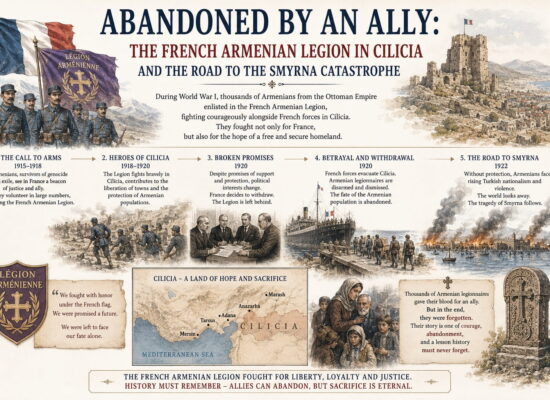
It was precisely at this moment that the Allies entered the Caucasus. Acting on behalf of General Thomson, the Allied Military Mission arrived in Karabakh, demanded a cessation of hostilities, and assumed responsibility for restoring order.
📜 The Armenian National Council of Karabakh on the Escalating Crisis and British Policy
May 1919
The Armenians submitted without resistance. The military forces of the Armenians and General Andranik withdrew to their bases. The Allied Mission declared that henceforth, no troop movements or concentrations would be permitted by either side.
Yet within a month, the Azerbaijani government began concentrating its forces in Armenian-populated areas and adjacent zones—specifically in Khankendi, Zabukh, and Karyagino—despite the Mission’s categorical declaration prohibiting such actions. All appeals by the Armenian National Council to the British Mission, stating that the deployment of Azerbaijani troops in Karabakh was a direct violation of General Thomson’s orders, were ignored.
Soon after, Azerbaijani forces resumed systematic attacks on Armenians. Despite the presence of the British Mission in Shushi, acts of violence occurred daily. For example, six Armenians were killed near the village of Martakert; four more were murdered at the tenth verst from Shushi on the Shushi–Gerusi highway, where later a British soldier was also killed. The village of Khtsaberd suffered repeated attacks during the Allies’ presence, as did the village of Dolanlar, where, in addition to killings, children were abducted and ransoms demanded for their release. In Khankendi, where Azerbaijani troops were stationed, there were cases of assaults on women and raids on villages such as Tug, Jamiad, and others.
Yet the Armenian population, accustomed to law and placing its hopes in the Allies, did not retaliate. The Armenian National Council of Karabakh consistently reported dozens of such incidents to the British Mission, receiving no response—except one, in which, replying to a warning that Armenian patience might soon run out, the Mission stated that any action against Azerbaijan would be considered an act of hostility toward Great Britain.
Eventually, the British command declared that in order to establish order among the 300,000 Armenians of Karabakh, the authority of the Azerbaijani government must be recognized—pending a final decision on Karabakh at the Peace Conference.
The Fourth and Fifth Congresses of the Armenians of Karabakh categorically rejected this proposal, as submission to Azerbaijan—well known to the Armenians from the time of Turkish rule—posed a direct threat to their physical survival. Moreover, neither the historical legacy of Nagorno-Karabakh, which had preserved its independence for centuries from Turks, Tatars, and Persians; nor its ethnographic composition, being overwhelmingly Armenian; nor its geographic proximity to Armenia; nor the cultural development of its Armenian population, which far surpassed that of the Azerbaijanis, could justify even temporary subordination to Azerbaijan.
In response, the British command announced that refusal to recognize the Azerbaijani Governor-General, Dr. Sultanov—a former Turkish agent and known Armenophobe—would be considered an act of hostility toward Britain.
At the same time, repressions against Armenian leaders began. The Armenian representative to the British Mission in Shushi, Mr. Arzumanov, was expelled from the city and searched at the Aghstafa station in the presence of a British officer escorting him. All diplomatic correspondence and weapons were confiscated.
The British command refused to recognize the Armenian National Council of Karabakh, despite it being the sole organized authority in the Armenian districts. All administration, forestry protection, medical services, judicial functions, and more were organized and governed by the Council, while Azerbaijani authority was virtually nonexistent. Thus, refusal to recognize the Council could only lead to anarchy, as it was not being replaced by any legitimate governing body.
Furthermore, just as under Turkish rule, the Tatars declared an economic boycott against the Armenians—an issue repeatedly reported to the British command. The picture is clear: on one side, attacks, murders, and economic blockade provoke deep resentment among Armenians. The British refusal to recognize the only functioning governing body—the National Council—can only lead to lawlessness in Armenian Karabakh, which would inevitably empower destructive forces. On the other side, the concentration of Azerbaijani troops in Armenian areas, despite the population’s explicit rejection of Azerbaijani authority, confirms that not only is there no established order in Karabakh, but all the seeds of a future interethnic conflagration are already present.
📜 Appeal from the Armenian National Council of Karabakh
On the Demand for British Administration in Karabakh May 1919
Karabakh and Zangezur seek the establishment of direct British administration in Armenian Karabakh until their fate is decided at the Peace Conference. However, in response to repeated appeals and requests for the creation of a temporary British Governor-Generalship, the high command declared to the population that such a request would be considered an act hostile to Great Britain.
This profoundly abnormal situation cannot bring peace or stability to the region. On the contrary, it threatens Karabakh with new horrors. This sole Armenian region not devastated by the Turks now stands on the brink of bloody clashes and destruction, reminiscent of last year’s brutal Turkish occupation.
In conclusion, we consider it our duty to protest even the slightest insinuation that the Armenian population of Karabakh could ever have harbored intentions of committing any act hostile to Great Britain. On the contrary, we awaited Britain last year with quiet desperation—as our great liberator—amid the flames ignited by the Turkish-Azerbaijani invasion of our homeland.
There is not the slightest doubt that the British command is guided by noble intentions to assist our long-suffering homeland. Therefore, we once again request the establishment of British authority, as we cannot comprehend the ultimatum demanding submission to Azerbaijan—a power that threatens us with the restoration of Turkish rule and renewed massacres. We regard this regrettable development as the result of insufficient information.
We are confident that the peaceful resolution of the looming tragedy lies in the hands of the British high command, and that the establishment of a British Governor-Generalship in Nagorno-Karabakh—until the question of borders is resolved at the Peace Conference—will bring calm to the region.
Chairman of the Armenian National Council of Karabakh A. Shakhnazarov Central State Historical Archive of Armenia, f. 200, op. 1, d. 309, pp. 128–131. Certified copy. Typescript. Published in: Nagorno-Karabakh in 1918–1923, Yerevan, 1992, doc. No. 145.
🪖 Report from the Diplomatic Representative of Azerbaijan in Armenia
To the Prime Minister of the Azerbaijani Government On the Need to Use the Kurds in the Struggle Against Azerbaijan’s Enemy—Armenia No. 202, [May] 1919
<…>
Azerbaijan, apart from Armenia, appears to have no other enemy at present. Therefore, special attention must be paid to Armenia. We must bring Simko the Kurd to our side. I request authorization to do so and ask that the military attaché be consulted regarding Simko.
Diplomatic Representative Tekinski Central State Historical Archive of Armenia, f. 200, op. 1, d. 358, p. 87. Copy. Typescript. Published in: Nagorno-Karabakh in 1918–1923, Yerevan, 1992, doc. No. 149. Copy also sent to the Minister of Foreign Affairs of Azerbaijan. 317
Yuri Barsegov “Nagorno-Karabakh in International Law and Global Politics”
Artatsolum
Read Also:
- Ancient and Medieval Sources on Artsakh (Karabakh) as Part of Armenia’s State Territory
- Message from Gandzasar Catholicos Esayi to Peter I August 10, 1716
- Memorandum Issued to Ivan Karapet Along with the Imperial Letter to the Armenian People Regarding Russia’s Readiness to Take the Armenians of Karabakh Under Its Protection June 3, 1723
- Decree of Peter I to the Armenian People Regarding Russia’s Willingness to Offer Protection to the Armenians of Karabakh
- On Armenian Hopes for Russian Assistance
- Report of Minas Vardapet to Peter I
- Contents of the Secret Letters from the Armenian Assembly and the Armenian Army of Karabakh to the Russian Emperor and Chancellor August 1724
- Contents of the Secret Letters from the Armenian Assembly and the Armenian Army of Karabakh to the Russian Emperor and Chancellor August 1724
- State Charter of Peter I On the Acceptance of the Armenian People Under the Protection of the Russian State and Their Resettlement from Karabakh to Newly Acquired Persian Provinces November 10, 1724
- Letters from the Catholicos and the Meliks of Karabakh
- Charter of Catherine I Addressed to the Armenian Assembly
- Message General Mkhitar—to the Russian Government
- The Armenian Assembly’s Request for Military Assistance June 19, 1727
- Result from Russia’s failure to fulfill its promises of assistance to the Armenians March 1736
- On the Issuance of the Decree Appointing Panah Khan
- Letter from General Potemkin to Prince Argutinsky with questions about the liberation of Armenia
- Appeal of Gandzasar Catholicos Hovhannes to Catherine II
- Letter from Melik Apov Iosifov to Provide Assistance to Russian Military Forces for the Liberation of Enslaved Karabakh
- Report of Prince G. Potemkin to Catherine II
- Request of General P. Potemkin to Prince G. Potemkin
- Letter from Archbishop Joseph Argutinsky to General P. Potemkin
- Memorandum to Catherine II on the Project for the Restoration of the Armenian Kingdom
- Decree of Paul I to General Count I. Gudovich
- Letter from Archbishop Joseph Argutinsky
- Report by State Councillor P. Kovalesky
- The Khan’s Vizier, Mirza Jamal Javanshir Karabakhsky
- From the Report of General Marquis Palluci to Alexander I
- The Gulistan Treaty – An Interstate Act of Iran’s Cession of the Karabakh Territory to Russia
- Report of General A. Yermolov to Alexander I Requesting the Waiver of Tax Arrears for the Karabakh Khanate
- LETTER FROM GENERAL A. YERMOLOV TO MEHTI-KULI KHAN
- Directive from General A. Yermolov to General I. Velyaminov
- Letter of Metropolitan Sarkis Hasan-Jalalyan To General A. Yermolov
- Letter from General I. Paskevich
- TREATY CONCLUDED BETWEEN RUSSIA AND PERSIA AT TURKMENCHAY
- Russian Military Historian V. Potto on the Essence of the Treaty of Turkmenchay
- Order of General I. Paskevich to Colonel L. Lazarev
- STATEMENT ON THE DIFFERING ATTITUDES OF ARMENIANS AND TATARS TOWARD THE ANNEXATION OF KARABAKH TO RUSSIA
- REPORT By the Acting Uezd Chief of the Dzhevanshir Uezd, D. Baranovsky
- From the Memoirs of a Member of the Russian National Council in Baku (1918–1919)
- “TREATY OF PEACE AND FRIENDSHIP” Between the Ottoman Empire and the Republic of Armenia
- Letter from A. Mikaelyan, Representative of the Karabakh and Zangezur Fellowship
- Note of Protest from the Ministry of Foreign Affairs of the Republic of Armenia
- Appeal of the Karabakh Armenian National Council To the Commander of Allied Forces in Baku
- LETTER FROM THE CHAIRMAN OF THE KARABAKH ARMENIAN NATIONAL COUNCIL
- Turks in Shushi
- Letter of Welcome from the Karabakh Armenian
- LETTER FROM GENERAL BAGRATUNI
- FROM THE MESSAGE OF THE ARMENIAN TELEGRAPH AGENCY
- REPORT FROM THE DIPLOMATIC REPRESENTATIVE OF ARMENIA IN GEORGIA
- Resolution of the Fifth Congress of Armenians of Karabakh
- Report by Prime Minister Hatisov to the Council of Ministers of Armenia
- FROM THE MEMORANDUM OF THE KARABAKH ARMENIAN NATIONAL COUNCIL
- 🇬🇧 ANNOUNCEMENT OF THE BRITISH MILITARY MISSION IN SHUSHA
- From the Memorandum of the Armenian Representative to the British Military Mission in Shusha

One thought on “Report from the Office of the Governor-General of Karabakh”