On the Urgent Need to Protect the Armenian Population of Karabakh, Zangezur, Baku, and Elizavetpol from Physical Extermination and to Resolve the Karabakh Question Based on the Proclaimed Principles of Law and Justice March 30, 1920
In addition to my telegram of March 28, No. 1920, regarding the general offensive launched by Azerbaijan against Karabakh and Zangezur, I have the honor to convey further information. According to reliable reports, Azerbaijani troops and armed Muslim bands are advancing along the entire front, devastating villages and massacring the peaceful Armenian population. In Shushi, the entire population has been exterminated.
The objective of this premeditated offensive—about which the Armenian government has repeatedly informed Your Excellency—is the complete subjugation by force of Armenian Karabakh and Zangezur, in defiance of the will of the local population, the directives of the Peace Conference, and the latest telegram from Lord Curzon.
Exploiting the peaceful disposition of the Armenian government, which has refrained from opposing the decisions of the Allies, the Azerbaijani government, on the eve of the scheduled conference of the three Transcaucasian republics in Tiflis on April 1, is executing a plan dictated by the Turks: to annihilate the 300,000-strong Armenian population of Karabakh and Zangezur, and to establish a connection with Turkey via Nakhichevan—thus encircling Armenia in a hostile Turkish-Tatar ring.
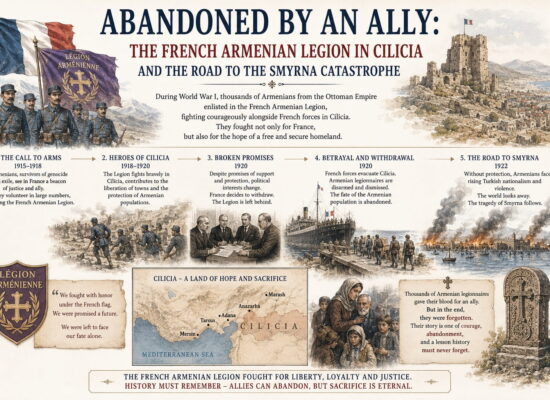
Following the horrific Cilician massacres, the same fate now threatens not only the populations of Zangezur and Karabakh, but also all Armenians residing in Baku, Elizavetpol, and other regions of the Azerbaijani Republic.
The Armenian government and the Armenian people cannot remain indifferent to the systematic slaughter of Armenians. They vehemently protest the actions undertaken by Azerbaijan and respectfully urge Your Excellency, in the name of the principles of law and justice proclaimed by the Peace Conference, to take the most vigorous and immediate measures to halt the Azerbaijani offensive and to prevent any attempt to resolve the Karabakh question by force of arms. We ask that Your Excellency inform your government of these developments and urgently notify the Armenian government of any measures taken, in order to calm public opinion in Armenia.
Prime Minister Minister of Foreign Affairs (Certified copy. Typescript. Central State Historical Archive of Armenia, Fund 200, Inventory 1, File 475, Sheet 204. Published in: Nagorno-Karabakh in 1918–1923, Yerevan, 1992, Document No. 269.) Copies sent to Gaskell (USA), Botancourt (France), Gabbe (Italy).
🕊️ Statement by the Minister of Foreign Affairs of Armenia to the Minister of Foreign Affairs of Azerbaijan
Condemning Azerbaijan’s Aggressive Actions and Calling for the Rejection of a Military Solution to the Karabakh Question March 30, 1920
In response to your telegram of March 28, No. 2028, I have the honor to inform you that your reference to the presence of regular Armenian troops in Karabakh is entirely unfounded. There are no regular Armenian military units—neither infantry nor artillery—stationed in Karabakh. Likewise, no reinforcements have been dispatched from Novo-Bayazet or other regions by the Armenian government, nor have any troop movements or increases in military strength occurred.
Contrary to your claims of attacks by the Armenian population of Karabakh on Azerbaijani forces, the Armenian government possesses accurate information indicating that the Azerbaijani government, in violation of its agreement with the Karabakh National Council dated August 22 of last year, concentrated regular and irregular military forces and issued an ultimatum demanding the disarmament of the Armenian population. Upon receiving a lawful refusal on March 20, Azerbaijan commenced forced disarmament and simultaneously launched offensives in multiple directions against Armenian Karabakh and Zangezur.
According to the latest reports, Azerbaijani troops and armed bands are advancing along the entire front, ravaging Armenian villages and massacring peaceful civilians, as occurred in Shushi. Public opinion in Armenia, outraged by the events unfolding in Karabakh, demands that the government take urgent and decisive action.
My government, expressing its categorical protest against Azerbaijan’s blatant violation of the August 22 agreement and its aggressive actions against the Armenian population of Karabakh, hopes that—on the eve of the conference intended to resolve all disputed issues—the Azerbaijani government will abandon its attempt to resolve the Karabakh question by force and will immediately cease its offensive.
(Copy. Typescript. Central State Historical Archive of Armenia, Fund 200, Inventory 1, File 486, Sheet 144. Published in: Nagorno-Karabakh in 1918–1923, Yerevan, 1992, Document No. 270.)
🕊️ Letter from the Minister of Foreign Affairs of Armenia to the Minister of Foreign Affairs of Georgia
Requesting Assistance in Halting the Azerbaijani Offensive on Karabakh Aimed at Resolving the Dispute by Force of Arms March 30, 1920
In the coming days, a conference is scheduled to take place in Tiflis by mutual agreement of the three Transcaucasian republics, with the aim of resolving all outstanding disputes, including territorial issues. Contrary to this spirit of cooperation, the Azerbaijani government has violated its agreement of August 22 of last year with the Armenian National Council of Karabakh and has resolved to seize Armenian Karabakh and Zangezur by force.
In the latter part of March, the Azerbaijani government concentrated regular troops and armed bands and issued an ultimatum to the Armenian population of Karabakh demanding disarmament. The population viewed this ultimatum as a blatant breach of the August 22 agreement and, interpreting it as a prelude to a predetermined massacre, rejected the unlawful demand. Upon receiving this refusal, Azerbaijan began forcibly disarming the Armenian population and launched a general offensive against Karabakh and Zangezur.
According to the latest reports, Azerbaijani regular forces and armed Muslim bands are advancing across the entire front, devastating villages and massacring peaceful Armenian civilians. In Shushi, the entire population has been exterminated. The goal of this premeditated offensive is the complete subjugation of Armenian Karabakh and Zangezur, in defiance of the will of the local population, the directives of the Peace Conference, and the recent telegram from Lord Curzon.
Exploiting the peaceful intentions of the Armenian government—which has consistently sought to resolve all disputes among the three republics through dialogue—the Azerbaijani government is once again igniting conflict in the Caucasus, with potentially disastrous consequences for the region.
On behalf of my government, and in the interest of preventing a catastrophe that threatens all of Transcaucasia, I respectfully request that you take all possible measures to urge the Azerbaijani government to immediately cease its offensive against Karabakh and Zangezur and to abandon its attempt to resolve the Karabakh issue through military force.
(Central State Historical Archive of Armenia, Fund 200, Inventory 1, File 249, Sheet 253. Typescript. Published in: Nagorno-Karabakh in 1918–1923, Yerevan, 1992, Document No. 271.)
⚠️ Letter from the Chairman of the Karabakh Homeland Union to the Presidium of the Armenian Parliament
On the Planned New Campaign by Musavatists Against Karabakh and Zangezur [Late March] 1920
According to verified and reliable sources, the Azerbaijani government has instructed Governor Sultanov and Turkish General Khalil Pasha to launch a new campaign against Zangezur and to disarm Karabakh. To this end, they have organized bandit groups composed of Kurds and Turks and are preparing a horrific massacre of Armenians, beginning in Khankendi and Aghdam.
Travelers are being murdered on the roads, women are being assaulted, livestock is being stolen, and an economic boycott has been declared. The conditions of Armenian life in Karabakh have become unbearable.
Sultanov is demanding the deployment of troops into the heart of Karabakh—Varanda and Jraberd—thereby violating the agreement concluded at the Seventh Congress. These actions have provoked outrage and unrest among Armenians, especially among Karabakh natives whose families reside in the region.
Before the eyes of the Allies and High Commissioners, the destruction of Armenian Karabakh is being prepared. We urgently appeal to the government, parliament, and public to take swift and decisive action, to seek the mediation of the Entente and neighboring republics, and to prevent the aggressive and bloody atrocities being orchestrated by Turkish emissaries and Azerbaijani chauvinists.
Chairman of the Karabakh Homeland Union Balayan (Central State Historical Archive of Armenia, Fund 198, Inventory 1, File 14, Sheet 4. Original manuscript. Translated from Armenian. Document No. 392.)
✊ Report from the Zangezur Commissar to the Ministry of Foreign Affairs of Armenia
On the Successful Actions of Armenians in Karabakh and Zangezur Against the Invading Azerbaijani Forces Gerusy, March 31, 1920 – Top Secret
With the deepest joy, I hasten to inform you: on all Zangezur and Karabakh fronts, we are witnessing brilliant successes. The valiant sons of Zangezur and Karabakh are performing miracles. All enemy attacks have been repelled; moreover, our forces have gone on the offensive, defeated Azerbaijani troops, taken prisoners, and are pursuing them to the Akera River.
The territory between Karabakh and Zangezur has been cleared and secured by our forces, including Domirchlab, Kubatlu, Dondarali, Khojelas, Zangelan, and up to Bartaz. At this moment, we have occupied the renowned Marquiz and Avdallar. The highway to Shushi is under our control.
Fighting continues on all fronts. Askeran is in the hands of Karabakh peasants. Repeated Tatar assaults have been repelled at the Askeran strongholds. Malibeklu, Khankendi, and Shushi are surrounded by Karabakh villagers. This morning, the brave Zangezuris crossed near Khtsaberd and joined forces with the Karabakhis, while the Kaladarasin forces from Karabakh crossed into Zangezur.
In the coming days, I will personally raise the flag of the Free Republic of Armenia over Marquiz. The battles continue, and I will report further results in due course. The entire territory around Ordubad is now under our control.
(Central State Historical Archive of Armenia, Fund 200, Inventory 1, File 486, Sheet 136. Certified copy. Typescript. Published in: Nagorno-Karabakh in 1918–1923, Yerevan, 1992, Document No. 273.)
🕊️ Statement by the Prime Minister of the Government of Armenia
To the High Commissioners of France, Great Britain, and Italy On Armenia’s Commitment to Ending the Bloodshed Caused by the Invasion of Karabakh and Zangezur by Azerbaijani Forces, Orchestrated by Turkish Agents No. 2100 — Erivan, April 2, 1920
In response to Your Excellency’s telegram dated April 1, I have the honor to inform you that the Government of Armenia is animated by one fervent desire: to preserve complete peace and maintain the most amicable relations with the neighboring Transcaucasian republics. The government’s delegates, who are departing for the joint conference of the republics in Tiflis on April 5, are imbued with the same spirit.
Faced with the grave threat posed by Turkey—toward which the attention of both the Armenian people and government is now directed—Armenia can only ardently wish for and welcome the establishment of the closest and most peaceful relations with its neighbors.
The events unfolding in Karabakh have been provoked by attacks from Azerbaijan, organized by Turkish agents. My government can categorically assure Your Excellency that not a single military unit of the Republic is present in Karabakh, nor has any ever been dispatched there.
The Armenian government continues to earnestly desire the immediate cessation of bloodshed and, to that end, once again appeals to Your Excellency with a heartfelt request to take the most decisive measures—measures that alone can prevent the further escalation of violence and contribute to the restoration of peace in the region.
I respectfully ask that Your Excellency not decline to inform me of the specific steps undertaken in pursuit of this goal.
Prime Minister and Minister of Foreign Affairs Hatisov
(Central State Historical Archive of Armenia, Fund 200, Inventory 1, File 563, Sheet 27. Copy. Typescript. Published in: Nagorno-Karabakh in 1918–1923, Yerevan, 1992, Document No. 276.)
🏛️ Address by the Head of the Government of Armenia
At the Emergency Session of Parliament on Azerbaijan’s Violation of the Agreement with Karabakh, Its Military Offensive to Seize Karabakh and Zangezur, and the Forfeiture of Its Right to Invoke the Temporary Accord April 3, 1920
Over the past two weeks, several significant events have occurred, which the government considers its duty to report and clarify, along with its position on the matter.
Parliament is aware that the Seventh Congress of Karabakh concluded a temporary agreement with the Government of Azerbaijan, intended to remain in force until the Peace Conference determined the final status of Karabakh. Under this agreement, Karabakh was to be governed by a local council. Azerbaijan committed to maintaining only a small military presence in Shushi and Khankendi. It was prohibited from relocating troops without the council’s consent and had no right to demand the disarmament of the population.
It was evident to all that even this agreement had been accepted by the Congress under duress. Six successive congresses had publicly and unanimously declared one position and adopted one resolution: Karabakh recognizes only one republic—Armenia. The Seventh Congress, under pressure from Azerbaijani authorities, was compelled to concede and temporarily reconcile with the arrangement established by mutual accord.
However, Governor-General Sultanov violated the agreement by deploying new military units into Karabakh. Simultaneously, the Azerbaijani government, in blatant disregard of the accord’s principles, is feverishly preparing to disarm the Armenian population and is advancing even further in its plans—seeking to seize Zangezur as well.
Last year, I had the honor of reporting to Parliament the heroic resistance and self-defense mounted by the peasants of Zangezur against the offensive of Azerbaijani regular forces. Yet, as it now appears, following that shameful defeat, Azerbaijan has not abandoned its ambitions. On the contrary, it is undertaking even greater preparations to capture Karabakh and Zangezur. Its primary objective is to present the Peace Conference with a fait accompli and, through Armenia, establish a direct link with its ally—Turkey. Both Turkey and Azerbaijan view the current political moment as opportune for implementing their long-standing agenda.
The Government of Armenia, fully aware of these developments and remaining steadfast in its principles of resolving disputes through peaceful means and preventing bloodshed, has appealed to the Allied Powers and to the governments of Georgia and Azerbaijan, warning of the grave consequences that may arise in the Caucasus as a result of Azerbaijan’s policies.
Despite the fervent desire of the populations of Karabakh and Zangezur to unite with their homeland—our Republic—the Government of Armenia has consistently upheld the principle of legality and awaits the final decision of the Peace Conference. In the meantime, it has continued to propose the establishment of friendly relations with its neighboring republics.
(Central State Historical Archive of Armenia, Fund 200, Inventory 1, File 563, Sheet 27. Published in: Nagorno-Karabakh in 1918–1923, Yerevan, 1992, Document No. 276.)
🏛️ Address by the Head of the Government of Armenia
At the Extraordinary Session of Parliament on Azerbaijan’s Breach of the Agreement with Karabakh, Its Military Offensive to Seize Karabakh and Zangezur, and the Loss of Its Right to Invoke the Temporary Accord April 3, 1920
Such was the government’s position and course of action. Yet Azerbaijan rejected our call for peace and unmistakably revealed its chosen path—achieving its aims through violence and force of arms. It mobilized local Kurdish masses, armed them in the style of the Turkish “Hamidiye,” and launched attacks aimed at annexing Nakhichevan—let us recall the battles in Gokhtan and the massacre in Agulis. Not content with this, it sought to turn Karabakh’s Kurds and Persians against the Armenians, though, to our knowledge, these efforts were rebuffed.
The local Armenians, cut off from their motherland, have heroically resisted each Azerbaijani assault. Yet Azerbaijan persists in its bloody policy, intensifying its preparations and renewing frequent attacks.
Throughout February, and especially toward its end, the Azerbaijani government’s treatment of Armenians became intolerable. The Yevlakh–Shushi road was blocked, an economic boycott was declared, and numerous killings occurred. The Armenian government again attempted to end these atrocities through peaceful means, only to be told that the reports were exaggerated and that only a few isolated incidents had taken place. Meanwhile, we received credible new information that the situation was worsening daily.
By early March, it became clear that Azerbaijani forces were disarming Armenians in Karabakh and that events were unfolding which signaled the beginning of a general offensive: a highway was being constructed along the Tartar River toward Basargechar, and efforts were underway to incite rebellion among the previously peaceful Muslim population of the region. Then, on March 22 at 3 a.m., following extensive preparations, regular Azerbaijani units, joined by Tatar mobs, launched an assault on Karabakh.
As is customary, the Azerbaijani government sought to conceal the facts, claiming that the Karabakh Armenians had risen against its authority. But irrefutable evidence has proven that no such uprising occurred—the attack was premeditated and orchestrated by Azerbaijan, while the local population engaged only in self-defense to preserve its existence.
Over the course of two days, Armenian forces repelled two offensives in the Goris direction. Although the Tatars achieved some success in the southern sector, on March 25, local peasants came to the aid of the defenders and repelled the enemy there as well.
Thus, Azerbaijan has effectively declared war on Karabakh and Zangezur. The local Armenian population, recognizing this and fully aware that its very survival is at stake, organized a strong resistance. On March 26, in a counteroffensive, they broke through the Tatar front and established a connection between Shushi and Goris. (Thunderous and prolonged applause. Cries of “Long live Karabakh! Long live Zangezur!”)
Communication along this route is now secured for the Armenian population.
Askeran is also in Armenian hands. (Resounding applause and ovation.) From Askeran, Armenian peasants advanced toward Malaklu, where the Azerbaijani headquarters is located. (Sustained loud applause.)
All of this once again proves that Zangezur and Karabakh share one heart and one soul, and that their decision is irreversible: to liberate themselves from foreign domination and eliminate the artificial barriers that divide them.
The Armenian people, enduring harsh conditions, were compelled to negotiate with Azerbaijan and make concessions. Yet the events have shown that no violence can suppress their will. (Applause.)
The Government of Armenia could not remain indifferent to these developments, and today I will announce the steps taken through diplomatic channels.
Some may find it strange that, after all that has transpired, we still speak of diplomacy. But the government has once again chosen this path, so as not to deviate from the peaceful process. Karabakh has no artillery, no army, and we are not sending military aid—not because we are unable, but because we have chosen the noble path. We await the final word of the Peace Congress with great anticipation. And if no resolution is forthcoming, the government will find the means to assist our compatriots. (Applause.)
We immediately sent a telegram to the representatives of the Allied Powers, urging them to take decisive measures to end the bloodshed. I must report that we received several telegrams in response, calling on us in the name of peace to cease hostilities. This is particularly astonishing, for how can we end a war we did not start, to which we are not party, and from which our people are the primary victims?
Naturally, we replied in that spirit, pointing out where the true responsibility lies for ending the bloodshed.
Azerbaijan has violated the agreement; therefore, its authority in Karabakh must cease. The Allies are aware that Azerbaijan’s ambitions extend beyond Karabakh. Its leaders are actively attempting to incite rebellion among Armenia’s Muslim population, and we possess numerous facts confirming this. We also have documentation showing that Azerbaijan is acting in concert with Turkey.
We have often said that when unrest begins somewhere in Armenia, one can predict where and when similar events will follow. But Azerbaijan has failed to achieve its goal—our brave army and commanders pursue the enemy relentlessly. (Applause.)
The Allies are aware of all this, and their representatives have decided to take certain measures: first, the telegram you know of; then, a decision to halt the advance of Azerbaijani troops on Karabakh; and finally, the dispatch of an inter-Allied commission to Karabakh to investigate the situation on the ground.
But if this commission is sent solely out of humanitarian concern, it will be in vain. It must declare that Karabakh, in accordance with its will, has determined its own fate and, at the cost of blood, has united with Armenia.
Upon learning that one of the local representatives would participate in the commission, I visited him along with several members of Parliament well-versed in Karabakh affairs. They unequivocally stated that the people of Zangezur and Karabakh do not trust any Englishman or Frenchman who seeks to suppress their free will.
Based on these considerations, the Council of Ministers adopted several resolutions to guide our representatives in the Tiflis commission.
We instructed our delegates to declare that we are open to reconciliation, but only on the condition that Karabakh and Zangezur form an integral part of Armenia.
Our representatives on the commission are: Minister of Foreign Affairs A. Ohandjanian, S. Khachatryan, S. Mamikonian, and T. Bekzadian.
In closing today’s address, I affirm that the government’s motto has always been—and remains—that we shall not take another’s land, but we shall not allow others to take ours. (Thunderous and sustained applause.)
Chairman: With great joy, I wish to read to you a telegram from the Armenian National Council of Zangezur, addressed to the President of Parliament.
The telegram is read aloud by the senior secretary.
Parliament members, ministers, and all attendees rise to their feet, erupting in applause and shouting: “Glory to Karabakh and Zangezur!”
The thunderous applause does not subside, and the jubilant expressions of joy continue for a long time.
The session is declared closed.
Arach, April 7, 1920. Translated from Armenian. Published in: Nagorno-Karabakh in 1918–1923, Yerevan, 1992, Document No. 277. 395
Yuri Barsegov “Nagorno-Karabakh in International Law and Global Politics”
Artatsolum
Read Also:
- Ancient and Medieval Sources on Artsakh (Karabakh) as Part of Armenia’s State Territory
- Message from Gandzasar Catholicos Esayi to Peter I August 10, 1716
- Memorandum Issued to Ivan Karapet Along with the Imperial Letter to the Armenian People Regarding Russia’s Readiness to Take the Armenians of Karabakh Under Its Protection June 3, 1723
- Decree of Peter I to the Armenian People Regarding Russia’s Willingness to Offer Protection to the Armenians of Karabakh
- On Armenian Hopes for Russian Assistance
- Report of Minas Vardapet to Peter I
- Contents of the Secret Letters from the Armenian Assembly and the Armenian Army of Karabakh to the Russian Emperor and Chancellor August 1724
- Contents of the Secret Letters from the Armenian Assembly and the Armenian Army of Karabakh to the Russian Emperor and Chancellor August 1724
- State Charter of Peter I On the Acceptance of the Armenian People Under the Protection of the Russian State and Their Resettlement from Karabakh to Newly Acquired Persian Provinces November 10, 1724
- Letters from the Catholicos and the Meliks of Karabakh
- Charter of Catherine I Addressed to the Armenian Assembly
- Message General Mkhitar—to the Russian Government
- The Armenian Assembly’s Request for Military Assistance June 19, 1727
- Result from Russia’s failure to fulfill its promises of assistance to the Armenians March 1736
- On the Issuance of the Decree Appointing Panah Khan
- Letter from General Potemkin to Prince Argutinsky with questions about the liberation of Armenia
- Appeal of Gandzasar Catholicos Hovhannes to Catherine II
- Letter from Melik Apov Iosifov to Provide Assistance to Russian Military Forces for the Liberation of Enslaved Karabakh
- Report of Prince G. Potemkin to Catherine II
- Request of General P. Potemkin to Prince G. Potemkin
- Letter from Archbishop Joseph Argutinsky to General P. Potemkin
- Memorandum to Catherine II on the Project for the Restoration of the Armenian Kingdom
- Decree of Paul I to General Count I. Gudovich
- Letter from Archbishop Joseph Argutinsky
- Report by State Councillor P. Kovalesky
- The Khan’s Vizier, Mirza Jamal Javanshir Karabakhsky
- From the Report of General Marquis Palluci to Alexander I
- The Gulistan Treaty – An Interstate Act of Iran’s Cession of the Karabakh Territory to Russia
- Report of General A. Yermolov to Alexander I Requesting the Waiver of Tax Arrears for the Karabakh Khanate
- LETTER FROM GENERAL A. YERMOLOV TO MEHTI-KULI KHAN
- Directive from General A. Yermolov to General I. Velyaminov
- Letter of Metropolitan Sarkis Hasan-Jalalyan To General A. Yermolov
- Letter from General I. Paskevich
- TREATY CONCLUDED BETWEEN RUSSIA AND PERSIA AT TURKMENCHAY
- Russian Military Historian V. Potto on the Essence of the Treaty of Turkmenchay
- Order of General I. Paskevich to Colonel L. Lazarev
- STATEMENT ON THE DIFFERING ATTITUDES OF ARMENIANS AND TATARS TOWARD THE ANNEXATION OF KARABAKH TO RUSSIA
- REPORT By the Acting Uezd Chief of the Dzhevanshir Uezd, D. Baranovsky
- From the Memoirs of a Member of the Russian National Council in Baku (1918–1919)
- “TREATY OF PEACE AND FRIENDSHIP” Between the Ottoman Empire and the Republic of Armenia
- Letter from A. Mikaelyan, Representative of the Karabakh and Zangezur Fellowship
- Note of Protest from the Ministry of Foreign Affairs of the Republic of Armenia
- Appeal of the Karabakh Armenian National Council To the Commander of Allied Forces in Baku
- LETTER FROM THE CHAIRMAN OF THE KARABAKH ARMENIAN NATIONAL COUNCIL
- Turks in Shushi
- Letter of Welcome from the Karabakh Armenian
- LETTER FROM GENERAL BAGRATUNI
- FROM THE MESSAGE OF THE ARMENIAN TELEGRAPH AGENCY
- REPORT FROM THE DIPLOMATIC REPRESENTATIVE OF ARMENIA IN GEORGIA
- Resolution of the Fifth Congress of Armenians of Karabakh
- Report by Prime Minister Hatisov to the Council of Ministers of Armenia
- FROM THE MEMORANDUM OF THE KARABAKH ARMENIAN NATIONAL COUNCIL
- 🇬🇧 ANNOUNCEMENT OF THE BRITISH MILITARY MISSION IN SHUSHA
- From the Memorandum of the Armenian Representative to the British Military Mission in Shusha
- Report from the Office of the Governor-General of Karabakh
- NOTICE FROM THE REPRESENTATIVE OF THE BRITISH MILITARY MISSION IN SHUSHI
- 🇬🇧 Doubts Expressed by British Delegate Eric Forbes Adam
- LETTER FROM THE ARMENIAN DIPLOMATIC REPRESENTATIVE
- Assessment by the Karabakh Armenian National Council
- “The Caucasian Word” on the Confirmation by a British Command Representative
- Letter from the Acting Governor-General of Karabakh
- OVERVIEW OF THE SITUATION IN THE CAUCASUS
- Proclamation of the Zangezur Armenian National Council