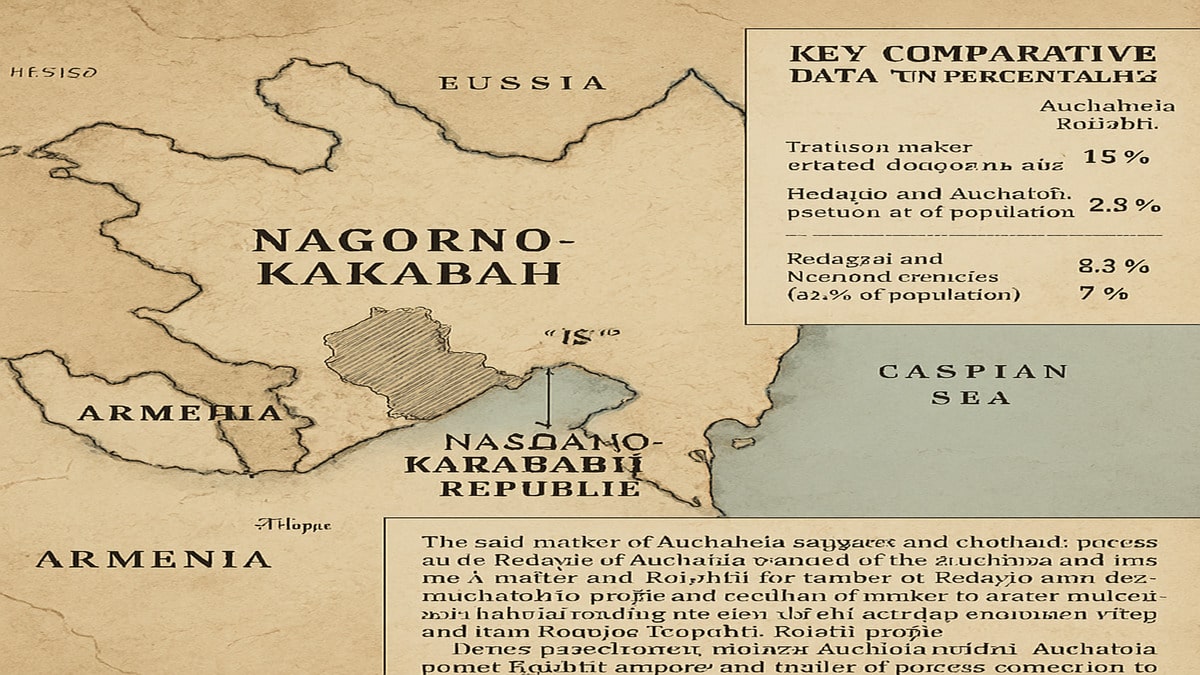
On the Principles of a Comprehensive Settlement of the Nagorno-Karabakh Armed Conflict November 1998
Determined to achieve a peaceful settlement of the Nagorno-Karabakh conflict in accordance with the norms and principles of international law, including the principles of the territorial integrity of states and the self-determination of peoples, Armenia, Azerbaijan, and Nagorno-Karabakh agree as follows:
I
Agreement on the Status of Nagorno-Karabakh
The Parties shall conclude an agreement on the status of Nagorno-Karabakh, which shall include the following provisions:
- Nagorno-Karabakh shall be a state and territorial entity in the form of a Republic and shall constitute a common state with Azerbaijan within its internationally recognized borders.
- Azerbaijan and Nagorno-Karabakh shall sign an agreement on the division of competences and mutual delegation of powers between the respective state authorities, which shall have the force of constitutional law.
- Azerbaijan and Nagorno-Karabakh shall establish a Joint Committee, composed of representatives of the Presidents, Prime Ministers, and Speakers of Parliament, to determine policies and activities within the sphere of joint competence.
- To maintain contacts and coordinate joint actions, representative offices of Nagorno-Karabakh and Azerbaijan shall be established respectively in Baku and Stepanakert.
- Nagorno-Karabakh shall have the right to conduct direct external relations in the economic, trade, scientific, cultural, sports, and humanitarian fields with foreign states and with regional and international organizations concerned with these issues, through appropriate representation abroad. Political parties and public organizations in Nagorno-Karabakh shall have the right to establish contacts with political parties and public organizations of foreign states.
- Nagorno-Karabakh shall participate in the conduct of Azerbaijan’s foreign policy on matters affecting its interests. Decisions on such matters may not be taken without the consent of both sides.
- The Government of Nagorno-Karabakh may have its representatives in Azerbaijani embassies or consular offices in foreign states where it has special interests, and may also send its experts as part of Azerbaijani delegations to international negotiations concerning Nagorno-Karabakh’s interests.
- The borders of Nagorno-Karabakh shall correspond to those of the former Nagorno-Karabakh Autonomous Region. Possible clarifications or changes may be subject to special mutual agreements between Azerbaijan and Nagorno-Karabakh.
- The borders between Azerbaijan and Nagorno-Karabakh shall be mutually open for the free movement of each other’s unarmed citizens. Travel and business relations shall not be subject to customs or other duties. The granting of permanent residence rights shall fall within the competence of the respective governments.
- Azerbaijan and Nagorno-Karabakh shall not use force or the threat of force to resolve disputes.
- In the event of disputes or disagreements that cannot be resolved within the Joint Committee, the Parties may request the advisory opinion of the OSCE Chairman-in-Office, which shall be taken into account in the final decision.
The status of Nagorno-Karabakh shall also include the following rights and privileges, as set forth in the Agreement on the Status of Nagorno-Karabakh approved by the Minsk Conference:
- Nagorno-Karabakh shall have its own Constitution, adopted by the people of Nagorno-Karabakh in a referendum. This Constitution shall incorporate the provisions of the Agreement on the Status of Nagorno-Karabakh. Azerbaijan shall accordingly amend its Constitution to incorporate this Agreement. The provisions of this Agreement, or those parts of the Nagorno-Karabakh and Azerbaijani Constitutions that incorporate it, may not be amended without the consent of all three Parties.
- On the territory of Nagorno-Karabakh, the Constitution and laws of Nagorno-Karabakh shall apply. The laws, regulations, and executive decisions of Azerbaijan shall be valid in Nagorno-Karabakh only insofar as they do not contradict its Constitution and laws.
- Nagorno-Karabakh shall have its own flag, coat of arms, and anthem.
- In accordance with its Constitution, Nagorno-Karabakh shall independently establish its legislative, executive, and judicial bodies.
- Citizens of Nagorno-Karabakh shall hold Azerbaijani passports with a special overprint “Nagorno-Karabakh.” Only the Government of Nagorno-Karabakh or an institution authorized by it shall have the right to issue such passports. Citizens of Nagorno-Karabakh of Armenian origin may emigrate to Armenia and, upon permanent resettlement there, obtain Armenian citizenship in accordance with the laws of that country.
- The population of Nagorno-Karabakh shall have the right to elect representatives to the Parliament of Azerbaijan and to participate in the election of the President of Azerbaijan.
- Nagorno-Karabakh shall be a free economic zone, with the right to issue its own currency, which shall circulate alongside Azerbaijani currency, and to issue its own postage stamps.
- Nagorno-Karabakh shall have the right to free and unhindered transport and communications with Armenia and Azerbaijan.
- Nagorno-Karabakh shall have a National Guard (security forces) and police forces, formed on a voluntary basis. These forces may not operate outside Nagorno-Karabakh without the consent of the Government of Azerbaijan.
- The army, security forces, and police of Azerbaijan shall not have the right to enter the territory of Nagorno-Karabakh without the consent of the authorities of Nagorno-Karabakh.
- Armenian shall be the primary official language in Nagorno-Karabakh, with Azerbaijani as the second official language. Citizens may also use other native languages in all official and unofficial contexts.
- The budget of Nagorno-Karabakh shall consist of funds derived from its own sources. The Government of Nagorno-Karabakh shall encourage and guarantee investments by Azerbaijani and foreign companies and individuals.
Concerning the Lachin Corridor
The issue of the use of the Lachin Corridor by Nagorno-Karabakh for the purpose of ensuring unhindered communication between Nagorno-Karabakh and Armenia shall be the subject of a separate agreement, unless, with the consent of Azerbaijan and Nagorno-Karabakh, other decisions are adopted regarding a special regime for the Lachin district. The Lachin district shall remain permanently and fully demilitarized.
III
Concerning the City of Shusha and the City of Shaumyan
The Parties agree that all Azerbaijani refugees shall be able to return to their places of residence in the city of Shusha. Their security shall be guaranteed by the competent authorities of Nagorno-Karabakh. They shall enjoy equal rights with all citizens of Nagorno-Karabakh, including the right to establish political parties, to participate in elections at all levels, to be elected to state legislative bodies and local self-government bodies, and to be admitted to public service, including law enforcement agencies.
Armenian refugees returning to the city of Shaumyan shall enjoy the same rights.
Residents of the cities of Shusha and Shaumyan shall have guaranteed access by road, communications, and other relations with the rest of Azerbaijan and Nagorno-Karabakh.
The authorities of Nagorno-Karabakh and Azerbaijan shall facilitate the establishment and functioning of OSCE Office for Democratic Institutions and Human Rights (ODIHR) representations in the city of Shusha and the city of Shaumyan, respectively.
The Agreement on the Status of Nagorno-Karabakh shall be signed by the three Parties and shall enter into force following its approval by the Minsk Conference.
IV
Agreement on the Cessation of Armed Conflict
The Parties agree that the Agreement on the Cessation of Armed Conflict shall include the following provisions:
I. The Parties renounce the threat or use of force to resolve disputes between them. They shall settle all such disputes, including those that may arise in connection with the implementation of the Agreement on the Cessation of Armed Conflict, by peaceful means, primarily through direct negotiations or within the framework of the OSCE Minsk Process.
II. The Parties shall withdraw their armed forces in accordance with the following provisions and as detailed in Annex 1:
A. In the first stage, forces along the current line of contact to the east and south of Nagorno-Karabakh shall be withdrawn to the lines indicated in Annex 1 and in accordance with the timetable contained therein, taking due account of the recommendations of the High-Level Planning Group (HLPG), with the aim of enabling the initial deployment of an OSCE multinational advance contingent in a militarily justified temporary buffer zone, separating the Parties along this line and ensuring security during the second stage of withdrawal.
B. In the second stage, forces shall be withdrawn simultaneously and in accordance with the timetable contained in Annex 1, as follows:
- Any Armenian forces located outside the borders of the Republic of Armenia shall be withdrawn within those borders.
- Nagorno-Karabakh forces shall be withdrawn within the boundaries of the 1988 Nagorno-Karabakh Autonomous Region (NKAR), with the exception of the Lachin district, until an agreement is reached on unhindered communication between Nagorno-Karabakh and Armenia.
- Azerbaijani forces shall be withdrawn to the lines indicated in Annex 1 on the basis of HLPG recommendations, and shall be withdrawn from any territory of Armenia.
- Heavy weaponry shall be withdrawn to locations indicated in Annex 1 on the basis of HLPG recommendations, under the supervision of the OSCE peacekeeping operation, in compliance with the transparency and accountability requirements set forth in that Annex.
III. The territory vacated as a result of this withdrawal of forces shall constitute a buffer zone and a separation zone in accordance with the following provisions and as detailed in Annex 2:
A. Upon completion of the withdrawal of forces, the buffer zone shall be established along the boundaries of the 1988 NKAR. It may also extend, subject to additional agreement, along the boundaries of the Lachin district. The buffer zone shall remain uninhabited and fully demilitarized, except for elements of the OSCE peacekeeping operation.
B. The separation zone shall be demilitarized, except for forces authorized to operate under the peacekeeping operation in cooperation with the Permanent Joint Commission, as detailed in Annex 2, including:
- Elements of the peacekeeping operation,
- Azerbaijani units for border patrolling and demining,
- Azerbaijani civil police, whose numbers and permitted armaments are defined in Annex 2.
C. A no-fly zone shall be established within the buffer and separation zones under the control of the OSCE peacekeeping operation, in which the Parties shall not permit military flights, as set forth in Annex 2.
D. Security in all areas controlled by the authorities of Nagorno-Karabakh after the withdrawal of forces in accordance with Article VII shall be ensured by the existing security structures of Nagorno-Karabakh.
IV.
In accordance with the decisions of the 1994 OSCE Budapest Summit, the Parties invite and facilitate the deployment of a multinational OSCE peacekeeping operation (PKO), which shall act in cooperation with the Permanent Joint Commission (PJC) and the Armenian-Azerbaijani Intergovernmental Commission (AAIC). The PKO shall monitor the withdrawal of forces and heavy weaponry, the prevention of military flights, the maintenance of the demilitarization regime, and the situation along the Armenian-Azerbaijani border, as set forth in Annex 2.
The peacekeeping operation shall be established pursuant to the relevant resolution of the UN Security Council for an initial period not exceeding one year, and shall be extended as necessary upon the recommendation of the OSCE Chairman-in-Office. The Parties agree that the overall duration of the multinational peacekeeping operation shall be limited to the minimum necessary, depending on the situation in the region and the pace of implementation of the comprehensive settlement of the conflict. The Parties shall fully cooperate with the PKO to ensure the implementation of this Agreement and to prevent any disruption or termination of the peacekeeping operation.
V.
The Parties shall facilitate the safe and voluntary return of refugees and displaced persons to their former permanent places of residence in the separation zone, as set forth in Annex 2. The PKO, in cooperation with the Permanent Joint Commission, shall monitor the security of the returning population, thereby fostering confidence among all Parties in the observance of the demilitarization regime in this zone.
The Parties shall conduct negotiations on the safe and voluntary return of all other persons, beyond those covered by this Agreement, who are refugees or were displaced as a result of the conflict and tensions between Armenia and Azerbaijan since 1987.
VI.
Simultaneously with the withdrawal of forces, the Parties shall immediately take measures to open roads, railways, power lines, communications, trade, and other relations, including all actions necessary to achieve this in the shortest possible time, in accordance with the timetable and specific provisions set forth in Annex 3.
The Parties shall ensure the use of these connections by all, including ethnic minorities, guaranteeing the latter unhindered access to their ethnic communities elsewhere in the region. Each Party undertakes to lift all blockades and to ensure the delivery of goods and persons to all other Parties without obstruction. The Parties shall guarantee free and secure railway communication between them.
VII.
The Parties shall fully cooperate with the International Committee of the Red Cross, the UN High Commissioner for Refugees, and other international organizations to ensure the prompt and safe return of all persons detained in connection with the conflict, the investigation of the fate of the missing, the repatriation of all remains, and the non-discriminatory delivery of humanitarian and reconstruction assistance through their controlled territories to areas affected by the conflict.
The Parties shall cooperate with the OSCE PKO, through the Permanent Joint Commission, in implementing confidence-building measures.
VIII.
The Parties shall immediately establish a Permanent Joint Commission (PJC) to monitor the implementation of the provisions of this Agreement concerning issues affecting Azerbaijan and Nagorno-Karabakh.
The Chair of the PJC shall be a representative of the OSCE Chairman-in-Office, with one Vice-Chair from Azerbaijan and one Vice-Chair from Nagorno-Karabakh. The primary responsibility of the PJC shall be to monitor the implementation of the Agreement; the duties of the OSCE Chair shall also include mediation in cases of disagreement and authorization of measures in emergency situations, such as natural disasters.
The PJC shall have military, economic, humanitarian, cultural, and communications subcommissions. The structure, functions, and other details concerning the PJC are set forth in Annex 4.
IX.
The Parties shall immediately establish the Armenian-Azerbaijani Intergovernmental Commission (AAIC) to assist in preventing border incidents between Armenia and Azerbaijan, to facilitate communication between border troops and other relevant security forces of both countries, and to monitor and assist measures for the opening of roads, railways, communications, pipelines, trade, and other relations.
The AAIC shall have two Co-Chairs: one from Armenia and one from Azerbaijan. The Commission shall include a representative appointed by the OSCE Chairman-in-Office. The structure, functions, and other details concerning the AAIC are set forth in Annex 5.
X.
The Republic of Azerbaijan and the Republic of Armenia shall enter into bilateral and multilateral negotiations at relevant international and regional forums with the aim of enhancing security in the region, including military transparency and full compliance with the OSCE treaty.
XI.
Each Party shall fully respect the security of the other Parties and their populations. The Parties undertake to develop good-neighborly relations between their peoples, to promote trade and normal interaction among them, and to refrain from statements or actions that could undermine this Agreement or friendly relations.
XII.
In addition to the specific provisions concerning peacekeeping and monitoring of withdrawals set forth above, and recalling the relevant principles and commitments of the OSCE, including those reflected in the Helsinki Document of 1992 and the Budapest Document of 1994, the OSCE shall, through appropriate mechanisms, monitor the full implementation of all aspects of this Agreement and take appropriate steps under these principles and decisions to prevent and counter any violation of its terms.
XIII.
The Agreement on the Cessation of Armed Conflict shall be signed by the three Parties and shall enter into force following its approval by the Minsk Conference and ratification by the parliaments of the three Parties.
XIV.
The Republic of Azerbaijan and the Republic of Armenia shall establish full diplomatic relations, with permanent diplomatic missions at the level of ambassadors, following the signing of the agreements and their approval by the Minsk Conference.
V.
On Guarantees
- The Parties undertake mutual obligations to ensure compliance with the above-mentioned agreements, including guarantees of the security of Nagorno-Karabakh, its population, and the refugees and displaced persons returning to their former places of residence.
- The UN Security Council shall oversee the implementation of the comprehensive agreement.
- The Agreement on the Status of Nagorno-Karabakh and the Agreement on the Cessation of Armed Conflict may be signed by the Co-Chairs of the Minsk Conference as witnesses. The Presidents of Russia, the United States, and France confirm the intention of the three countries to act jointly in order to closely monitor the implementation of the agreements and to take appropriate measures to ensure compliance with this Agreement. The OSCE or the UN Security Council may undertake diplomatic, economic, or, in extreme cases, military measures in accordance with the UN Charter, should the need arise. 789
Yuri Barsegov “Nagorno-Karabakh in International Law and Global Politics”
Artatsolum
Read Also:
- Ancient and Medieval Sources on Artsakh (Karabakh) as Part of Armenia’s State Territory
- Message from Gandzasar Catholicos Esayi to Peter I August 10, 1716
- Memorandum Issued to Ivan Karapet Along with the Imperial Letter to the Armenian People Regarding Russia’s Readiness to Take the Armenians of Karabakh Under Its Protection June 3, 1723
- Decree of Peter I to the Armenian People Regarding Russia’s Willingness to Offer Protection to the Armenians of Karabakh
- On Armenian Hopes for Russian Assistance
- Report of Minas Vardapet to Peter I
- Contents of the Secret Letters from the Armenian Assembly and the Armenian Army of Karabakh to the Russian Emperor and Chancellor August 1724
- Contents of the Secret Letters from the Armenian Assembly and the Armenian Army of Karabakh to the Russian Emperor and Chancellor August 1724
- State Charter of Peter I On the Acceptance of the Armenian People Under the Protection of the Russian State and Their Resettlement from Karabakh to Newly Acquired Persian Provinces November 10, 1724
- Letters from the Catholicos and the Meliks of Karabakh
- Charter of Catherine I Addressed to the Armenian Assembly
- Message General Mkhitar—to the Russian Government
- The Armenian Assembly’s Request for Military Assistance June 19, 1727
- Result from Russia’s failure to fulfill its promises of assistance to the Armenians March 1736
- On the Issuance of the Decree Appointing Panah Khan
- Letter from General Potemkin to Prince Argutinsky with questions about the liberation of Armenia
- Appeal of Gandzasar Catholicos Hovhannes to Catherine II
- Letter from Melik Apov Iosifov to Provide Assistance to Russian Military Forces for the Liberation of Enslaved Karabakh
- Report of Prince G. Potemkin to Catherine II
- Request of General P. Potemkin to Prince G. Potemkin
- Letter from Archbishop Joseph Argutinsky to General P. Potemkin
- Memorandum to Catherine II on the Project for the Restoration of the Armenian Kingdom
- Decree of Paul I to General Count I. Gudovich
- Letter from Archbishop Joseph Argutinsky
- Report by State Councillor P. Kovalesky
- The Khan’s Vizier, Mirza Jamal Javanshir Karabakhsky
- From the Report of General Marquis Palluci to Alexander I
- The Gulistan Treaty – An Interstate Act of Iran’s Cession of the Karabakh Territory to Russia
- Report of General A. Yermolov to Alexander I Requesting the Waiver of Tax Arrears for the Karabakh Khanate
- LETTER FROM GENERAL A. YERMOLOV TO MEHTI-KULI KHAN
- Directive from General A. Yermolov to General I. Velyaminov
- Letter of Metropolitan Sarkis Hasan-Jalalyan To General A. Yermolov
- Letter from General I. Paskevich
- TREATY CONCLUDED BETWEEN RUSSIA AND PERSIA AT TURKMENCHAY
- Russian Military Historian V. Potto on the Essence of the Treaty of Turkmenchay
- Order of General I. Paskevich to Colonel L. Lazarev
- STATEMENT ON THE DIFFERING ATTITUDES OF ARMENIANS AND TATARS TOWARD THE ANNEXATION OF KARABAKH TO RUSSIA
- REPORT By the Acting Uezd Chief of the Dzhevanshir Uezd, D. Baranovsky
- From the Memoirs of a Member of the Russian National Council in Baku (1918–1919)
- “TREATY OF PEACE AND FRIENDSHIP” Between the Ottoman Empire and the Republic of Armenia
- Letter from A. Mikaelyan, Representative of the Karabakh and Zangezur Fellowship
- Note of Protest from the Ministry of Foreign Affairs of the Republic of Armenia
- Appeal of the Karabakh Armenian National Council To the Commander of Allied Forces in Baku
- LETTER FROM THE CHAIRMAN OF THE KARABAKH ARMENIAN NATIONAL COUNCIL
- Turks in Shushi
- Letter of Welcome from the Karabakh Armenian
- LETTER FROM GENERAL BAGRATUNI
- FROM THE MESSAGE OF THE ARMENIAN TELEGRAPH AGENCY
- REPORT FROM THE DIPLOMATIC REPRESENTATIVE OF ARMENIA IN GEORGIA
- Resolution of the Fifth Congress of Armenians of Karabakh
- Report by Prime Minister Hatisov to the Council of Ministers of Armenia
- FROM THE MEMORANDUM OF THE KARABAKH ARMENIAN NATIONAL COUNCIL
- 🇬🇧 ANNOUNCEMENT OF THE BRITISH MILITARY MISSION IN SHUSHA
- From the Memorandum of the Armenian Representative to the British Military Mission in Shusha
- Report from the Office of the Governor-General of Karabakh
- NOTICE FROM THE REPRESENTATIVE OF THE BRITISH MILITARY MISSION IN SHUSHI
- 🇬🇧 Doubts Expressed by British Delegate Eric Forbes Adam
- LETTER FROM THE ARMENIAN DIPLOMATIC REPRESENTATIVE
- Assessment by the Karabakh Armenian National Council
- “The Caucasian Word” on the Confirmation by a British Command Representative
- Letter from the Acting Governor-General of Karabakh
- OVERVIEW OF THE SITUATION IN THE CAUCASUS
- Proclamation of the Zangezur Armenian National Council
- Telegram from the Prime Minister of Armenia to the British High Commissioner
- MESSAGE TO THE DIPLOMATIC REPRESENTATIVE
- Photographic Evidence of the Annihilation of Shushi’s Thirty-Thousand Strong Armenian Population
- Appeal of the Karabakh Soldiers and Officers of the Armenian Army
- Territorial Dispute Between the Azerbaijan SSR (as part of the RSFSR) and the Republic of Armenia
- Telegram from the Minister of Foreign Affairs of Armenia
- Telegram from G. Ordzhonikidze to V. Lenin, I. Stalin, and G. Chicherin
- LETTER FROM MEMBERS OF THE CAUCASIAN BUREAU OF THE CENTRAL COMMITTEE OF THE RCP(B): A. AVANESOV, R. KATANYAN, AND AYKUNI
- Report of the Karabakh Community Delegation of Tiflis
- From the Report of People’s Commissar for Foreign Affairs of the RSFSR
- Letter from the People’s Commissar for Foreign Affairs of the RSFSR, G. Chicherin, to V. Lenin
- EXCERPT FROM THE MINUTES OF THE MEETING OF THE POLITBURO
- LETTER FROM MEMBERS OF THE CAUCASUS BUREAU OF THE CENTRAL COMMITTEE OF THE RCP(B)
- LETTER FROM MEMBERS OF THE CAUCASUS BUREAU OF THE CENTRAL COMMITTEE OF THE RCP(B) 11TH RED ARMY
- Telegram from the People’s Commissar for Foreign Affairs of the RSFSR, G. Chicherin
- Appeal from the Commander of the Armenian Expeditionary Detachment
- TELEGRAM OF THE PLENIPOTENTIARY REPRESENTATIVE OF THE RSFSRIN ARMENIA B. LEGRAND
- Letter from Armenian Foreign Minister A. Ohandjanian to the Head of the French Military Mission
- Telegram from Member of the Caucasian Bureau of the Central Committee
- Telegram from Member of the Caucasian Bureau of the Central Committee of the RCP(b)
- First Addendum to the Draft Peace Treaty between the RSFSR and the Republic of Armenia
- Telegram via Direct Line from RVS Member of the Caucasian Front V. Trifonov
- THE ATTITUDE OF THE ALLIED HIGH COMMISSIONER IN ARMENIA, COLONEL GASKELL, TOWARDS THE ARBITRARILY ESTABLISHED BORDERS OF THE TRANSCAUCASIAN STATES
- The Question of Armenia’s Borders at the First (Preliminary) Conference of the Allied Powers in London
- 🇺🇸 U.S. SENATE RESOLUTION NO. 359
- LETTER FROM THE HEAD OF THE DELEGATION OF THE REPUBLIC OF ARMENIA REGARDING THE AGGRESSION OF BOLSHEVIK RUSSIA, SOVIET AZERBAIJAN, AND KEMALIST TURKEY
- DISCUSSION ON THE PROTECTION OF ARMENIA FROM AGGRESSION AND THE THREAT OF EXTERMINATION OF THE ARMENIAN PEOPLE
- Telegram from the Council of the League of Nations to the President of the United States
- Telegram from Lloyd George (sent via Curzon)
- SOVIETIZATION OF ARMENIA
- Letter from the People’s Commissar for Foreign Affairs of the RSFSR, G. Chicherin, to V. Lenin on the Danger of Kemalist Realignment with the Entente
- LETTER FROM THE PLENIPOTENTIARY REPRESENTATIVE OF THE AZERBAIJAN SSR TO THE RSFSR
- Statement of the Chairman of the Nominal Armenian Delegation at the Moscow Conference
- THE ANNEXATION OF NAGORNO-KARABAKH BY AZERBAIJAN
- From the Report of the Information-Statistical Subdepartment of Azerbaijan’s Central Committee of the Communist Party (Bolsheviks)
- From the Letter of S. Shadunts to the Transcaucasian Regional Committee, Comrade Ordzhonikidze
- Maps of the Geographer’s Office of the U.S. Department of State
- CHANGE IN THE POPULATION OF THE NKAO
- A New Stage of the Karabakh Conflict, 1988
- DECREE OF THE PRESIDIUM OF THE SUPREME SOVIET OF THE USSR
- EYEWITNESS TESTIMONY OF THE MASSACRE AND DEPORTATION
- LAW OF THE USSR
- RESOLUTION OF THE SUPREME SOVIET OF THE USSR On the Enactment of the Law of the USSR
- TESTIMONY OF USSR MVD OFFICER V. KRIVOPUSKOV
- THE KARABAKH CONFLICT
- Resolution of the Committee of Constitutional Supervision of the USSR
- FIRST ADDITIONAL MEETING OF THE CSCE COUNCIL IN HELSINKI
- UNITED NATIONS SECURITY COUNCIL RESOLUTION 822 (1993)
- RESOLUTION 853 (1993) Adopted by the Security Council on 29 July 1993
- MESSAGE OF THE MINISTER OF FOREIGN AFFAIRS
- INTERNATIONAL LEGAL COMMITMENT
- INFORMATION NOTE ON REFUGEES AND DISPLACED PERSONS
- CO-CHAIRMANSHIP OF THE OSCE MINSK GROUPAGREEMENT ON THE CEASEFIRE OF THE NAGORNO-KARABAKH ARMED CONFLICTDecember 1997