OF THE ARMENIAN POPULATION FROM BAKU, JANUARY 1990
January 1990
Much has seemingly been written about the events in Baku. Yet they could not be silenced, unlike the bloody drama in Sumgait, or the mass Armenian pogroms of 1988 in Kirovabad, Nakhichevan, Shamkhor, Khanlar, Kazakh, Sheki, and Mingechaur. In terms of the number of victims, the duration, and the scale of the violence—especially in their consequences for Soviet reality—these events were unparalleled.
They proved fatal for the fate of nearly a million Azerbaijanis and Armenians, as well as thousands of Russians, who suddenly became refugees and deportees in their own country, for many years to come. And yet, official information about the weeks-long pogroms, violence, countless murders, the rampant rise of Muslim nationalism, and the assault on the constitutional order was presented in a muted, filtered manner. The essence of what was in fact a state coup was carefully concealed behind lamentations about “persistent interethnic strife.”
The truth about Baku’s events, once known, plunges one into moral and spiritual shock. Even eyewitness accounts of those January days pointed not only to their deliberate place in the chain of nationalist, anti-Armenian confrontations, but also to the opposition’s preparation for an armed anti-Soviet constitutional coup in Azerbaijan—its true ideologues and organizers—and the belated measures taken by the Soviet leadership to prevent it.
Throughout 1989, the so-called democratic opposition hardened itself by deliberately creating instability in Baku and across the republic. It moved from sporadic acts of terror against the Armenian population to organizational consolidation and centralized control of its nationalist movement. In July, the Azerbaijani Popular Front was formed, with branches soon opening in many cities and districts of the republic.
With the support of Turkish pan-Turkist organizations—the Musavat Nationalist Party, the People’s Democratic Party of Turan, the Azerbaijani Cultural Society, the Kars Cultural Society, the terrorist far-right extremist and neo-fascist group “Grey Wolves,” the National Movement Party, and others—a network of nationalist agents and pan-Turkist organizations spread across Azerbaijan. Their activities in fueling extremism echoed the slogans of Azerbaijani nationalists from 1918–1920: “Death to Armenians,” “Azerbaijan for Azerbaijanis,” “Union with brotherly Turkey,” “For Greater Turan.”
The major cities—Baku, Sumgait, Mingechaur—were divided into districts for organizing provocations, riots, pogroms, and resistance against law enforcement and the army. The scenarios of Sumgait and subsequent events were used to train new ranks of pogromists.
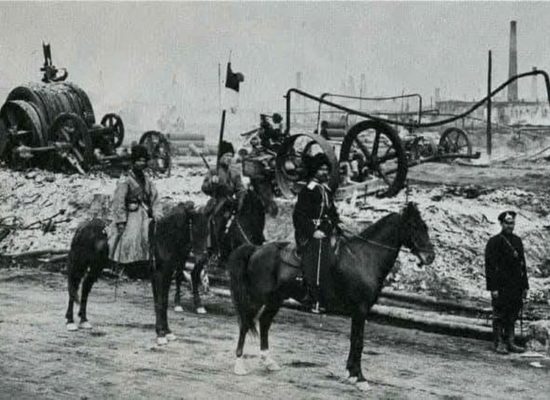
The unrest in Baku was carefully prepared by the Popular Front. On New Year’s Eve 1990, crowds destroyed the state border with Iran (stretching nearly 800 kilometers). On January 11, mass pogroms of Armenians began in Baku. Around 40 groups, each numbering between 50 and 300 people, took part. Complete anarchy reigned. The police were powerless. Fifty-nine people were killed (42 of them Armenians), and about 300 were wounded.
By early January, power in Baku belonged entirely to the Popular Front. For more than a month, Armenian apartments were attacked, accompanied by murders, violence, and looting. Cases of violence against Russian residents, military families, and their forced eviction from apartments increased.
One of thousands of anti-Russian outrages committed by Azerbaijanis intoxicated by the nationalist Islamist propaganda of the Popular Front at the end of 1989 was described by Elena Gennadyevna Semeryakova—then the wife of a Soviet officer, now a member of the Public Chamber of the Russian Federation and chair of the national organization Women’s Dialogue:
“We, Russians, Soviet citizens, found ourselves at the end of 1989 surrounded by Muslim populations in Soviet Azerbaijan, in what felt like a true occupation. No food, no water, no electricity. For me, a pregnant woman with two children, it was a terrifying reality: complete defenselessness and helplessness, when at any moment armed Azerbaijanis could come, kill, rob, do whatever they wanted.”
She recalled hiding two Armenian children—a boy and a girl, the same age as her own sons—whose father had been killed by Azerbaijanis, while their mother’s fate was unknown.
On January 13, a rally of 150,000 people was held. Afterward, crowds of pogromists, led by Popular Front activists, chanting anti-Armenian slogans, went through addresses taken from duplicated lists and began expelling Armenians from their homes. Bandits broke into apartments and houses, threw Armenians from balconies, burned them alive on pyres, subjected them to barbaric torture, dismembered some, raped girls, women, and elderly women. For seven days, the orgy of rapists, looters, and murderers continued unchecked. Those who escaped death were forcibly deported.
Thousands of Armenians were shipped by ferry across the Caspian Sea to Krasnovodsk in the Turkmen SSR, and from there flown to Armenia. According to Interior Ministry reports—likely understated—by January 19, 60 Armenians had been killed in Baku, about 200 wounded, and 13,000 expelled from the city.
The deportations were organized and supervised by Popular Front activists. The pattern was the same: first, a crowd of 10–20 people burst into an apartment and beat the Armenians. Then a representative of the Popular Front appeared, usually with documents already prepared for an “exchange” or supposed “sale” of the apartment. The family was ordered to leave immediately and head to the port. They were allowed to take belongings, but money, jewelry, and savings books were confiscated. At the port, Popular Front pickets searched the refugees, sometimes beating them again.
Azerbaijani law enforcement not only stood idle but often participated in the pogroms and looting. Feeling impunity, the pogromists began attacking Russians and Russian-speakers as well, forcing them to leave the republic en masse. Yet, as in Sumgait and Kirovabad, there were Azerbaijanis who, at great personal risk, saved their Armenian friends, neighbors, and even strangers.
On the night of January 20, Soviet troops were finally sent into Baku by order of Moscow. This saved thousands of lives, though the operation was extremely difficult.
At a closed session of the Supreme Soviet of the USSR on February 29, 1990, Defense Minister Yazov, Interior Minister Bakatin, and KGB Chairman Kryuchkov presented facts about the massacre and carnage in Baku, carried out by nationalist extremists. The report on the slaughter and deportation of Armenians from Azerbaijan was merely “taken into account,” while attempts by nationalist forces to stage a coup and armed resistance to the army received no proper assessment.
Thus, under the label of “Events in Baku, January 20,” the Soviet leadership effectively concealed from its people that these Muslim demonstrations were accompanied by unprecedented killings and pogroms, mass forced deportations of Armenians and Russians, and brutal armed resistance to Soviet troops. Moscow’s guilt was evident. In no other country would authorities have allowed such pogroms to go unpunished. The Soviet leadership did not intervene until the very existence of Soviet power in Azerbaijan was at stake, and the republic was on the verge of secession. Only the entry of troops into Baku on the night of January 20 halted the bloody orgy and restored constitutional order in the republic.
V. Krivopuskov, “Rebellious Karabakh. From the Diary of a USSR Ministry of Internal Affairs Officer.” 2nd edition. Moscow, 2007, pp. 213–231.
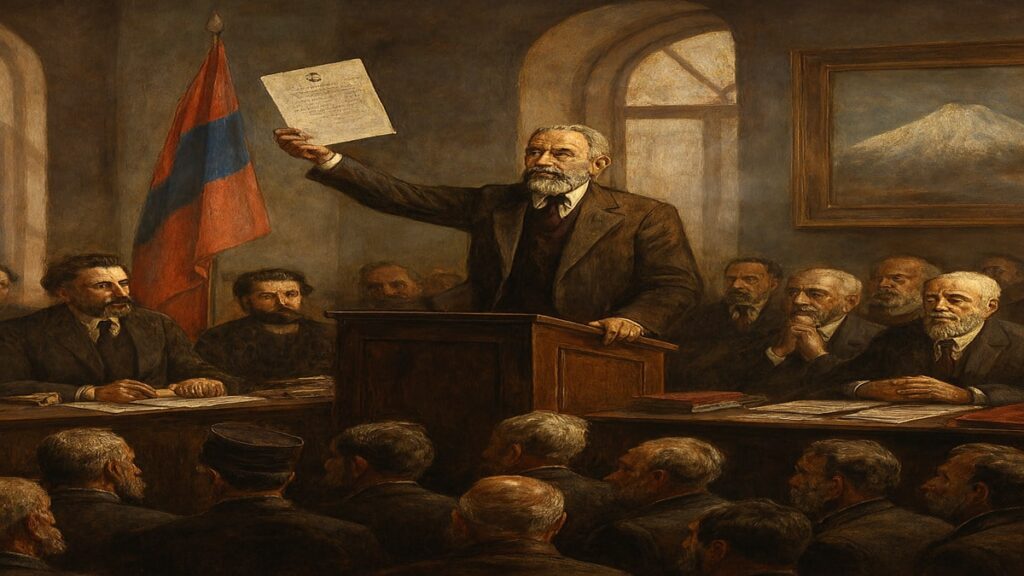
RESOLUTION OF THE SUPREME SOVIET OF THE ARMENIAN SSR
“On Declaring Illegal the Decision of the Caucasian Bureau of the Central Committee of the RCP(b) of July 5, 1921”
Yerevan, February 13, 1990
Proceeding from the fact that Nagorno-Karabakh–Artsakh is an inseparable part of Armenia and has never belonged to Azerbaijan, and that in 1918–1921 Nagorno-Karabakh existed independently and possessed its own statehood through the People’s Government of the region and the Armenian National Council;
Proceeding from the circumstance that the fate of Nagorno-Karabakh was determined by the arbitrary decision of an unconstitutional and unauthorized party body—the Caucasian Bureau of the Central Committee of the RCP(b) on July 5, 1921—which was adopted by an entity lacking the right to participate in the national-state construction of another republic, and which therefore constituted a gross act of interference in the internal affairs of another sovereign Soviet republic, thereby trampling upon the principles of the right of nations to self-determination, disregarding the will of the Armenian population of the region (comprising 95 percent), as well as that of the population of Soviet Armenia;
Basing itself on the right of nations to free self-determination, on the decision of the meeting of the Politburo of the Central Committee of the RCP(b) of July 7, 1920, held under the chairmanship of V.I. Lenin, according to which the fate of Nagorno-Karabakh was to be decided by the ethnic composition of its population and its will; on the Decree of the Armenian Soviet Socialist Republic of June 12, 1921, which, on the basis of the Declaration of the Azerbaijani Revolutionary Committee and the agreement concluded between the governments of the socialist republics of Armenia and Azerbaijan, proclaimed Nagorno-Karabakh an inseparable part of the Soviet Republic of Armenia;
Noting that the right of the Armenian population of Nagorno-Karabakh to free self-determination was also recognized by the decision of November 30, 1920, and the Declaration of December 1, 1920, of the Revolutionary Committee of the Azerbaijani SSR;
Unwaveringly defending the principles of the right of nations to self-determination, enshrined in the Treaty on the Formation of the USSR and the Constitution of the USSR as the foundation of interethnic relations in the multinational Soviet state,
The Supreme Soviet of the Armenian Soviet Socialist Republic hereby resolves:
The decision of the Caucasian Bureau of the Central Committee of the RCP(b) of July 5, 1921, concerning Nagorno-Karabakh—by which the right of the Armenians of Nagorno-Karabakh to self-determination was violated, part of the territory of the Armenian SSR was annexed, and the Armenian people were divided into two parts—is to be considered devoid of legal force, lacking authority, contrary to international law, and unlawful.
Chairman of the Presidium of the Supreme Soviet of the Armenian SSR G. Voskanian
Secretary of the Presidium of the Supreme Soviet of the Armenian SSR N. Stepanyan
Newspaper “Kommunist” (Yerevan), No. 40, February 17, 1990 (emphasis added by Yu.B.). 734
Yuri Barsegov “Nagorno-Karabakh in International Law and Global Politics”
Artatsolum
Read Also:
- Ancient and Medieval Sources on Artsakh (Karabakh) as Part of Armenia’s State Territory
- Message from Gandzasar Catholicos Esayi to Peter I August 10, 1716
- Memorandum Issued to Ivan Karapet Along with the Imperial Letter to the Armenian People Regarding Russia’s Readiness to Take the Armenians of Karabakh Under Its Protection June 3, 1723
- Decree of Peter I to the Armenian People Regarding Russia’s Willingness to Offer Protection to the Armenians of Karabakh
- On Armenian Hopes for Russian Assistance
- Report of Minas Vardapet to Peter I
- Contents of the Secret Letters from the Armenian Assembly and the Armenian Army of Karabakh to the Russian Emperor and Chancellor August 1724
- Contents of the Secret Letters from the Armenian Assembly and the Armenian Army of Karabakh to the Russian Emperor and Chancellor August 1724
- State Charter of Peter I On the Acceptance of the Armenian People Under the Protection of the Russian State and Their Resettlement from Karabakh to Newly Acquired Persian Provinces November 10, 1724
- Letters from the Catholicos and the Meliks of Karabakh
- Charter of Catherine I Addressed to the Armenian Assembly
- Message General Mkhitar—to the Russian Government
- The Armenian Assembly’s Request for Military Assistance June 19, 1727
- Result from Russia’s failure to fulfill its promises of assistance to the Armenians March 1736
- On the Issuance of the Decree Appointing Panah Khan
- Letter from General Potemkin to Prince Argutinsky with questions about the liberation of Armenia
- Appeal of Gandzasar Catholicos Hovhannes to Catherine II
- Letter from Melik Apov Iosifov to Provide Assistance to Russian Military Forces for the Liberation of Enslaved Karabakh
- Report of Prince G. Potemkin to Catherine II
- Request of General P. Potemkin to Prince G. Potemkin
- Letter from Archbishop Joseph Argutinsky to General P. Potemkin
- Memorandum to Catherine II on the Project for the Restoration of the Armenian Kingdom
- Decree of Paul I to General Count I. Gudovich
- Letter from Archbishop Joseph Argutinsky
- Report by State Councillor P. Kovalesky
- The Khan’s Vizier, Mirza Jamal Javanshir Karabakhsky
- From the Report of General Marquis Palluci to Alexander I
- The Gulistan Treaty – An Interstate Act of Iran’s Cession of the Karabakh Territory to Russia
- Report of General A. Yermolov to Alexander I Requesting the Waiver of Tax Arrears for the Karabakh Khanate
- LETTER FROM GENERAL A. YERMOLOV TO MEHTI-KULI KHAN
- Directive from General A. Yermolov to General I. Velyaminov
- Letter of Metropolitan Sarkis Hasan-Jalalyan To General A. Yermolov
- Letter from General I. Paskevich
- TREATY CONCLUDED BETWEEN RUSSIA AND PERSIA AT TURKMENCHAY
- Russian Military Historian V. Potto on the Essence of the Treaty of Turkmenchay
- Order of General I. Paskevich to Colonel L. Lazarev
- STATEMENT ON THE DIFFERING ATTITUDES OF ARMENIANS AND TATARS TOWARD THE ANNEXATION OF KARABAKH TO RUSSIA
- REPORT By the Acting Uezd Chief of the Dzhevanshir Uezd, D. Baranovsky
- From the Memoirs of a Member of the Russian National Council in Baku (1918–1919)
- “TREATY OF PEACE AND FRIENDSHIP” Between the Ottoman Empire and the Republic of Armenia
- Letter from A. Mikaelyan, Representative of the Karabakh and Zangezur Fellowship
- Note of Protest from the Ministry of Foreign Affairs of the Republic of Armenia
- Appeal of the Karabakh Armenian National Council To the Commander of Allied Forces in Baku
- LETTER FROM THE CHAIRMAN OF THE KARABAKH ARMENIAN NATIONAL COUNCIL
- Turks in Shushi
- Letter of Welcome from the Karabakh Armenian
- LETTER FROM GENERAL BAGRATUNI
- FROM THE MESSAGE OF THE ARMENIAN TELEGRAPH AGENCY
- REPORT FROM THE DIPLOMATIC REPRESENTATIVE OF ARMENIA IN GEORGIA
- Resolution of the Fifth Congress of Armenians of Karabakh
- Report by Prime Minister Hatisov to the Council of Ministers of Armenia
- FROM THE MEMORANDUM OF THE KARABAKH ARMENIAN NATIONAL COUNCIL
- 🇬🇧 ANNOUNCEMENT OF THE BRITISH MILITARY MISSION IN SHUSHA
- From the Memorandum of the Armenian Representative to the British Military Mission in Shusha
- Report from the Office of the Governor-General of Karabakh
- NOTICE FROM THE REPRESENTATIVE OF THE BRITISH MILITARY MISSION IN SHUSHI
- 🇬🇧 Doubts Expressed by British Delegate Eric Forbes Adam
- LETTER FROM THE ARMENIAN DIPLOMATIC REPRESENTATIVE
- Assessment by the Karabakh Armenian National Council
- “The Caucasian Word” on the Confirmation by a British Command Representative
- Letter from the Acting Governor-General of Karabakh
- OVERVIEW OF THE SITUATION IN THE CAUCASUS
- Proclamation of the Zangezur Armenian National Council
- Telegram from the Prime Minister of Armenia to the British High Commissioner
- MESSAGE TO THE DIPLOMATIC REPRESENTATIVE
- Photographic Evidence of the Annihilation of Shushi’s Thirty-Thousand Strong Armenian Population
- Appeal of the Karabakh Soldiers and Officers of the Armenian Army
- Territorial Dispute Between the Azerbaijan SSR (as part of the RSFSR) and the Republic of Armenia
- Telegram from the Minister of Foreign Affairs of Armenia
- Telegram from G. Ordzhonikidze to V. Lenin, I. Stalin, and G. Chicherin
- LETTER FROM MEMBERS OF THE CAUCASIAN BUREAU OF THE CENTRAL COMMITTEE OF THE RCP(B): A. AVANESOV, R. KATANYAN, AND AYKUNI
- Report of the Karabakh Community Delegation of Tiflis
- From the Report of People’s Commissar for Foreign Affairs of the RSFSR
- Letter from the People’s Commissar for Foreign Affairs of the RSFSR, G. Chicherin, to V. Lenin
- EXCERPT FROM THE MINUTES OF THE MEETING OF THE POLITBURO
- LETTER FROM MEMBERS OF THE CAUCASUS BUREAU OF THE CENTRAL COMMITTEE OF THE RCP(B)
- LETTER FROM MEMBERS OF THE CAUCASUS BUREAU OF THE CENTRAL COMMITTEE OF THE RCP(B) 11TH RED ARMY
- Telegram from the People’s Commissar for Foreign Affairs of the RSFSR, G. Chicherin
- Appeal from the Commander of the Armenian Expeditionary Detachment
- TELEGRAM OF THE PLENIPOTENTIARY REPRESENTATIVE OF THE RSFSRIN ARMENIA B. LEGRAND
- Letter from Armenian Foreign Minister A. Ohandjanian to the Head of the French Military Mission
- Telegram from Member of the Caucasian Bureau of the Central Committee
- Telegram from Member of the Caucasian Bureau of the Central Committee of the RCP(b)
- First Addendum to the Draft Peace Treaty between the RSFSR and the Republic of Armenia
- Telegram via Direct Line from RVS Member of the Caucasian Front V. Trifonov
- THE ATTITUDE OF THE ALLIED HIGH COMMISSIONER IN ARMENIA, COLONEL GASKELL, TOWARDS THE ARBITRARILY ESTABLISHED BORDERS OF THE TRANSCAUCASIAN STATES
- The Question of Armenia’s Borders at the First (Preliminary) Conference of the Allied Powers in London
- 🇺🇸 U.S. SENATE RESOLUTION NO. 359
- LETTER FROM THE HEAD OF THE DELEGATION OF THE REPUBLIC OF ARMENIA REGARDING THE AGGRESSION OF BOLSHEVIK RUSSIA, SOVIET AZERBAIJAN, AND KEMALIST TURKEY
- DISCUSSION ON THE PROTECTION OF ARMENIA FROM AGGRESSION AND THE THREAT OF EXTERMINATION OF THE ARMENIAN PEOPLE
- Telegram from the Council of the League of Nations to the President of the United States
- Telegram from Lloyd George (sent via Curzon)
- SOVIETIZATION OF ARMENIA
- Letter from the People’s Commissar for Foreign Affairs of the RSFSR, G. Chicherin, to V. Lenin on the Danger of Kemalist Realignment with the Entente
- LETTER FROM THE PLENIPOTENTIARY REPRESENTATIVE OF THE AZERBAIJAN SSR TO THE RSFSR
- Statement of the Chairman of the Nominal Armenian Delegation at the Moscow Conference
- THE ANNEXATION OF NAGORNO-KARABAKH BY AZERBAIJAN
- From the Report of the Information-Statistical Subdepartment of Azerbaijan’s Central Committee of the Communist Party (Bolsheviks)
- From the Letter of S. Shadunts to the Transcaucasian Regional Committee, Comrade Ordzhonikidze
- Maps of the Geographer’s Office of the U.S. Department of State
- CHANGE IN THE POPULATION OF THE NKAO
- A New Stage of the Karabakh Conflict, 1988
- DECREE OF THE PRESIDIUM OF THE SUPREME SOVIET OF THE USSR