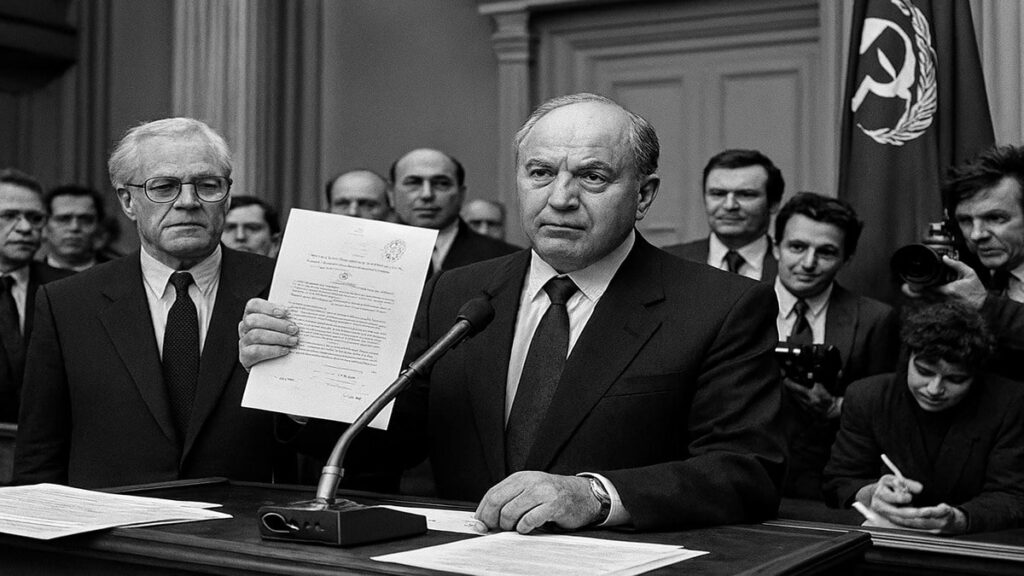
On the Procedure for Resolving Issues Related to the Secession of a Union Republic from the USSR April 3, 1990
Article 1
The procedure for resolving issues related to the secession of a Union Republic from the USSR, in accordance with Article 72 of the Constitution of the USSR, is determined by this Law.
Article 2
A decision on the secession of a Union Republic from the USSR shall be made by the free will of the peoples of the Union Republic through a referendum (popular vote). The decision to hold a referendum shall be adopted by the Supreme Soviet of the Union Republic either on its own initiative or upon the demand signed by one-tenth of the citizens of the USSR permanently residing in the territory of the Republic and entitled to vote under the legislation of the USSR.
The referendum shall be conducted in accordance with the Law of the USSR and the Law of the Union or Autonomous Republic on referenda, provided that their provisions do not contradict this Law.
The referendum shall be held by secret ballot not earlier than six months and not later than nine months after the decision to raise the question of the secession of the Union Republic from the USSR.
Participants in the referendum shall be citizens of the USSR permanently residing in the territory of the Republic at the time the question of its secession is raised, and who are entitled to vote under the legislation of the USSR.
During the referendum, any campaigning on the issue submitted to the vote shall not be permitted.
Article 3
In a Union Republic that includes Autonomous Republics, Autonomous Regions, or Autonomous Districts, the referendum shall be conducted separately in each autonomy. The peoples of the Autonomous Republics and Autonomous entities retain the right to independently decide the question of remaining within the USSR or within the seceding Union Republic, as well as to raise the question of their own state-legal status.
In a Union Republic where there are areas of compact settlement of national groups constituting the majority of the population in those localities, the results of voting in such areas shall be considered separately when determining the outcome of the referendum.
Article 4
For the organization of the referendum on secession from the USSR, the determination of its date, and the tabulation of its results, the Supreme Soviet of the Union Republic shall establish a commission with the participation of representatives of all interested parties, including those mentioned in parts one and two of Article 3 of this Law.
Article 5
To ensure the full freedom of expression of the will of the peoples of the Union Republic in preparing, conducting, and determining the results of the referendum on secession from the USSR, the Supreme Soviet of the USSR, in agreement with the Supreme Soviet of the Union Republic, shall decide on the presence in its territory of authorized representatives of the USSR, Union and Autonomous Republics, and Autonomous entities as observers. The Supreme Soviet of the USSR may, if it deems necessary, invite representatives of the United Nations to the territory of the Republic for the duration of the voting.
Article 6
A decision on the secession of a Union Republic from the USSR shall be considered adopted by referendum if at least two-thirds of the citizens of the USSR permanently residing in the territory of the Republic at the time the question of its secession is raised, and entitled to vote under the legislation of the USSR, have voted in favor.
The results of the referendum shall be reviewed by the Supreme Soviet of the Union Republic.
In a Union Republic that includes Autonomous Republics, Autonomous Regions, Autonomous Districts, or areas of compact settlement of national groups mentioned in part two of Article 3 of this Law, the results of the referendum shall be reviewed by the Supreme Soviet of the Union Republic jointly with the Supreme Soviet of the Autonomous Republic and the relevant Councils of People’s Deputies.
Article 7
The Supreme Soviet of the Union Republic shall submit the results of the referendum to the Supreme Soviet of the USSR. A Union Republic that includes Autonomous Republics, Autonomous entities, or areas of compact settlement of national groups mentioned in part two of Article 3 of this Law shall submit to the Supreme Soviet of the USSR the results of the referendum for each Autonomous Republic, each Autonomous entity, or each area of compact settlement of national groups, together with the conclusions and proposals of the relevant state authorities.
If it is established that the referendum was conducted in accordance with the law, the Supreme Soviet of the USSR shall submit the matter for consideration by the Congress of People’s Deputies of the USSR.
In the event of violations of the law during the referendum, the Supreme Soviet of the USSR shall, within three months, schedule a repeat referendum for the Republic, or for part of it, or for an Autonomous entity, or for an area of compact settlement of national groups mentioned in part two of Article 3 of this Law.
Article 8
The results of the referendum on the secession of a Union Republic from the USSR, together with the proposals received from interested parties, shall be forwarded by the Supreme Soviet of the USSR within one month to the highest state authorities of all Union and Autonomous Republics, as well as to the state authorities of Autonomous entities, for study and assessment of the consequences arising for each Union and Autonomous Republic and Autonomous entity from the possible secession of the respective Union Republic from the USSR.
Article 9
The results of the referendum in a Union Republic on the question of secession from the USSR, as well as the opinions of the highest state authorities of the Union and Autonomous Republics, and of the state authorities of Autonomous Regions and Districts on this matter, shall be considered by the Congress of People’s Deputies of the USSR.
On the proposal of the Supreme Soviet of the USSR, agreed with the Supreme Soviet of the seceding Republic, the Congress of People’s Deputies of the USSR shall establish a transitional period not exceeding five years, during which issues arising in connection with the Republic’s secession from the USSR must be resolved.
During the transitional period, the Constitution of the USSR and the laws of the USSR shall remain in force on the territory of the seceding Republic.
Article 10
If, according to the results of the referendum, no decision is adopted on the secession of the Union Republic from the USSR, a new referendum on this question may be held no earlier than ten years after the previous referendum.
Article 11
In order to safeguard the rights and interests of the USSR, the seceding Republic, other Union Republics, Autonomous entities, and national groups mentioned in part two of Article 3 of this Law, conciliatory commissions shall be established for the transitional period by the Supreme Soviet of the USSR, the Supreme Soviets of the Union Republics, and the highest state authority of the seceding Republic to address issues arising from the Republic’s secession from the USSR.
Article 12
During the transitional period, the Council of Ministers of the USSR, with the participation of the government of the seceding Republic, shall prepare proposals on matters concerning the State Border of the USSR, as well as military installations and units of the Armed Forces of the USSR located on the territory of the seceding Republic. These proposals shall be submitted to the President of the USSR and the Supreme Soviet of the USSR, and thereafter referred to the Congress of People’s Deputies of the USSR for consideration.
Article 13
The seceding Republic shall be obliged to observe universally recognized principles and norms of international law, as well as human rights and freedoms enshrined in international treaties to which the USSR is a party.
The question of the seceding Republic’s participation in multilateral treaties concluded by the USSR and open to accession shall be resolved in accordance with the rules established by the relevant treaty. Multilateral and bilateral treaties concluded by the USSR and in force at the time of the Union Republic’s secession shall continue to apply to the seceding Republic unless otherwise agreed.
After reviewing and settling all issues related to the USSR’s participation in international treaties in connection with the secession of a Union Republic, the Council of Ministers of the USSR shall present its conclusions to the President of the USSR and the Supreme Soviet of the USSR.
Article 14
During the transitional period, the Council of Ministers of the USSR, the state administrative bodies of the Union and Autonomous Republics, and Autonomous entities, together with the government of the seceding Republic, shall examine and resolve issues of property and material-financial settlements.
In relations between the seceding Republic, on the one hand, and the USSR, other Union Republics, Autonomous Republics, Autonomous entities, and national groups mentioned in part two of Article 3 of this Law, on the other hand, the following issues shall be resolved during the transitional period:
- Determination of the fate of all-Union property located on the territory of the Republic (enterprises and complexes of basic industries, space research, energy, communications, maritime, railway and air transport, communication lines, main pipelines, property of the Armed Forces of the USSR, defense and other facilities), as well as the property of all-Union public organizations.
- Settlement of financial and credit relations between the seceding Republic and the USSR, including relations between banks.
- Settlement of property and financial-credit relations between the seceding Republic and other Union Republics, as well as Autonomous Republics and Autonomous entities.
- Determination of the procedure for enterprises and organizations of the seceding Republic to fulfill contractual obligations previously undertaken with respect to enterprises and organizations located in other Union Republics, Autonomous Republics, and Autonomous entities.
- Determination of the legal status and forms of settlement of joint ventures or branches of enterprises established on the basis of all-Union property or the property of other Union Republics, Autonomous Republics, and Autonomous entities.
- Agreement on the procedure for settlements with other states and international organizations regarding credits and loans obtained for the construction of facilities on the territory of the seceding Republic or for meeting the needs of that Republic and its population, as well as for the corresponding share of credits and loans expended on all-Union procurements and programs from which the seceding Republic benefited.
- Agreement on the status of territories not belonging to the seceding Republic at the time of its accession to the USSR.
- Agreement on the status of territories with compact settlement of national groups mentioned in part two of Article 3 of this Law, taking into account the results of their will expressed in the referendum.
- Provision of guarantees for the preservation of historical and cultural monuments and burial sites located on the territory of the seceding Republic.
- Resolution of other issues requiring mutual settlement.
Article 15
Citizens of the USSR residing in the territory of the seceding Republic shall be granted the right to choose their citizenship, place of residence, and employment. The seceding Republic shall compensate all expenses related to the resettlement of citizens from its territory.
Article 16
In accordance with universally recognized principles and norms of international law and the international obligations of the USSR, the seceding Republic shall guarantee civil, political, social, economic, cultural, and other rights and freedoms to citizens of the USSR who remain residing in its territory, without any discrimination on the grounds of race, color, sex, language, religion, political or other beliefs, national or social origin, property status, place or time of birth.
Article 17
Citizens of the seceding Republic who have been convicted by its courts and are serving sentences on the territory of the USSR shall be transferred to that Republic for the continuation of their sentences.
Citizens of the seceding Republic who have been convicted by the courts of the USSR or of another Union Republic and are serving sentences on the territory of the USSR shall be transferred to that Republic for the continuation of their sentences if the crimes for which they were convicted were committed on the territory of that Republic.
Questions concerning the transfer of citizens of the seceding Republic convicted by the courts of the USSR or another Union Republic, where at least one of the crimes for which they were convicted was committed outside the territory of the seceding Republic, shall be considered by the Supreme Court of the USSR upon submission by the Procurator General of the USSR or upon petition of the Supreme Court of the seceding Republic.
Citizens of the USSR, foreign citizens, and stateless persons convicted by the courts of the USSR or of any Union Republic and serving sentences on the territory of the seceding Republic shall be transferred to the USSR.
Article 18
All administrative and criminal cases initiated on the basis of offenses committed on the territory of the seceding Republic and pending before the organs of the USSR shall be transferred, through the Procuracy of the USSR or the Supreme Court of the USSR, to the jurisdiction of the organs of the seceding Republic. This rule shall not apply to cases where at least one of the offenses was committed outside the territory of the seceding Republic, nor to criminal cases subject to the jurisdiction of military tribunals. Questions concerning the transfer of cases shall be decided by the Procurator General of the USSR upon submission by a lower-level procurator or upon petition of the procurator of the seceding Republic, and, if the case is pending before a judicial body, by the Supreme Court of the USSR.
During the transitional period, all civil cases shall be resolved in accordance with the civil and civil-procedural legislation of the USSR, unless otherwise provided by agreement between the seceding Republic and the USSR.
Article 19
In the final year of the transitional period, at the initiative of the highest state authority of the seceding Republic, a repeat referendum may be held once on the question of confirming the decision on the secession of the Union Republic from the USSR. The holding of a repeat referendum shall be mandatory if demanded by one-tenth of the citizens of the USSR permanently residing in the territory of the Republic and entitled to vote under the legislation of the USSR.
If fewer than two-thirds of the citizens of the USSR permanently residing in the territory of the Republic at the time the question of holding the repeat referendum is raised, and entitled to vote under the legislation of the USSR, vote in favor of confirming the decision on secession, the decision on the secession of the Union Republic from the USSR shall be deemed annulled, and the procedures established by this Law shall be terminated.
Article 20
Upon the expiration of the transitional period, or upon the early settlement of the issues provided for in this Law, the Supreme Soviet of the USSR shall convene the Congress of People’s Deputies of the USSR to adopt a decision confirming the completion of the process of reconciling interests and satisfying the claims of the seceding Republic, on the one hand, and of the USSR, the Union Republics, as well as the Autonomous Republics, Autonomous entities, and national groups mentioned in part two of Article 3 of this Law, on the other hand.
From the moment such a decision is adopted by the Congress of People’s Deputies of the USSR, the secession of the Union Republic from the USSR shall be considered accomplished, and the People’s Deputies of the USSR from the seceded Republic shall lose their authority.
The Congress of People’s Deputies of the USSR shall introduce the corresponding amendments to the Constitution of the USSR. 735
Yuri Barsegov “Nagorno-Karabakh in International Law and Global Politics”
Artatsolum
Read Also:
- Ancient and Medieval Sources on Artsakh (Karabakh) as Part of Armenia’s State Territory
- Message from Gandzasar Catholicos Esayi to Peter I August 10, 1716
- Memorandum Issued to Ivan Karapet Along with the Imperial Letter to the Armenian People Regarding Russia’s Readiness to Take the Armenians of Karabakh Under Its Protection June 3, 1723
- Decree of Peter I to the Armenian People Regarding Russia’s Willingness to Offer Protection to the Armenians of Karabakh
- On Armenian Hopes for Russian Assistance
- Report of Minas Vardapet to Peter I
- Contents of the Secret Letters from the Armenian Assembly and the Armenian Army of Karabakh to the Russian Emperor and Chancellor August 1724
- Contents of the Secret Letters from the Armenian Assembly and the Armenian Army of Karabakh to the Russian Emperor and Chancellor August 1724
- State Charter of Peter I On the Acceptance of the Armenian People Under the Protection of the Russian State and Their Resettlement from Karabakh to Newly Acquired Persian Provinces November 10, 1724
- Letters from the Catholicos and the Meliks of Karabakh
- Charter of Catherine I Addressed to the Armenian Assembly
- Message General Mkhitar—to the Russian Government
- The Armenian Assembly’s Request for Military Assistance June 19, 1727
- Result from Russia’s failure to fulfill its promises of assistance to the Armenians March 1736
- On the Issuance of the Decree Appointing Panah Khan
- Letter from General Potemkin to Prince Argutinsky with questions about the liberation of Armenia
- Appeal of Gandzasar Catholicos Hovhannes to Catherine II
- Letter from Melik Apov Iosifov to Provide Assistance to Russian Military Forces for the Liberation of Enslaved Karabakh
- Report of Prince G. Potemkin to Catherine II
- Request of General P. Potemkin to Prince G. Potemkin
- Letter from Archbishop Joseph Argutinsky to General P. Potemkin
- Memorandum to Catherine II on the Project for the Restoration of the Armenian Kingdom
- Decree of Paul I to General Count I. Gudovich
- Letter from Archbishop Joseph Argutinsky
- Report by State Councillor P. Kovalesky
- The Khan’s Vizier, Mirza Jamal Javanshir Karabakhsky
- From the Report of General Marquis Palluci to Alexander I
- The Gulistan Treaty – An Interstate Act of Iran’s Cession of the Karabakh Territory to Russia
- Report of General A. Yermolov to Alexander I Requesting the Waiver of Tax Arrears for the Karabakh Khanate
- LETTER FROM GENERAL A. YERMOLOV TO MEHTI-KULI KHAN
- Directive from General A. Yermolov to General I. Velyaminov
- Letter of Metropolitan Sarkis Hasan-Jalalyan To General A. Yermolov
- Letter from General I. Paskevich
- TREATY CONCLUDED BETWEEN RUSSIA AND PERSIA AT TURKMENCHAY
- Russian Military Historian V. Potto on the Essence of the Treaty of Turkmenchay
- Order of General I. Paskevich to Colonel L. Lazarev
- STATEMENT ON THE DIFFERING ATTITUDES OF ARMENIANS AND TATARS TOWARD THE ANNEXATION OF KARABAKH TO RUSSIA
- REPORT By the Acting Uezd Chief of the Dzhevanshir Uezd, D. Baranovsky
- From the Memoirs of a Member of the Russian National Council in Baku (1918–1919)
- “TREATY OF PEACE AND FRIENDSHIP” Between the Ottoman Empire and the Republic of Armenia
- Letter from A. Mikaelyan, Representative of the Karabakh and Zangezur Fellowship
- Note of Protest from the Ministry of Foreign Affairs of the Republic of Armenia
- Appeal of the Karabakh Armenian National Council To the Commander of Allied Forces in Baku
- LETTER FROM THE CHAIRMAN OF THE KARABAKH ARMENIAN NATIONAL COUNCIL
- Turks in Shushi
- Letter of Welcome from the Karabakh Armenian
- LETTER FROM GENERAL BAGRATUNI
- FROM THE MESSAGE OF THE ARMENIAN TELEGRAPH AGENCY
- REPORT FROM THE DIPLOMATIC REPRESENTATIVE OF ARMENIA IN GEORGIA
- Resolution of the Fifth Congress of Armenians of Karabakh
- Report by Prime Minister Hatisov to the Council of Ministers of Armenia
- FROM THE MEMORANDUM OF THE KARABAKH ARMENIAN NATIONAL COUNCIL
- 🇬🇧 ANNOUNCEMENT OF THE BRITISH MILITARY MISSION IN SHUSHA
- From the Memorandum of the Armenian Representative to the British Military Mission in Shusha
- Report from the Office of the Governor-General of Karabakh
- NOTICE FROM THE REPRESENTATIVE OF THE BRITISH MILITARY MISSION IN SHUSHI
- 🇬🇧 Doubts Expressed by British Delegate Eric Forbes Adam
- LETTER FROM THE ARMENIAN DIPLOMATIC REPRESENTATIVE
- Assessment by the Karabakh Armenian National Council
- “The Caucasian Word” on the Confirmation by a British Command Representative
- Letter from the Acting Governor-General of Karabakh
- OVERVIEW OF THE SITUATION IN THE CAUCASUS
- Proclamation of the Zangezur Armenian National Council
- Telegram from the Prime Minister of Armenia to the British High Commissioner
- MESSAGE TO THE DIPLOMATIC REPRESENTATIVE
- Photographic Evidence of the Annihilation of Shushi’s Thirty-Thousand Strong Armenian Population
- Appeal of the Karabakh Soldiers and Officers of the Armenian Army
- Territorial Dispute Between the Azerbaijan SSR (as part of the RSFSR) and the Republic of Armenia
- Telegram from the Minister of Foreign Affairs of Armenia
- Telegram from G. Ordzhonikidze to V. Lenin, I. Stalin, and G. Chicherin
- LETTER FROM MEMBERS OF THE CAUCASIAN BUREAU OF THE CENTRAL COMMITTEE OF THE RCP(B): A. AVANESOV, R. KATANYAN, AND AYKUNI
- Report of the Karabakh Community Delegation of Tiflis
- From the Report of People’s Commissar for Foreign Affairs of the RSFSR
- Letter from the People’s Commissar for Foreign Affairs of the RSFSR, G. Chicherin, to V. Lenin
- EXCERPT FROM THE MINUTES OF THE MEETING OF THE POLITBURO
- LETTER FROM MEMBERS OF THE CAUCASUS BUREAU OF THE CENTRAL COMMITTEE OF THE RCP(B)
- LETTER FROM MEMBERS OF THE CAUCASUS BUREAU OF THE CENTRAL COMMITTEE OF THE RCP(B) 11TH RED ARMY
- Telegram from the People’s Commissar for Foreign Affairs of the RSFSR, G. Chicherin
- Appeal from the Commander of the Armenian Expeditionary Detachment
- TELEGRAM OF THE PLENIPOTENTIARY REPRESENTATIVE OF THE RSFSRIN ARMENIA B. LEGRAND
- Letter from Armenian Foreign Minister A. Ohandjanian to the Head of the French Military Mission
- Telegram from Member of the Caucasian Bureau of the Central Committee
- Telegram from Member of the Caucasian Bureau of the Central Committee of the RCP(b)
- First Addendum to the Draft Peace Treaty between the RSFSR and the Republic of Armenia
- Telegram via Direct Line from RVS Member of the Caucasian Front V. Trifonov
- THE ATTITUDE OF THE ALLIED HIGH COMMISSIONER IN ARMENIA, COLONEL GASKELL, TOWARDS THE ARBITRARILY ESTABLISHED BORDERS OF THE TRANSCAUCASIAN STATES
- The Question of Armenia’s Borders at the First (Preliminary) Conference of the Allied Powers in London
- 🇺🇸 U.S. SENATE RESOLUTION NO. 359
- LETTER FROM THE HEAD OF THE DELEGATION OF THE REPUBLIC OF ARMENIA REGARDING THE AGGRESSION OF BOLSHEVIK RUSSIA, SOVIET AZERBAIJAN, AND KEMALIST TURKEY
- DISCUSSION ON THE PROTECTION OF ARMENIA FROM AGGRESSION AND THE THREAT OF EXTERMINATION OF THE ARMENIAN PEOPLE
- Telegram from the Council of the League of Nations to the President of the United States
- Telegram from Lloyd George (sent via Curzon)
- SOVIETIZATION OF ARMENIA
- Letter from the People’s Commissar for Foreign Affairs of the RSFSR, G. Chicherin, to V. Lenin on the Danger of Kemalist Realignment with the Entente
- LETTER FROM THE PLENIPOTENTIARY REPRESENTATIVE OF THE AZERBAIJAN SSR TO THE RSFSR
- Statement of the Chairman of the Nominal Armenian Delegation at the Moscow Conference
- THE ANNEXATION OF NAGORNO-KARABAKH BY AZERBAIJAN
- From the Report of the Information-Statistical Subdepartment of Azerbaijan’s Central Committee of the Communist Party (Bolsheviks)
- From the Letter of S. Shadunts to the Transcaucasian Regional Committee, Comrade Ordzhonikidze
- Maps of the Geographer’s Office of the U.S. Department of State
- CHANGE IN THE POPULATION OF THE NKAO
- A New Stage of the Karabakh Conflict, 1988
- DECREE OF THE PRESIDIUM OF THE SUPREME SOVIET OF THE USSR
- EYEWITNESS TESTIMONY OF THE MASSACRE AND DEPORTATION
One thought on “LAW OF THE USSR”